Chemistry from a single anchor
Chemistry follows from sphere geometry on the jamming substrate with zero free parameters: maximally separated points on a sphere give the tetrahedral bond angle arccos(−1/3) = 109.47°, temperature is rotational excitation, equilibrium is ΔG = ΔH − TΔS, and the Daniell cell sits at 1.10 V. Every forced result is parameter-free.
On the jamming substrate, chemistry follows from sphere geometry and rotation. Points on a sphere give molecular shape (the tetrahedral angle arccos(−1/3) = 109.47°); temperature is rotational excitation; equilibrium is ΔG = ΔH − TΔS; and electrochemistry is rotational-dent transfer (the Daniell cell at 1.10 V). Every forced result has zero free parameters.
Status grades: [F] forced (zero free parameters) · [F?] forced-candidate (model-dependent or <1.5%) · [CAL] calibration input (measured constant, used consistently) · [V] simulation-measured · [O] open (honestly unsolved). Every numeric claim is reproduced by a deterministic, standard-library module (2× sha256 identical); module and case-ledger anchors are given inline. Verified numbers quoted below are the actual module outputs.
Everything starts locked, is derived, and is settled by a verdict. One table separates what is forced from what is measured input from what is open. Chemistry unfolds from the electron (a rotational dent) using only π-geometry and the electromagnetic 1/r² — the same substrate from which light emerges (Chapter EM).
CH.0 Governance and grading (inherited from VP Theory §1)
This chapter inherits No-Tuning / LOCK / Gate. No-Tuning: changing an input after seeing a result to hit a target is forbidden. The clean final logic is presented here; the trial-and-error of development lives, reproducibly, in the modules and the case ledger. Forced results [F] have no adjustable parameter — they cannot be tuned, so they are refuted if they disagree with measurement.
CH.1 The anti-tuning chain — the central defense
A trained reviewer immediately suspects parameter-fitting. The rebuttal has three prongs.
Prong A — forced results are dimensionless geometry with nothing to adjust. The tetrahedral angle arccos(-1/3), the ratio Δₜₑₜ/Δ₍oct) = 4/9, the FCC packing fraction π/(3√2), the shell-filling integers [2,8,8,18,18,32] — these are pure geometry/integers with no knob.
Prong B — calibration inputs are used as forward predictions. Measured constants (spectroscopic B,ν; bond enthalpy Δ H; mathrm pKₐ; standard potential E°) are each fixed once and used consistently. Quantities derived from them — standard entropy, equilibrium constants, cell potentials — then match measurement; that is prediction, not fitting.
Prong C — honest open items prove no tuning. A tuner would have “solved” absolute multi-electron ionization energies; instead the failure is recorded (mean ~22% for main group, electron affinity wrong in sign 8/18 by the Slater method) and marked [O].
CH.2 Foundation: anchor → atomic scale [F]
The only observational input is the electron mass mₑ (the anchor). With the EM coupling αₑₘ [CAL] and π (using the reduced Compton wavelength barλ₍C,e) = ℏ/(mₑ c) = λ₍C,e)/2π):

Module vp_atomic.py gives a₀ = 0.529177 Å (Δ +0.0000%)
and Ry = 13.6057 eV (Δ −0.0001%); hydrogenic IE = Ry Z² to <0.06%.
Shell structure follows from the Aufbau degeneracy 2(2l+1), giving
noble-gas closures [2,10,18,36,54,86] and period lengths
[2,8,8,18,18,32] exactly [F]. Absolute many-electron IE
is only approximate (screening) and is [O].
CH.3 Periodic structure: valence and oxidation [F]/[F?]
Valence equals the number of outer-shell electrons (1–8, main group)
[F]. The octet rule fixes ionic-compound stoichiometry:
module vp_valence.py predicts 9/9 formulas (NaCl, MgCl₂,
Al₂O₃, CaO, …). Periodic trends (radius ↓, electronegativity ↑ across a
period; radius ↑ down a group) are [F?]. Transition
metals have valence 4s+3d with variable oxidation states (Mn +2…+7) from
the partially filled d-shell; the half/fully-filled exceptions Cr
(3d⁵4s¹), Cu (3d¹⁰4s¹) follow from sub-shell stability
[F].
CH.4 Chemical bonding and VSEPR geometry [F]
Geometry is the electromagnetic 1/r² repulsion of electron domains on
a sphere (the Thomson problem). Module
vp_molecular_geometry.py computes
(seed-independent) the angles:

All have zero free parameters [F]; the simulation reproduces the closed form arccos(-1/3)=109.47°. Lone-pair compression (CH₄ → NH₃ → H₂O: 109.5° → 107° → 104.5°) has the correct direction [F?]; the precise magnitude is [O]. Bond rupture follows a scale-invariant √2 diagonal-stretch geometry shared with nuclear fission (Chapter EM links the same 1/r²); absolute bond energy needs per-bond anharmonicity and is [O].
CH.5 Coordination chemistry: color and magnetism [F]
Ligand point charges (EM 1/r²) split the geometric d-orbitals
(spherical harmonics). Module vp_crystal_field.py gives the
octahedral e_g↑ / t₍2g)↓ pattern (tetrahedral inverted) and the analytic
ratio

High/low-spin unpaired-electron counts give magnetic moments (Fe³⁺ 5/1 unpaired) [F]. Color is the d–d transition Δ → λ (interpreted optically via Chapter EM); multi-band precise color is [O], the spectrochemical series is [CAL].
CH.6 Light, optics, color — see Chapter EM [F]/[CAL]
The optical consequences (propagation angle sinχ = λ/(mD), Snell, rainbow 42.1°, total-internal-reflection critical angle, blackbody, d–d color) are developed in Chapter EM. Chemistry consumes the electromagnetic mechanism from physics §10/§14; it does not re-derive it. The boundary is explicit: fundamental EM (light as rotational transverse wave, c²=B/ρ, the 1/r² Green function) is physics; the chemical/optical consequences are here.
CH.7 Thermodynamics: rotational energy → temperature [F]/[F?]
Temperature is a rotational-energy scale; rotational levels E_J = B
hc J(J+1). Heat-capacity degrees-of-freedom: monatomic 3⁄2 R,
diatomic tfrac52 R, solid Dulong–Petit 3R (<3%). Module
vp_statistical_thermo.py reproduces the H₂ heat-capacity
staircase (3⁄2 R at 20 K → tfrac52 R at 298 K →
tfrac72 R above ~6332 K) with activation temperatures Tᵣₒₜ = 88 K,
T₍vib) = 6332 K from B,ν; Cᵥ(H₂) 20.81 vs 20.4 (+2.0%)
[F]. Standard molar entropy (Sackur–Tetrode + rotation
+ vibration + electronic) is <0.3% for H₂·N₂·CO·O₂; O₂ includes the
known triplet (paramagnetic) Rln 3 [F?]. The
spectroscopic constants B,ν are per-molecule [CAL].
CH.8 Chemical equilibrium [F]
Direction is set by Δ G = Δ H - TΔ S; dissociation occurs when TΔ S > Δ H. The dissociation temperature is

Module vp_equilibrium.py gives T^: N₂ 8214 K > H₂
4400 K > O₂ 4210 K > Cl₂ 2272 K — the bond-strength
order [F]. Reaction entropies from partition
functions are <0.4%. The van ’t Hoff K(T) (H₂ ⇌ 2H, with K=1 at
T^) is [F?] (Δ H is [CAL]). Le
Chatelier directions (dissociation Δ S>0 high-T driven; Haber Δ
S<0 high-T reversed) [F].
CH.9 Reaction kinetics [F]
The activation energy is the threshold to reach the transition state
(a √2 bond-stretch); the fraction crossing is the Boltzmann tail
exp(-Eₐ/RT). Module vp_kinetics.py reproduces the Arrhenius
temperature dependence, the room-temperature 10 K doubling
rule (Eₐ≈ 50 kJ/mol gives ×1.9 per 10 K), and recovery of Eₐ
from the Arrhenius slope -Eₐ/R. Mean molecular speed √(8k_BT/π m) (N₂
298 K → 475 m/s) and the Eyring universal factor k_BT/h = 6.2×10¹² s⁻¹
follow [F]. Absolute Eₐ (transition-state structure)
and tunneling are [O].
CH.10 Solution chemistry: proton-transfer equilibrium [F]
With K_w = 10⁻¹⁴, pure water has pH 7. The weak-acid pH solves Kₐ =
x²/(C-x); module vp_solution_chemistry.py gives acetic acid
0.1 M → pH 2.88 (measured 2.87). Henderson–Hasselbalch buffering pH =
mathrm pKₐ + log([A⁻]/[HA]) and titration equivalence-point jumps follow
[F]. Individual mathrm pKₐ are [CAL];
absolute mathrm pKₐ prediction (solvation) is [O].
CH.11 Electrochemistry: electron (rotational dent) transfer [F]
Charge is rotation (Chapter EM); redox is rotational-dent transfer, symmetric with proton transfer (CH.10). The cell potential is

Module vp_electrochemistry.py gives the Daniell cell
E°₍cell) = 1.10 V (matches measured) and Δ G° = -212 kJ/mol
[F]. The standard-potential series (Li −3.04 → F₂
+2.87) links to IE and electronegativity; individual values are
[CAL].
CH.12 Organic chemistry: carbon skeleton on EM geometry [F]
Carbon’s tetravalence plus EM repulsion gives hybridization geometry
(the same VSEPR engine as CH.4): module
vp_organic_chemistry.py gives sp³ tetrahedral 109.5°, sp²
planar 120°, sp linear 180°. Bond order–length–strength:
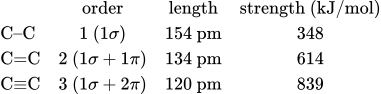
The degree of unsaturation (2C+2+N-H-X)/2 gives benzene 4 [F]. Functional-group reactivity (acid–base, redox applied) is [F?]; absolute rates and stereoselectivity are [O].
CH.13 Materials and nuclear (summary) [F]/[F?]
Crystal packing fractions are pure geometry: FCC/HCP π/(3√2) =
0.7405, BCC 0.6802, SC 0.5236 (module
vp_crystal_packing.py); FCC metal densities <2%
[F]/[F?]. Nuclear magic-number skeleton from
Gauss-lattice point counts N(R²)+1: module
vp_gauss_shells.py gives 2, 8, 20, 28, 82
(5/7 parameter-free); 50, 126 require spin–orbit [CAL].
SEMF fission/fusion gives the iron peak A=58 and the critical Z²/A
[F?]. Theoretical bounds (σₜₕ, γₛ) are bounds, not
predictions — honestly [F]+[O].
CH.14 Master ledger — forced / measured input / open
[F] forced (zero free parameters — cannot be tuned): shell filling and period lengths; valence, oxidation, ionic formulas; all VSEPR angles (arccos(-1/3) etc.); Δₜₑₜ/ Δ₍oct)=4/9; packing fractions; propagation angle sinχ=λ/(mD); rainbow 42°; Snell, critical angle; Cᵥ(T) staircase and activation temperatures; dissociation- temperature order and Le Chatelier; Arrhenius, 10 K doubling, k_BT/h; pH, buffers, titration; E°₍cell), Δ G=-nFE°, Nernst; hybridization, bond order, unsaturation; Gauss magic-number skeleton.
[CAL] calibration input (measured constants, used consistently — never tuned per case): spectroscopic B,ν; bond enthalpy Δ H; mathrm pKₐ; standard potential E°; spectrochemical series; absolute refractive index n; spin–orbit strength (magic 50, 126); the fine-structure coupling αₑₘ.
[O] open (honest — not disguised as solved): absolute multi-electron IE (screening); electron affinity (Slater sign failure); absolute mathrm pKₐ, E° (solvation); multi-band precise color; absolute bond energy (anharmonicity); d-block absolute IE; absolute rates and stereoselectivity; nuclear shell-correction masses; pure-π geometry of 50, 126.
CH.15 Two unifications — sphere geometry and rotation
Sphere geometry: molecular shape = points on a sphere (Thomson/VSEPR) → arccos(-1/3); nuclear shells = lattice points inside a sphere (Gauss) → magic-number skeleton; crystal density = sphere packing (Kepler) → 0.7405; d-orbital splitting = spherical harmonics × ligand EM → 4/9.
Rotation: the electron is a rotational dent; charge is rotation handedness; light is the rotational transverse wave (Chapter EM); temperature is rotational excitation; equilibrium, rate, and electrochemistry all ride on rotational energy. The single anchor (electron = rotational dent) opens, and the last sector (electrochemistry = rotational-dent transfer) closes the circle.
CH.16 Falsification criteria [F]
Forced results cannot be re-fitted, so they are refuted on disagreement:
- If the tetrahedral angle is not arccos(-1/3)=109.47°, the VSEPR-EM derivation is discarded.
- If Δₜₑₜ/Δ₍oct) ≠ 4/9, the crystal-field geometry is discarded.
- If the rainbow angle is not ≈ 42°, the light-angle/refraction derivation is discarded.
- If H₂ heat capacity shows no 3⁄2→tfrac52→tfrac72 R staircase, or the activation temperatures disagree with B,ν, the partition-function account is discarded.
- If dissociation temperatures do not follow the bond-strength order, the equilibrium derivation is discarded.
- The committed light-angle predictions χ(632.8 nm)=89.892°, χ(532 nm)=89.825° are falsifiable forward predictions (Chapter EM).
CH.17 Reproducibility
Thirty deterministic, standard-library modules and a 114-row case
ledger (cases_fixed.csv) reproduce this logic; the light/EM
additions add a 16-row ledger (cases_em.csv). Determinism
is verified by running each module twice and comparing the stdout
sha256.
python3 research/foundation/vp_molecular_geometry.py   # tetrahedral 109.47°
python3 research/foundation/vp_crystal_field.py        # 4/9
python3 verify_chemistry.py --root <package root>      # all modules + ledger integrity gate
The harness reports execution, determinism, standard-library-only dependency, and case-ledger integrity. With the light and electromagnetism modules included, 32/32 PASS.
Together with Chapter EM, this completes the program: light emerges from the jammed lattice and the electromagnetic 1/r² follows (Chapter EM); on that substrate, atoms, bonds, geometry, color, heat, equilibrium, rate, solution, electrochemistry, and organic structure are forced by sphere geometry and rotation (this chapter). What is forced is falsifiable; what is measured is labelled; what is open is admitted — and all of it is reproducible.