Why the Acoustic Length Is Structurally Hard
The acoustic-peak scale is not merely an unknown number for the framework but structurally hard: a present, static emission lattice lacks the early sound-horizon physics that sets it in ΛCDM. This page attacks the three criteria head-on, shows why the length is structurally rather than contingently missing, and offers a Big-Bang-free interpretation of the scale as a hypothesis.
Reproducing the CMB acoustic length requires a standard ruler the framework does not obviously have. This page attacks the three criteria a candidate must meet, argues the missing length is structural — tied to the absence of an early sound horizon — rather than a contingent gap, and offers a Big-Bang-free reading of the scale as an explicit hypothesis, not a derivation. The photon-fluid sound speed is c_s = 1/√3.
Attacking the three criteria head-on
A dedicated calculation (derive_acoustic_length.py; deterministic, constants only) takes
the three criteria one at a time and reports, without softening, which of them close.
standing-wave cavity:    peaks at k*L/pi = 1,2,3,4   heights 1.00, 0.20, 0.91, 0.17
                         odd>even alternation: 1st>2nd and 3rd>2nd (baryon signature)
isolated shell |sinc|^2: peaks shifted, heights 1.00, 0.35, 0.18, 0.11
                         monotonic 1/k^2 fall-off, NO alternation (wrong height pattern)
So the height pattern—the part a single shell could not deliver—does follow from a genuine standing-wave cavity. Criterion (ii) is met at the level of mechanism (the loading R and the damping scale enter as standard inputs, exactly as in the standard model, which does not derive them from first principles either); what stays tied to (i) is that the cavity length is the same underived 150Mpc.
Criterion (iii)—the γ-ray dispersion limit. A 150Mpc standing wave is an ultra-low-frequency mode, ν≈3×10⁻¹⁷Hz. A 10GeV burst photon sits at ν≈2×10²⁴Hz—some forty-one orders higher—so the coherent background is a rigid, near-DC offset on γ-ray scales and cannot add high-wavenumber dispersion. (The lattice dispersion that drives the Chapter 2 tension lives near c/a, only about two orders above the γ-ray scale; that proximity is the pre-existing tension, and it is untouched by a background forty-one orders below it.) Criterion (iii) closes.The tally is therefore: (iii) closed outright; (ii) closed at the level of mechanism; (i) the single remaining open core, now sharpened from a vague conflict to one precisely named missing object—a cosmological cavity length ≈150Mpc. Two of the three criteria close; the chapter stays an open program ([HYP]) on the strength of the one that does not, and—this is the point of the discipline—no constant was moved to fit the target, so the gap is reported as a gap. It is the same length Chapter 15 needs for the BAO ruler; the absolute 2.725K value of Chapter 9 remains separately open.
Why the missing length is structurally hard, not merely unknown
It would be easy to leave criterion (i) as a bare “number we have not yet guessed.” A second
deterministic diagnostic (probe_subhorizon_desert.py) shows the gap is sharper than that:
the ≈150Mpc scale is structurally hard for a present-emission lattice, for a reason that
also explains why no honest patch is available.
The sub-horizon desert.
Listing every length the fixed constants can build—the lattice cell a, the per-nucleon inflow length c/νₚ≈10³km, their geometric mean, the Hubble length c/H₀, the relativistic Jeans length c√π/Gρ_c, and the a₀-length 2π c/H₀—places them in exactly two regimes: microscopic inflow scales (≲10⁶m) and cosmological scales ( 10²⁶m). The target ≈5×10²⁴m (150Mpc) falls in the empty 10-decade gap between them, 8.6 dex above the nearest microscopic-cosmological geometric mean and 1.5 dex below the Hubble length. The only dimensionless cosmological ratio the framework supplies is H₀/νₚ; writing L=(c/H₀)(H₀/νₚ)^p and solving for the exponent that lands on 150Mpc returns p≈0.072, not 0,½,1,2, so no clean power-law reaches the scale either. The desert is real.What kind of object 150Mpc is.
In the standard model the scale is not a geometric constant but a comoving sound-horizon integral,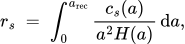
the distance a baryon–photon pressure wave travels through an expanding fluid up to a specific early epoch (z_(rec)≈1090). Evaluating Eq. (soundhorizon) with standard parameters—invoked here only diagnostically, as they belong to the history this volume rejects—returns rₛ≈144Mpc and (c/H₀)/rₛ≈30, with the baryon–photon ratio at recombination R(a_(rec))≈0.62 landing independently on the R≈0.6 used in the height calculation above. The lesson is the decisive one: the “factor 29” between the Hubble length and 150Mpc is the value of that integral—it depends on Ωₘ,Ω_b,Ω_r and z_(rec), and shifts with them (it is ≈28.6 at H₀=70, ≈30.8 at H₀=67.4)—not a clean O(10) geometric number. A present-emission lattice has neither ingredient the integral requires: no expansion history a(η)≠const to integrate over, and no recombination epoch a_(rec) to integrate up to. It therefore cannot produce 150Mpc by the standard route at all—the route is structurally absent, not merely unevaluated—and dressing the result as L=(c/H₀)/28.6 with a clean constant would misrepresent a messy history integral as forced geometry: physically false, and exactly the tuning the governance forbids.
The gap, named precisely.
The two diagnostics together promote criterion (i) from “find a number” to a named structural object. The only sources of a 150Mpc scale are (a) an early epoch with a genuine expansion history—excluded by the volume's own thesis—or (b) a new present-day, sub-horizon, length-generating mechanism, such as a jamming/cavity correlation length pinned to the fixed constants, which the framework does not currently contain. This does not close criterion (i); it states, as precisely as the framework allows, exactly what would.A Big-Bang-free interpretation of the scale (hypothesis)
The structural diagnostic names what a closure would require: a present-day,
sub-horizon, length-selecting mechanism. The companion fluid-dynamics
volume supplies exactly that mechanism, and it invites a reading of the
150Mpc scale that needs no hot dense past. We record it here as a
hypothesis-level interpretation—one consistent way the scale can
be read—and emphasise at the outset what it is not: it is not a first-principles
derivation of the number 150, and no specific π-factor is claimed
(acoustic_length_hypothesis_interpretation.py reports all five test
routes and the non-claims).