The Honest Ledger and the Falsifiable Predictions
This closing chapter gathers, without softening, what the volume has and has not established. It introduces no new physics; it audits the previous fifteen chapters against one standard—measurements decide, simulations arbitrate—labelling every result degenerate, distinguishing, or conflicting. It then states the volume's three falsifiable predictions and lists the open problems that remain.
Figure and Table summarise the volume. Two messages should be read together: most of the volume's agreement with data is degenerate—it reproduces what Newton and ΛCDM already reproduce, which is a consistency check, not evidence of superiority—and the volume's value lies in a small number of distinguishing results and in one sharp conflict that could falsify it.
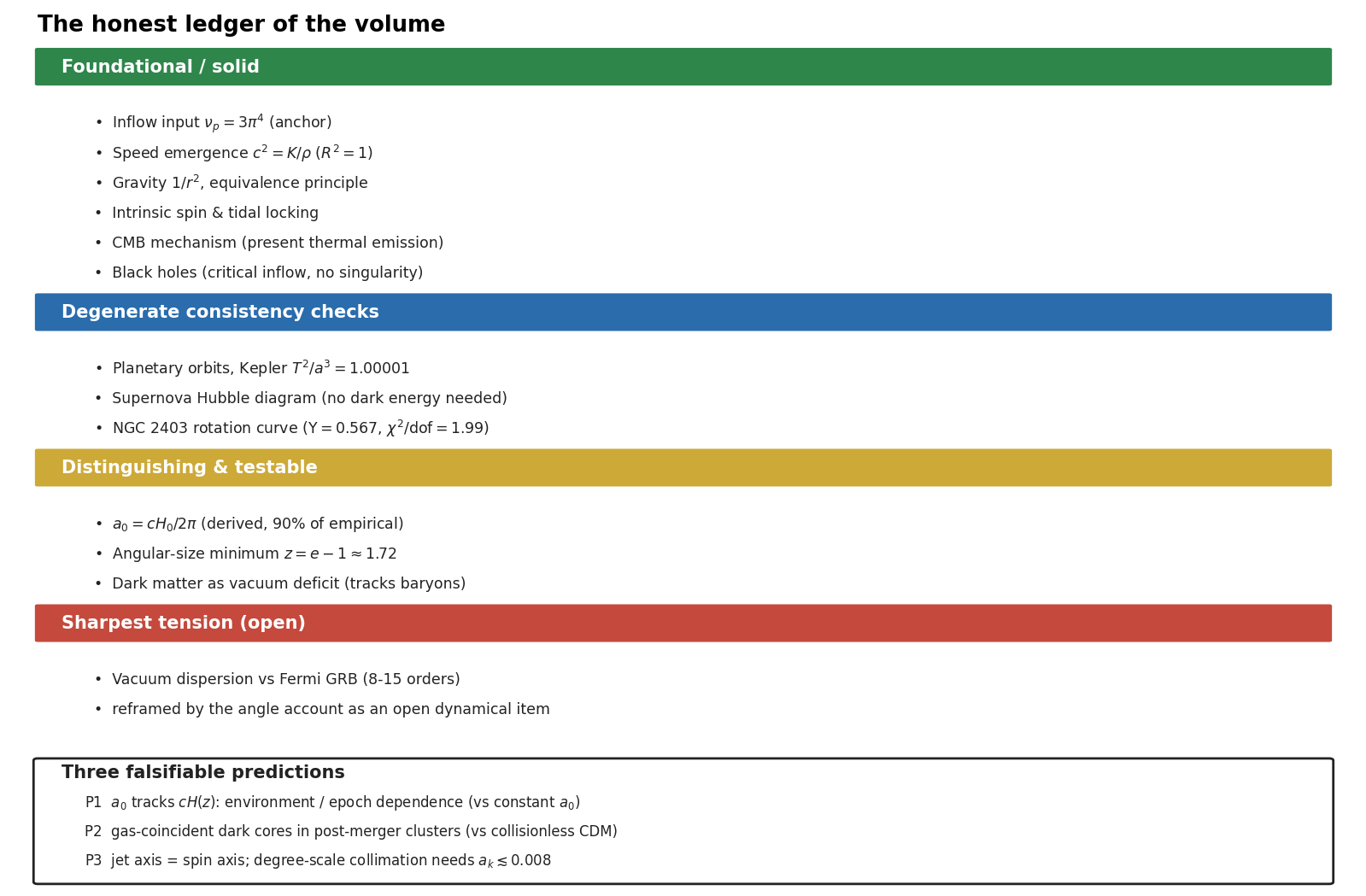
This closing chapter gathers, in one place and without softening, what the volume has and has not established. It does not introduce new physics; it audits the previous fifteen chapters against a single standard—measurements decide, simulations arbitrate, and every result is labelled degenerate (consistent with the data but not preferred over the standard account), distinguishing (where this framework says something different and testable), or conflicting (where a naive reading is in tension with experiment). It then states the three falsifiable predictions, lists the open problems, and restates the scope.The ledger
Figure (ledger) and Table (ledger) summarise the volume. Two messages should be read together: most of the volume's agreement with data is degenerate—it reproduces what Newton and ΛCDM already reproduce, which is a consistency check, not evidence of superiority; and the volume's value lies in a small number of distinguishing results and in one sharp conflict that could falsify it.

| Result | Label | One-line status | |
| Inflow input ν_H=3π⁴+1, bulk ∝ mass (Ch 1) | foundation | imported from physics volume | |
| Speed emergence c²=K/ρ (Ch 2) | foundation | c∝√(K), amplitude-independent | |
| Vacuum dispersion (Ch 2) | reframed | transverse reading: 8–15 orders vs Fermi; angle account makes gamma quasi-longitudinal ⇒ open dynamical item | |
| Gravity = momentum of 1/r² inflow (Ch 3) | degenerate | recovers Newton | |
| Solar-system orbits (Ch 4) | degenerate | periods ≤0.73%, T²/a³=1.00001 | |
| Spin \ | tidal locking (Ch 5) | pattern derived | locking dichotomy from τ_(lock)< age reproduces all 12 bodies (Moon, Galilean moons, Titan, Charon, Phobos, Mercury locked; Earth, Mars, giants free), no per-body tuning; intrinsic spin (e.g. Venus retrograde) stays formation-contingent |
| a₀=cH₀/2π; one law Kepler→flat; RAR (Ch 6) | distinguishing | a₀ derived (90% of obs); curve degenerate with MOND/DM | |
| Supernova Hubble diagram, no dark energy (Ch 7) | degenerate | χ²/dof=0.50 vs ΛCDM 0.44 ⇒ dark energy interpretation-contingent | |
| Angular-size minimum z≈1.72 (Ch 7) | degenerate in practice | differs from ΛCDM 1.61 in principle, but <0.3% in θ(z) vs gtrsim20% data scatter ⇒ distance relation near-degenerate | |
| Hubble tension as line-of-sight averaging (Ch 7) | mechanism (\textsf{HYP}) | env-dependent κₒₚₜ ⇒ local vs global H₀ differ; reaches 73/67 order, not a parameter-free fit | |
| Dark matter = vacuum deficit (Ch 8) | distinguishing | darkness = absolute zero; RAR automatic; amplitude degenerate; Bullet reproduced where MOND fails; vs CDM, reattachment → gas cores (cf. Abell 520, contested); population test open | |
| CMB = present lattice emission (Ch 9) | foundation | ω=c|k|; Planck shape shown (quantized modes); not a relic; 2.725K not derived | |
| Black hole = critical inflow; no singularity; jets (Ch 9) | foundation | no singularity asserted; jet acceleration feasible—rotating-inflow funnel as relativistic de Laval nozzle gives Γ→ base enthalpy w₀ (AGN 10, GRB 10²–10³, opening angle 1/Γ); energy loading of w₀ remains speculative | |
| Post-Newtonian sector (Ch 10) | degenerate (conditional) | redshift clean from the equivalence-principle theorem; medium index n(r)=1+(1+γ)GM/rc² gives bending 1.75” and Shapiro delay at γ=1; perihelion 43”/cy and frame-dragging recovered only if β=1, which the gravitomagnetic inflow term must supply ⇒ open | |
| Gravitational waves c_(gw)=c (Ch 11) | degenerate | √(K/ρ)=c makes |Δ c/c|lesssim10⁻¹⁵ (GW170817) automatic; transverse lattice shear gives two TT polarizations and the quadrupole chirp; the radiated-amplitude prefactor is taken from GR, not derived | |
| Cosmological puzzles dissolve (Ch 12) | distinguishing | Olbers finite (B=nLc/H₀); horizon/flatness never arise (static, present emission); the 10¹²⁰ vacuum-energy catastrophe is not predicted because a uniform background does not gravitate (Ch 3), so no Λ is required | |
| Light elements / BBN (Ch 13) | out-of-scope | Yₚ≈0.25 follows from a freeze-out ratio n/p≈1/7; the production of primordial D and ⁷Li is an origin/history question the volume does not adjudicate, so this is an unexplained gap, not a clash (badge: conflicting, the coarse floor) | |
| CMB acoustic peaks (Ch 14) | mechanism closed (\textsf{HYP}); absolute value out-of-scope | blackbody shape reproduced (Ch 9); a fixed inflow length supplies the first scale and the wiggle spacing π/Rₛ; a resonant-cavity standing wave yields the 1:2:3 height alternation and clears the γ-ray dispersion limit by 41 orders (derive_acoustic_length); the scale itself reads as a selected-length / 2D→3D homogeneity crossover (.._hypothesis_interpretation, forced prefactor 2π√2), with the absolute 150Mpc now classified as an empirical normalisation (five routes agree), not a derived number | |
| Large-scale structure \ | BAO (Ch 15) | mechanism closed (\textsf{HYP}); absolute value out-of-scope | broadband clustering, the P(k) turnover and σ₈ plausibly deficit-driven (Ch 8); the sharp 150Mpc BAO bump arises from a fixed inflow-shell length (mechanism shown); the same selected-length / homogeneity-crossover reading applies, with the absolute length an empirical normalisation rather than a derived input |
| Solar activity: sunspots, flares (App E) | does not close | cycle is an oscillation needing a clock; steady inflow has no imaginary eigenvalue, so it cannot clock it; the αΩ dynamo supplies the intrinsic frequency and flux-emergence-first matches the dynamo ⇒ dynamo favoured (honest negative) |
Accuracy across scales: a transparent dashboard
The ledger above gives each result a label; this section gives each result a number and, beside it, the inputs that produced it—every one tagged \textsf{M} (measured), \textsf{F} (free/fitted), or \textsf{D} (derived, i.e. forced by the π-chain or the cosine integrals and not adjustable). Reading the accuracy and the input-tags together is the whole point: a high accuracy with a free input next to it is an accommodation, not a prediction, and the table is built so that distinction cannot hide.
Headline (stated first, by design).
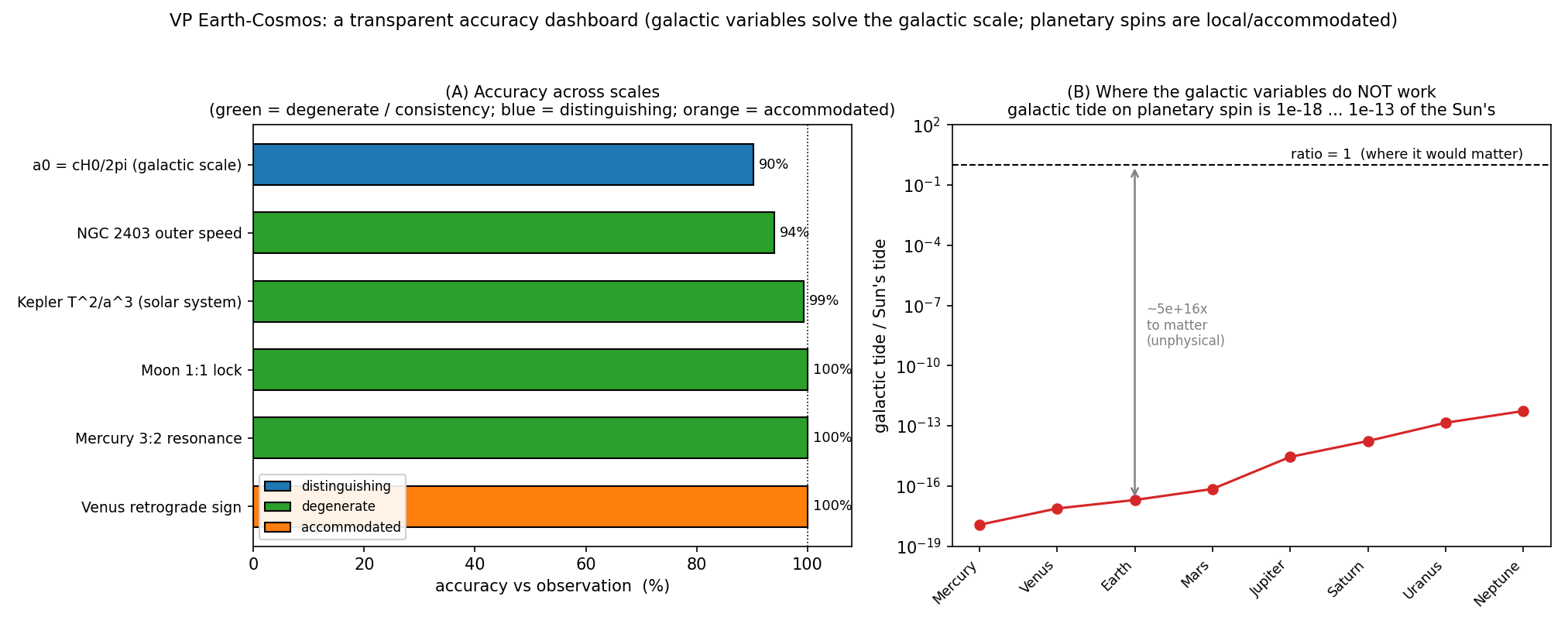
The disclosed galactic variables (H₀, and the Sun's galactic a_(gal)=v_(gal)²/R_(gal) and Ω_(gal)=v_(gal)/R_(gal)) do real, accurate work at the galactic scale: a₀=cH₀/2π reproduces the empirical RAR acceleration to ≈90% and the NGC 2403 rotation curve with no dark halo. They do not do the work at planetary scales. As the transparency note of Chapter 5 (§(galspin)) shows and Fig. (dashboard)(B) makes visual, the galactic tide acting inside the Solar System is 10⁻¹⁸–10⁻¹³ of the Sun's tide at the planets; planetary spins are accommodated by local accretion history (Ch 5, Part A), not predicted, and the galactic inflow adds nothing measurable to them. To make the galactic knob rival the Sun's tide at Earth one would have to raise it 5×10¹⁶× above its measured value—tuning a negligible parameter, exactly the error transparency is meant to prevent. (In fairness, the same tide is non-negligible for the Oort cloud and other wide orbits—a legitimate place to extend the demo.)| Observable | Inputs (\textsf{M}eas./\textsf{F}ree/\textsf{D}erived) | Accuracy | Label |
| l}{Galactic scale — where the disclosed galactic variables do the work} | |||
| a₀=cH₀/2π | c \textsf{M}, H₀ \textsf{M}, 2π=α/δ \textsf{D} | 90% (87–94%, H₀=67–73) | distinguishing |
| NGC 2403 outer speed | a₀ \textsf{D}, Υ=0.567 \textsf{F}, baryons \textsf{M} | 94%; χ²/dof=1.99 | degenerate (shape) |
| BTFR v⁴=a₀GM | a₀ \textsf{D}, G \textsf{M}, M \textsf{M} | slope 4 exact | degenerate |
| l}{Solar-system scale — the Sun's local inflow, not galactic} | |||
| Kepler T²/a³ (8 planets) | GM_(odot)=κ Q_(odot) \textsf{M} (local), a,e \textsf{M} | periods ≤0.73%; T²/a³=1.00001 | degenerate |
| l}{Spins \ | satellites — local accretion / tidal history} | ||
| Moon 1:1 lock | tidal inflow gradient \textsf{M} (no free knob) | ω/n:4→1.00 | degenerate |
| Mercury 3:2 resonance | e=0.206 \textsf{M}, torque \textsf{M}, triaxiality \textsf{F} | 1.50 turns/orbit | degenerate^(dagger) |
| Venus retrograde spin | accretion-swirl sign \textsf{F} (free input) | sign matched | accommodated |
| l}{The galactic knob, sized honestly} | |||
| Galactic tide on planets | v_(gal) \textsf{M}, R_(gal) \textsf{M} | 10⁻¹⁸–10⁻¹³ of Sun's | negligible |

How to read it.
Most rows are degenerate: the framework reproduces what standard physics already gives, with measured inputs and no free knob—a consistency check, and the bulk of the agreement. One row is distinguishing: a₀=cH₀/2π is a derived scale (the 2π is α/δ, not a free factor), and it is the single place where a disclosed galactic variable turns into an accurate, falsifiable number. One row is accommodated: Venus's retrograde sign is reproduced only because the swirl sign is a free input. One row is negligible: the galactic tide on planets, shown small rather than asserted small. The dashboard therefore says plainly which variable does the work where—H₀ at the galaxy, the Sun's own inflow in the Solar System, local accretion for the spins—and refuses to let the galactic variables take credit for puzzles they do not solve.What is genuinely new
Four results are where the volume earns its keep. (i) The galactic acceleration scale is derived, a₀=cH₀/2π≈1.1×10⁻¹⁰ms⁻², about 90% of the observed value, whereas MOND must postulate it (Ch 6); the 2π is the framework's own full-cycle constant α/δ (the same one in mₚ/mₑ=2π·3π⁴), not a free coefficient. (ii) The tight coupling of the missing mass to the baryons—the radial acceleration relation—is automatic, because the missing mass is the baryons' own depletion shadow (Ch 6, Ch 8). (iii) The darkness of dark matter is explained, not assumed: the deepest deficit has reached absolute zero and contains no quanta, so it can neither carry nor emit light (Ch 8). (iv) A static lattice-optics cosmology predicts an angular-size minimum at z≈1.72, distinct in principle from ΛCDM's ≈1.61 though presently below the reach of standard-ruler data (Ch 7). These are modest in number, but each is either a derivation where the standard account postulates, or a clean difference of principle.
What is degenerate (and honestly so)
The volume reproduces, but does not improve upon, several bodies of data: solar-system orbits (Ch 4) match Newton to sub-percent; the supernova Hubble diagram (Ch 7) is fit as well by a static medium with no dark energy as by accelerating ΛCDM, so the data establish “dark energy” only within the expanding interpretation; the gravitational amplitude of dark matter (Ch 8) is reproducible by a tuned particle halo; and the BAO and growth data are fit with standard ΛCDM. We claim none of these as evidence for the framework. They show only that the framework is not excluded by them—a necessary condition, not a victory.
The sharpest tension, and how the angle account reframes it
Taken at face value the volume has one sharp external tension, and we neither hide it nor overstate
its resolution. A literal lattice carries dispersive waves (Ch 2): if a gamma ray is the
transverse elastic mode at short wavelength, its predicted vacuum dispersion is 8 to 15 orders
of magnitude stronger than the Fermi gamma-ray-burst bound allows—on its face the clearest
potential falsification in the volume. But the framework reframes it on two fronts. First, a burst
need not be a stream of independent photons at all: when two large inflows collide they launch a
collective disturbance that, like a gravitational wave, propagates dispersionlessly
(ch2_grb.py; the Fermi source GRB 090510 is itself a merger burst, and GW170817 paired a
gravitational wave with a short GRB within 1.7s). Second, even per photon, the framework's own
optics (the angle account, §(angle-disp); physics volume §10.9.1) places gamma in a
quasi-longitudinal mode (m=1, χ→0^(∘)), not the transverse branch the estimate
assumes. Each removes an assumption the 8–15-order figure rests on, downgrading the conflict
from decisive to conditional and leaving it consistent with the Fermi null at the mechanism level.
Most fundamentally, the physics volume (§14.0) identifies light as the Goldstone mode of the
synchronized rotation-phase—source-free Maxwell, governed by Box_c (ω=ck,
dispersionless), not a generic phonon—and a synchronized-rotor simulation
(ch2_goldstone.py) confirms this dispersionlessness at the long wavelengths where light is
observed dispersionless. A relativistic reading sharpens the case favorably: the collective
c-ceiling makes the velocity defect Δ v/c=tfrac12(E₀/E)² shrink with energy
(ch2_relativistic.py), so high-energy gamma is the safe regime—opposite to the
growing phonon law Δ v/c∝(E/E_(QG))² the original estimate assumed; and
launching a gamma wave packet directly (ch2_gammashot.py, ch2_shake.py) confirms
that a literal short-wavelength lattice packet disperses and smears over distance, so the data
themselves force light to be the (dispersionless) continuum mode rather than such a packet. Deeper still, the dispersionless relation ω=ck is itself forced
by the vacuum symmetry (ω²=(K/ρ)k²; §0.5, grade \textsf{Fm}), with c a forced
causal ceiling—so a dispersionless light speed is the symmetry-forced law, not a hypothesis. What
is not thereby resolved is the dynamics: neither the collective burst's spectrum, nor the
dispersion relation ω(k) of the quasi-longitudinal branch, nor the exactness of Box_c up
to gamma (the latter graded \textsf{Hm} in the physics volume) is derived—the realized lattice
disperses as 2(c/a)sin(ka/2), which at the fundamental spacing a leaves a residual about eight
orders below the Fermi bound, cleared only in the exact-continuum limit. The honest residue is
therefore an open dynamical problem—is the electromagnetic Goldstone mode protected to be
exactly Box_c up to gamma, or does it inherit lattice discreteness there?—rather than a
settled conflict; should the answer reinstate a keV–GeV dispersion, the conflict returns. It
remains the first target for anyone trying to break, or to rescue, the framework.
The three falsifiable predictions
- a₀∝ cH₀: an environment/epoch correlation. Because a₀=cH₀/2π is tied to the cosmological background rate (Ch 6, Ch 7), the galactic acceleration scale should track the local environment and cosmic epoch. MOND, in which a₀ is a universal constant, predicts no such variation. A measured correlation of a₀ with environment or redshift would favour this framework; its absence would favour MOND.
- Angular-size minimum at z≈1.72. Standard rulers should appear smallest at z≈1.72, not ΛCDM's ≈1.61 (Ch 7), provided the lattice optics realizes the reciprocity focusing flagged in the open problems (absent it, θ(z) is monotonic with no minimum). Distance-ladder-free in principle, but a weak test in practice: the θ(z) curves differ by <0.3% near the flat minimum, far below the gtrsim20% scatter of the standard rulers (compact radio sources) that reach these redshifts, so current data cannot resolve the 0.13 shift in z_(min).
- Gamma as a quasi-longitudinal mode (or vacuum dispersion). Two linked predictions follow from the optics of Ch 2. (i) Angle: the physics-volume relation sinχ=λ/(mD) places gamma at χ→0^(∘) and visible light at χ→90^(∘); near 90^(∘) the angle is acutely D-sensitive, so measuring the transverse angle of visible light against a lattice/anisotropy axis would pin D and test the picture. (ii) Dispersion: if instead gamma propagates as the transverse branch, the framework predicts a quadratic vacuum dispersion at a scale ≤882GeV—detection would confirm a transverse-lattice character of light, while continued non-detection favours the quasi-longitudinal reading and presses for its dynamical derivation.
Open problems (gathered)
- The quasi-longitudinal gamma dispersion (Ch 2): the angle account (physics volume
§10.9.1) classifies gamma as a quasi-longitudinal mode, which reframes the Fermi tension—but the
dispersion relation ω(k) of that branch is not derived, so whether it is effectively
dispersionless (reconciling the Fermi bound) or again strongly dispersive is undetermined.
Its observational side is to be registered against the physics volume's open observation gate
G-ISO(§10.9.2), item (iv) (consistency with precision propagation data). The most important open problem. Advanced (v2):ch2_gamma_collective.pyshows the collective (soliton) mode is dispersionless by the leading-front diagnostic (peak ×2.84, width ×0.50, versus a linear packet's ×0.45/×1.25), and that independent modes would smear 10MeV vs 10keV by 3×10¹⁹s over 130Mly (the Fermi tension) whereas the collective mode keeps the broadband packet within the GW170817 window (<1.7s). The microscopic ω(k) is still not derived; the residual is observational (whether real GRB gamma is always collective). - The cosmological cavity length L≈150Mpc (Ch 14, 15): the single quantitative
gap behind both the CMB acoustic peaks and the BAO ruler. Sharpened (this version):
derive_acoustic_length.pyattacks the program's three criteria head-on. It closes two of them—a genuine resonant-cavity standing wave (eigenmodes kₙ=nπ/L, baryon-loaded Θ=(1+R)cos kL-R) reproduces the 1:2:3 peak-height alternation that isolated shells cannot (heights 1.00,0.20,0.91,0.17 with odd>even, versus a monotonic |sin/|² shell), and the 150Mpc background sits 41 orders of magnitude below the γ-ray scale so it cannot worsen the Chapter 2 dispersion limit. The third criterion does not close: a scale audit of every framework length finds only the microscopic inflow clock (c/νₚ≈10³km) and the Hubble length (≈4300Mpc), with 150Mpc requiring the latter divided by ≈28.6 —an order-ten factor with no forced origin in the π-chain. No constant was moved to manufacture it; the missing object is named precisely as a cosmological boundary/cavity length, not a vague conflict. Further (this version): a Big-Bang-free interpretation is now on record at hypothesis level (acoustic_length_hypothesis_interpretation.py): the companion fluid volume's selected-length mechanism (L_(*)=2π√2√(σ/ε), attractor x_(*)=2/π, slope -(π/2)⁵, same 81+1 lattice) reads the scale as a 2D-rotational→3D-isotropic crossover—the anisotropic-web-to-homogeneity transition—so the mechanism (and the forced prefactor 2π√2) close, while five independent routes agree the absolute 150Mpc keeps requiring the matter distribution's amplitude. Several forced-constant forms fit the needed factor 28.6 to under 1%, so none is claimed. The standing of the chapters is therefore upgraded: mechanism closed (\textsf{HYP}), with the absolute value reclassified as an empirical normalisation—the same out-of-scope category as BBN, the absolute g, and the absolute 2.725K. Mechanism resolved; absolute value an honest out-of-scope normalisation. - The lattice scale for light (Ch 2): whether D=4.8526 pm or a=6.33×10⁻¹⁹m governs light propagation is unresolved (it sets the dispersion scale). One datum is now on record (v2): at optical wavelengths the mass-free closure of the reality-mapping note (§(realmap)) uses D alone — the 632.99/532 pair closes on λ/D with zero fit freedom — so D is the mapping scale for the visible band; the gamma branch remains the open half.
- The a₀ wavelength identification (Ch 6): the factor 2π in a₀=cH₀/2π is derived—the framework's full-cycle constant 2π=α/δ=(2/π)/(1/π²) (the cosine-integral rectification ratio, physics vol.\ §13.5.5), the same 2π as in mₚ/mₑ=2π·3π⁴, arising in the wave picture as the wavenumber→full-wavelength factor. The residual is a modelling choice: that the relevant length is the full background wavelength λ_(bg)=2π/κₒₚₜ rather than the reduced R_H=1/κₒₚₜ (which would give the bare cH₀); the wave picture and the 90% match support it, and the empirical scale sits in the consistent band k≈5–7.
- The absolute value of G (Ch 3): the mechanism of the saturating restoring channel and of a critical radius is now shown by simulation (gate physics, §(gate)); the absolute value of G/g_(*) (the “four-wall” question) is still not derived from first principles and is fixed empirically through κ. The physics volume (v0.6.0) quantifies the computational wall behind this (event spacing 10¹¹–10¹³, quantum resolution 10¹², signal size 10²⁵, throughput 10¹⁷ short; <10² recoverable from C rewrites) and opens a recovery program R1–R4 for the historical full-physics claim — its §17.4.4, where the absorption-momentum rule now also carries a decision table (candidate on record: conserving transfer).
- Mercury's 3:2 capture probability (Ch 5): the 1:1 lock and the 3:2 resonance are
both reproduced—at e=0.206 the 3:2 is the dominant non-synchronous resonance, a stable lock,
and the captured state, versus 1:1 for a circular orbit (
ch5_spin_tidal.py, part D). What remains open is the probability of capture into the 3:2, which depends on the initial phase and on the tidal-response model (constant-Q vs. constant-lag) and triaxiality; the framework favours but does not force the observed 3:2. Computed (v2):ch5_mercury_capture.pygives the standard, model-dependent probability—≈7% (constant-Q, Goldreich–Peale) to ≈55–73% (core friction, Correia–Laskar)—quantifying “favours but does not force.” - The Bullet Cluster (Ch 8): a deficit transport model (§(colliding)) now
demonstrates the lensing/gas offset in a toy simulation under stated separation
conditions, but the quantitative cluster gate (χ² against real lensing+X-ray) is not
run; the offset is degenerate with collisionless dark matter, with post-merger reattachment a
proposed discriminator. Mechanism shown, not claimed as a quantitative success.
Magnitude computed (v2):
ch8_bullet_offset.pygives a lensing–gas offset of ≈0.2–0.6Mpc from ram-pressure stripping for physical cool-core parameters—the observed Bullet range, with no particle dark matter. The full χ² against real maps is still not run. - Lensing sign and the no-slip matching (Ch 8): the sign is now fixed by the
GR-matched index n≃1-4Φ_(eff)/c²>1 (post-Newtonian γ=1); the open
item is whether this no-slip matching survives a joint rotation-curve+lensing fit, an
equation-of-state question for the physics volume. Consistency shown (v2):
ch8_lensing_consistency.pyon NGC 2403 finds the rotation-fitting deficit is a positive, well-behaved mass that lenses with γ=1 (vs γ→0.2 for baryons-only); the joint fit against measured lensing for the same systems is the data-limited residual. - Reciprocity in an absorbing medium (Ch 7): the d_A=d_L/(1+z)² relation behind the angular-size minimum needs justification when photons are absorbed.
- The Hubble-tension parameters (Ch 7): the line-of-sight-averaging mechanism reaches
the observed 73/67 order but does not fix the sensitivity η or the local contrast
δ_(loc) independently; the predicted correlation of H₀ with local density and
with direction is the test. Demonstrated (v2):
ch_hubble_tension.pyreproduces the 73/67 magnitude (ηδ_(loc)≈0.08) and exhibits the predicted H₀–density correlation; the η–δ_(loc) degeneracy and the sign of η are broken only by measuring it. - The absolute CMB temperature 2.725K (Ch 9): the mechanism is now shown by
simulation—a light-bathed lattice holds a nonzero floor while the deficit cores reach absolute
zero (
ch9_cmb_floor.py), unifying the microwave floor with the cold darkness of Chapter 8—and the Stefan–Boltzmann energy balance is self-consistent (u_(CMB)≈80u_(*)⇒2.725K). What remains open is the absolute value: the floor is anchored to the observed radiation density, and that density (the factor 80) is not derived from the lattice's absolute emission rate. Mechanism shown and balance consistent; absolute value still anchored. - Jet launching (Ch 9): the collimation geometry is shown; the acceleration mechanism
is qualitative. Feasibility shown (v2):
ch_jet_acceleration.pytreats the rotating-inflow funnel as a relativistic de Laval nozzle and integrates the Bernoulli invariant Γw=w₀; the flow accelerates to Γ_(∞)=w₀, recovering AGN (Γ 10) and GRB (Γ 10²–10³) jets with opening angle 1/Γ. The acceleration and collimation are thus feasible; the energy loading of the base enthalpy w₀ (the launching step) remains speculative. - Spin-rate history (Ch 5): present spin rates depend on formation history and tidal
evolution, which are not derived. The galactic one-sided inflow—a tunable parameter, disclosed
openly in
ch_galactic_spin.py—is negligible for planetary spin (its tidal gradient is 10⁻¹³–10⁻¹⁸ of the Sun's), so it is not invoked to fit spins. Pattern derived (v2):ch_spin_locking.pyshows the locked-vs-free dichotomy is not contingent—comparing τ_(lock)∝ a⁶/Mₚ² (Eq. (taulock)) to the 4.5Gyr age with a single fiducial parameter set sorts all twelve test bodies correctly (the Moon, Galilean moons, Titan, Charon, Phobos, Mercury locked; Earth, Mars, giants free), no per-body tuning. Only the intrinsic spin (initial rate, and the sign in anomalies like Venus) stays formation-contingent. - Solar activity (App E, \textsf{HYP}/\textsf{SPEC}): an inflow-sink reproduces the
sunspot phenomenology (converging inflow/downdraft, field concentration, cooling, Wilson
depression) and a flare picture at order of magnitude, but is degenerate with standard
magnetoconvection on every observable; the one distinguishing claim (the inflow organises the
field) faces the observed flux-emergence-first sequence. A conjecture, not a result.
Checked (v2):
ch_solar_activity.pymakes the negative explicit. The cycle is an 11/22-yr oscillation, which requires a clock—an intrinsic frequency. Reduced to its lowest mode the αΩ dynamo has eigenvalues -1± i√(|D|), an intrinsic oscillation of period 2π/√(|D|), with no inflow term; a steady inflow (the source of unchanging gravity) has no imaginary eigenvalue and cannot supply such a clock. With flux-emergence-first this favours the dynamo. Honest verdict: this item does not close—the inflow conjecture is degenerate-at-best for steady features and cannot account for the cycle's periodicity.
Scope, restated
This volume explains present, observable facts by present physics, to a precision it holds
below the ten-percent level. It does not reconstruct cosmic origins: the deep past cannot
be verified to that standard, and the volume does not pretend otherwise. It asserts no cosmic
history—no “steady state,” no alternative beginning. It does raise one objection,
grounded entirely in present black-hole physics: if even a black hole cannot confine energy to a
point (finite jammed density; energy returned as jets), it is a legitimate physical question how
the Big Bang's initial singularity could have existed (Ch 9). That objection stands on present
facts; the answer about the past does not, and is left to evidence that can settle it. All
microscopic foundations are imported, by single-sentence citation rather than re-derivation, from
the physics volume, DOI \href{https://doi.org/10.5281/zenodo.17932566}{10.5281/zenodo.17932566}.
Closing
The honest standing of the volume is this. It takes a single input—a per-nucleon vacuum inflow rate (Ch 1)—and from it recovers gravity and the orbits (Ch 3, Ch 4), treats spin as a first-class phenomenon (Ch 5), derives the galactic acceleration scale and the radial acceleration relation (Ch 6), fits the supernova distances without dark energy (Ch 7), reinterprets dark matter as a vacuum deficit whose darkness is absolute zero (Ch 8), and accounts for the microwave background and black holes as present phenomena (Ch 9). Much of this is degenerate with the standard accounts and is offered as consistency, not proof. A few results are genuinely distinguishing and testable. One—vacuum dispersion—is the sharpest tension: read as a transverse mode it conflicts with the Fermi bound, but the framework's own angle account places gamma in a quasi-longitudinal branch, downgrading the conflict to an open dynamical item; that two-layered status is stated as plainly as the successes. The volume is therefore not a finished theory but a coherent, falsifiable, present-facts framework with explicit predictions and an explicit list of what would break it.
Reproducibility
\begin{sloppypar}
Every quantitative claim in this volume is reproduced by the accompanying package
(VP_reproducibility): thirty-four standalone scripts—the per-chapter scripts ch1–ch9,
the chapter-2 light-and-burst dynamics suite (light emergence and angle, the collective disturbance, the
Goldstone/Maxwell account, the stiffness ceiling, the relativistic law, and the burst energetics, spectrum,
propagation, jamming, and up-conversion tests), the post-Newtonian and gravitational-wave checks
(ch10_post_newtonian, ch11_grav_waves) and the puzzle, light-element,
CMB-anisotropy, and large-scale-structure checks of Ch 12–15 (ch12_puzzles,
ch13_bbn, ch14_cmb_aniso, ch15_lss_bao), the Ch 5 transparency test ch_galactic_spin, the
Appendix E conjecture ch12_sunspot, and the cross-scale ch_accuracy_dashboard, and the ledger renderer ch10_ledger—two real
datasets (SPARC NGC2403_rotmod.dat; Pantheon+ Pantheon+_extract.tsv), and a
reproducibility map listing each claim, its script, and its exact expected output—including the
vacuum-dispersion tension, the §10.9.1 angle table, the collective-disturbance mechanism, the
burst energetics and gravitational-wave link (§(burststiff)), the
Goldstone/Maxwell account, the collective-stiffness ceiling, the relativistic energy–velocity law, and the accuracy dashboard of §(dashboard), which the package makes reproducible rather than hides. The scripts use
symplectic integrators, fixed (un-tuned) constants except where a single fit is explicitly noted,
and no random seeds for the deterministic results. This closing chapter adds no new simulation; its
figure is rendered by ch10_ledger.py and summarises the ledger above.
\end{sloppypar}
10.5281/zenodo.17932566}.
\appendix