Appendix E: Conjectures on solar activity (exploratory, textsfHYP/textsfSPEC)
This appendix is exploratory and deliberately separated from the chapters; nothing in it is established. It records a conjecture—that the volume's inflow dynamics can accommodate solar activity such as sunspots and flares—at hypothesis grade only. It is degenerate with standard solar magnetoconvection on every observable it touches, but exposes one clean distinguishing claim and one honest tension.
Five present, model-independent facts about sunspots and flares: a sub-surface downflow with near-surface horizontal inflows (Duvall et al. 1996); the depressed Wilson surface; a strong, cool, dark umbral field; a surface flow reversal to outflow; and flare activity correlated with the field divergence. A worked inflow-sink reproduces the sunspot darkness via F∝T⁴, with magnetic pressure B²/2μ₀≈3.6×10⁴ Pa.
This appendix is exploratory and is deliberately separated from the chapters. Nothing in it is established. It records a conjecture—that the volume's inflow dynamics can accommodate solar activity—at [HYP]/[SPEC] grade only. It is degenerate with standard solar magnetoconvection on every observable it touches, adds no reproducible evidence for the framework, and does not bear on the audited results of Chapters 1–10. It is included because attempting the problem exposes one clean distinguishing claim and one honest tension—and because saying so plainly is part of the volume's standard.The observations to be accommodated
Five present, model-independent facts about sunspots and flares. (i) Beneath a sunspot, helioseismology finds a downflow with near-surface horizontal inflows that replace the mass drained downward (Duvall et al. 1996); converging flows persist beneath developed spots. (ii) The sunspot surface is depressed—the Wilson depression, 400–800km below the quiet photosphere. (iii) The umbra carries a strong near-vertical field ( 3kG) and is cool and dark ( 3800K versus 5800K). (iv) At the surface the flow reverses to outflow (the penumbral Evershed flow 3–4km/s and the moat flow 0.5–1km/s); the link between the deep inflow and the shallow outflow is observationally debated. (v) Flare activity correlates with the divergence and helicity of the subsurface flow.
A single inflow sink reproduces the core phenomenology
Model a sunspot as a localized converging-inflow/downdraft sink—in the framework, a local
concentration of the gravitational inflow (Chapter 3). Four of the five facts follow from this one
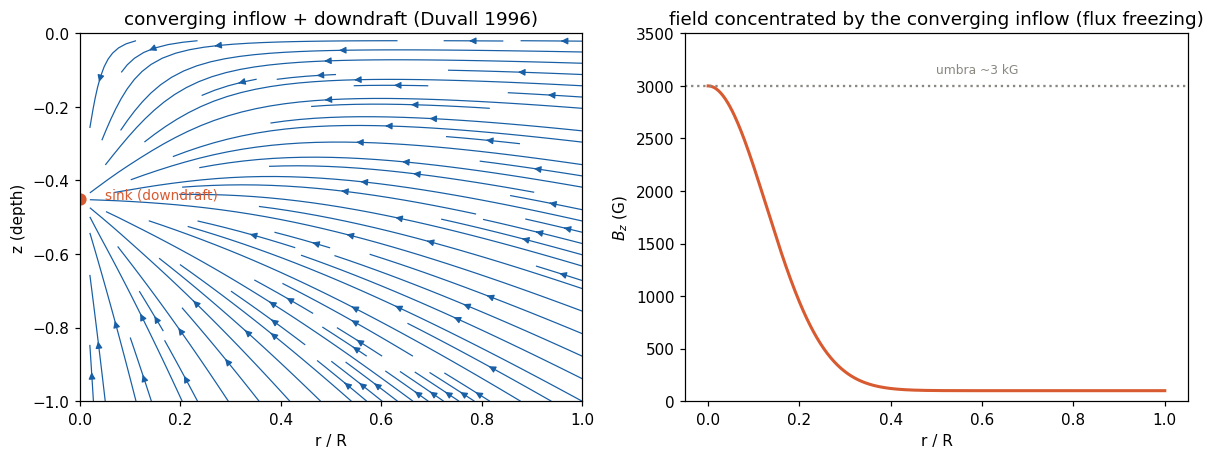
object (Fig. (sunspot); ch12_sunspot.py):
- Converging inflow + downdraft. Flow toward a subsurface sink is horizontally converging near the surface and downward at the centre—directly the Duvall et al. picture (Fig. (sunspot), left).
- Field organised by the inflow. The converging inflow concentrates the vertical field by flux freezing; an area convergence of 30 takes a quiet 100G to the umbral 3kG (Fig. (sunspot), right). In the framework the field is organised rotation, so here the inflow organises the field, not the reverse.
- Cooling by suppressed throughput. The concentrated field/downdraft suppresses the upward random-thermal (convective) transport; blocking 82% of the heat flux gives T=5800(0.18)^(1/4)≈3800K by F∝ T⁴—the observed umbral temperature.
- The Wilson depression. The magnetic pressure B²/2μ₀≈3.6×10⁴Pa exceeds the photospheric gas pressure, so the τ=1 surface sinks by a few pressure scale heights, 300km—the order observed.
The fifth fact, the shallow Evershed/moat outflow, is a separate near-surface component (magnetoconvection in the inclined field); it is not part of this toy, and we do not force it.
Flares as a destabilised sink
If the inflow that maintains the sink slows or reorganises, the local inflow momentum—hence the local gravity (Chapter 3)—drops, so the confined organised-field energy is released and the no-longer-bound gas is ejected: a flare with an associated mass ejection. This is the transient, high-energy limit of the framework's low-pressure “sprinkler” ejection (physics volume, PART 12), and it is consistent with the observed correlation of flares with subsurface-flow divergence and helicity. An order-of-magnitude check closes: the organised-field energy of a spot, B²/2μ₀× V 10²⁵–10²⁶J for B 0.3T and V (10⁷m)³, matches large-flare energies 10²⁵J.
Internal-consistency audit, and the honest limits
This account was checked against the rest of the volume and against magnitude:
- Not the deficit darkness. A sunspot is dark by reduced throughput and is still warm ( 3800K) with quanta present; this is not the absolute-zero darkness of the dark-matter cores (Chapter 8), where there are no quanta. The two “darks” are different.
- Not a redshift, not a black hole. The umbral dimming is far too large to be a gravitational or path redshift of emitted light—that reading needs z 0.5 against an available z 10⁻⁶, a 10⁵ shortfall—so the darkening is thermal, not optical. And a sunspot is a local inflow concentration, not a near-critical object: the solar surface lies 10⁵ Schwarzschild radii from the critical inflow of a black hole (Chapter 9). The “black-hole-like” intuition is rejected quantitatively.
- Transient, not permanent, deficit. The flare's under-supply is a transient that refills—distinct from the permanent annihilation deficit of Chapter 8.
- Degenerate. Every observable above is reproduced equally by standard magnetoconvection and the solar dynamo. This appendix shows inflow-dynamics consistency, not superiority, and supplies no evidence for the framework.
- One distinguishing claim. The framework reverses the causal order: the converging inflow is primary and organises the field, whereas the dynamo makes the field primary and the flows its consequence.
- One honest tension. Observation suggests magnetic flux emerges first and the converging flow forms afterwards—which reads field-first. The inflow-primary view must hold that the emerging flux is the inflow's organised-rotation manifestation; whether that survives scrutiny is open. This is the first thing to test, and the reason the account is a conjecture, not a result.