Algorithm boxes (complete forms)
Notation: F is the discrete Fourier transform; · a Fourier coefficient; the 2/3 rule zeroes the top third of wavenumbers (dealiasing). These are the complete pseudocode forms of the in-body algorithm boxes. Each is written so that a reader, or an AI, can re-implement the result directly from this appendix—without opening the bundle—and reach the stated tolerance. [LOCK]
Notation: F is the discrete Fourier transform; · a Fourier coefficient; the 2/3 rule zeroes the top third of wavenumbers (dealiasing).
These are the complete pseudocode forms of the in-body algorithm boxes.
Each is written so that a reader, or an AI, can re-implement the result directly
from this appendix—without opening the bundle—and reach the stated tolerance.
Notation:  is the discrete Fourier transform;
  a Fourier
coefficient; the
a Fourier
coefficient; the  rule zeroes the top third of wavenumbers (dealiasing).
Pillar I — 2D Euler/Navier–Stokes invariants
Input: grid  , viscosity
  , band-limited initial vorticity
 , time
  , domain
  .
Steps:
.
Steps:
- Build wavenumbers
 ;
;  ; inverse
  (zero at
 ); dealias mask
  .
. - Stream function
 ; velocity
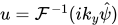 ,
,  .
. - Nonlinear term
 .
. - Time step by integrating-factor RK4 using the exact viscous factor
 (so the linear part is integrated exactly).
 - Each step record
 and
and  .
.
 ; for
; for  the drifts
  ;
for
;
for  the ratio
  .
pass:
.
pass:  ;
;
 budget ratio
  and
and  monotone non-increasing.
Pillar II — the RCCI capacity identity
Input: published audit samples, each a tuple  .
Steps:
.
Steps:
- For each sample compute the predicted count from the identity
 , i.e.
  .
. - Residual
 (and the analogous residuals of any derived
metric reported in the audit).
(and the analogous residuals of any derived
metric reported in the audit).
 and the metric residuals.
pass: identity reproduced to
and the metric residuals.
pass: identity reproduced to  (machine precision);
derived-metric residuals
(machine precision);
derived-metric residuals  .
.Pillar III — length selection and the one-half law
Input: dispersion offsets  , curvature
  , hyper-diffusion
 over a range (linear part), and a Swift–Hohenberg field (nonlinear part).
Steps:
over a range (linear part), and a Swift–Hohenberg field (nonlinear part).
Steps:
- Linear growth rate
 .
. - Maximize:
 ,
independent of ; selected length
,
independent of ; selected length  .
. - Sweep
 ; fit slope of
  vs
vs
 .
. - (Nonlinear) integrate Swift–Hohenberg to a steady pattern; measure the dominant wavenumber.
 and the fitted exponent
  .
pass:
.
pass:  independent of ;
  (
( refining the grid); the nonlinear pattern locks at
(matching DNS
refining the grid); the nonlinear pattern locks at
(matching DNS  ).
).Pillar IV — budget closure and Onsager saturation
Input: injection  , viscous coefficient
  , binding coefficient
  ,
range of .
Steps:
,
range of .
Steps:
- Evolve
 to steady state
  .
. - Split dissipation: viscous
 , binding
 .
. - Check closure
 ; track
  as
as
 .
.
 ; ratio
vs .
pass: residual
; ratio
vs .
pass: residual  for all ;
  as (anomaly). A naive contact-merger closure leaves a residual
 (the gate).
Pillar IV — events carry the flux (Burgers Duchon–Robert)
Input: viscosity , grid , time ; decaying Burgers from
 .
Steps:
.
Steps:
- Integrate spectral Burgers (IF-RK4, dealiasing) until a shock forms.
- Locate the shock (steepest descent,
 ); measure the jump
 across it.
 - Viscous dissipation
 .
. - Duchon–Robert flux density
![\Pi_\ell(x)=\tfrac14\!\int \phi_\ell'(r)\,[u(x{+}r){-}u(x)]^3\,dr](/fluid-dynamics/eq/fluid-dynamics/i/i902bbe95812f.svg) with a Gaussian
filter
with a Gaussian
filter  , at an inertial scale
  .
. - Concentration: fraction of
 within
  of the shock.
 , the event flux
  , the
concentration fraction.
pass:
, the
concentration fraction.
pass:  (to
(to  ),
-independent, with
),
-independent, with  of the flux at the shock.
Pillar IV — 2D NS flux concentrates on events (multid_flux.py)
Input: grid , viscosity , time , filter scale  ;
band-limited random vorticity (energy near
;
band-limited random vorticity (energy near  ).
Steps:
).
Steps:
- Evolve 2D NS (vorticity, IF-RK4, dealiasing) to a filamented snapshot.
- Gaussian-filter at :
 ;
recover
;
recover  via the stream function.
 - Subfilter vorticity flux
 (filter the product, subtract
the product of filtered fields).
(filter the product, subtract
the product of filtered fields). - Local enstrophy flux
 ; palinstrophy density
  .
. - Sort cells by
 (events first); cumulate the positive flux
  ;
read the top-
;
read the top- fraction, the area carrying half, and
 . Repeat for
  at fixed physical .
forward-flux fraction; half-flux area fraction;
; their stability in .
pass: top- , half-flux area
  –
– ,
,
 , stable across — the events carry the inter-scale
flux to the small scale.
, stable across — the events carry the inter-scale
flux to the small scale.Pillar IV — 3D NS energy flux concentrates on strain events (ns3d.py)
Input: grid , viscosity , step  , forcing energy
  , filter
; random divergence-free IC.
Steps:
, filter
; random divergence-free IC.
Steps:
- Evolve 3D NS (velocity/rotational form, IF-RK4, dealias), holding the
energy in
![|k|\!\in\![1,2]](/fluid-dynamics/eq/fluid-dynamics/i/i325014e443a1.svg) at (low-
at (low- forcing), until developed: the
velocity-derivative skewness
forcing), until developed: the
velocity-derivative skewness  .
. - Gaussian-filter at ; form the subfilter stress
 and the filtered strain
 .
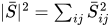
. - Local energy flux
 ; strain density
 .
. - Sort cells by
 (events first); cumulate the positive flux; read
the forward fraction, the top- share, the half-flux volume, and
(events first); cumulate the positive flux; read
the forward fraction, the top- share, the half-flux volume, and
 . Repeat for
  at fixed physical .
 ; top- share;
half-flux volume; correlation; convergence in .
pass: inviscid energy conserved to
; top- share;
half-flux volume; correlation; convergence in .
pass: inviscid energy conserved to  (solver check);
 ,
,  –
– forward; top-
 –
– , half-flux
volume
, half-flux
volume  –
– ,
,  , converged across .
Event RG — the  plateau (
event_rg.py)
Input: exponents  ; coarse-graining factor
  ;
steps; initial
;
steps; initial  .
Steps:
.
Steps:
- Each step record
 .
. - Coarse-grain:
 ,
,  ,
,  .
. - Gap
 .
.
sequence and  .
pass:
.
pass:  constant (plateau, fixed point);
 grows;
  decays. Measured:
  ,
,
 ,
,  .
.Mechanism M — forced co-rotation, merger, pumping (corotation.py)
(M1) Frustration  co-rotation. Build the contact graph of a square
and a triangular lattice; greedy two-colour it (counter-rotation attempt); count
frustrated edges.
pass: square
co-rotation. Build the contact graph of a square
and a triangular lattice; greedy two-colour it (counter-rotation attempt); count
frustrated edges.
pass: square  (bipartite
  counter-rotate, net
  );
triangular
);
triangular  (not bipartite co-rotate forced).
(M2) Co-rotation larger rotation. 2D Navier–Stokes; two strongly
overlapping Gaussian vortices, same or opposite sign; integrate; count connected
strong-vorticity blobs (
(not bipartite co-rotate forced).
(M2) Co-rotation larger rotation. 2D Navier–Stokes; two strongly
overlapping Gaussian vortices, same or opposite sign; integrate; count connected
strong-vorticity blobs ( ).
pass: same-sign
).
pass: same-sign  (merged); opposite
  .
(M3) Rotation through-flow. Ekman spiral
.
(M3) Rotation through-flow. Ekman spiral
 ,
,  ; radial inflow
transport
; radial inflow
transport  ; fit
; fit  vs
vs  .
pass: slope
.
pass: slope  (
( ), measured
  .
.
G-Q — the  lattice-with-inflow (
lattice_inflow.py)
Input: 3D lattice  co-rotating cells
  nozzle; planar
disk slice
nozzle; planar
disk slice  for the Biot–Savart test; rotation
  , .
Steps:
, .
Steps:
- Net circulation around a loop enclosing the disk cells, for co-rotating signs and for an alternating control.
 : net radial flux of a regular divergence-free field through an
enclosing sphere (Gauss
: net radial flux of a regular divergence-free field through an
enclosing sphere (Gauss  regularity, no external source).
 : axial through-flux
  fed by the Ekman radial inflow
  (open rotation axis).
 ;
;  .
pass: co-rotating circulation adds (
.
pass: co-rotating circulation adds ( ) vs control ();
 (nozzle closes);
  (sustained). The dimensional split matches
E3, so the falsification test passes.
(sustained). The dimensional split matches
E3, so the falsification test passes.Universality U1–U3 (universality.py)
(U1) Burgers anomalous dissipation. Integrate Burgers at several ;
record . pass: saturates (-indep,
 spread).
(U2) Capacity identity in dimension
spread).
(U2) Capacity identity in dimension  . For
. For  form
form
 and
and  from a packed core. pass:
 (identity, dimension-general).
(U3) Reaction–diffusion selection. Two-species dispersion; locate the
fastest-growing mode . pass: matches the
extremum-selection prediction to
(identity, dimension-general).
(U3) Reaction–diffusion selection. Two-species dispersion; locate the
fastest-growing mode . pass: matches the
extremum-selection prediction to  –
– .
.
Extensibility E1–E4 (extensibility.py, rigid_shell.py)
(E1) Genome  fluid. Condensate identity
  in ; droplet preferred size at jamming
  .
pass: residual .
(E2) Droplet length selection. Rayleigh–Plateau dispersion of a
liquid column; maximize growth. pass:
.
pass: residual .
(E2) Droplet length selection. Rayleigh–Plateau dispersion of a
liquid column; maximize growth. pass:  ,
,
 .
(E3) Plane breathes, sphere closes. Planar continuity
.
(E3) Plane breathes, sphere closes. Planar continuity  (axial outflow); spherical
  (no axis). pass:
2D sustains, 3D closes.
(E4) Rigid shell.
(no axis). pass:
2D sustains, 3D closes.
(E4) Rigid shell.  ,
,  empty (Legendre), so
 ;
;  -fold rate
  ; quantum length
  triangulated
three ways. pass: spread
triangulated
three ways. pass: spread  ; relative spread of
  narrows
  as coordination grows.
Marginal substrate — relaxed moduli and the fluidity intercept (marginal_fluidity.py)
setup:  D bidisperse (
 , ratio
  ) harmonic spheres,
 for
for  , periodic box
  ;
;
 ,
, ![\phi\in[0.650,0.720]](/fluid-dynamics/eq/fluid-dynamics/i/i0c65881583a6.svg) (
( values)
 seeds.
minimize: L-BFGS FIRE L-BFGS to residual force
seeds.
minimize: L-BFGS FIRE L-BFGS to residual force  .
backbone: iteratively remove rattlers (contacts
.
backbone: iteratively remove rattlers (contacts  );
);
 .
moduli (analytic, FD-verified): affine (Born) shear
.
moduli (analytic, FD-verified): affine (Born) shear
![G_{\rm Born}=\sum_b\,[\,V''\,(n_xn_y r)^2+V'\,r\,n_y^2(1-n_x^2)\,]/V](/fluid-dynamics/eq/fluid-dynamics/i/i50984098c870.svg) ; bulk
; bulk
 with virial pressure
  ; mismatch
 assembled per bond.
non-affine (the trap and its avoidance): never form an
eigendecomposition pseudoinverse—near the margin the soft modes make
assembled per bond.
non-affine (the trap and its avoidance): never form an
eigendecomposition pseudoinverse—near the margin the soft modes make
 over-subtract through near-zero
  weights.
Instead pin DOF of the most-coordinated backbone particle,
Cholesky-factor the reduced positive-definite
weights.
Instead pin DOF of the most-coordinated backbone particle,
Cholesky-factor the reduced positive-definite  , solve, apply
  iterative-refinement steps; then
 with
with
 by construction. Keep negative accepted
values if any occur (no clamping).
acceptance (physical, untuned): jammed (
by construction. Keep negative accepted
values if any occur (no clamping).
acceptance (physical, untuned): jammed ( ),
positive-semidefinite (Cholesky succeeds), residual force .
fit: pooled
),
positive-semidefinite (Cholesky succeeds), residual force .
fit: pooled  ; bootstrap (
 ) CI for
 . pass: CI
  ;
;  monotone in
 ;
;  finite at the lowest- quartile;
  size-independent.
result:
size-independent.
result:  , CI
, CI ![[5.49,6.29]\ni6](/fluid-dynamics/eq/fluid-dynamics/i/ie874eddcce0d.svg) (
( ); quartile means
 ;
;  spread
  ; softening
 ;
;  accepted,
negative.
accepted,
negative.
Rotation unjams; forced-radius attractor (unjam_inflow.py)
packings: as above,  ,
,  (
( values) seeds.
rigid rotation: extension per bond under
values) seeds.
rigid rotation: extension per bond under
 is
is
 ; measured
 . PASS
shear reserve: per extending bond the breaking strain is
. PASS
shear reserve: per extending bond the breaking strain is
 ; track the distribution (
 ,
median) across the
,
median) across the  ensemble against pressure. pass:
ratio
ensemble against pressure. pass:
ratio  ,
,  ,
,
 (the single first break is
extreme-value noise: reported, not gated).
attractor: integrate
(the single first break is
extreme-value noise: reported, not gated).
attractor: integrate  (RK4) from
 with inherited
  . pass:
all
. pass:
all  to
to  ;
;  .
.
Transition class — the G-SOC rules land on DP (transition_dp.py, 3 stages)
model: 1D ring; reserve  from the pseudogap
  (
( , flagged); inactive site unjams if
 ; active re-jams w.p.
  ; toggled sites
redraw . All-inactive is absorbing.
stage 1: slope-matched bisection (
; toggled sites
redraw . All-inactive is absorbing.
stage 1: slope-matched bisection ( k,
k,  k), then
curvature-minimised refine (
k), then
curvature-minimised refine ( k,
k,  k):
k):  ,
,
 .
stages 2–3: spreading (
.
stages 2–3: spreading ( ,
,  k):
k):
 windows
  ,
,  ,
hyperscaling sum
,
hyperscaling sum  vs
vs  ; lifetimes
 (
( censored); activity correlation (fit
 ):
):  vs
vs  .
pass: five for five on DP (
.
pass: five for five on DP ( d); mean-field (
 ) and
compact-DP (
) and
compact-DP ( ) excluded. SOC avalanche
  : cutoff
  at
at
 below threshold, thin statistics — reported, not gated.