The non-equilibrium-dissipation module (nonequilibrium_dissipation.py)
Tests the dissipation magnitude law (ledger row IV/C_ε). A developed ns3d.py field (skewness ≈-0.5) is released into free decay (forcing off); along the decay it computes the integral scale L from the spherically-binned energy spectrum, u'=√2E/3, ε=2ν Z, the Taylor microscale λ and Rey_λ=u'λ/ν, and the dissipation coefficient C_ε=ε L/u'³, logging the trajectory C_ε(Rey_λ).
Tests the dissipation magnitude law (ledger row IV/C_ε). A developed ns3d.py field (skewness ≈-0.5) is released into free decay (forcing off); along the decay it computes the integral scale L from the spherically-binned energy spectrum, u'=√2E/3, ε=2ν Z, the Taylor microscale λ and Rey_λ=u'λ/ν, and the dissipation coefficient C_ε=ε L/u'³, logging the trajectory C_ε(Rey_λ).
Tests the dissipation magnitude law (ledger row IV/ ). A developed
ns3d.py field (skewness  ) is released into free decay
(forcing off); along the decay it computes the integral scale
) is released into free decay
(forcing off); along the decay it computes the integral scale  from the
spherically-binned energy spectrum,
from the
spherically-binned energy spectrum,  ,
,  , the Taylor
microscale
, the Taylor
microscale  and
and  , and the dissipation
coefficient
, and the dissipation
coefficient  , logging the trajectory
  .
In the high-
.
In the high- (non-equilibrium) window follows the Vassilicos
law
(non-equilibrium) window follows the Vassilicos
law 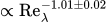 at
at  (well resolved,
 ;
;  ) and
) and  at
at  ; as the decay becomes
self-similar the slope flattens to
; as the decay becomes
self-similar the slope flattens to  and approaches a plateau
(
and approaches a plateau
( ) — the
  event-RG fixed point (§5), i.e. the
zeroth law. A checkpointed driver (
event-RG fixed point (§5), i.e. the
zeroth law. A checkpointed driver (decay.py, analyze_ce.py)
reproduces both resolutions; captured output ships with the module.