Shared physics: the closure number
Both clocks share one dimensionless group: the diffusion (Fourier) number N_D = Dτ/L² ≡ Fo. Dodson’s closure temperature carries the same grouping AτD₀/a² inside its logarithm, so a frozen system exchanging with a reservoir is formally the closure-temperature problem. The radiocarbon reservoir effect, isotopic closure and zircon retention are one physics, not an analogy.
Both clocks share one dimensionless group. The diffusion (Fourier) number N_D = Dτ/L² ≡ Fo measures matrix exchange, and Dodson’s closure temperature T_c carries the same grouping AτD₀/a² inside its logarithm. A frozen system exchanging with a reservoir is formally the closure-temperature problem—so the radiocarbon reservoir effect, isotopic closure, and zircon age retention are one physics, not an analogy.
The companion radiocarbon framework characterises matrix exchange through a Fourier-type diffusion number, and the same dimensionless group governs diffusive retention in minerals. The diffusion number,

is the ratio of a characteristic diffusion length to the system size, and it is formally the Fourier number Fo of heat/mass transfer. Dodson’s closure-temperature formulation,
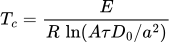
contains the same dimensionless grouping AτD₀/a² inside the logarithm[2]. Dodson explicitly noted that a frozen chemical system in contact with a reservoir is formally identical to the closure-temperature problem—which is exactly what unifies the radiocarbon reservoir effect with diffusive isotopic closure and, by extension, with the retention that preserves a zircon’s crystallisation age. [I] The two papers are thus methodological siblings, not analogies of convenience.