Working range and honest limits
U–Pb has a working range like any measurement: at the young end, trace common Pb dominates; at the old end, ²³⁵U falls to ~1.3% by ~4.4 Ga. The deeper limit is epistemic — radiocarbon is checked against dendrochronology to 12,593 yr, but deep-time U–Pb cannot be checked against any written record; its accuracy rests on consilience.
U–Pb has a working range like any measurement: at the young end trace common Pb dominates the correction; at the old end ²³⁵U falls to ~1.3% by ~4.4 Ga, so ²⁰⁶Pb/²³⁸U and ²⁰⁷Pb/²⁰⁶Pb are preferred. The deeper asymmetry is epistemic—radiocarbon is checked against dendrochronology to 12,593 yr, but deep-time U–Pb cannot be checked against any written record; its accuracy rests on consilience. Stated soft spots: ambiguous autocryst/antecryst textures (a competing LCT age of 658.8 ± 6.6 ka) and locality-dependent reservoir offsets.
Both ends degrade. U–Pb is not uniformly precise across all ages. At the young end the accumulated daughter is minute and is swamped by even trace common Pb, so apparent ages are dominated by the common-Pb correction and its assumed composition. At the extreme-old end the parent is depleted—²³⁵U → ~1.3% by ~4.4 Ga, so ²⁰⁷Pb/²³⁵U becomes hard for the oldest samples (²³⁸U remains ~50%, so ²⁰⁶Pb/²³⁸U and ²⁰⁷Pb/²⁰⁶Pb are preferred there). The method has a range, like any measurement. [F]
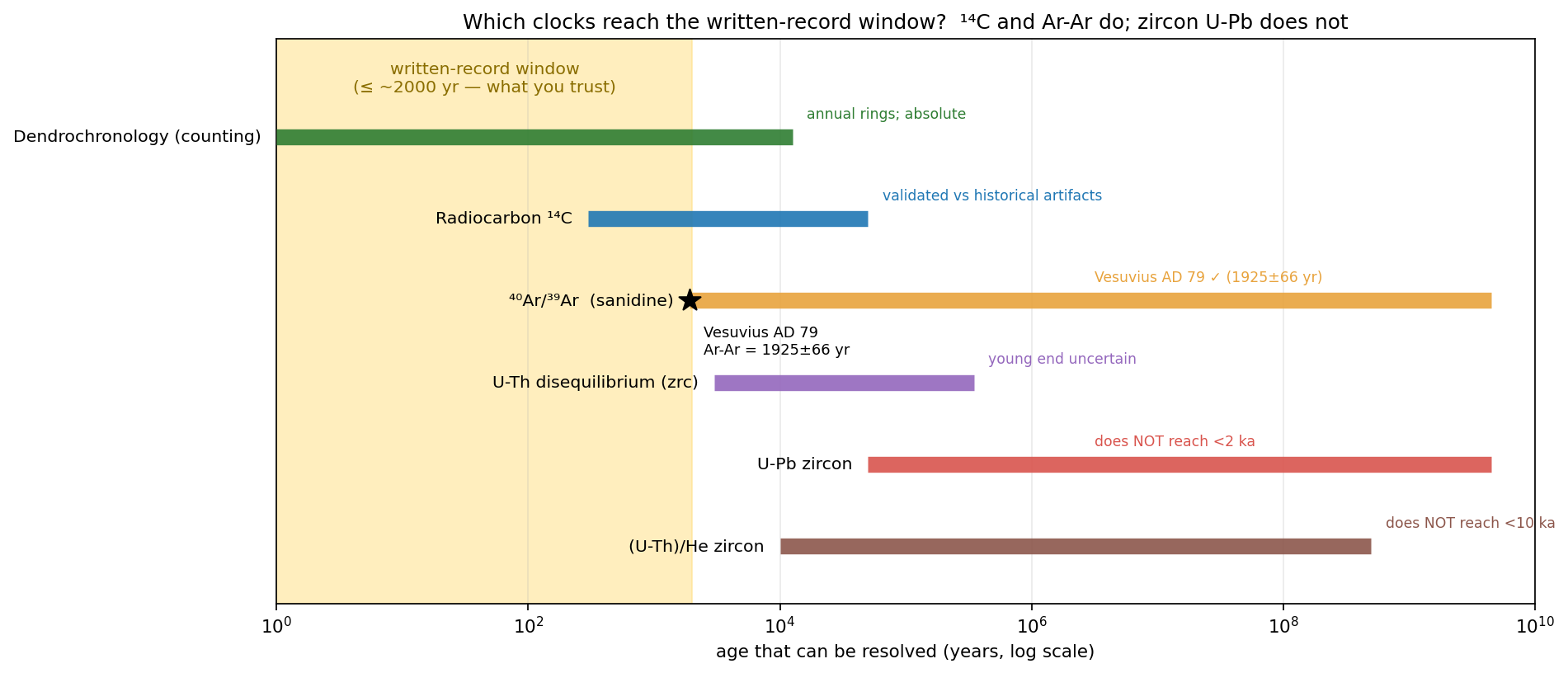
The irreducible asymmetry. Radiocarbon is directly validated in its core interval against historical artefacts and dendrochronology counted to 12,593 calendar years, with the floating Lake Suigetsu varve record extending it further (its independence partly tied to Hulu Cave)[9]. [F] Zircon U–Pb, by contrast, operates in an interval that cannot be checked against any written record. Its accuracy is established by consilience: internal concordance of two decay clocks, agreement with independent methods (e.g. ⁴⁰Ar/³⁹Ar), and astrochronological tuning. This is strong evidence, but it is not the same kind of evidence as direct ground truth, and this paper states the distinction plainly rather than eliding it. [I]
Residual soft spots, stated. (i) Autocryst/antecryst assignment can become circular where CL texture and trace-element chemistry are ambiguous—the LCT itself has a competing near-rim interpretation at 658.8 ± 6.6 ka[4], and other systems are reported as inconclusive. [A] (ii) Reservoir-offset transferability in radiocarbon is locality-dependent, as the unequal LOO gains show. [A] Neither is concealed; both define where the protocol’s uncertainty is genuinely large.