Trigger: Pacific-side uplift and antipodal
Trigger: Pacific-side uplift and antipodal tensile rupture — Because Earth is a closed sphere, a rapid expansion/uplift on one side forces tension on the opposite side. An everyday analogy is a rubber ball: if you inflate one side abruptly, the opposite surface may tear first.
Because Earth is a closed sphere, a rapid expansion/uplift on one side forces tension on the opposite side. An everyday analogy is a rubber ball: if you inflate one side abruptly, the opposite surface may tear first.
Intuition
Because Earth is a closed sphere, a rapid expansion/uplift on one side forces tension on the opposite side. An everyday analogy is a rubber ball: if you inflate one side abruptly, the opposite surface may tear first. Instead of assuming “the Atlantic must be slow spreading,” this white paper elevates antipodal rupture as a falsifiable hypothesis.
Order-of-magnitude: hoop strain and a failure condition
Assume a Pacific-side uplift/expansion tries to increase the effective radius by Δ R. The corresponding hoop strain is 
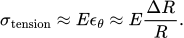

Interpretation. This expression makes “how large must Δ R be to allow Atlantic opening?” a pre-registrable threshold relation. If Δ R must be unrealistically large, the model must STOP under Ω-NoGo.