Resource cross-evidence predictions P31
Resource cross-evidence predictions P31 to P35 — This section maps user-posed resource-validation questions one-to-one to prediction modules, to reduce terminology confusion and to lock “what counts as PASS” and “what counts as FAIL” early (LOCK → Derive → Gate). Even on shelves, thick river-input deltaic/clastic wedges can introduce bias: not “absent,” but “hard to discover/image”
This section maps user-posed resource-validation questions one-to-one to prediction modules, to reduce terminology confusion and to lock “what counts as PASS” and “what counts as FAIL” early (LOCK → Derive → Gate).
This section maps user-posed resource-validation questions one-to-one to prediction modules, to reduce terminology confusion and to lock “what counts as PASS” and “what counts as FAIL” early. (Resource modules have high discovery-bias risk (H-DISC), so P35 is used as a front gate.)
User TEST ID (summary) Module mapping PASS/FAIL key (summary) TEST-OIL-1 (ice / large transport ↔ oil distribution) P22 (+P35) Must show additional explanatory power beyond a basin null model. Even where direct ice cover is absent, use parallel proxies such as meltwater/mega-drainage + delta sink channels. No effect beyond null → FAIL/HOLD. If discovery bias is large (H-DISC), interpret as HOLD. TEST-GLACIAL-1 (Source–Sink separation) P22/P32 (+P35) Check whether “scraped” (ice-core) vs “dump” (terminal basin) separation patterns are explained by basin/thermal maturity alone. If separation disappears → FAIL/HOLD. TEST-COAL-1 (compaction ↔ coal rank) P31 After controlling burial/thermal maturity proxies, deformation/stress indicators must still explain coal rank (or Rₒ). No effect after controls → FAIL (= H-RANK dominates). TEST-BUDGET-1 (source rock budget) P32 (+P35) If R_budget=Oil_obs/Oilₘₐₓ is consistently ≫ 1 after uncertainty propagation, standard source-rock-only explanation becomes difficult (requires external transport/injection hypotheses). If R_budget~ 1, H-BUDG dominates. TEST-TEMP-1 (geothermal / intrusion) P33 If oilfields are stably preserved in high-geothermal/direct-intrusion contexts (violating the oil window), P33 FAILs. Conversely, if preservation concentrates in “moderate heat + low compaction,” constraints strengthen. TEST-ISO-1 (direct dating / chronometers for petroleum) P34 If independent chronometers (Re–Os etc.) repeatedly agree on deep-time ages, V-REC/V-HOLO family conclusions are FAIL/HOLD (strong falsifier).
Memo (Middle East / deltas). Even on shelves, thick river-input deltaic/clastic wedges can introduce bias: not “absent,” but “hard to discover/image” (H-DISC). Conversely, low-clastic platforms (e.g., parts of the Middle East) can exhibit high discoverability. Thus do not treat such cases as immediate counterexamples in P22/P32; quantify bias first via P35.
P31 (exploratory; V-RES): Coal Rank vs Deformation — “is anthracite only in orogenic belts?”
Bundle verdict (2025-12-27): PASS. (results/p31_coal_rank_stress.json)
P31 tests, at a global-sample level, the claim that coal rank (lignite→bituminous→anthracite) is not solely a function of time, but also of compaction/deformation (stress field). The key is whether anthracite can be sufficiently produced in stable cratons by burial/temperature alone, or whether it is substantially concentrated in orogenic/fold-thrust belts.
Test (TEST-COAL2). In data/geo/coal_rank_stress_cases.csv, record: (1) coal rank or a rank proxy such as vitrinite reflectance Rₒ, (2) structural/deformation proxies (e.g., fold-thrust belt flag, fault density, strain indicators), (3) burial/thermal proxies (maximum burial depth, geothermal gradient, etc.). The analysis fits a null model with “burial/thermal only” predictors, then evaluates the additional explanatory power of deformation proxies (Δ R² or AIC improvement).
File stubs. config/p31_coal_rank_stress_prereg.yml (pre-register case selection/order/thresholds). code/p31_coal_rank_stress.py (correlation/rank-correlation/logistic-regression stubs). data/geo/coal_rank_stress_pilot.csv (user-provided 5-sample demo; not used for evidence-grade scoring).
Bundle results (2025-12-27; PASS). This release includes a QA0 global sample constructed from public data (WoCQI + GSRM): data/geo/coal_rank_stress_cases.csv (N=1006; anthracite=104), reproducible via code/p31_build_cases_from_wocqi_gsrm.py. Pipeline summary (code/p31_coal_rank_stress.py): Spearman ρ=-0.345 meets the |ρ|≥0.30 threshold (p≪0.01), and in the “low-deformation subset” the anthracite fraction is 0.127, not meeting the FAIL condition (>0.30). Thus P31 is locked as PASS. However, PASS does not establish causality; a covariate-controlled version (including burial/thermal proxies) remains future work.
FALSIFIER.
- (counterexample) if anthracite is commonly produced in low-deformation stable cratons/basins and is explainable by burial proxies alone, the “compaction-dominant” claim weakens (P31 FAIL/HOLD).
- (null) if deformation proxies add no significant explanatory power beyond the null model, P31 FAIL/HOLD.
Linked AR/H. AR-35; competing hypothesis H-RANK.
P32 (exploratory; V-RES): Source Rock Budget vs Reserves — “Mass Balance Fail” test
Bundle verdict (2025-12-27): HOLD (no evidence). (results/p32_oil_mass_balance.json)
P32 locks the claim “this region's source rock (TOC) alone cannot produce current reserves” via a budget calculation. The key is regional-scale definition: not “right beneath a field,” but the total source-rock mass within the prereg basin_footprint.
Test (TEST-BUDGET1). In data/petroleum/oil_source_budget_cases.csv, record: (1) reserves (separating oil-in-place vs recoverable if possible), (2) source-rock area/thickness/density, (3) TOC, conversion efficiency η_conv, expulsion efficiency η_exp, (4) uncertainty bounds. Caution: M_oil,obs may be “discovered” reserves (dependent on exploration maturity/cover/imaging difficulty; AR-39), so record exploration metadata when possible and run sensitivity on lower/upper bounds. Define a simple upper bound: 
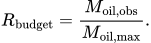
FALSIFIER. If core cases repeatedly yield R_budget≤ 1 (with uncertainty), the claim “external inflow (bulldozer/megaflood) is required” weakens (P32 FAIL/HOLD). Conversely, if R_budget≫ 1 persists outside uncertainty, a transport/missing-source scenario remains a candidate (but missing-source scenarios must be eliminated first).
Linked AR/H. AR-36, AR-39; competing hypotheses H-BUDG, H-DISC (and H-OIL).
P33 (exploratory; V-RES): Thermal Window & Intrusion Exclusion — “direct intrusion burns it”
Bundle verdict (2025-12-27): HOLD (no evidence). (results/p33_oil_thermal_context.json)
P33 organizes the claim (shared by the standard model) that petroleum is not preserved in direct magma-intrusion contact zones, but rather near the boundaries of a thermal window / indirectly heated zones. This is not standalone evidence; it provides a physical constraint needed to interpret P32/P34.
Test (TEST-TEMP1). In data/petroleum/oil_thermal_context.csv, record: (1) geothermal gradient/heatflow, (2) distance to intrusions/igneous bodies, (3) maturity indicators (Rₒ, Tmax, etc.), (4) occurrence type (oil/heavy oil/gas/pyrolysis traces). If crude oil is stably preserved under “direct intrusion” conditions, this module fails (or indicates misclassification).
FALSIFIER. If giant fields are commonly preserved as crude oil despite (a) direct intrusion contact and (b) extreme over-temperature/overmaturity contexts, P33 is FAIL/HOLD (or requires data/definition review).
Linked AR/H. AR-38; competing hypothesis H-OIL.
P34 (optional; V-REC/V-RES): Petroleum Chronometers — Re–Os/U–Pb/⁴⁰{40}Ar–³⁹Ar window test
Bundle verdict (2025-12-27): HOLD (no evidence). (results/p34_petroleum_chronometers.json)
P34 is a kill test that targets “young event (V-REC)” most directly. In petroleum systems, one can directly constrain charge/mineralization timing using (i) Re–Os isochrons of bitumen/oil, (ii) U–Pb of reservoir carbonate cements, (iii) Ar-series ages of fault-zone clays (illite), etc. If many independent chronometers consistently indicate deep time (Ma), a “recent (kyr–0.1 Myr) event” variant becomes difficult to maintain.
Test (TEST-PETAGE1). In data/petroleum/petroleum_chronometers.csv, record province, age_Ma, sigma_Ma, method(ReOs/UPb/ArAr/...), material, interpretation(charge/diagenesis/faulting), qa_flag, ref. Fix young_max_age_Ma in preregistration, and evaluate: (1) fraction within the young window, (2) mixture-model clustering index, and (3) cross-method agreement.
FALSIFIER.
- (strong falsifier) if high-quality (qa_flag=0) chronometers across multiple petroleum systems repeatedly yield age_Ma ≫ youngₘaxₐge_Ma with high cross-method agreement, V-REC conclusions are FAIL (or downgraded strongly to HOLD).
- (weak adjudication) if data are sparse/mixed (qa_flag>0), P34 is HOLD (do not use for conclusions before more collection).
Linked AR/H. AR-37; competing hypotheses H-ISO, H-OIL.
P35 (exploratory; V-RES/H-CONF): Oil Discoverability vs Sediment Cover — quantifying “discovery bias”
Bundle verdict (2025-12-27): HOLD (no evidence). (results/p35_oil_discovery_bias.json)
P35 quantifies a “discovery bias” that can distort interpretation of P22 (oil distribution correlation) and P32 (budget). In thick-river-input shelf/delta settings, (1) structures are buried deeper, (2) seismic velocity models become complex, and (3) drilling costs rise, lowering discoverability (AR-39; H-DISC). Conversely, as noted by the user, low-clastic shelf platforms (e.g., parts of the Middle East) can have higher discoverability. Thus P35 includes region contrasts (Middle East vs mega-deltas, etc.) to quantify bias sign/magnitude. From a petroleum-systems view, higher sedimentation can also increase storage/seal/reservoir opportunities, so P35 explicitly adjudicates the sign.
Refined two-layer observability model (core). Petroleum “distribution” data are not V_true directly, but a set of “discovered” items. Interpret observed volume as 
Test (TEST-OIL-SED1; pre-registered). In data/petroleum/oil_discovery_bias_cases.csv, per basin (or exploration block) record: (i) discovery outcome (e.g., discovered_bboe, giant_fields), (ii) exploration maturity (e.g., wells, seismic_km2, exploration_years), (iii) cover/sedimentation proxies (e.g., sed_flux_proxy, shelf_sed_thickness_m), (iv) geological controls (e.g., basin_type, heatflow, water_depth). Example model (log-linear): 
FALSIFIER / decision rule (important).
- PASS (evidence; strong discovery-bias confounder): after controlling exploration effort/basin type, if the 95% CI upper bound of β_S is below 0 (fully negative) and stable under sensitivity, treat it as evidence that “thick cover suppresses discovery.” In this case, P22/P32 have high confounding risk from H-DISC and are downgraded (or held).
- FAIL (counter-evidence; H-DISC weakened): if the 95% CI lower bound of β_S is above 0 (fully positive) and stable, the “can't find it because of sediment cover” assumption (H-DISC) is contradicted.
- HOLD (no evidence; low power): if the CI includes 0, it is typically a power limitation due to sample/covariate/effort scarcity, not a falsifier. In this case P22/P32 cannot claim “bias controlled,” so resource modules remain only candidate explanations.
File stubs. config/p35_oil_discovery_bias_prereg.yml (pre-register variable definitions/selection rules/thresholds). code/p35_oil_discovery_bias.py (regression/correlation/sensitivity stubs). data/petroleum/oil_discovery_bias_cases.csv (data schema/codebook). Linked AR/H. AR-39; competing hypotheses H-DISC, H-CONF (and H-OIL).