Time and Gravity
Time and Gravity: This chapter does two opposite things and it matters that it does both. Grade [F] forced.
This chapter does two opposite things and it matters that it does both. It states the framework's strongest time result — that one medium mechanism reproduces, to all orders, both the kinematic (motion) and the gravitational time dilation that experiment measures — and, in the same breath, it records honestly that the gravity sector this buys is observationally degenerate with general relativity, so the framework's testable weight does not sit here. z=6.
This chapter does two opposite things and it matters that it does both. It states the framework's strongest time result — that one medium mechanism reproduces, to all orders, both the kinematic (motion) and the gravitational time dilation that experiment measures — and, in the same breath, it records honestly that the gravity sector this buys is observationally degenerate with general relativity, so the framework's testable weight does not sit here. Time and gravity are presented as two separate tracks (§18.1–§18.4 time; §18.5–§18.8 gravity) that are then shown to be one mechanism (§18.9).
18.0 Principle and overview: one mechanism, two faces
The organizing statement is a single sentence: a clock is the medium's processing rate, and a clock slows by exactly the kinematic factor of its velocity relative to the local medium. Motion supplies that velocity directly (the body moves through the plenum); gravity supplies it through the inflow (a static body sits in a medium that is itself flowing inward). The two dilations are therefore the same effect with two different velocities, and the free-fall inflow — the "river" of §18.6 — is what makes the identity exact. No external relativistic postulate is used as a derivation basis anywhere in this chapter; agreement with the measured (and with the relativistic) numbers is reproduction in the framework's standard sense, not import.

Map of the chapter. Time track: §18.1 the clock (referenced), §18.2 motion dilation and the exact factor, §18.3 status of the exact factor, §18.4 time gates. Gravity track: §18.5 gravity as inflow (promoted from §17.4), §18.6 the river unification (the connection), §18.7 the two velocities, §18.8 gravity gates and the honest negative. Connection: §18.9 one principle and the cosmology hook, §18.10 grade ledger, open frontier, and scope.
18.1 The clock (referenced, not re-derived)
The clock is the electron Compton rotation-emission clock of §10 and §12; this chapter references it and does not re-derive it (SSOT: the locks live in their home sections).

Two guardrails carry over from §10 and are used below without restatement: τ_q is the rotational winding period, not a signal-crossing time, so c=D/τ_q must not be read backwards; and the rotation-emission clock is not a light-clock — no photon is bounced across D. The motion result of §18.2 is built on the winding's own geometry and the medium signal speed, never on a light-clock shortcut.
18.2 Motion time dilation and the exact factor
A moving rotation-emission clock slows. To leading order this is the self-wake / refill-competition result (the refill budget diverted to the moving body's plenum displacement scales as v^2/c^2):
![\begin{equation} \left.\frac{d\tau}{dt}\right|_{\mathrm{motion}}=1-\frac{1}{2}\frac{v^2}{c^2}+O(c^{-4})\qquad[\mathrm{F}\ \text{leading}]. \end{equation}](/physics/eq/physics/phy-18-002.svg)
The exact factor is fixed without relativity and without a light-clock, by the medium's finite signal speed acting on the winding's own closure together with the isotropy of the electron rate. A winding is a signal that must close a loop at the medium speed c. For a moving excitation whose longitudinal scale is contracted by a factor κ, the closure round-trip time of an arm of proper length L at rest-angle θ to the velocity is (derived in the medium rest frame; "Michelson-for-winding"):

The electron rate νₑ (hence mₑ=2πνₑ) is a scalar — isotropic — and the jammed medium's rest response is isotropic (φ_jam, z{=}6 carry no preferred direction). The rate must therefore be independent of the winding orientation θ, which forces T to be θ-independent:

At that unique contraction the θ-dependence cancels and the rate is exactly the Lorentz factor, for every orientation and to all orders:
![\begin{equation} \boxed{\,\left.\frac{d\tau}{dt}\right|_{\mathrm{motion}}=\sqrt{1-\frac{v^2}{c^2}}\,}\qquad[\mathrm{F}\ \text{value forced; expands to \eqref{eq:phy-18-002} at }O(c^{-2})]. \end{equation}](/physics/eq/physics/phy-18-005.svg)
Any other contraction leaves a residual orientation dependence (a Michelson-Morley fringe for the winding); isotropy admits only κ=√(1-v²/c²). This is verified numerically (the orientation-anisotropy is machine-zero only at this κ, recovered as the unique minimizer to ~ 10⁻¹² up to v/c=0.99) in the deterministic module \texttt{vp\_exact\_sqrt.py}.
18.3 Status of the exact factor (value forced; full-vector dynamics open)
The result of §18.2 fixes the \emph{value} of the exact factor by (finite-c closure) + (rate isotropy); both are framework assets, so this is grade [F]. What remains open is the \emph{ab-initio dynamical realization} of the longitudinal contraction in the full transverse/vector sector — the moving excitation's Heaviside/Searle ellipsoid. In the scalar (longitudinal) sector the wave operator Box=∇²-c⁻²∂ₜ² produces the contraction directly; the full rotational case needs the vector sector, which is exactly the open item already flagged in §14.0.6 (status note: "not yet derived ... the exact v/c scaling"). The value cannot move — isotropy has pinned it — so this chapter is complete as stated; only the dynamics is the frontier. Grade: value [F]; full-vector dynamics [O] (=§14.0.6). This is Lorentzian ether mechanics (a preferred medium frame, a dynamical contraction) — the opposite of special relativity, which it reproduces.
18.4 Time gates

Modules: \texttt{vp\_exact\_sqrt.py} (G-EXACT-SQRT), \texttt{vp\_timegravity\_ssot.py} (I-TIME-1/2, drift gate). Both deterministic, standard-library, 2×sha256 identical.
18.5 Gravity as inflow (promoted here from §17.4)
Gravity is not a primitive in this framework; it is the inflow forced by an annihilation sink in a void-forbidding plenum. The locks remain in §17.4 (this chapter promotes the result to featured status and references the locks): a point sink of annihilation rate Q enters the lattice continuity field as a delta source, the Laplacian Green's function gives the deficit field φ∝ Q/(4π r), and the void-forbidden (fullness) rule converts net annihilation into an always-attractive inflow with F∝ Q/r² (§17.4.0). The fullness theorem (§17.4.0.1) gives, from the same root, the single signal speed c²=K/ρ_eff — there is no faster channel because there is no void to bypass through — and this is the speed that the river identity of §18.6 uses. The inflow saturates at a cap g_* (§17.4.1ff), and the absolute magnitude of g_* at a given body is back-substituted (the four-wall theorem, §17.4.4: a proven no-go, grade [O]).
![\begin{equation} \left.\frac{d\tau}{dt}\right|_{\mathrm{grav}}=1+\frac{\phi_N}{c^2}+O(c^{-4})\qquad[\mathrm{F}\ \text{leading}],\qquad \phi_N=-\frac{GM}{r}. \end{equation}](/physics/eq/physics/phy-18-007.svg)
18.6 The river unification (the connection between the two tracks)
This is where the two tracks become one. Gravity is inflow, so the medium near a sink is genuinely moving inward; a clock held static in a gravity well is therefore a clock at rest in a \emph{moving} medium — equivalently, a clock moving relative to the local medium at the free-fall ("river") velocity. The river velocity is the escape velocity, set by energy in the framework's 1/r^2 field (its shape [F]; its magnitude inherits the [O] of g_*):
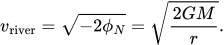
Applying the motion factor of §18.2 with v=v_river gives the gravitational dilation as a kinematic effect — and it is the exact Schwarzschild static-clock rate, identically:
![\begin{equation} \boxed{\,\left.\frac{d\tau}{dt}\right|_{\mathrm{grav}}=\sqrt{1-\frac{v_{\mathrm{river}}^2}{c^2}}=\sqrt{1-\frac{2GM}{rc^2}}\,}\qquad[\texttt{G-RIVER}]. \end{equation}](/physics/eq/physics/phy-18-009.svg)
The consequence is structural: gravitational time dilation is exact to all orders \emph{conditional only on the exact motion factor} of §18.3. The framework's two open time-items — the exact motion factor and whether gravity holds beyond leading order — collapse to one: derive the motion factor's dynamics (§14.0.6) and both motion and gravity dilation are simultaneously exact. \texttt{vp\_timegravity\_ssot.py} verifies \eqref{eq:phy-18-009} to machine precision for bodies from the Moon to a neutron-star surface (v_river/c=0.59, strong field).
18.7 The two velocities (a distinction the framework must keep)
The single field φ_N carries two different velocities, and they must not be conflated. The incompressible mass-current that books the sink's steady consumption falls as 1/r^2; the time-dilation velocity is the potential (free-fall/river) velocity and falls as 1/√(r):

Both descend from φ_N; the river identity of §18.6 uses the potential velocity, not the mass-current.
18.8 Gravity gates and the honest negative
\texttt{G-RIVER} passes (machine-exact, through the neutron-star strong field). The adversarial gate \texttt{G-CAP-DEPART} confronts the cap with current data and returns an honest negative. The cap is read through the framework's own two-channel structure (Appendix G): the saturating channel g_restore is a \emph{contact} normal-force effect, while redshift, orbits, light bending, and gravitational waves are the uncapped \emph{geom} channel, which equals exact Schwarzschild by §18.6. Writing the cap fluidization radius as a framework quantity,
![\begin{equation} r_{\mathrm{fluid}}=\frac{r_s}{\alpha^2},\qquad \alpha=\text{yield-velocity fraction (}[\mathrm{O}]\text{; }\alpha{=}1\text{ sonic} \Rightarrow r_{\mathrm{fluid}}=r_s=\text{horizon}), \end{equation}](/physics/eq/physics/phy-18-011.svg)
the verdict is layered: in the most-forced (sonic) reading the departure hides at the horizon and the geom channel is exact Schwarzschild everywhere accessible, so the redshift of a static surface equals GR to machine precision (PSR J0740+6620: v_river/c=0.69, z=0.38, NICER pulse fit GR-consistent); earlier-yield readings (α<0.69 at the NS surface, α<0.82 at the BH light ring) are excluded by the GR-consistency of NS pulse profiles and of ringdown (|ε_Ω|<0.05); and the surviving window (αgtrsim0.82, near-sonic yield) is in tension with the framework's own marginally-rigid isostatic jamming (z{=}6, φ_jam≈0.64), which favors early yield. The bottom line is recorded plainly: the gravity sector yields \emph{no surviving prediction distinct from GR in accessible regimes} — it is either degenerate (α=1) or excluded (α<0.82). Module: \texttt{vp\_cap\_depart.py}. The companion cosmology volume reaches the same verdict for its own sectors (the supernova Hubble diagram and gravity are both labelled degenerate), so the two volumes agree: the testable weight is elsewhere.
18.9 Unification: one principle, and the cosmology hook
The two tracks are one law. A clock slows by the kinematic factor of its velocity relative to the \emph{local} medium; motion supplies that velocity as motion through the plenum, gravity supplies it as the inflow the clock sits in:
![\begin{equation} \boxed{\,\frac{d\tau}{dt}=\sqrt{1-\frac{v_{\mathrm{loc}}^2}{c^2}}\,},\qquad v_{\mathrm{loc}}=\begin{cases}v,& \text{motion (relative to its own wake)},\\[2pt] v_{\mathrm{river}}=\sqrt{2GM/r},& \text{gravity (relative to the inflow)}.\end{cases} \end{equation}](/physics/eq/physics/phy-18-012.svg)
Three consequences. (i) \textbf{Reduction:} deriving the exact motion factor's dynamics (§18.3 / §14.0.6) makes motion and gravity dilation simultaneously exact to all orders — one frontier, not two. (ii) \textbf{Universality unified:} whether the electron and proton clocks slow by the same factor (the LPI question) becomes whether the kinematic slowdown is species-blind, i.e.\ rotor-scale isotropy η_rotor→1 — the same isotropy that forced κ in §18.2 — so the equivalence principle (acceleration) and LPI (rate) are two faces of "competition is species-blind"; the empirical handle is the nuclear p/n systematics. (iii) \textbf{Cosmology hook (hand-off; development in the companion cosmology volume, Ch 7):} the clock rate is the local medium signal speed √K/ρ_eff, and the refractive index n=c_ref/c_medium is the same signal speed; a \emph{cosmic} evolution of ρ_eff therefore moves index and clock rate by the \emph{same} factor, so the redshift's energy-loss (1+z) and its arrival-rate (1+z) are one and the same, not two coincidentally-equal assumptions:
![\begin{equation} \text{cosmic:}\quad 1+z=\frac{n(t_{\mathrm{obs}})}{n(t_{\mathrm{em}})}\qquad[\text{E-COSMO regime (§17.2 list, §17.5 registry); development in the cosmology volume}]. \end{equation}](/physics/eq/physics/phy-18-013.svg)
This grounds the cosmology volume's time-varying-index (1+z) in the processing-rate clock of this chapter and places local (here) and cosmic dilation under one principle. The rate κ_opt=H₀/c stays [INPUT] (neither volume derives H_0); \emph{why} ρ_eff evolves over cosmic time is the E-COSMO question and remains open.
18.10 Grade ledger, open frontier, and scope
![\begin{equation} \begin{array}{ll} [\mathrm{F}] & \text{motion leading }1-v^2/2c^2;\ \text{gravity leading }1+\phi_N/c^2;\ O(c^{-2})\ \text{matches the GPS expression}\\ [\mathrm{F}] & \text{exact motion factor }\sqrt{1-v^2/c^2}\ \text{value forced (finite-c}+\text{isotropy, §18.2)}\\ [\mathrm{F}] & v_{\mathrm{river}}=\sqrt{2GM/r}\ \text{shape; G-RIVER: }\sqrt{1-v_{\mathrm{river}}^2/c^2}\equiv\sqrt{1-2GM/rc^2}\\ [\mathrm{F?}] & \text{universality }\eta_{\mathrm{rotor}}\!\to\!1\ (\text{LPI}=\text{rotor isotropy; EP its acceleration face})\\ [\mathrm{O}] & \text{full-vector dynamics of the contraction (=§14.0.6 exact v/c);\ absolute }g\ \text{magnitude (}m_q,\ \text{four-wall)}\\ \text{negative} & \text{gravity sector observationally degenerate with GR (G-CAP-DEPART)}\\ \text{hand-off} & \text{cosmological }(1+z)\ \text{to the cosmology volume Ch 7 (E-COSMO; }\kappa_{\mathrm{opt}}{=}H_0/c\ \text{[INPUT])} \end{array} \end{equation}](/physics/eq/physics/phy-18-014.svg)
Open frontier (flagged, deliberately not forced): the full-vector dynamics of the contraction (§14.0.6) is the single remaining derivation; the absolute g magnitude (m_q, four-wall) is blocked; η_rotor→1 is structural. Scope statement (recorded here and consistent across both volumes): the framework's testable weight is \emph{not} in the gravity sector, which is degenerate with general relativity — it rests on the cosmology volume's distinguishing predictions, principally a₀=cH₀/2π (galactic rotation) and the γ-ray dispersion mode. Stating this is the honest scope of the time-and-gravity sector, not a concession hidden in it.