Appendix A. Mathematical lemmas and proof sketches
Appendix A. Mathematical lemmas and proof: R is the field of real numbers and C is the field of complex numbers. Let V be a vector space over R or C. Thus b_j=0, so π(u_j) is a basis and dim(V/W)=n-k.
R is the field of real numbers and C is the field of complex numbers. Let V be a vector space over R or C. Thus b_j=0, so π(u_j) is a basis and dim(V/W)=n-k.
A.0 Notation and basic conventions (common)
(1) Numbers and vectors
R is the field of real numbers and C is the field of complex numbers. Let V be a vector space over R or C.
(2) Inner product and norm
In a complex inner-product space (V,⟨·,·⟩), the inner product satisfies the following properties.
- (Linearity) ⟨ ax+by, z⟩ = a⟨ x,z⟩ + b⟨ y,z⟩.
- (Conjugate symmetry) ⟨ x,y⟩ = ⟨ y,x⟩.
- (Positive definiteness) ⟨ x,x⟩ ≥ 0, and ⟨ x,x⟩=0 ⇔ x=0.
The norm is defined by |x|:=√(⟨ x,x⟩).
(3) Linear operators and adjoints
The adjoint A^dagger of a linear operator A:V→ V is defined by

as the operator satisfying the above. If A=A^dagger, then A is (in the mathematical sense) self-adjoint (Hermitian).
(4) Commutator
For operators A,B, the commutator is defined by [A,B]:=AB-BA.
A.1 Cauchy–Schwarz inequality
Theorem A.1 (Cauchy–Schwarz)
For any x,y∈ V,

holds.
Proof
If y=0 then the left-hand side is 0 and the claim holds. Now assume y≠ 0 and, for any λ∈C,

expand the expression.

Choosing λ:=⟨ x,y⟩/|y|², we obtain

Therefore |⟨ x,y⟩|²≤ |x|²|y|², and taking square roots yields (AppA_CS). square
A.2 Triangle inequality
Theorem A.2 (Triangle inequality)
For any x,y∈ V,

holds.
Proof

From Cauchy–Schwarz (AppA_CS) we have |⟨ x,y⟩|≤ |x||y|, and since Re⟨ x,y⟩≤ |⟨ x,y⟩|,

taking square roots of both sides gives (AppA_triangle). square
A.3 Quotient-space dimension theorem (removing global reference degrees of freedom)
Theorem A.3 (Quotient-space dimension)
Let V be a finite-dimensional vector space and W⊂ V a subspace. Then

holds.
Proof
Extend a basis w₁,…,wₖ of W to a basis of V so that w₁,…,wₖ,u₁,…,uₙ₋ₖ becomes a basis of V (n=dim(V)). For the quotient map π:V→ V/W, show that π(u₁),…,π(uₙ₋ₖ) generates V/W. Any v∈ V can be written as
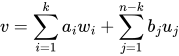
and since π(w_i)=0,
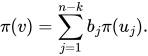
therefore

But since w_i,u_j is a basis, any vector in W must have all u_j components equal to 0. Thus b_j=0, so π(u_j) is a basis and dim(V/W)=n-k. square
Application A.3.1 (removing the global reference in a 6-face channel)
If V=R⁶, W=span1₆, and 1₆=(1,1,1,1,1,1), then dim(W)=1 and dim(V)=6, hence by (AppA_dim_quotient) we have dim(V/W)=5.
A.4 Discrete Fourier transform and Parseval's theorem (finite lattice)
Setup
For N∈N, let Z_N=0,1,…,N-1 be the cyclic group modulo N. Define the inner product of a complex sequence x:Z_N→C by
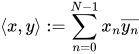
as above.
DFT
Define the discrete Fourier transform (DFT) by

and define the inverse transform by

as follows.
Theorem A.4.1 (Orthogonality)
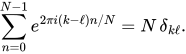
Proof
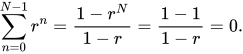
If k=ℓ then the sum is N. If k≠ ℓ, it is a geometric series with ratio r=e^(2π i (k-ℓ)/N)≠ 1, hence
square
Theorem A.4.2 (Parseval)
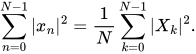
Proof
Using (AppA_IDFT),

therefore
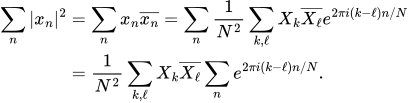
By Theorem A.4.1, the inner sum equals Nδ_(kℓ), hence

square
A.5 Commutator-based uncertainty inequality (pure algebra)
Theorem A.5 (Robertson form)
For self-adjoint A,B in an inner-product space and a normalized vector ψ (|ψ|=1),
![\begin{equation} \Delta_\psi A\cdot \Delta_\psi B \ge \frac{1}{2}\left|\left\langle \psi,\;[A,B]\psi\right\rangle\right| \end{equation}](/physics/eq/physics/phy-axa-009.svg)
holds. Here

we define
Proof
Let A':=A-⟨ A⟩ I and B':=B-⟨ B⟩ I, and set u:=A'ψ and v:=B'ψ. Then

By Cauchy–Schwarz (AppA_CS),

On the other hand,

For the complex number z:=⟨ ψ,A'B'ψ⟩, since Im(z)≤ |z|,

Also,
![\begin{align*} z-\overline{z} &=\langle \psi,A'B'\psi\rangle-\overline{\langle \psi,A'B'\psi\rangle} =\langle \psi,A'B'\psi\rangle-\langle \psi,(A'B')^\dagger\psi\rangle\\ &=\langle \psi,A'B'\psi\rangle-\langle \psi,B'A'\psi\rangle =\langle \psi,[A',B']\psi\rangle. \end{align*}](/physics/eq/physics/phy-axa-010.svg)
Therefore
![2i\,\operatorname{Im}(z)=\langle \psi,[A',B']\psi\rangle.](/physics/eq/physics/phy-axa-029.svg)
Taking absolute values gives
![2|\operatorname{Im}(z)|=\left|\langle \psi,[A',B']\psi\rangle\right|.](/physics/eq/physics/phy-axa-030.svg)
But the constant term cancels in the commutator, so [A',B']=[A,B]. Therefore
![|z|\ge |\operatorname{Im}(z)|=\frac{1}{2}\left|\langle \psi,[A,B]\psi\rangle\right|.](/physics/eq/physics/phy-axa-031.svg)
Finally, combining |z|=|⟨ u,v⟩|≤ Δ_ψ AΔ_ψ B yields (AppA_Robertson). square
A.6 Sensitivity (error propagation) upper bound
Theorem A.6 (first-order sensitivity bound)
Let f:Rⁿ→R be differentiable at x, and let the input error be δ x∈Rⁿ. Then

Proof
By the definition of differentiability,

By Cauchy–Schwarz, |∇ f(x)· δ x|≤ |∇ f(x)|₂|δ x|₂. Thus (AppA_sensitivity). square
A.7 Significant-digit rounding operator (reporting convention)
Definition A.7 (rounding operator)
For k∈Z, define Roundₖ:R→R by

as above. Here, round denotes rounding to the nearest integer (the tie-breaking rule is locked in analysis_lock).
Property A.7.1 (Error bound)
Regardless of the tie-breaking rule,

holds (since the integer lattice spacing is 10^(-k), the worst case is half the spacing).