The gamete, emerged from DNA: one substrate makes an oscillator and a held switch
The four questions about the germ cell answer on the same substrate. A gamete is made by meiosis — one DNA replication then two divisions, reductional before equational, forced by ordered two-stage REC8 cohesin release (arm separase 0.684 → centromeric 1.085). Gametes are NOT identical: independent assortment is exactly 223 = 8,388,608, and crossover interference is the substrate refractory period mapped onto the chromosome (sub-Poisson, Fano 0.108 versus Poisson 0.976). The sperm flagellum is the fast end of the oscillator ladder; the egg is a switch held at metaphase II, and fertilisation is a one-way spinodal flip. One substrate, two opposite gametes — anisogamy. code output with measured-γ and structural anchors.
Each germ-cell question is a discriminant against the vendored R19 switch and FHN oscillator, with measured gamete-program promoter γ (TEKT1…REC8) as the only new input. Meiosis is ploidy 2N,2C→1N,1C with the reductional–equational order set by shugoshin-protected cohesin (a protection sign, not a tuned parameter); non-identity is 223 assortment times interference-thinned recombination; the flagellar beat is the fastest relaxation clock (26.2 < 132.4 < 675.0 < 1133.7); the egg is a held switch whose fertilisation flip is supra-spinodal and irreversible. A pre-registered test of whether γ separates the functional modules is reported as it falls, including its null.
The package emerged the organs and the rhythms, but never the germ cell
Earlier chapters derived the reproductive organs from measured γ and the HPG, menstrual and spermatogenic rhythms from one oscillator. None of them opened the gamete itself. This chapter asks the four questions directly — how a gamete is made, whether gametes are identical, how the sperm moves and how the egg works — and answers each as a discriminant against the same two primitives, with measured gamete-machinery promoter γ as the only new input.
The gamete-program genes (TEKT1, MOS, CATSPER1, DMC1, MLH1, SPO11, PRDM9, REC8, ZP3, and the rest) were declared by function before any γ was read, and the reception refuses to persist unless both vendored anchors (SOX9, DAZL) reproduce exactly. γ enters the dynamics only where a measured master names a mechanism the substrate already owns.
How a gamete is made: one replication, two ordered divisions
Meiosis copies the genome once and then divides twice, so a diploid cell becomes four haploid gametes; fertilisation restores the diploid count. The ploidy bookkeeping is exact.

| meiotic stage | ploidy (N = sets, C = chromatids) |
|---|---|
| start (diploid) | 2N,2C |
| after S-phase (replicate) | 2N,4C |
| after meiosis I (reductional) | 1N,2C |
| after meiosis II (equational) | 1N,1C |
The non-trivial part is the order: meiosis I is reductional (it separates homologues, halving N) and meiosis II is equational (it separates sister chromatids, like mitosis). On the substrate this order is not assumed — it is forced by a two-stage release of REC8 cohesin (measured γ = 1.4525, spinodal 0.6738). Arm cohesin is unprotected and releases first (separase reaches 0.684 at MI); centromeric cohesin is shielded by shugoshin, modelled as a protection offset, and only releases at MII (separase 1.085). The order follows from the sign of the protection, not from any tuned rate.
Are gametes identical? No — by an astronomical margin
Two independent mechanisms make two identical gametes effectively impossible. Independent assortment of the 23 homologue pairs gives exactly 223 orientations on its own.

Recombination then adds far more, and it does so in a structured way. Crossovers are not placed at random: they show interference — one crossover suppresses another nearby. On this substrate interference is the same refractory dead-zone that regularises FHN spikes, but mapped from time onto the chromosome axis. Dense candidate crossovers thinned by a minimum-separation refractory length become sub-Poisson and regularly spaced, with an obligate crossover per bivalent.
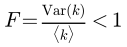
The modelled crossover count is 3.80 per bivalent with Fano factor 0.108 — far below the Poisson null of 0.976 — gap CV 0.26 (more regular than random), and an obligate-crossover fraction of 1.0. Combined with assortment, the floor on distinct gametes exceeds 1047: two identical gametes from one person are, for all practical purposes, impossible. code output
Sperm motility: the flagellum is the fast end of the oscillator ladder
The flagellar beat is not a new device. It is the same relaxation oscillator that runs every other reproductive rhythm, taken to its fast limit by shortening the recovery timescale. That places it at the bottom of a four-clock ladder.

In arbitrary substrate units the periods order as 26.2 (flagellum) < 132.4 (GnRH pulse) < 675.0 (spermatogenic) < 1133.7 (menstrual), anchored to a beat of about 20 Hz. Hyperactivation — the switch to the whip-like motility that lets a sperm penetrate the egg coat — is driven by CatSper Ca2+ (measured γ = 1.4019), modelled as a rise in oscillator gain. Two co-signatures must move together, and they do: the beat grows in amplitude (2.21 → 2.83) and slows (77 → 57 beats). The 9+2 axoneme’s nine-fold symmetry is a structural integer the framework does not derive — it is declared open, not back-fitted.
The egg: a switch held at the brink, released once
Where the sperm is a free-running oscillator, the egg is the opposite use of the same kernel: a switch held in a metastable basin. The mature egg arrests at metaphase II, waiting, held there by a sustained cytostatic drive (c-Mos, measured γ = 1.3619; arrested state -1.088). Fertilisation is a single supra-spinodal kick: a Ca2+ transient below the spinodal (0.3849) does nothing, but one above it flips the switch irreversibly.

The same irreversibility is the polyspermy block: once the egg has flipped, the basin it sat in is gone, so a second sperm’s Ca2+ has nothing left to trigger (ZP3 receptor γ = 1.4486). The egg does not need an active ‘lock’ — past-spinodal geometry is the lock. code output
The measured γ atlas, and an honest null
The gamete-program promoters were measured through the identical DNA pipeline used for the organ masters. In ascending γ: TEKT1 1.3400, NLRP5 1.3475, MOS 1.3619, DAZL 1.3803, CATSPER1 1.4019, DMC1 1.4056, MLH1 1.4085, SPO11 1.4105, PRDM9 1.4165, ZAR1 1.4226, DNAH1 1.4469, ZP3 1.4486, REC8 1.4525.
| module | n | mean γ | sd | range |
|---|---|---|---|---|
| germline | 1 | 1.3803 | 0.0000 | 1.3803–1.3803 |
| meiosis | 5 | 1.4187 | 0.0173 | 1.4056–1.4525 |
| sperm | 3 | 1.3963 | 0.0438 | 1.3400–1.4469 |
| oocyte | 4 | 1.3951 | 0.0418 | 1.3475–1.4486 |
A pre-registered test asked whether promoter γ separates the three functional modules (meiosis / sperm / oocyte). It does not: the permutation test returns F-like 0.109, p = 0.617 — a null, reported as it falls. What is supported is narrower and was tested separately: the core recombination genes (SPO11, DMC1, MLH1, PRDM9) form a tight γ cluster (CV 0.0028 versus panel CV 0.0253, p = 0.0014). The framework claims only the second result, and only at the grade the test supports.
One substrate, two gametes: the dynamical root of anisogamy
The chapter closes where it began. The same kernel is a free-running oscillator for the sperm and a held switch for the egg — motion versus patience, read off one equation. The count asymmetry has the same origin: spermatogenesis divides symmetrically into 4 equal gametes, while oogenesis divides asymmetrically into 1 large egg plus 3 vanishing polar bodies, concentrating the cytoplasm (egg:polar-body mass 49×). The measured size consequence is an egg:sperm volume ratio of about 18,963 × (120 µm versus 4.5 µm, cubed). Anisogamy — the deepest asymmetry in reproduction — is, on this substrate, an oscillator and a switch built from one rule. The evolutionary ‘why’ of that asymmetry is game-theoretic and sits outside the substrate; it is marked open.
Mechanisms and ploidy logic are simulated (code output); promoter γ and the size, cohesin and Ca2+ magnitudes are measured or anchored [L]; separase kinetics, the integer 9 of the axoneme, the realised per-meiosis crossover count, and the evolutionary origin of anisogamy are declared open [O]. This is a research model, not clinical advice.