Infertility and subfertility: one distinction, a spinodal apart
The reproductive arc is a chain of substrate operations and conception requires every one to succeed. Infertility is an operation on the wrong side of a spinodal — categorical and deterministic, a per-cycle probability of exactly zero that a sub-threshold drive cannot move. Subfertility is an operation near its threshold — a small but finite Kramers crossing rate per cycle, so the same drive that does nothing across a spinodal moves it exponentially. One distinction, two failure classes. code output
Each link of the chain is an operation the earlier chapters verified (the GnRH pulse, the follicle/sperm switch, ordered REC8 meiosis, gamete number, the metaphase-II flip, syngamy, ZGA, the gene-clock). The categorical/probabilistic split is computed on the same R19 spinodal and Kramers exp(−ΔV/D) the oncology chapter uses: a fixed drive nudge raises a near-threshold cycle probability 1.56× while leaving a past-spinodal operation at exactly zero. Male factor is oscillator throughput; female factor adds REC8 cohesin fatigue, the rising-with-age mis-segregation clock; and treatment is read as a substrate move. Honestly graded; a research model, not a diagnostic.
Conception is an AND of substrate operations
Every step the package built — the GnRH pulse, the follicle and sperm switches, ordered meiosis, gamete number, the metaphase-II flip, syngamy, ZGA, the gene-clock body plan — is an operation that must succeed. Conception is their logical AND, so a single link below threshold is sterility, whatever the rest of the chain does.
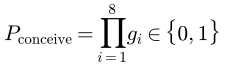
| operation | substrate gate that must fire | kind |
|---|---|---|
| HPG pulse | GnRH FHN oscillator must run (T1) | oscillator |
| follicle/sperm switch | folliculogenesis / spermatogenesis switch flips (T2/T4) | switch |
| meiosis order | ordered two-stage REC8 release (G1) | switch |
| gamete number | oscillator throughput makes gametes (G3/oogenesis) | oscillator |
| MII arrest+flip | egg held at MII, fertilisation supra-spinodal flip (G4) | switch |
| syngamy | two haploids restore diploidy (E1) | switch |
| ZGA | maternal->zygotic spinodal crossing (E3) | switch |
| gene-clock | argsort(spinodal(gamma)) body plan (E4) | order |
The central distinction: a spinodal apart
Infertility and subfertility are not two points on one scale; they are two sides of a spinodal. An operation pushed past its spinodal loses the conception basin entirely — per-cycle success is exactly zero, and a sub-threshold change in drive does nothing. An operation that merely sits near its threshold still has the basin, just behind a high barrier.

For the near-threshold case the per-cycle probability is a Kramers crossing — the same escape-over-a-barrier the oncology chapter uses, here for a good outcome. Because the rate is exponential in the barrier, a modest favourable drive moves it a lot.
![p_{\mathrm{cycle}} = p_{\max}\,\exp\!\left[-\frac{\Delta V(d)-\Delta V_{0}}{D}\right]](../eq/rep-inf-002.svg)
The dissociation is the whole point. A single fixed drive nudge raises the subfertile cycle probability from 0.039 to 0.061 (1.56×), turning a 0.38 annual chance into 0.53; the identical nudge applied past the spinodal leaves the sterile operation at 0.0. Same drive, exponential versus nothing.
| operation | deficit | p/cycle | p/cycle (nudged) | response | p/year (→ nudged) |
|---|---|---|---|---|---|
| subfertile (near threshold) | 0.327 | 0.039 | 0.061 | 1.56× | 0.38 → 0.53 |
| sterile (past spinodal) | 0.616 | 0.000 | 0.000 | — | 0.00 |

Male factor: spermatogenesis is oscillator throughput
Whether sperm are made at all is an R19 switch: below its spinodal the switch never flips, which is azoospermia — categorical, sterile. How many are made once it is on is oscillator throughput: the seminiferous and flagellar beat (the fast clock of §11), whose rate falls from 51 beats to 7 as the recovery slows — oligo- and asthenozoospermia, subfertile but not zero.
Hyperactivation is a separate gate. Without the supra-spinodal CatSper gain (measured γ = 1.4019) the beat cannot enter the penetrating regime, so a normal count can still fail at the egg coat — a categorical sub-case sitting on top of the throughput axis.
Female factor: the ovulation switch and REC8 cohesin fatigue
Anovulation is the mid-cycle surge switch failing to flip — sub-spinodal drive, no surge, sterile — the same switch §5 and §10 describe. The deeper female clock is the egg itself: a bivalent is held for decades by REC8 cohesin (measured γ = 1.4525), a switch whose holding barrier is the same γ²/4 the substrate sets.
As cohesin integrity decays with the years held, that barrier falls and the per-egg mis-segregation (aneuploidy) escape rate rises — from 0.121 modelled at 25 to 0.752 by 45. This rising shape is the molecular clock of age-related subfertility; the latch lost early and irreversibly is premature ovarian insufficiency, the menopause failure of §10 brought forward.
![P_{\mathrm{miss}}(\mathrm{age}) = \exp\!\left[-\frac{\Delta V_{0}\,c(\mathrm{age})}{D}\right],\quad c\downarrow](../eq/rep-inf-005.svg)
| maternal age (y) | modelled mis-segregation P |
|---|---|
| 25 | 0.121 |
| 30 | 0.278 |
| 35 | 0.460 |
| 37 | 0.530 |
| 40 | 0.625 |
| 43 | 0.706 |
| 45 | 0.752 |
Treatment is a move on the substrate
The clinic’s tools read as three substrate moves. The hCG trigger and ovulation induction are a supra-spinodal kick that forces a stuck switch across (the spinodal kick §10 already retrodicts); pulsatile GnRH restarts the oscillator where continuous suppresses it (41 pulses versus 0, from §9); and ICSI or IVF bypass a missing gate by supplying the flip it could not reach.
Each maps onto the chain: push a near-threshold operation across, restart a stalled oscillator, or substitute for a categorical gate. The framework adds the why — which class of failure each tool is for — not a schedule.
The chain-AND logic and the categorical/probabilistic dissociation are simulated (code output); fecundability, the Kramers temperature, REC8/CatSper γ and the clinical age-aneuploidy anchor are measured or anchored [L]; every absolute per-cycle probability, the map from a real semen or age value to a drive, and specific azoospermia/POI gene γ are open [O]. This is a physics-derived research model, not a diagnosis or a treatment plan.