The color of molecules
Color is a d–d transition. A ligand field splits the d-orbitals and the geometry forces the ratio Δ_tet/Δ_oct = 4/9; the absorbed wavelength then fixes the observed color. The splitting magnitude is a calibration input, but the 4/9 ratio is forced sphere geometry with no free parameters.
Color is a d–d transition. A ligand field splits the d-orbitals, and the geometry forces the ratio Δ_tet/Δ_oct = 4/9; the absorbed wavelength then fixes the observed color. The splitting magnitude is a calibration input, but the 4/9 ratio is forced sphere geometry.
(crystal field), and Chapter CM. Numbers reproduced by
vp_molecular_color.py (and
vp_crystal_field.py); deterministic, standard-library,
self-checking.
Color is a subtraction. White light arrives; the molecule removes the photons whose energy matches an electronic gap, and what is left — transmitted or reflected — is the color we see. Four different gaps give the four families of molecular color, but the rule is one: a gap the size of a visible photon makes a colored substance.
CC.0 The question
Why is copper sulfate blue, a carrot orange, cadmium-yellow paint yellow, and titanium-white paint white? This chapter derives the color of molecules and pigments from the electromagnetism of Chapter EM: visible light is the transverse electromagnetic wave (§EM.6), and color is which visible photons a substance absorbs, set by the size of an electronic energy gap.
CC.1 The principle — color is selective absorption [F]
A substance has color when its electronic structure absorbs part of the visible spectrum (400–700 nm). An absorbed photon (a transverse light quantum) lifts an electron across an electronic gap; the gap size fixes which wavelength is absorbed, and the remaining light is the perceived color. For dissolved molecules the eye sees the complementary of the absorbed band; for opaque pigments it sees the reflected band. Two limits frame the rest: a gap larger than any visible photon absorbs nothing (white or colorless), and a gap smaller than every visible photon absorbs everything (black).
CC.2 Energy and wavelength [F]
The bridge is the photon relation of Chapter EM,
![E = \frac{hc}{\lambda}, \qquad \lambda[\mathrm{nm}] = \frac{1240}{E[\mathrm{eV}]}.](/chemistry/eq/chemistry/chm-04-001.svg)
Visible light spans E = 1.77 eV (red, 700 nm) to 3.10 eV (violet, 400 nm). A gap in this energy window produces color; outside it, the substance is white/colorless (gap too large) or black (gap too small).
CC.3 Mechanism 1 — d–d transitions (transition-metal complexes) [F]/[CAL]/[O]
In a transition-metal complex the ligands’ electromagnetic 1/r² field splits the geometric d-orbitals by the crystal-field gap Δ (Chapter CH §CH.5). An electron absorbs a photon to cross Δ:
![\lambda_{\text{abs}}[\mathrm{nm}] = \frac{10^7}{\Delta[\mathrm{cm}^{-1}]}.](/chemistry/eq/chemistry/chm-04-002.svg)
For [Ti(mathrm H₂mathrm O)₆]³⁺ (d¹, single transition), Δ =
20300 mathrmcm⁻¹ gives λ₍abs) = 493 nm (blue-green absorbed) → reddish
violet, matching observation (vp_molecular_color.py, §1).
The mechanism — color is the d–d gap — is forced by VP geometry
[F]; the spectrochemical ordering of Δ is calibration
[CAL]; and for multi-electron ions (d⁹ Cu²⁺, d⁸ Ni²⁺)
the single-Δ point model is insufficient (broad multi-band absorption
tails into the red, giving the real blue/green), an honestly
[O] limitation. Weak-field ligands give a small Δ (red
absorption); strong-field ligands a large Δ (blue absorption).
CC.4 Mechanism 2 — conjugated π systems (organic dyes) [F]/[F?]
In a conjugated polyene the π-electrons behave as a free electron gas in a one-dimensional box of length L (the conjugation length). The levels are Eₙ = n² h²/(8 mₑ L²); with N = 2k electrons (k double bonds) filling levels up to k, the HOMO→LUMO gap is
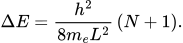
Because L grows with conjugation, the gap shrinks and the
absorption red-shifts — the derived trend
(vp_molecular_color.py, §2): short polyenes (ethene,
butadiene, hexatriene) absorb in the ultraviolet and are colorless,
while extended conjugation (β-carotene, 11 double bonds) absorbs in the
visible and is colored (orange; lycopene, red). The scaling Δ E ∝
(N+1)/L² and the UV→visible crossover are forced [F];
the absolute wavelengths from the free-electron model overestimate for
long chains (bond alternation caps the gap), so the model’s numbers are
trend-only [F?]. This is why carrots and tomatoes are
colored: long π-conjugation pulls the gap down into the visible.
CC.5 Mechanism 3 — the band gap (inorganic pigments and paint) [F]/[CAL]
A solid pigment is a semiconductor with a band gap E_g. Photons with
E > E_g (wavelength below the absorption edge λ₍edge) = hc/E_g) are
absorbed; photons with E < E_g (longer wavelength) are reflected, and
the reflected band is the color. As E_g decreases, the
edge sweeps across the visible and the pigment runs white →
yellow → orange → red → black
(vp_molecular_color.py, §3):
| pigment | E_g (eV) | edge (nm) | reflected color |
|---|---|---|---|
| TiO₂ titanium white | 3.05 | 407 | white (all visible reflected) |
| ZnO zinc white | 3.20 | 387 | white |
| As₂S₃ orpiment | 2.70 | 459 | yellow (violet/blue absorbed) |
| CdS cadmium yellow | 2.42 | 512 | yellow |
| CdS·Se cadmium orange | 2.10 | 590 | orange/red |
| HgS vermilion (cinnabar) | 2.00 | 620 | red |
| Fe₂O₃ red ochre (hematite) | 2.10 | 590 | red |
| CdSe cadmium red | 1.73 | 717 | red (only deep red reflected) |
| carbon black | ~0.5 | — | black (all visible absorbed) |
The same single rule λ₍edge) = hc/E_g orders the entire cadmium pigment series and the historical mineral pigments (vermilion, orpiment, hematite) [F], with E_g a measured material constant [CAL]. This is the physics of paint: the band gap is the color knob. Titanium white reflects everything because its gap (3.05 eV) sits just past the violet edge; cadmium red absorbs nearly all visible because its gap (1.73 eV) sits at the red edge.
CC.6 Mechanism 4 — charge transfer (intense colors) [F]/[CAL]
When a photon moves an electron between a metal and a ligand
(ligand-to-metal or metal-to-ligand charge transfer), the transition is
fully allowed and therefore intense — 100–1000×
stronger than a d–d transition, so a trace gives a deep color.
Permanganate MnO₄⁻ absorbs ∼ 525 nm (O→Mn charge transfer) and is deep
purple; dichromate mathrmCr₂O₇²⁻ is orange; Prussian blue is an
Fe²⁺↔︎Fe³⁺ charge transfer (vp_molecular_color.py, §4). The
mechanism is the same electron-across-a-gap; only the gap’s origin
(metal↔︎ligand) and its allowedness differ.
CC.7 White, black, and everything between [F]
The two achromatic limits follow from the same rule and require no extra assumption:
- White: gap larger than any visible photon (E_g > 3.1 eV, edge in the ultraviolet). No visible light is absorbed; all is reflected. Titanium white, zinc white, table salt, snow.
- Black: gap smaller than every visible photon (E_g < 1.8 eV, edge in the infrared). All visible light is absorbed. Carbon black, graphite.
- Color: gap inside the visible window. The substance absorbs the short-wavelength side of the edge and shows the long-wavelength side.
So white and black are not “colors added” but the two ends of where the gap sits relative to the visible band.
CC.8 The unifying picture
All four families are one mechanism — a transverse visible photon absorbed by lifting an electron across an electronic gap — differing only in what sets the gap:
- d–d: the crystal-field splitting Δ (ligand electromagnetic 1/r² field).
- conjugated π: the HOMO–LUMO gap ∝ (N+1)/L² (conjugation length).
- band gap: the semiconductor E_g (the pigment’s electronic structure).
- charge transfer: the metal↔︎ligand donor–acceptor gap.
The absorbing light is the transverse electromagnetic wave of Chapter EM (χ→ 90°); only a photon whose energy matches the gap is absorbed (resonance), and the gap size determines the wavelength and hence the color. One principle — gap-sized absorption — and four ways nature builds the gap.
CC.9 Falsification and reproducibility [F]
- If a transition-metal complex’s color did not track its crystal-field Δ (weak-field red, strong-field blue absorption), the d–d account fails.
- If extending π-conjugation did not red-shift absorption (UV for short, visible for long), the particle-in-a-box account fails.
- If a semiconductor pigment’s color did not follow its band-gap edge λ₍edge) = hc/E_g (large gap white, small gap black, intermediate colored), the band-gap account fails — this is tested across the cadmium series and historical pigments.
python3 code/foundation/vp_molecular_color.py    # complementary color, d-d, FEM, band-gap pigments
python3 code/foundation/vp_crystal_field.py      # crystal-field Δ and 4/9
Both modules are deterministic (stdout sha256 identical on re-run) and standard-library only.
Color completes the optical arc of Chapter EM: light emerges from the lattice, refraction and the rainbow split it by wavelength, and here matter subtracts* selected wavelengths by lifting electrons across gaps — crystal-field, conjugation, band-gap, and charge-transfer gaps — so that a carrot is orange and titanium-white is white for the same reason, read through the size of a gap.*