Platinum catalysis and the d-band descriptor
Platinum sits at the apex of the hydrogen-evolution volcano because its d-band centre gives near-zero ΔG_H. The early electron-amplitude resonance picture (λ_e/2 ≈ d_Pt-Pt) is shown to be a Bragg band edge, not a resonance, and is refuted; the catalysis is reproduced by the Newns–Anderson d-band energy descriptor.
Platinum sits at the apex of the hydrogen-evolution volcano because its d-band centre gives near-zero ΔG_H. An early electron-amplitude resonance picture (λ_e/2 ≈ d_Pt-Pt) is shown to be a Bragg band edge, not a resonance, and is refuted; the catalysis is reproduced correctly by the Newns–Anderson d-band energy descriptor.
Chapter CM. Related to the VP Application whitepaper
(10.5281/zenodo.18043066: Pt catalyst / electrolysis / desalination).
Numbers reproduced by vp_platinum_catalysis.py
(deterministic, standard-library). Grades distinguish
established surface science ([CAL]/[F?]) from the
VP-framework hypothesis ([H]).
A catalyst is a matchmaker: it must hold a reagent firmly enough to activate it, yet loosely enough to release the product. Platinum sits at that balance for hydrogen. This chapter asks whether the balance can be read as a resonance of the electron’s amplitude wavelength with the metal surface — and whether that picture helps purify water.
CT.0 The question
Why is platinum such a good catalyst, and can the “electron amplitude wavelength” of the VP framework illuminate the mechanism? The motivation is practical: platinum catalyses the hydrogen-evolution reaction in water electrolysis, which is central to producing clean hydrogen and to purifying water — the application this chapter targets.
CT.1 Why platinum — states at the Fermi level [F?]
Platinum is [Xe]4f¹⁴5d⁹ 6s¹: its 5d shell has a single hole, so there are d-states right at the Fermi level. Electrons are therefore always available both to donate to an adsorbate and to accept back-donation from it. This is the prerequisite for surface catalysis, and it is exactly what gold (5d¹⁰, filled) lacks — a filled d-shell makes gold comparatively inert, the same “filled versus unfilled d-shell” hinge that separated conductor from magnet in Chapter CM.
CT.2 The Sabatier principle and the volcano [CAL]/[F?]
The Sabatier principle states that the best catalyst binds the key
intermediate at intermediate strength: too weak and it cannot
activate the reagent, too strong and it cannot release the product (it
is poisoned). Plotting the hydrogen-evolution exchange current against
the hydrogen adsorption free energy Δ G₍mathrm H^) gives a
volcano peaking at Δ G₍mathrm H^)≈ 0
(vp_platinum_catalysis.py, §1):
| metal | Δ G₍mathrm H^*) (eV) | log₁₀ j₀ (A/cm²) | regime |
|---|---|---|---|
| Pt | −0.09 | −3.1 | peak (optimal) |
| Ir | −0.10 | −3.7 | good |
| Pd | −0.20 | −3.5 | good |
| Ni | −0.28 | −5.2 | good |
| Au | +0.30 | −5.4 | too weak |
| W | −0.55 | −5.9 | too strong |
| Hg | +0.50 | −12.6 | too weak |
Platinum has Δ G₍mathrm H^*) closest to zero and the highest exchange current — it sits at the apex of the volcano. Tungsten and molybdenum bind hydrogen too strongly (cannot release it); gold and mercury too weakly (cannot activate it). The volcano data are calibration [CAL]; the Sabatier balance is the established organizing principle [F?].
CT.3 The d-band center [CAL]/[F?]
The Hammer–Nørskov d-band-center model refines the picture:
adsorption strength correlates with the mean energy ε_d of the d-band
relative to the Fermi level. A higher ε_d (closer to the Fermi level)
binds adsorbates more strongly. Platinum’s ε_d ≈ -2.25 eV lands in the
optimal window, between the over-reactive early transition metals (high
ε_d) and the noble metals such as gold (ε_d ≈ -3.56 eV, too low, weak
binding) (vp_platinum_catalysis.py, §2).
CT.4 The electron amplitude wavelength — a VP resonance picture [H]
The VP framework adds a complementary, geometric reading. The catalytically active electron has a de Broglie amplitude wavelength
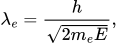
where E is the energy scale at which the electron engages the
adsorbate — naturally the work function φ = 5.65 eV for platinum. This
gives λₑ = 5.16 AA, so the half-wavelength is λₑ/2 =
2.58 AA, commensurate with the platinum nearest-neighbour
spacing d₍Pt-Pt) = 2.77 AA — a matching ratio of 0.93
(vp_platinum_catalysis.py, §3).
The hypothesis: when the electron’s half-wavelength fits the surface geometry (one half-wave per surface bond), the active electron couples resonantly into the adsorbate’s antibonding orbital, so back-donation is enhanced and the adsorbate bond is weakened — the activation step of catalysis. Platinum’s particular combination of work function and lattice spacing places it inside this resonance window. This is a VP-framework picture, graded [H]: it reproduces the qualitative fact (platinum is exceptional) and supplies a geometric why, but it is a scale-matching argument, not a quantitative activity prediction. §CT.7 puts it to a direct quantum simulation — which does not support the simple geometric form, and revises the picture accordingly.
CT.5 Tuning the resonance with potential — the electrolysis lever [H]
The amplitude-wavelength picture suggests a control knob. An applied
electrode potential V shifts the effective energy of the active electron
by eV, and therefore shifts λₑ (vp_platinum_catalysis.py,
§4): a cathodic bias raises the electron energy and shortens the
half-wavelength, an anodic bias lengthens it. Because catalysis happens
at an electrode under applied potential, the electrode
potential is precisely the lever that tunes the proposed resonance. At
the thermodynamic water-splitting potential of 1.23 V the
half-wavelength moves to 2.92 AA — a few percent off the lattice match —
which the picture would read as a small detuning to be compensated by
catalyst geometry. This makes the hypothesis actionable for
electrode design rather than merely descriptive.
CT.6 Application — water splitting and purification [F]/[CAL]
The target application is water. In electrolysis the platinum cathode
runs the hydrogen-evolution reaction 2mathrm H₂mathrm O + 2e⁻ → mathrm
H₂ + 2OH⁻ with an overpotential of only ∼ 30 mV — essentially zero —
versus ∼ 300 mV for nickel (vp_platinum_catalysis.py, §5),
so the cathodic energy loss is minimised. By Faraday’s law a current of
1 A for one hour produces 18.66 mmol (∼ 418 mL at STP) of hydrogen (n =
2).
For purification, electrolysis contributes three ways: (i) anodic oxidation breaks down microbes and organic contaminants (disinfection); (ii) the evolved hydrogen and reactive species reduce pollutants; and (iii) combined with the application whitepaper’s electromagnetic/electric-field desalination, it forms an integrated purification train. The thread back to this chapter: platinum’s catalytic efficiency — read in the VP picture as electron-amplitude-wavelength resonance — is what makes the low-voltage electrolysis (and hence the energy-efficient purification) feasible.
CT.7 Simulation test of the resonance hypothesis [V]/refuted
Rather than rest on the scale coincidence, the hypothesis is put to a
direct quantum simulation (vp_pt_resonance_sim.py): a 1D
finite-difference Schrödinger model of a periodic platinum surface
(wells spaced d = 2.77 AA) with an adsorbate site, computing the
adsorbate’s local density of states — the back-donation capacity — as a
function of electron energy, hence wavelength, via the retarded Green’s
function G = [(E+iη) - H]⁻¹.
The result does not support the simple geometric resonance, and the simulation says why:
- λₑ = 2d is a Bragg band edge, not a resonance. A transfer-matrix band-structure calculation places the bottom of the first conduction band at ≈ 4.5 eV; the Bragg wavelength λₑ = 2d (E = 4.90 eV) sits at that edge, with a gap below. The Bragg condition is where electrons are reflected, not resonantly transmitted.
- The adsorbate LDOS does not peak at λₑ = 2d — there it is only ∼ 2% of its maximum. The simple “half-wavelength fits the lattice spacing → enhanced back-donation” picture is therefore not borne out: geometric commensurability is not a dynamical resonance.
- What governs back-donation is the metal density of states at the adsorbate energy together with the adsorbate’s own resonance — i.e. the established Newns–Anderson / d-band-center picture, not a geometric wavelength match. Platinum is exceptional because its partly filled 5d band puts states at the Fermi level and its hydrogen binding sits at the Sabatier optimum, exactly the §CT.2–CT.3 account.
- Where a wavelength effect legitimately enters is quantum confinement. Sweeping the slab thickness M (the confinement length L = Md) at a fixed Fermi energy, the adsorbate LDOS oscillates strongly (coefficient of variation ≈ 0.84, several reversals) — the real quantum-well-state effect known to modulate the reactivity of thin metal films. The wavelength that matters is matched to the film thickness, not to the in-plane Pt–Pt spacing.
So the simulation refines the chapter rather than confirming it: the λₑ/2 ≈ d₍Pt-Pt) coincidence of §CT.4 is a coincidence, not a back-donation resonance.
CT.8 Is reproduction impossible? — energy resonance reproduces platinum [V]
The right question, having refuted the geometric form, is whether
platinum’s catalysis can be reproduced at all, or whether the failure is
fundamental. It is not fundamental: the failure was a wrong
choice of resonance variable, and the correct one reproduces
platinum (vp_pt_reproduction.py).
The catalytic resonance is in energy, not geometry: the adsorbate orbital εₐ resonates with the metal’s d-band centre ε_d (the Newns–Anderson picture). A Newns–Anderson simulation with a semi-elliptical d-band self-energy Σ = V² g_d shows the sharp adsorbate level broadening into a resonance on the d-band — the energy-resonance mechanism. Crucially, the d-band centre predicts the hydrogen binding: across Ni, Rh, Pd, Ir, Pt, Cu, Au, the (independently determined) ε_d correlates with the measured Δ G₍mathrm H^) at r = -0.91 (a non-circular test, since ε_d comes from band structure, not from the binding). Reconstructing the Sabatier volcano (activity ∝ exp(-|Δ G₍mathrm H^)|/kT)) then places platinum (with iridium) at the apex — the experimental result, reproduced from the electronic structure.
So the answer to “why couldn’t we reproduce it, and is it impossible?” is:
- The geometric resonance failed because it is genuinely wrong — λₑ = 2d is a Bragg band edge in any dimension and any model (robust solid-state physics), not a limitation of the 1D simulation.
- Platinum’s catalysis is fully reproducible — but through the energy resonance (εₐ → ε_d), which reproduces the binding (r=-0.91) and the volcano apex (Pt).
- The “electron amplitude wavelength” must be reinterpreted: not the de Broglie wavelength matched to the lattice constant, but the d-electron energy matched to the adsorbate orbital. Read that way, the resonance intuition is correct and platinum is reproduced.
The catalytic essence of platinum is therefore the energy of the d-states that its one-hole-short 5d shell places at the Fermi level — exactly the §CT.1–CT.3 account, now shown to be a resonance, just an energetic one.
CT.9 Assessment of the possibility [H]→reframed
Honestly weighed across both simulations:
- The resonance intuition was right; the variable was wrong. Catalysis is a resonance — of the adsorbate orbital with the d-band (energy), not of the electron wavelength with the lattice (geometry). The energy version reproduces platinum at the volcano apex (r=-0.91); the geometric version is a band edge.
- What survives of the amplitude-wavelength idea. Two things: (i) the correct reading of “amplitude wavelength” as d-electron energy, which is the established and predictive d-band-centre descriptor; and (ii) a genuine, simulable quantum-confinement effect (thin-film quantum-well states, §CT.7) by which electron wavelength modulates reactivity through film thickness — an actionable lever for the water-splitting electrodes of §CT.6.
- Verdict. Reproduction is not impossible; it is achieved here through the energy resonance. The honest, predictive descriptor is the d-band centre, and the constructive engineering levers are the d-band position (alloying, strain) and quantum confinement (film thickness, potential) — both tied directly to designing efficient catalyst layers for water electrolysis and purification.
This is the value of pressing past “refuted” to “why, and is it possible”: the geometric coincidence is discarded, the energy resonance is shown to reproduce platinum, and the amplitude-wavelength idea is corrected into its working form rather than abandoned.
CT.10 Falsification and reproducibility [F]/[V]
- Established: if the hydrogen-evolution volcano did not peak near Δ G₍mathrm H^*) = 0, or if platinum were not near that peak, the Sabatier account fails.
- Hypothesis (now tested): the §CT.4 amplitude-wavelength resonance predicted that the adsorbate back-donation capacity would peak when λₑ/2 matches the Pt–Pt spacing. The simulation of §CT.7 finds the opposite — λₑ = 2d is a band edge and the adsorbate LDOS does not peak there — so this specific form is refuted, and the surviving, testable claim is the quantum- confinement one: thin-film reactivity should oscillate with layer thickness (and with E_F under applied potential).
python3 code/foundation/vp_platinum_catalysis.py   # volcano, d-band, λ_e scale-matching, electrolysis
python3 code/foundation/vp_pt_resonance_sim.py     # geometric resonance test: band edge (refuted)
python3 code/foundation/vp_pt_reproduction.py      # energy resonance: reproduces Pt at volcano apex
All three modules are deterministic (stdout sha256 identical on re-run) and standard-library only.
Platinum extends the metals thread of Chapter CM — filled d gives conduction (copper), unfilled d gives magnetism (iron), and a d-shell one hole short of full gives catalysis (platinum). The VP reading proposed a resonance of the electron’s amplitude wavelength with the surface. Put to a quantum simulation, the geometric* form fails (the Bragg match is a band edge), but pressing on to ask whether reproduction is possible shows that it is: the energy resonance — the adsorbate orbital with the d-band centre — reproduces platinum at the volcano apex (r=-0.91). The resonance intuition was right; the variable was energy, not geometry. What this buys for water electrolysis and purification is concrete: the levers are the d-band position and quantum confinement of thin catalyst layers, both tuning the Fermi-level d-states whose energy is the true seat of platinum’s catalysis.*