Galactic Rotation and the a₀ Scale
This is the first chapter whose central result is distinguishing rather than degenerate. Once the cosmic background inflow is included, the same inflow law departs from Newton in the weak field of galaxies, producing flat rotation curves and the acceleration scale a₀ = cH₀/2π ≈ 1.08×10⁻¹⁰ m/s². Why this is distinguishing is examined separately.
With the cosmic background inflow included, the inflow law that gives Newtonian gravity in the solar system departs from Newton in the weak field of galaxies. The departure produces flat rotation curves and a characteristic acceleration scale a₀ = cH₀/2π ≈ 1.08×10⁻¹⁰ m/s², set by the cosmic inflow rate rather than fitted, the volume's first non-degenerate result.
This is the first chapter whose central result is distinguishing rather than degenerate. Chapters 3–5 reproduced Newtonian gravity (orbits, spin, tides) and made the same predictions as standard theory; their value was economy. Here the same inflow law, once the cosmic background inflow is included, departs from Newton in the weak field of galaxies—and, crucially, it derives the galactic acceleration scale a₀=cH₀/2π, a quantity that Modified Newtonian Dynamics must take as a free constant of nature and that particle dark matter has no reason to produce at all. We give the derivation with no step omitted, confirm it on the radial acceleration relation and on the measured rotation curve of NGC 2403, and are explicit about exactly which parts are distinguishing, which remain degenerate, and which (the precise 2π) are still open.The raw facts to be explained
Three model-independent facts define the problem. (i) Flat rotation curves: the orbital speed in the outer parts of disk galaxies does not fall as Kepler's v∝ r^(-1/2) but levels off to a constant. (ii) The radial acceleration relation (RAR): the measured centripetal acceleration g_(obs)=v²/r is a tight, one-to-one function of the acceleration g_N computed from the visible (baryonic) matter alone, with a characteristic scale near 1.2×10⁻¹⁰ms⁻² separating two behaviours. (iii) The baryonic Tully–Fisher relation (BTFR): the flat speed obeys v⁴∝ M_(bar). A successful theory must produce all three, and—if it is to be more than a fit—should explain why the scale in (ii) takes the value it does.
The logical chain (no step omitted)
- The local inflow. A galaxy's baryons are sinks of the medium (Chapter 3), so they set up a local inflow whose Newtonian acceleration at radius r is g_N=GM_(bar)(<r)/r², with GM_(bar)=κQ_(bar) as in Chapter 3. This term alone gives Kepler and is what dark-matter advocates compute as “baryons only.”
- The background inflow. The medium is not static. The cosmological redshift
(developed in Chapter 7) is, in this framework, light losing energy to the medium at the rate
![\begin{equation} \kappa_{\mathrm{opt}} \;=\; \frac{H_{0}}{c}\qquad[\text{redshift per unit path length}], \end{equation}](/cosmology/eq/cosmology/cos-06-000.svg)
which is a property of the medium itself: everywhere, the lattice is being processed at a rate tied to H₀. There is therefore a universal background inflow, present in every galaxy, characterised by the single rate κₒₚₜ.
- The background acceleration scale. A rate-per-length κₒₚₜ combined with the
medium's wave speed c defines an acceleration,

(dimensionally [m²s⁻²][m⁻¹]=ms⁻²). This is the acceleration below which the background processing of the medium is no longer negligible compared with a body's own inflow.
- The crossover scale: the full background wave-cycle. The dynamics crosses over from
“local-dominated” (g_Ngg a_(bg)) to “background-dominated”
(g_Nll a_(bg)) at an acceleration of order cH₀. The precise crossover carries
the factor 2π of one full wave cycle:
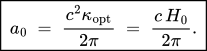
This 2π is the wave-cycle factor, and in this framework it is derived, not inserted. The redshift rate κₒₚₜ=H₀/c (Eq. (kopt)) is the background lattice wave's spatial frequency—a wavenumber. One full cycle of that wave (the cosine completing its 2π period) spans the wavelength λ_(bg)=2π/κₒₚₜ=2π c/H₀=2π R_H; equivalently the angular processing rate ω_(bg)=cκₒₚₜ=H₀ corresponds to the cyclic frequency f_(bg)=H₀/2π. The acceleration set by one full background cycle is then a₀=c²/λ_(bg)=cf_(bg)=cH₀/2π. (Step 3's a_(bg)=c²κₒₚₜ=cH₀ is the per-radian value; one full cycle is 2π radians, hence the division.) The factor is therefore the framework's canonical full-cycle constant,
![\begin{equation} 2\pi \;=\; \frac{\alpha}{\delta}\;=\;\frac{2/\pi}{1/\pi^{2}},\qquad \alpha=\langle|\cos\theta|\rangle=\tfrac{1}{2\pi}\!\int_{0}^{2\pi}\!|\cos\theta|\,d\theta=\tfrac{2}{\pi}, \quad \delta=\Big(\tfrac{1}{2\pi}\!\int_{0}^{2\pi}\![\cos\theta]_{+}\,d\theta\Big)^{2}=\tfrac{1}{\pi^{2}}, \end{equation}](/cosmology/eq/cosmology/cos-06-003.svg)
the derived ratio of the two cosine-integral rectification constants (physics volume, DOI
10.5281/zenodo.17932566, §5.1–5.2 and §13.5.5)—the same 2π that gives mₚ/mₑ=2π·3π⁴=6π⁵. The horizon route is a consistency cross-check, not the source: the de Sitter horizon at R_H=c/H₀ returns the same a≃ cH₀/2π through the Unruh relation (Verlinde), and its 2π—the periodicity of the Euclidean thermal cycle—is this same full-cycle constant. What remains a modelling choice, honestly flagged (Status, §5), is the identification of the relevant length as the full wavelength λ_(bg) rather than the reduced barλ=1/κₒₚₜ=R_H (which would give the bare cH₀); the wave picture and the 90% empirical match (Table (a0)) support the full-cycle reading. - The combined law and its two limits. With a₀ fixed, the effective
acceleration is the one-parameter interpolation

The two limits are forced, not chosen:
- g_Ngga₀ (Solar System, inner galaxy): ν→1, so a=g_N=GM/r² — Kepler, recovering Chapter 4 exactly.
- g_Nlla₀ (outer galaxy): ν→√a₀/g_N, so a=√a₀g_N=√a₀GM/r, giving v²=ar=√a₀GM=const — a flat rotation curve, and v⁴=a₀GM_(bar) — the BTFR.
- The number. Equation (a0) evaluates (Table (a0)) to a₀≈1.08×10⁻¹⁰ms⁻² for H₀=70, i.e. 90% of the empirical RAR scale 1.2×10⁻¹⁰, with the value rising from 0.87× to 0.94× across the measured range of H₀.
| H₀ [km s⁻¹Mpc⁻¹] | cH₀ [m s⁻²] | a₀=cH₀/2π | ratio to 1.2×10⁻¹⁰ |
| 67.4 | 6.55×10⁻¹⁰ | 1.042×10⁻¹⁰ | 0.87 |
| 70.0 | 6.80×10⁻¹⁰ | 1.082×10⁻¹⁰ | 0.90 |
| 73.0 | 7.09×10⁻¹⁰ | 1.129×10⁻¹⁰ | 0.94 |
Simulation and verification
Two checks, both reproducible (ch6_galaxy_rar.py).
The RAR over 10 decades.
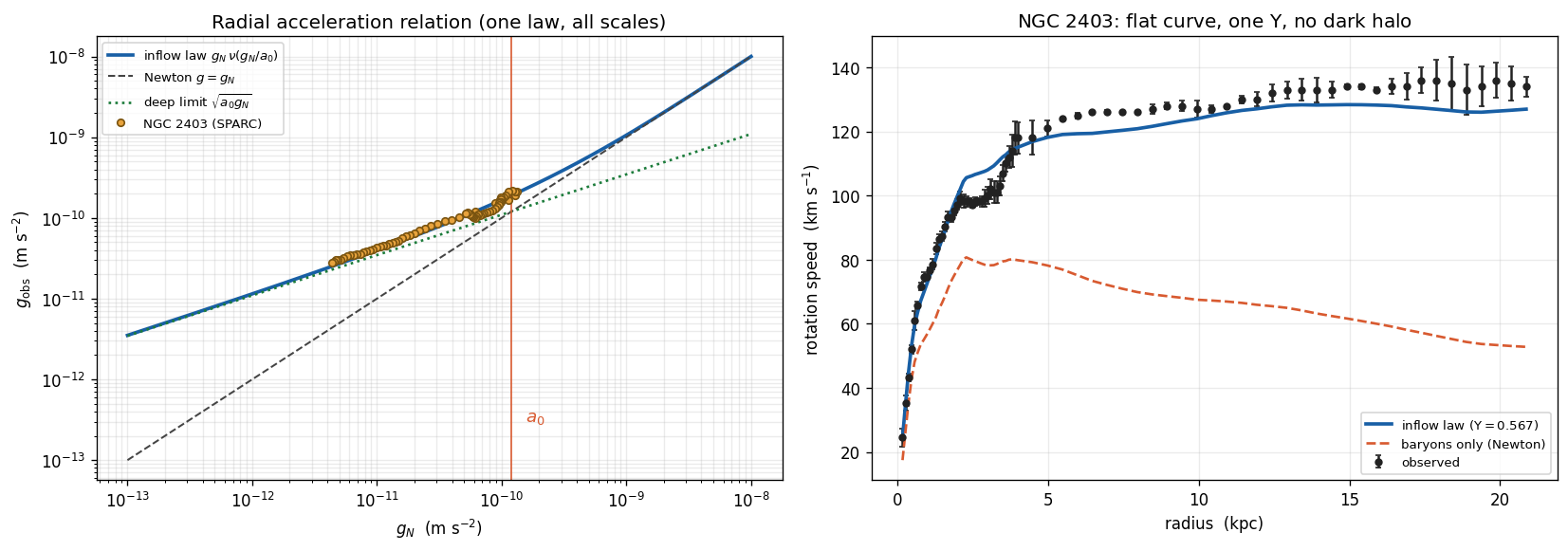
Figure (gal) (left) plots the single law (law). The Solar-System points (Mercury through Neptune, g_N 10⁰ to 10⁻⁵ms⁻²) lie on the Newtonian diagonal a=g_N; the data of NGC 2403 (g_N 10⁻¹¹ms⁻²) lie on the deep branch a=√a₀ g_N; one curve connects them across about ten decades in acceleration, with the bend at a₀. The framework thus places the Solar System and galaxies on the same acceleration relation, the inner and outer limits of one inflow law.NGC 2403.
Figure (gal) (right) fits the measured rotation curve of NGC 2403 (73 points, SPARC) with the law (law) at the derived a₀, the only adjustable quantity being the stellar disk mass-to-light ratio Υ. The fit gives Υ=0.567 (a normal stellar value) and χ²/dof=1.99; the outer speed is reproduced (v_(obs)≃134kms⁻¹ against a baryons-only Newtonian ≃53kms⁻¹, the inflow model giving ≃126kms⁻¹). The flat curve emerges with no dark-matter halo and no per-point tuning.The full SPARC sample, and an honest comparison with MOND.
NGC 2403 is one galaxy. The same law, with the same universal parameters and no per-galaxy tuning, was run across the entire SPARC Rotmod sample of 175 rotation-dominated late-type galaxies in a five-fold cross-validation (companion archive, DOI10.5281/zenodo.17622357); it reproduces the
rotation curves with a median RMS of ≈13kms⁻¹ at the derived a₀, fixed
mass-to-light ratios, and a single gas-thickness prescription. The honest comparison with MOND must
be made on matched assumptions: when MOND's standard interpolation is evaluated with the same
mass-to-light ratios and gas treatment (rather than the unit mass-to-light, no-thickness defaults,
which inflate its residuals), the two are statistically indistinguishable—median RMS within
0.1kms⁻¹ and a roughly even split galaxy-by-galaxy. On the rotation curves
the inflow law is MOND's fit. We therefore claim no advantage from the curve fit; the
advantage is solely that a₀ is derived rather than postulated.