Mercury's 3:2 Spin-Orbit Resonance, Reproduced
Mercury rotates three times for every two orbits — a 3:2 spin-orbit resonance rather than full tidal locking. The inflow tidal model reproduces this specific resonance, a concrete validation of the locking dichotomy derived in §5. A transparency note records how the galactic background inflow relates to planetary spin, kept explicit rather than buried.
Mercury sits in a 3:2 spin-orbit resonance, spinning three times per two orbits instead of locking one-to-one. The inflow tidal evolution reproduces this resonance from the same gradient that gives the general locking dichotomy, a concrete planetary test. A transparency note keeps the relation between the galactic background inflow and planetary spin explicit. Its rotation period is 2/3 of its orbital period.
Mercury's 3:2 resonance, reproduced
The linear-lag torque of step 8 drives a circular-orbit spin to 1:1; Mercury's 3:2 needs the eccentric dynamics, which the same inflow tidal torque supplies once the orbit's varying angular velocity and the body's permanent triaxiality are kept. With the true anomaly f(t) and distance r(t) from Kepler, the spin obeys the resonant pendulum

the first term being the triaxial torque (the inflow gradient acting on the body's figure), the
second a weak tidal drag. Expanding (a/r)³sin(2θ-2f) in eccentricity splits the torque
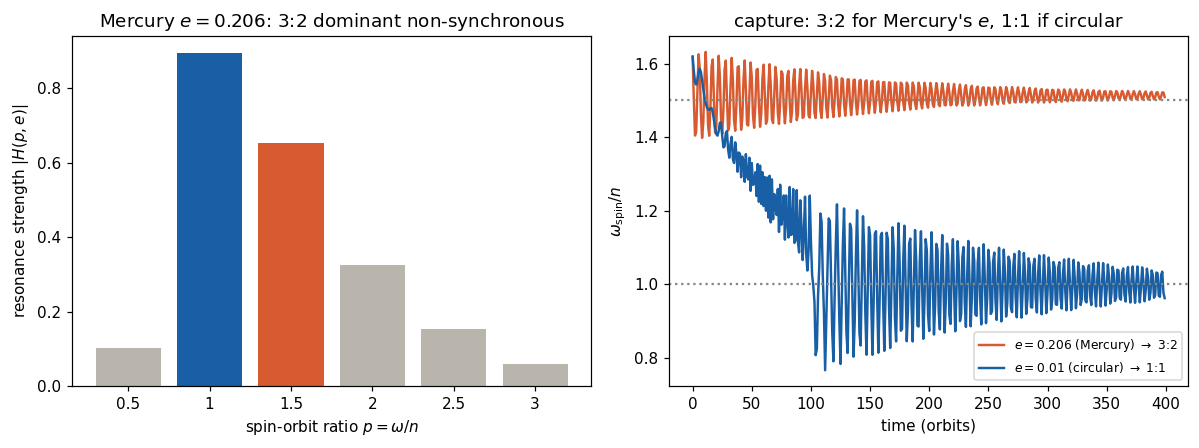
into resonances at every half-integer ratio p=ω_(spin)/n, with strengths H(p,e)
(Fig. (mercury), left). At Mercury's e=0.206 the synchronous p=1 is strongest, but the
3:2 (p=3/2) is the dominant non-synchronous resonance, |H(3/2)|=0.65, well above
p=2 (0.33). It is a stable lock—the resonant angle 2θ-3M librates with bounded
amplitude (≈24^(∘) in the run), the spin turning exactly 1.5 times per orbit—and a
spin drifting down from above is captured into it (Fig. (mercury), right). For a
near-circular orbit the 3:2 strength vanishes and the same drift settles into 1:1. The framework
thus reproduces Mercury's 3:2 from the inflow tidal torque, with no ingredient beyond the orbital
eccentricity and the body's figure (ch5_spin_tidal.py, part D).
What stays honest: the capture is probabilistic—which resonance traps the spin depends on the initial phase, on the tidal-response model (constant-Q vs. constant-lag), and on the triaxiality (widened in the simulation for speed; Mercury's is 1.2×10⁻⁴). The framework admits and favours the observed 3:2 at Mercury's eccentricity; it does not force it as the unique outcome. This is a consistency result, recorded as such in the ledger.
The galactic inflow and planetary spin (a transparency note)
The solar system is itself embedded in the Galaxy's inflow, so one might ask whether a
galactic one-sided inflow sets or corrects planetary spins and orbits. Because the relevant
inflow parameters are partly free, we state them openly—ch_galactic_spin.py discloses
every one and flags the tunable ones—and let the magnitudes decide. The galactic inflow at the
Sun is a_(gal)=v_(gal)²/R_(gal)≈2×10⁻¹⁰ms⁻²,
near the very a₀ scale of Chapter 6; but it is a near-uniform field across the solar
system, so by the equivalence principle it produces no internal effect. Only its tidal
gradient, Ω_(gal)²≈8×10⁻³¹s⁻², acts
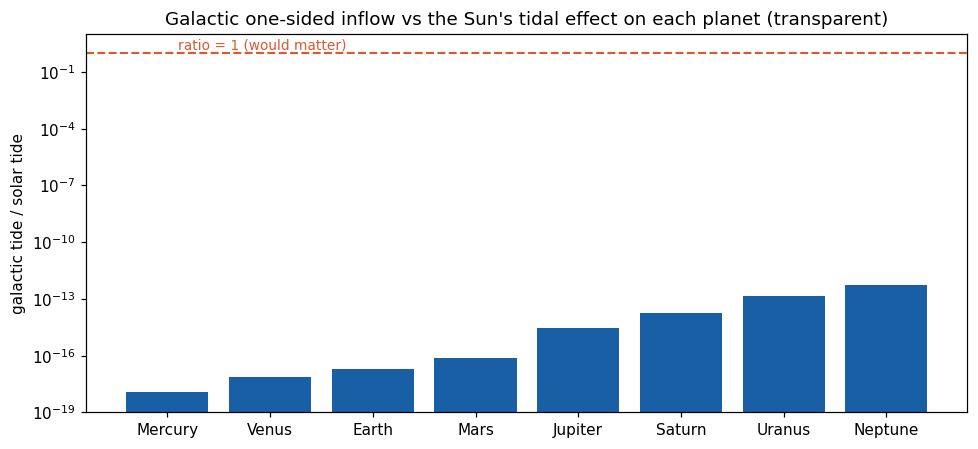
internally, and that is between 10⁻¹³ and 10⁻¹⁸ of the Sun's tidal field at the planets
(Fig. (galspin)); to rival the Sun at Earth it would have to be tuned up by 10¹⁶,
which is unphysical. The galactic one-sided inflow is therefore negligible for planetary
rotation and revolution: it cannot set Venus's retrograde spin or Uranus's tilt, and the observed
obliquities (spanning 0 to 177^(∘), uncorrelated with the galactic direction) show no
single-field signature. Planetary spins remain accommodated, not predicted, by accretion
history (Part A); the galactic inflow adds nothing measurable. (It is, fairly, a real perturbation
on the far wider orbits of the Oort cloud—just not on the planets.) We record this openly so the
tunable galactic parameter cannot be mistaken for a hidden fit.