A Non-Expanding, Lattice-Optics Cosmology
This chapter shows that the supernova Hubble diagram — usually read as evidence for cosmic acceleration and dark energy — is reproduced without expansion, by treating redshift as light losing energy to the lattice over distance rather than space stretching. No cosmic acceleration and no dark energy are invoked. The Hubble tension is treated separately.
The supernova Hubble diagram is usually read as evidence that cosmic expansion is accelerating, requiring dark energy. Here it is reproduced with no expansion at all: redshift is light losing energy to the lattice (photon energy ∝ 1/(1+z)) over distance, and the apparent dimming of distant supernovae follows without acceleration. No dark energy enters; the fit is a present-optics account.
This chapter supplies the background rate κₒₚₜ=H₀/c that Chapter 6 used to derive a₀, and shows that the supernova Hubble diagram—usually read as evidence for cosmic acceleration and dark energy—is reproduced without expansion and without dark energy by treating the redshift as light losing energy to the medium. We are careful about what this does and does not establish: fitting the supernovae is degenerate (it does not prefer this picture over ΛCDM), so the honest conclusion is only that “dark energy” is interpretation-contingent; the genuinely distinguishing, distance-ladder-free prediction is the redshift of the angular-size minimum, z≈1.72 here versus ≈1.61 for ΛCDM (conditional on the lattice realizing refractive focusing, flagged in §Status). We also state plainly why this is not the long-refuted static “tired light.”The raw facts, and the raw/inferred split (again)
The model-independent cosmological data are: the spectral redshift z of distant sources; their photon flux (the supernova Hubble diagram); the stretching of transient light curves with z; and the angular sizes of objects of known physical scale. From these are inferred, only after assuming an expanding metric, the recession velocity, the proper distance, the cosmic acceleration, and “dark energy.” This chapter tests the raw column and shows that a static medium reproduces it, so the inferred column is a choice of interpretation, not a measurement.
The logical chain (no step omitted)
- Redshift as energy loss. A photon traversing the medium loses a fixed fraction
of its energy per unit path, dE/E=-κₒₚₜds. Integrating, E(s)=E₀e^-κₒₚₜ s, so the
observed-to-emitted energy ratio gives

The rate is fixed by requiring the low-redshift limit to be Hubble's law: for small s, z≃κₒₚₜ s=(H₀/c)s, i.e. cz≃ H₀s. (This κₒₚₜ is exactly the background rate used in Chapter 6.) Status tag (shared two-volume convention): κₒₚₜ is
[INPUT]— fixed from data by the low-z Hubble law, not derived; identical in status to the physics volume's κ-LOCK (its §17.5.2). Microscopic step form (absorbed from the physics volume in the v0.6.0 handover): with a per-step loss ε at the step length ℓ_(rot), ν_(obs)=νₑₘ(1-ε)^D/ℓ_(rot), so κₒₚₜ=-ln(1-ε)/ℓ_(rot)≃ε/ℓ_(rot) for εll1 — the lattice reading of the same exponential law. The operational registry (the equation skeleton, the κ-LOCK protocol, the hard-gate registrations, and theE-COSMOembargo) remains in the physics volume, §17.5; this chapter owns the development. - Proper distance. Inverting (redshift), the distance light has travelled is
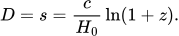
- Luminosity distance. The flux received from a source of luminosity L is reduced
by three factors: geometric spreading over 4π D²; the energy lost per photon, a factor
(1+z)⁻¹; and the reduced photon arrival rate, another (1+z)⁻¹ (Step 4). Hence
F=L/[4π D²(1+z)²], and with F≡ L/(4π d_L²),

- Time dilation (why this is not tired light). The medium's refractive index varies
in time as the lattice is processed, so an interval emitted long ago is observed dilated by
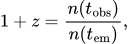
i.e. transient timescales (supernova light curves) are stretched by (1+z), exactly as observed. This is the decisive break from classical static “tired light,” which predicts no time dilation (a stretching exponent b=0) and is excluded by the data; here the (1+z) stretch is built in, and it is the second of the two (1+z) factors in Eq. (dL).
Grounding (v2.1; physics volume §18). The two (1+z) factors are not independent assumptions. In the physics volume's time sector (§18, the processing-rate clock), a clock's rate is the local medium signal speed √(K/ρ_eff), and the refractive index n=c_ref/c_med is that same signal speed. A cosmic evolution of ρ_eff therefore moves the index and the clock rate by the same factor, so the energy-loss (1+z) of Step 1 and the arrival-rate (1+z) of Step 4 are one and the same medium quantity,

with stretch exponent b=1 (not the tired-light b=0). This grounds the time dilation in the imported c²=K/ρ (P1, P4) rather than positing it. What stays
[INPUT]is the rate κ_opt=H₀/c; why ρ_eff evolves over cosmic time is theE-COSMOquestion (physics §17.5) and remains open. - No dark energy is needed. The form (dL) fits the supernova Hubble diagram with no accelerating term (§3). What ΛCDM attributes to dark energy is here the gentle curvature of (1+z)ln(1+z).
- Angular size and its minimum. The angular-diameter distance follows from the
luminosity distance by the reciprocity relation d_A=d_L/(1+z)² (assuming the lattice
realizes refractive focusing—see Status, item (ii); under this assumption surface brightness
dims as (1+z)⁻⁴, consistent with the Tolman test and unlike static tired light):

A standard ruler therefore appears smallest where d_A is largest. Setting d[(1+z)/ln(1+z)]/dz=0 gives ln(1+z)=1, i.e.

to be compared with ≈1.61 for ΛCDM (Ωₘ=0.3). This is a clean, distance-ladder-free discriminator.
Simulation and verification
Both tests are reproducible (ch7_lattice_optics.py) and use the real Pantheon+
compilation (1580 supernovae with z>0.01, calibrators removed).
The supernova Hubble diagram.
Fitting the distance modulus μ=5log₁₀d_L+25 with a single marginalised offset (absorbing H₀ and the absolute magnitude), the lattice-optics distance (dL) gives χ²/dof=0.50, against χ²/dof=0.44 for ΛCDM (Ω_(Λ)=0.7); the two distance laws differ by at most |Δμ|=0.145mag over 0<z<2.3, comparable to the per-supernova scatter ( 0.15mag). The data therefore do not distinguish them (Fig. (cosmo), left): a static medium with no dark energy fits the Hubble diagram as well as accelerating ΛCDM.The angular-size minimum.
Evaluating Eq. (dA) numerically locates the minimum of the angular size at z_(min)=1.718, matching the analytic e-1, versus 1.605 for ΛCDM (Fig. (cosmo), right). Unlike the Hubble diagram, this is a qualitative difference in where standard rulers stop shrinking, and it needs no distance calibration.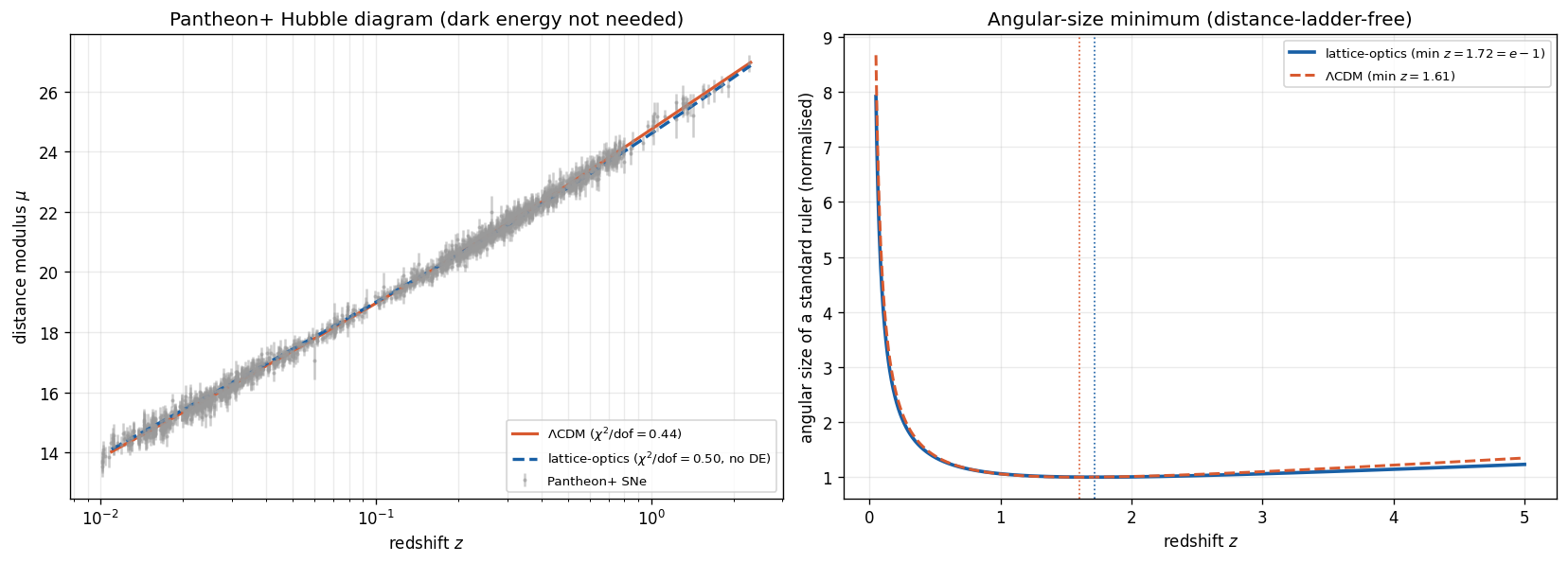
Status of this chapter
- Degenerate (the supernova fit). The lattice-optics distance (dL) and ΛCDM fit the Pantheon+ Hubble diagram equally well; the supernovae do not prefer this picture. The honest, limited conclusion is that “dark energy” is interpretation-contingent—it is required by the expanding reading, not by the raw flux–redshift data. We claim no observational advantage here. (Cross-volume, v2.1: the physics volume's v0.10.0 time-gravity sector reaches the same kind of verdict for its channel — the gravity sector is observationally degenerate with general relativity (its G-CAP-DEPART: the cap modifies only contact mechanics, while redshift/orbits/light/GW are the uncapped geometric channel = exact Schwarzschild) — so both volumes agree that the testable weight sits not in the supernova-distance or gravity channels but in a₀=cH₀/2π and the γ-ray dispersion. The (1+z) grounding above now links the two volumes' time sectors.)
- Distinguishing in principle, but presently undecidable. The angular-size minimum at z=e-1≈1.72 (vs ≈1.61) is a falsifiable, distance-ladder-free prediction (conditional on the focusing assumption, item (ii) below); however the θ(z) curves differ by under 0.3% near the flat minimum, far below the ≳20% intrinsic scatter of the standard rulers that reach these redshifts, so it cannot at present separate this picture from ΛCDM (the distance relation is observationally near-degenerate—see “The distinguishing prediction” below). The framework also passes the test that most cleanly excludes static tired light—the (1+z) light-curve stretch (Eq. (timedil)), built in through the time-varying index; the (1+z)⁻⁴ surface-brightness dimming follows only under that same focusing assumption.
- Candidate mechanism (Hubble tension). Because H_(inf) is a line-of-sight average of κₒₚₜ, an environment-dependent coupling reproduces the local-vs-global H₀ discrepancy at the right order (Eq. (hubble-tension)); this is a [HYP]/[SPEC] mechanism, not a parameter-free fit, and its honest test is the predicted correlation of H₀ with local density and with direction.
- Open / flagged. (i) The supernova fit uses diagonal errors; the full
Pantheon+ covariance would tighten the comparison, though the degeneracy holds at present
precision. (ii) The reciprocity d_A=d_L/(1+z)² in an absorbing medium, on which
both Eq. (zmin) and the (1+z)⁻⁴ dimming rest, is justified at the level of the
lattice optics in the physics volume, DOI
10.5281/zenodo.17932566, but is treated as a hard gate in the cosmos-volume optics module: the static-Euclidean alternative (no focusing, d_A≈D) would instead give surface brightness (1+z)⁻² and a monotonic θ(z) with no minimum—distinguishable from ΛCDM, but differently. Demonstrating the focusing is the open step. (iii) A complete treatment of supernova spectral aging, and the reinterpretation of the BAO and growth (fσ₈) data—which we fit with standard ΛCDM and therefore regard as degenerate—are deferred; the microwave background is Chapter 9. (iv) Cross-volume registry: the hard-gate registrations and theE-COSMOembargo live in the physics volume (§17.5.3–§17.5.6); pass evidence from this chapter's runs is to be registered there (v0.6.0 handover).
Anticipated objections
“The supernovae proved cosmic acceleration and dark energy.”
The raw flux–redshift relation is fit equally well by the static law (dL) with no acceleration (§3). “Acceleration” and “dark energy” are inferences within the expanding-metric interpretation; the same data admit a static lattice-optics reading. We do not claim the static reading is correct—only that the supernovae do not establish dark energy independently of the interpretation.
“This is just tired light, which is ruled out.”
Classical static tired light fails on two counts: it predicts no time dilation (light curves not stretched, b=0) and the wrong surface-brightness scaling. The decisive break here is the first: time dilation is built in through the time-varying index (Eq. (timedil)), giving the observed (1+z) light-curve stretch—which static tired light cannot produce. The (1+z)⁻⁴ surface brightness follows additionally if the lattice realizes the reciprocity focusing (Status, item (ii)); absent that it would be (1+z)⁻². Either way the time-dilation prediction alone already separates this mechanism from the tired light that the data exclude.
“BAO and the CMB require expansion.”
The BAO and growth-rate data are fit here with standard ΛCDM and are treated as degenerate (not discriminating between the pictures at present). The microwave background is a separate matter taken up in Chapter 9, where this framework rejects the hot Big Bang and reinterprets the CMB as steady-state lattice emission; the acoustic-scale argument presupposes the Big Bang and is therefore not binding here.
The distinguishing prediction
The falsifiable, distance-ladder-free test of this chapter is the location of the angular-size minimum: standard rulers should appear smallest at z≈1.72, not ≈1.61. Its reach, however, must be stated honestly. The shift in z_(min) (0.13) is real, but the θ(z) curves themselves differ by under 0.3% near the (flat) minimum and only 2% by z=2.5. Meanwhile the only standard rulers reaching these redshifts—compact radio sources—carry intrinsic size-evolution scatter of ≳20%, and recent analyses estimate that 10⁵ such sources (with a standardisation) would be needed merely to constrain cosmology at the ΛCDM-versus-alternatives level—far short of resolving a 0.13 shift in z_(min). So while distance-ladder-free in principle, this minimum cannot at present separate the framework from ΛCDM: the lattice-optics distance relation is observationally near-degenerate with ΛCDM—the very fact that lets it fit the supernovae (this chapter's status, above). The cleaner near-term discriminator is therefore the galactic one: the Chapter 6 prediction that a₀ tracks H₀.
Reproducibility
ch7_lattice_optics.py (reproducibility package) loads Pantheon+_extract.tsv,
selects the cosmology sample (z>0.01, non-calibrators), computes
d_L^(VP)=(c/H₀)(1+z)ln(1+z) and d_L^(LambdaCDM) (numerical
∫ dz/E), fits each by a single marginalised offset, and reports
χ²/dof=0.50 (VP) and 0.44 (ΛCDM) with |Δμ|_(max)=0.145 mag;
it then evaluates d_A(z) for both and locates the angular-size minima at 1.718 (VP, =e-1)
and 1.605 (ΛCDM). Part C illustrates the Hubble-tension mechanism: with
κₒₚₜ=κ₀(1+ηδ_(bg)) it prints H_(local)/H_(global)
=1+ηδ_(loc) and the plausible (η,δ_(loc)) pairs that reach the
observed 73/67≈1.09, flagged explicitly as a candidate mechanism rather than a fit.
Expected output is exactly these numbers. Data: Pantheon+
(Scolnic et al. 2022; Brout et al. 2022), shipped with the package.
Next stage: Chapter 8 (“dark matter” as a vacuum deficit that gravitates,
lenses, and goes dark), which supplies the microphysics behind the galactic law of Chapter 6.
Foundations continue to be imported from the physics volume, DOI 10.5281/zenodo.17932566.