The Hubble Tension as Line-of-Sight Averaging
The Hubble tension — the mismatch between early-universe and local measurements of H₀ — is read here as line-of-sight averaging. In a lattice-optics cosmology different sightlines sample different amounts of inflow, so the inferred expansion rate depends on the path. This offers the discrepancy as a candidate mechanism rather than a crisis.
Early-universe and local determinations of the Hubble constant disagree, the Hubble tension. In the lattice-optics picture redshift accumulates along the line of sight, and different sightlines sample different inflow, so the inferred H₀ depends on what is averaged over. This is presented as a candidate mechanism for the early-versus-late discrepancy, not a derivation. Early and late determinations differ (67 vs 73 km/s/Mpc).
The Hubble tension as line-of-sight averaging (a candidate mechanism)
Because the redshift is path-integrated, ln(1+z)=∫_(γ)κₒₚₜds, the slope a distance ladder infers, H_(inf)(D)=c⟨κₒₚₜ⟩_(γ,D), is a line-of-sight average of the optical coupling, not a single global constant. If κₒₚₜ depends on the local medium density—κₒₚₜ=κ₀(1+ηδ_(bg)) with δ_(bg) the fractional background-energy contrast and η a sensitivity—then a local sample of depth inside an anomaly δ_(loc) and a deep sample (over which ⟨δ_(bg)⟩→0) return different rates:
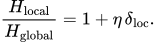
The observed discrepancy H_(local)/H_(global)≈ 73/67≈1.09 is then
reproduced for ηδ_(loc)≈0.09—an order-unity sensitivity to a
10% local structure contrast, or a local void with η -0.3,δ_(loc)
-0.3 (ch7_lattice_optics.py, part C).
What this is and is not.
This is a candidate mechanism ([HYP]/[SPEC]): one and the same field κₒₚₜ, viewed over different path averages, yields different inferred H, so a tension can arise without inconsistent data reduction or new dark-sector physics. It is not a parameter-free prediction—η and δ_(loc) are not fixed independently here, only shown to reach the observed order with plausible values. Two falsifiable signatures are the proper test: the inferred H₀ should correlate with local large-scale density, and it should be direction-dependent at fixed depth if δ_(bg) is anisotropic.ch_hubble_tension.py makes both
explicit (v2): propagating light through a structured density field with
κₒₚₜ(ρ)=barκ(1+δ)^(η) reproduces the 73/67 magnitude for
ηδ_(loc)≈0.08 and exhibits the predicted H₀–density correlation
(slope set by η), while the η–δ_(loc) degeneracy and the sign of
η (local over- vs under-density) remain open—to be broken only by measuring that correlation.