Black Holes and Jets as Critical-Inflow Objects
The framework reads black holes as present critical-inflow objects — regions where vacuum inflow reaches the causal ceiling — rather than singularities, and astrophysical jets as collimation along the spin axis. Both follow from the same inflow physics that gives gravity and the microwave floor, accounted for by present mechanism without invoking a hidden interior.
Black holes appear here as present objects where vacuum inflow reaches the speed ceiling, not as singularities with unphysical interiors. The same inflow picture collimates jets along the spin axis. Both are described by present critical-inflow physics — a present-mechanism reading consistent with observation, not a claim about what lies inside a horizon. The horizon sits near the critical radius r = 2GM/c².
Black holes as present critical-inflow objects (not mysteries)
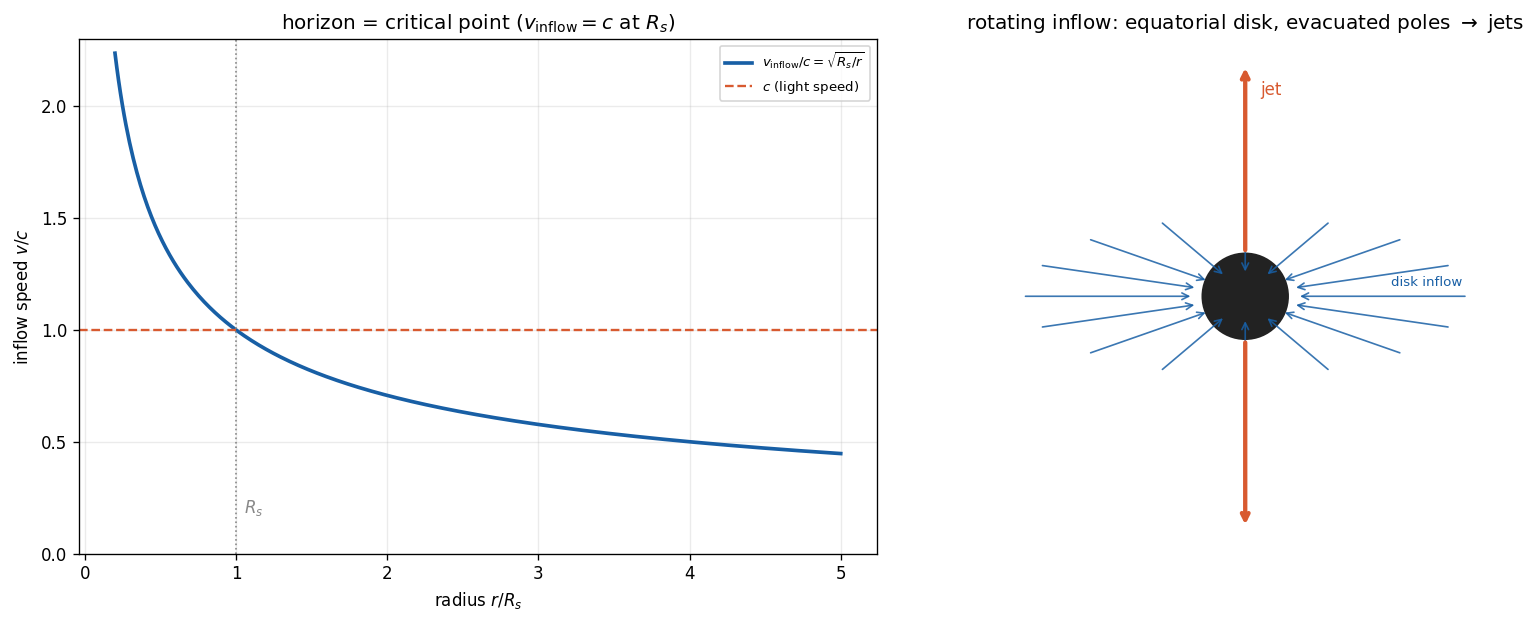
Black holes are present, observed objects, and in this framework they are not mysterious. The inflow of Chapter 3 reaches the wave speed at a finite radius: with v_(inflow)(r)=c√Rₛ/r, the speed equals c exactly at Rₛ=2GM/c² and exceeds it inside (Fig. (bh), left). The “event horizon” is simply the critical point of the inflow—the radius past which light, a wave in the medium, can no longer swim upstream—exactly analogous to the sonic point of a waterfall. Nothing metaphysical is required. (This horizon is the strong-field instance of the general gate-physics critical radius of §(gate)—a surface where the inflow reaches the wave speed and chokes; here the uncapped geometric channel fixes the linear coefficient Rₛ=2GM/c².)
Three present-physics features matter for the objection of §5.
- No singularity. The quanta are finite-volume elements, so the medium has a maximum packing density (jamming): n_(max) a⁻³≈4×10⁵⁴m⁻³ for the cell size a=6.33×10⁻¹⁹m (far above nuclear density, but finite). The core is therefore a jammed ball of finite density, not a point of infinite density.
- Energy cannot be stored without limit. Volume quanta cannot pile up beyond jamming; what can concentrate is energy, but once the core is jammed there is no way to store more, so incoming energy must be returned.
- It is returned as jets. A rotating inflow forms an equatorial disk at the centrifugal radius R_c=ℓ²/GM, while the centrifugal barrier ℓ²/2R²→∞ evacuates the rotation axis; the only open channel for the energy that cannot be stored is up the evacuated poles, which is what collimates a jet (Fig. (bh), right). The power is the absorbed rest-energy throughput, L εdot M c²≈6×10⁴⁵ergs⁻¹ for dot M 1M_odotyr⁻¹ at ε=0.1—squarely in the observed range of active galactic nuclei.
The acceleration is feasible, the loading is not yet derived (v2).
Item (c) fixes the collimation—the evacuated poles are the only open channel—but not the acceleration to the bulk Lorentz factors observed. That step is standard, reproducible relativistic gas dynamics once the funnel is granted. On a steady streamline the relativistic Bernoulli invariant is Γw=const, with specific enthalpy w=1+fracΓ_(ad)Γ_(ad)-1 fracpρ c²; a base that is hot or magnetized (w₀>1) and slow (Γ≈1) expands adiabatically through the converging–diverging funnel (a relativistic de Laval nozzle, with a throat at the transonic point), cooling as it goes (w→1) so that the enthalpy converts into bulk motion and the flow asymptotes to Γ_(∞)=w₀. The scriptch_jet_acceleration.py integrates this and recovers the observed ranges: a mildly
relativistic base w₀ 10 gives the Γ 10 of AGN jets, an extreme base
w₀ 10²–10³ the Γ 10²–10³ of gamma-ray bursts, each with a causal
opening angle 1/Γ of a few degrees down to a fraction of a degree—matching what is
seen. What the framework does not yet derive is the loading: how the inflow deposits
the base enthalpy w₀ (the launching/energy-extraction step, the inflow analogue of the
Blandford–Znajek or Blandford–Payne process). The acceleration mechanism and the collimation are
therefore secured at the level of feasibility; the energy loading is, honestly, still speculative.
Light bending, owned here (v2).
The same river flow fixes how light bends. A wave in a medium falling at v(r)=c√Rₛ/r propagates, to leading order, as in a medium of effective index n(r)≃1+v²/c²=1+Rₛ/r (the weak-field optical reading of the inflow; the quadratic v²/c², not v/c, because the bending is sense-independent under inflow reversal). A ray grazing the Sun at impact parameter b=R_☉ then deflects by
— the Eddington value, degenerate with general relativity at this order. This paragraph makes the
volume self-contained on the bending claim (previously mis-cited to the physics volume; ownership
corrected in v2). The cap and the absolute G remain physics-volume [INPUT] matters
exactly as stated in Chapter 3.
Jets: collimation and the spin axis
The qualitative funnel of Fig. (bh) is sharpened, in this volume\'s strong-field reading (ownership corrected in v2; the physics volume does not carry the jet analysis), into two quantitative statements that make the jet sector falsifiable. First, the jet axis is not arbitrary: an alignment-relaxation law

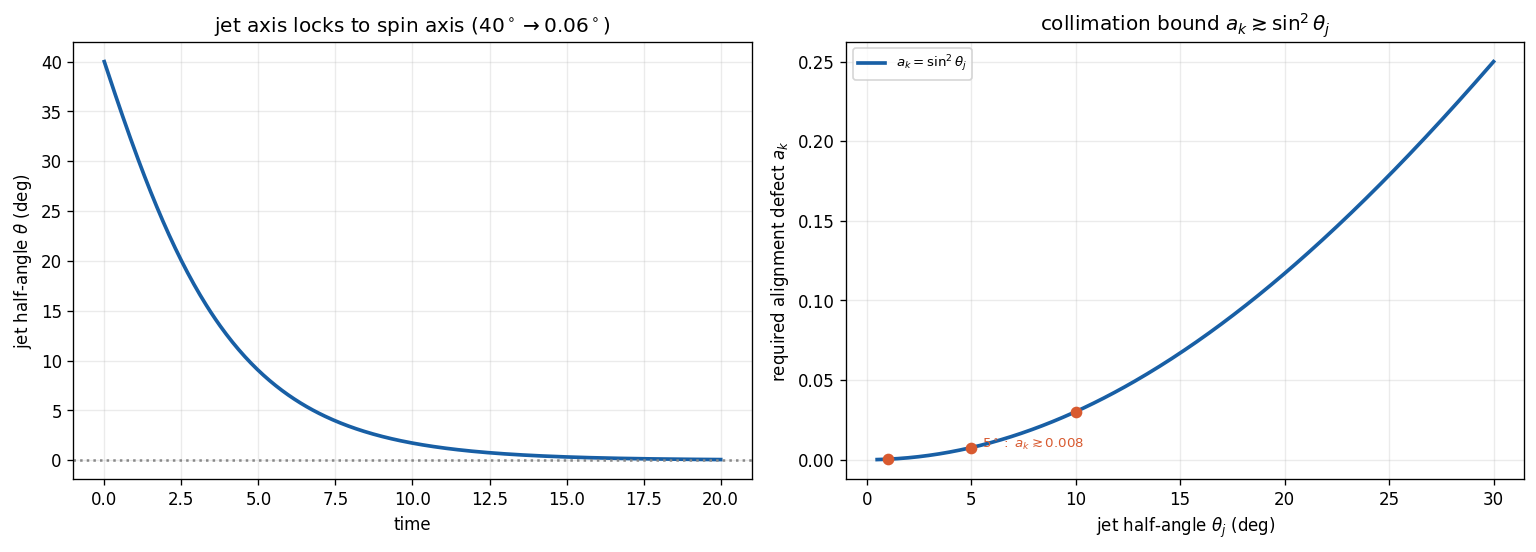
drives the jet axis exponentially onto the rotation (spin) axis—a misalignment of 40^(∘) decays below 0.1^(∘) within a few locking times (Fig. (jet), left), with the verified rate dlntanθ/dt=-κₛ/τₖ. Second, collimation is bounded by the alignment quality: a Cauchy–Schwarz inequality gives
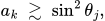
so the observed opening angle θ_j sets a floor on the allowed second-moment alignment defect aₖ (Fig. (jet), right). A degree-scale jet (θ_j 1–5^(∘)) therefore demands aₖ≲0.008—a strongly aligned flow, which is exactly what the spin-locking law produces. The resulting prediction is sharp and falsifiable: the jet axis should coincide with the spin axis, and narrower jets should correspond to better spin alignment. The full magnetohydrodynamic launching of the jet is not modelled here; what the framework supplies is the geometric collimation law and the spin-axis prediction.