The Microwave Background as Present Lattice Emission

This chapter explains the microwave background as a present emission of the medium rather than relic radiation from a hot past, accounting for its near-perfect 2.725 K blackbody spectrum by present physics. It makes no claim about cosmic origins, but raises one objection grounded in observed black-hole physics: whether the hot Big Bang's initial singularity is physically possible.

Two present, model-independent facts concern us. (i) The sky carries a near-perfect blackbody microwave background at T=2.725K, isotropic to one part in 10⁵, observed now.

A word on scope before anything else. This framework explains present, observable facts by present physics; it does not reconstruct cosmic origins, because the deep past cannot be verified to the precision this volume otherwise holds itself to. We therefore make no positive claim about what the universe was—no “steady state,” no alternative history. What we may do, and do not avoid, is raise a clear physical objection grounded entirely in present, verifiable physics: the behaviour of black holes—the most extreme concentrations of energy we actually observe—bears directly on whether the hot Big Bang's initial singularity is physically possible. This chapter explains the microwave background as a present emission of the medium, and raises that objection, while explicitly declining to say what the past was.

The raw facts to be explained

Two present, model-independent facts concern us. (i) The sky carries a near-perfect blackbody microwave background at T=2.725K, isotropic to one part in 10⁵, observed now. (ii) The most compact objects we observe—black holes—swallow matter, are bounded by a horizon, and frequently launch collimated relativistic jets. We give a present-physics account of (i) and use (ii) to raise our objection. We do not treat the inferred history behind these facts (a hot dense past, recombination) as itself a fact; that is an interpretation about the past, which we leave aside.

Temperature is quantum rotation; the thermal floor

In this framework temperature is the rotation of the vacuum quanta (physics volume, DOI \href{https://doi.org/10.5281/zenodo.17932566}{10.5281/zenodo.17932566}). A region cannot ordinarily reach absolute zero: inflow continually stirs the medium, and the energy of attenuated light (the redshift mechanism of Chapter 7) is deposited as it propagates, so ordinary space is held at a nonzero thermal floor. Absolute zero is reached only where the medium has been annihilated away—the deficit cores of Chapter 8 (“dark matter”), which are therefore cold and dark. Ordinary space, by contrast, is everywhere slightly warm, and a warm medium radiates. The microwave background is that radiation.

The microwave background as present lattice emission

The mechanism is direct. A medium at temperature T is a lattice of quanta in thermal motion; its thermal excitations are small disturbances, i.e. lattice elastic waves, and those waves are light (Chapter 2: light is the lattice wave, with ω=c|k| at long wavelength). A warm lattice therefore continuously radiates a thermal spectrum of these waves. This is not a relic of any past event; it is the present thermal emission of a present, slightly warm medium.

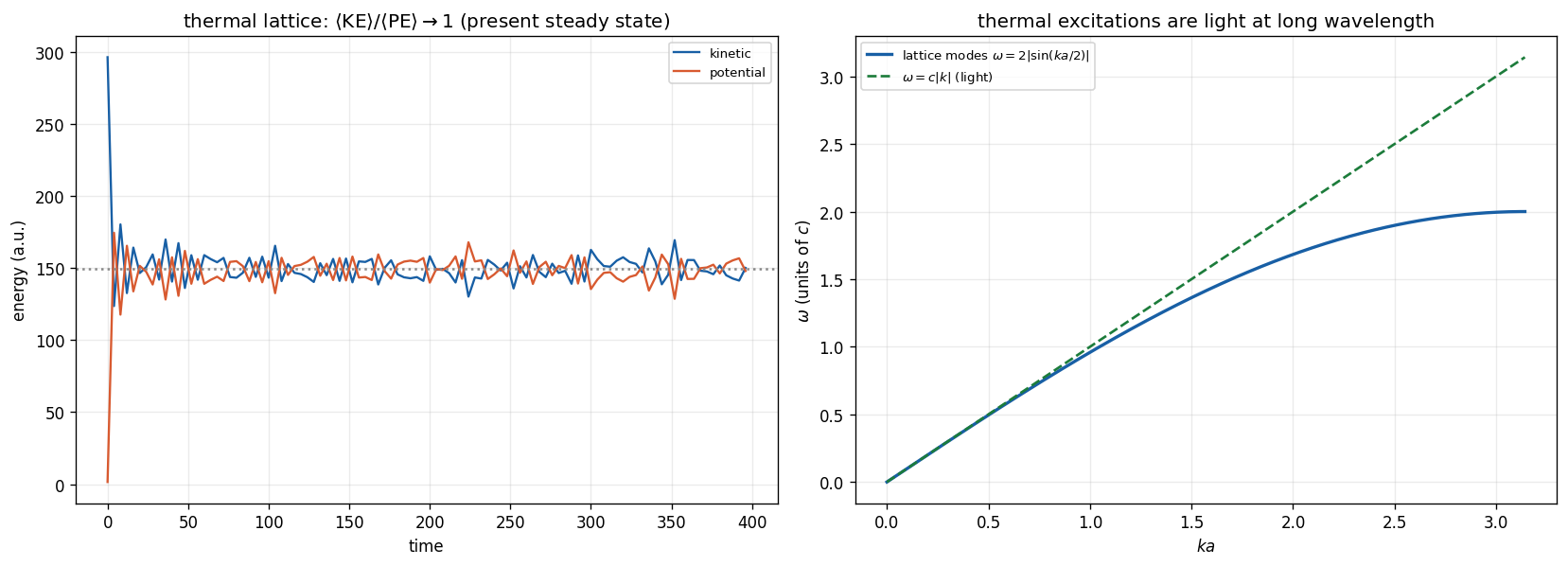
A simulation confirms the two ingredients (Fig. (cmb)). A one-dimensional lattice of coupled quanta, started with thermal velocities, settles to equipartition, langleKE⟩/langlePE⟩=0.998 (a thermalised steady state), and its excitations lie on the lattice dispersion ω(k)=2√(k/m)|sin(ka/2)|, whose long-wavelength slope is exactly the wave speed, dω/dk→ c. The thermal fluctuations of the medium are thus waves on ω=c|k|—they are light—so a warm lattice emits a thermal electromagnetic background by the simple fact of having a temperature.
The Planck shape from quantized lattice modes

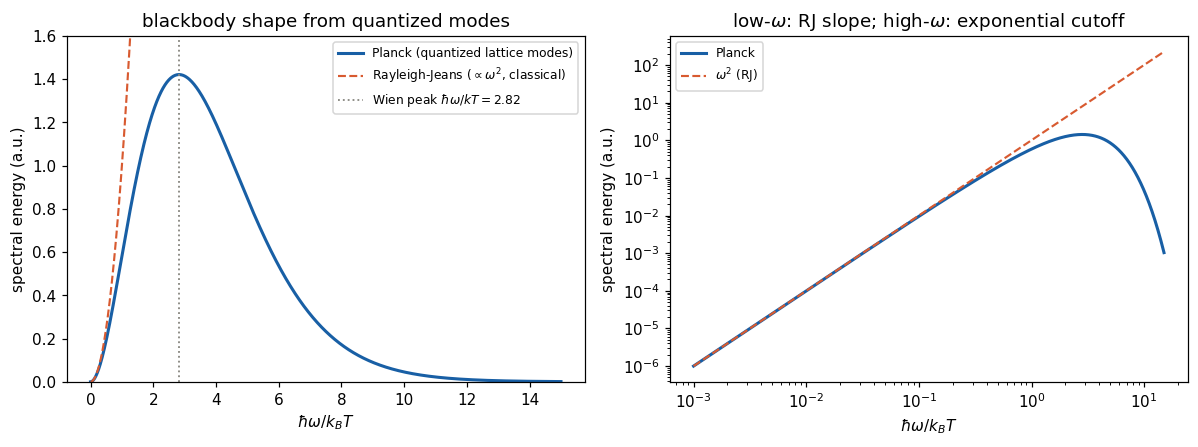
The classical simulation above reaches equipartition—the Rayleigh–Jeans regime, which by itself would diverge at high frequency (the ultraviolet catastrophe). The blackbody shape follows once the lattice modes are quantized: each mode of frequency ω carries excitations of energy ħω (the rotational quantum of the vacuum quanta, physics volume, DOI \href{https://doi.org/10.5281/zenodo.17932566}{10.5281/zenodo.17932566}), with the Bose–Einstein occupation ⟨ n(ω)⟩=1/(e^(ħω/k_BT)-1). The emitted spectral energy is then

\begin{equation} u(\omega)\,d\omega \;=\; g(\omega)\,\hbar\omega\,\langle n(\omega)\rangle\,d\omega \;\propto\; \frac{\omega^{3}}{e^{\hbar\omega/k_BT}-1}\,d\omega, \end{equation}

the Planck law (Fig. (planck)). Its low-frequency limit ħωll k_BT recovers the classical u∝ω²k_BT of the equipartition run; its peak sits at ħω≃2.82k_BT (Wien). Quantization is precisely what averts the ultraviolet catastrophe and fixes the observed blackbody form.

The one lattice-specific correction is a high-frequency cutoff at the Debye frequency ω_(max)=2c/a. For the actual background (T=2.725K, a the fundamental spacing), ħω_(max)/k_BT≈2.7×10¹⁵, so the discreteness alters the spectrum by only 10⁻³⁰ at the peak—unobservably small. The model therefore predicts a Planck background to some thirty decimals, with an in-principle deviation only far in the Wien tail (ch9_lattice_cmb.py, part 4). The absolute temperature—the value of k_BT itself—remains not derived, as recorded below.
The temperature floor made quantitative: the dark-matter contrast and the energy balance

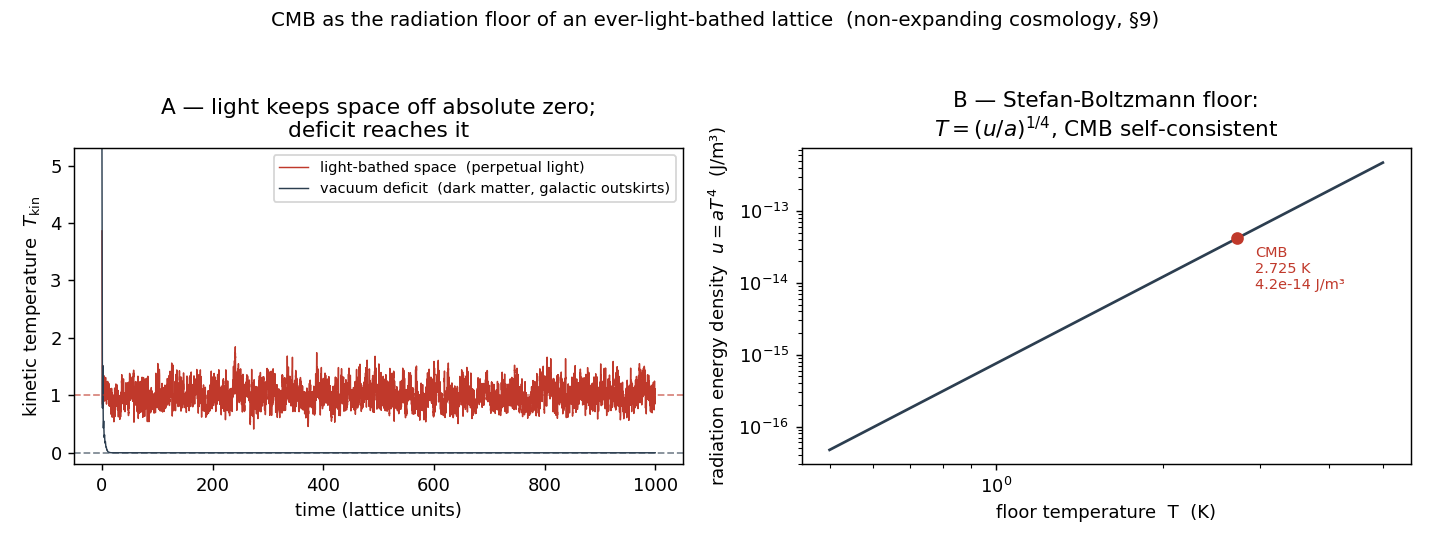
The thermal-floor mechanism above can be made quantitative and, in the same step, tied to the deficit cores of Chapter 8. Two regions are integrated under identical dynamics (ch9_cmb_floor.py, Fig. (cmbfloor)): ordinary space, in perpetual radiative contact with the ever-present light of the medium (lattice-mode emergence, physics volume \href{https://doi.org/10.5281/zenodo.17932566}{10.5281/zenodo.17932566}, plus ambient starlight); and a vacuum-deficit region, in which the annihilated medium provides no such contact. Started identically hot, ordinary space relaxes to a nonzero floor and holds it, while the deficit region decays to absolute zero. The contrast is the point: the same calculation that keeps ordinary space at a microwave floor drives the deficit cores to true zero, so the cold darkness of “dark matter” (Chapter 8) and the warm microwave floor of ordinary space are two outputs of one mechanism.

The floor temperature itself follows from a Stefan–Boltzmann balance, u=aT⁴ with a=4σ/c=7.566×10⁻¹⁶Jm⁻³K⁻⁴. The observed background T=2.725K corresponds to u_(CMB)=4.17×10⁻¹⁴Jm⁻³; the volume's stated relation u_(CMB)≈80u_(*) then implies a starlight density u_(*)≈5.2×10⁻¹⁶Jm⁻³, within the band of the measured cosmic optical background—so the energy balance the ledger calls for closes self-consistently. What this does not do is fix the value from first principles: the floor is set by the ambient radiation density, and that density (equivalently the factor 80) must come from the lattice's absolute emission rate, a scale this volume does not derive. The mechanism is therefore shown and the balance is consistent; the absolute 2.725K remains anchored to the observed density, exactly as the open-problem ledger records.
Where the quantization comes from: a finite topology with a minimum grain

The previous section took the quantization for granted—each mode carries ħω with Bose–Einstein occupation—and showed that this fixes the Planck shape. In this framework it need not be assumed: it follows from the same finite, granular lattice that underlies everything else, with no photon hypothesis put in by hand. Two ingredients suffice. A finite topology: a wave confined to a bounded region has discrete standing wavevectors (k_i=n_iπ/L), so the field is a countable set of oscillators whose number below ω grows by Weyl's law, giving the mode density g(ω)∝ Vω²/c³—the discreteness of the modes is purely geometric. And a minimum grain: the phase-space partition function carries a cell of action h, which classically one sends to zero, but a granular medium cannot resolve information below its own cell—a limit of the Nyquist–Shannon kind, no infinite information in a finite bandwidth. Holding h finite turns the phase-space integral into a sum, the single-mode partition function becomes Z_ω=1/(1-e^(-βħω)), and the mean energy is ⟨ E⟩=ħω/(e^(βħω)-1). Multiplying by g(ω) returns Planck's law, Eq. (planck)—only a finite domain and a finite grain, no quantum of light assumed.

The point for this framework is that the grain is the lattice: the cell of action h is the same granularity that already fixes ħ. The discreteness that gives the vacuum its quantum of action gives the microwave background its blackbody shape; what the previous section assumed is, at this level, derived.

This also sets the scale of the residual. After a disturbance radiates (Chapter 2) the lattice settles to a thermal floor far below its own scale: the grain energy ħ c/a≈312GeV corresponds to a temperature ħ c/(ak_B)≈3.6×10¹⁵K, so the observed 2.725K floor lies some fifteen orders beneath it—an almost perfectly frozen medium whose faint leftover emission is the background. Its energy density aT⁴≈4.2×10⁻¹⁴J m⁻³ is about eighty times the cosmic starlight, and it is precisely that ratio a steady-state balance—occasional violent shaking and the continual stimulation of starlight, against the medium's own emission—must reproduce. The blackbody shape is now grounded; the absolute 2.725K remains the open energy-balance item recorded in this chapter's status.

The same principle outside cosmology.

The boundary condition behind this argument is fixed by causality alone—a wave in a finite domain may send energy outward or hold it, never draw it from the vacuum. Quantization is one consequence. A second, noted only for reach, is in particle physics: for a spherically symmetric (J=0) mode the angle-averaged reflection at such a boundary cannot vanish in three dimensions (a geometric floor ≈0.286), so an isotropic field cannot radiate all its energy away; the portion forced to reflect forms a trapped standing wave whose energy is a mass—a finite-topology origin for a Yang–Mills-type mass gap. We record the link and leave it there; the concern here is the blackbody.

Black holes as present critical-inflow objects (not mysteries)

Black holes are present, observed objects, and in this framework they are not mysterious. The inflow of Chapter 3 reaches the wave speed at a finite radius: with v_(inflow)(r)=c√Rₛ/r, the speed equals c exactly at Rₛ=2GM/c² and exceeds it inside (Fig. (bh), left). The “event horizon” is simply the critical point of the inflow—the radius past which light, a wave in the medium, can no longer swim upstream—exactly analogous to the sonic point of a waterfall. Nothing metaphysical is required. (This horizon is the strong-field instance of the general gate-physics critical radius of §(gate)—a surface where the inflow reaches the wave speed and chokes; here the uncapped geometric channel fixes the linear coefficient Rₛ=2GM/c².)

Three present-physics features matter for the objection of §5.

  1. No singularity. The quanta are finite-volume elements, so the medium has a maximum packing density (jamming): n_(max) a⁻³≈4×10⁵⁴m⁻³ for the cell size a=6.33×10⁻¹⁹m (far above nuclear density, but finite). The core is therefore a jammed ball of finite density, not a point of infinite density.
  2. Energy cannot be stored without limit. Volume quanta cannot pile up beyond jamming; what can concentrate is energy, but once the core is jammed there is no way to store more, so incoming energy must be returned.
  3. It is returned as jets. A rotating inflow forms an equatorial disk at the centrifugal radius R_c=ℓ²/GM, while the centrifugal barrier ℓ²/2R²→∞ evacuates the rotation axis; the only open channel for the energy that cannot be stored is up the evacuated poles, which is what collimates a jet (Fig. (bh), right). The power is the absorbed rest-energy throughput, L εdot M c²≈6×10⁴⁵ergs⁻¹ for dot M 1M_odotyr⁻¹ at ε=0.1—squarely in the observed range of active galactic nuclei.

The acceleration is feasible, the loading is not yet derived (v2).

Item (c) fixes the collimation—the evacuated poles are the only open channel—but not the acceleration to the bulk Lorentz factors observed. That step is standard, reproducible relativistic gas dynamics once the funnel is granted. On a steady streamline the relativistic Bernoulli invariant is Γw=const, with specific enthalpy w=1+fracΓ_(ad)Γ_(ad)-1 fracpρ c²; a base that is hot or magnetized (w₀>1) and slow (Γ≈1) expands adiabatically through the converging–diverging funnel (a relativistic de Laval nozzle, with a throat at the transonic point), cooling as it goes (w→1) so that the enthalpy converts into bulk motion and the flow asymptotes to Γ_(∞)=w₀. The script ch_jet_acceleration.py integrates this and recovers the observed ranges: a mildly relativistic base w₀ 10 gives the Γ 10 of AGN jets, an extreme base w₀ 10²–10³ the Γ 10²–10³ of gamma-ray bursts, each with a causal opening angle 1/Γ of a few degrees down to a fraction of a degree—matching what is seen. What the framework does not yet derive is the loading: how the inflow deposits the base enthalpy w₀ (the launching/energy-extraction step, the inflow analogue of the Blandford–Znajek or Blandford–Payne process). The acceleration mechanism and the collimation are therefore secured at the level of feasibility; the energy loading is, honestly, still speculative.

Light bending, owned here (v2).

The same river flow fixes how light bends. A wave in a medium falling at v(r)=c√Rₛ/r propagates, to leading order, as in a medium of effective index n(r)≃1+v²/c²=1+Rₛ/r (the weak-field optical reading of the inflow; the quadratic v²/c², not v/c, because the bending is sense-independent under inflow reversal). A ray grazing the Sun at impact parameter b=R_(odot) then deflects by
\delta=\frac{2R_{s}}{b}=\frac{4GM_{\odot}}{c^{2}R_{\odot}}=1.751''\approx1.752''

— the Eddington value, degenerate with general relativity at this order. This paragraph makes the volume self-contained on the bending claim (previously mis-cited to the physics volume; ownership corrected in v2). The cap and the absolute G remain physics-volume [INPUT] matters exactly as stated in Chapter 3.

Jets: collimation and the spin axis

The qualitative funnel of Fig. (bh) is sharpened, in this volume\'s strong-field reading (ownership corrected in v2; the physics volume does not carry the jet analysis), into two quantitative statements that make the jet sector falsifiable. First, the jet axis is not arbitrary: an alignment-relaxation law

\begin{equation} \tan\theta(t)=\tan\theta_{0}\,e^{-\kappa_{s}t/\tau_{k}} \end{equation}

drives the jet axis exponentially onto the rotation (spin) axis—a misalignment of 40^(∘) decays below 0.1^(∘) within a few locking times (Fig. (jet), left), with the verified rate dlntanθ/dt=-κₛ/τₖ. Second, collimation is bounded by the alignment quality: a Cauchy–Schwarz inequality gives

\begin{equation} a_{k}\;\gtrsim\;\sin^{2}\theta_{j}, \end{equation}

so the observed opening angle θ_j sets a floor on the allowed second-moment alignment defect aₖ (Fig. (jet), right). A degree-scale jet (θ_j 1–5^(∘)) therefore demands aₖlesssim0.008—a strongly aligned flow, which is exactly what the spin-locking law produces. The resulting prediction is sharp and falsifiable: the jet axis should coincide with the spin axis, and narrower jets should correspond to better spin alignment. The full magnetohydrodynamic launching of the jet is not modelled here; what the framework supplies is the geometric collimation law and the spin-axis prediction.

A clear objection to the Big Bang singularity (no alternative is claimed)

We now state the objection, and we are careful about its logical status. The hot Big Bang posits an initial state in which essentially all the energy of the universe is at near-infinite density—a singularity. The present physics of black holes, summarised above and verified by the simulation, says three things about the most extreme concentrations of energy we actually observe: the density saturates at a finite, jammed value (no true singularity); energy beyond that cannot be stored; and what cannot be stored is pumped back out, ultimately as jets.

The objection. If even a black hole—the most extreme concentration of energy in the present universe—cannot confine energy to a point, but instead saturates at finite density and expels what it cannot hold, then it is a legitimate physical question how the Big Bang's initial singularity, an even more extreme confinement of all energy, could have existed. The mechanism by which present physics resists the confinement of energy to a point applies, if anything, more strongly to the proposed initial state. The stronger claim, within this framework. The question sharpens into a structural impossibility once the vacuum is taken to be a jammed packing of finite-volume quanta. A true initial singularity requires all the energy of the universe at a single point—unbounded density. But finite-volume quanta cannot be packed beyond n_(max) a⁻³: there is no state of the medium denser than the jammed core, and a black-hole core already realises that ceiling without becoming singular. Within the premises of this volume, therefore, an initial singularity—unbounded density, all energy at a point—is not merely improbable but impossible: there is nowhere for the energy to be put that the jamming bound does not already forbid. This is a conditional impossibility, following from the finite-volume-quantum premise, and it is bounded precisely: it forbids the singularity, not a hot or dense past at sub-jamming densities, on which this volume still makes no claim. The hot Big Bang and this framework are thus incompatible at exactly one point—the initial singularity—and nowhere else that the volume adjudicates. What we are not saying. We are not asserting that the universe was “steady” or eternal, nor proposing any alternative history. Such claims concern the past and cannot be verified to the precision this volume requires; they are outside its scope. We raise a question, grounded entirely in present, verifiable black-hole physics; we do not answer what the past actually was, and we regard that answer as not presently knowable to the standard we hold. The objection stands on present facts; the origin does not.

Scope: present facts, not origins

The position of this chapter, and of the volume, is consistent and deliberate. We explain a present observable—the microwave background—by a present mechanism (a warm medium radiates thermal waves, which are light). That account does not require the interpretation of the background as a relic of a hot past; but neither does it disprove that past. Arguments that the acoustic peaks of the background demonstrate recombination presuppose the hot Big Bang—a hypothesis about the past—which we neither assert nor refute, because we do not adjudicate origins. The microwave background, as a fact, is here and warm and emitted now; that is what we explain. What it may or may not imply about the deep past is a question we leave to evidence that can settle it to better than the ten-percent uncertainty below which this volume operates.

Anticipated objections

“The acoustic peaks (ℓ≈220) prove recombination.”

They are evidence for recombination within the hot Big Bang interpretation, which is a hypothesis about the past. This volume does not adjudicate the past (§6), so it neither claims the peaks as support nor sets out to explain them away; it gives a present-physics account of the present background and leaves the historical question to evidence that can settle it. The objection is therefore not binding on what this chapter actually claims.

“Did you derive the 2.725K?”

No. We derive the mechanism—a warm lattice radiates a thermal spectrum of light—but not the absolute temperature. The background's energy density is roughly 80 times that of starlight, so the specific value requires a complete energy balance that we do not have; it is recorded as open (status, below), not asserted.

Status of this chapter

Reproducibility

ch9_lattice_cmb.py (reproducibility package) does two things. (1) It evolves a thermal 1D lattice and reports langleKE⟩/langlePE⟩=0.998 (equipartition) and the dispersion ω(k) with long-wavelength slope → c (thermal excitations are light). (2) It evaluates the black-hole checks: v_(inflow)=c at Rₛ (critical point), the finite jamming density n_(max) a⁻³ (no singularity), the rotating-inflow disk/funnel geometry (R_c=ℓ²/GM; polar evacuation), and the jet power L εdot M c² (AGN-scale). Expected output: equipartition ratio ≈1.0, slope ≈ c, Rₛ values, n_(max)≈4×10⁵⁴m⁻³, and L≈6×10⁴⁵ergs⁻¹. Part 4 computes the Planck spectrum from the quantized lattice modes, reporting the Wien peak at ħω/k_BT=2.82, the Rayleigh–Jeans low-frequency limit, and the negligible ( 10⁻³⁰) lattice-cutoff deviation at the CMB peak. The absolute 2.725K is not produced (flagged). Next stages: Chapter 2 (light as the lattice elastic wave, with the honest vacuum-dispersion tension), and Chapter 16 (the honest ledger and the falsifiable predictions of the whole volume). Foundations continue to be imported from the physics volume, DOI \href{https://doi.org/10.5281/zenodo.17932566}{10.5281/zenodo.17932566}.