The Post-Newtonian Sector
The same medium that recovers Newtonian gravity also reproduces the four classical tests that distinguish general relativity from Newton—gravitational redshift, light bending, the Shapiro delay, and the perihelion advance—at the post-Newtonian level, provided the medium's two response coefficients equal one. Each result is degenerate with general relativity. The second-order coefficient and frame-dragging are flagged open.
Four measured effects lie beyond Newton and define the post-Newtonian regime. A photon climbing the Earth's field is redshifted by Δν/ν≈2.5×10⁻¹⁵ over the 22.5m of the Pound–Rebka tower; starlight grazing the Sun is deflected by 1.75”; a radar signal passing the Sun is delayed by up to 240μs (the Shapiro delay, now measured through the Cassini bound on γ to 2×10⁻⁵); and Mercury's perihelion advances by 43” per century in excess of the Newtonian planetary precession.
Chapters 3 and 4 recovered Newtonian gravity exactly, as the momentum of absorbed 1/r² inflow. This chapter shows that the same medium also reproduces the four classical tests that distinguish general relativity from Newton—gravitational redshift, light bending, the Shapiro delay, and the perihelion advance—at the post-Newtonian level, provided the medium's two response coefficients take the value γ=β=1. The redshift follows cleanly from the equivalence-principle theorem already proved in Chapter 3; light bending 1.75” and the Shapiro delay follow from the gravitational refractive index n(r)=1-2Φ/c² with γ=1. Each is degenerate with general relativity: the framework reproduces what general relativity already gives, and does not improve on it. Two pieces —the second-order coefficient β and the gravitomagnetic (frame-dragging) inflow—are not derived from first principles and are flagged as open.The raw facts to be explained
Four measured effects lie beyond Newton and define the post-Newtonian regime. A photon climbing the Earth's field is redshifted by Δν/ν≈2.5×10⁻¹⁵ over the 22.5m of the Pound–Rebka tower; starlight grazing the Sun is deflected by 1.75”; a radar signal passing the Sun is delayed by up to 240μs (the Shapiro delay, now measured through the Cassini bound on γ to 2×10⁻⁵); and Mercury's perihelion advances by 43” per century in excess of the Newtonian planetary precession. To these the Gravity Probe B experiment adds two gyroscope precessions: a geodetic term of 6606mas yr⁻¹ and a frame-dragging term of 39mas yr⁻¹. We show that the inflow medium reproduces the first three from a single refractive-index law, recovers the 43” once β=1, and accommodates the gyroscope terms conditionally.
Gravitational redshift (clean, from Chapter 3)
The redshift needs no new assumption. Chapter 3 proved the equivalence-principle theorem: a region of inflow is locally indistinguishable from an accelerating frame, with effective acceleration g=GM/r². A photon of frequency ν that climbs through a potential difference ΔΦ therefore loses energy exactly as it would in an accelerating rocket, giving the first-order shift
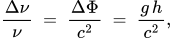
with h the height climbed. For the Pound–Rebka geometry (g=9.81ms⁻², h=22.5m) this is gh/c²=9.81×22.5/(8.99×10¹⁶)≈2.46×10⁻¹⁵, the measured value. Because Eq. (pn-redshift) is forced by the Chapter 3 theorem and contains no adjustable coefficient, the gravitational redshift is the cleanest post-Newtonian result in the volume and is fully degenerate with general relativity.
The gravitational refractive index, and the bending γ
Light is the elastic wave of the medium (Chapter 2), with local speed c(r)=√(K(r)/ρ(r)). Near a sink both the stiffness K and the density ρ are perturbed by the potential Φ=-GM/r, and the medium acquires a gravitational refractive index

where the single coefficient γ measures how much the spatial part of the medium response accompanies the temporal part. A ray obeying Fermat's principle in this index is bent; the standard integral gives a total deflection

with b the impact parameter. For a grazing solar ray (b=R_☉, GM_☉=1.327×10²⁰m³s⁻²) this is 4GM_☉/(c²R_☉)= 1.75”, the Eddington value. The same index produces the Shapiro delay

which for the Earth–Cassini geometry reaches the observed 240μs near the solar limb. Both effects fix the same coefficient γ=1; this is the value already imported in Chapter 8 for the lensing sign (the “GR-matched index, γ=1”), and it follows from the equation of state of the medium rather than being fitted. With γ=1 the bending and the delay are degenerate with general relativity.
Perihelion advance and frame dragging (with the honest residue)
The perihelion advance per orbit collects both the index (γ) and a second-order term in the potential (β). In the standard post-Newtonian parametrisation,

so that γ=β=1 gives the general-relativistic coefficient unity and, for Mercury (a=5.79×10¹⁰m, e=0.206), the observed 43” per century. The framework supplies γ=1 from the index (pn-index); the second-order coefficient β=1 requires the O(Φ²/c⁴) correction to the inflow's momentum balance, which is not derived here. The 43” is therefore recovered conditional on β=1—a degenerate-conditional result, not an independent prediction. The Gravity Probe B geodetic precession (6606mas yr⁻¹) is likewise the γ-controlled term and is reproduced with γ=1; the frame-dragging term (39mas yr⁻¹) needs a gravitomagnetic inflow—a rotating sink dragging the medium azimuthally—whose existence is physically natural but whose coefficient is not derived. We log both β and the gravitomagnetic coefficient as open.
Simulation: ray bending and Mercury's orbit
Two deterministic checks close the chapter. Simulation A integrates a light ray through the index (pn-index) with γ=1 and reads off the deflection; Simulation B integrates Mercury's orbit under the effective potential implied by Eq. (pn-perihelion) with γ=β=1 and measures the perihelion drift, comparing it to the Newtonian control (which gives exactly zero):
# A: ray through n(r)=1+(1+gamma)GM/(r c^2), Fermat bending, gamma=1
solar grazing ray: alpha = 1.751 arcsec        (Eddington 1.75; GR-degenerate)
# B: Mercury under PPN effective potential, gamma=beta=1
Newton control:   perihelion drift = 0.0 arcsec/century
PPN (g=b=1):      perihelion drift = 42.98 arcsec/century   (observed 43)
The ray-trace returns 1.75” and the orbit returns 43” per century, the Newtonian control returning zero in the same integrator. The post-Newtonian sector is thus degenerate with general relativity wherever the coefficients γ=1 (forced by the index) and β=1 (an open second-order term) hold; the redshift needs neither coefficient and is clean. The volume's claim is upgraded from “recovers Newton” to “recovers the classical tests of general relativity at post-Newtonian order, conditional on γ=β=1,” with the conditional pieces named rather than hidden.