Gravitational Waves as Medium Perturbations
If the vacuum is an elastic medium whose transverse wave is light, then a time-varying mass distribution launches a second transverse wave—a gravitational wave—travelling at exactly the speed of light, with no tuning. Monopole and dipole radiation are forbidden by the conservation of inflow, leaving quadrupole radiation with two polarisations. Every feature is degenerate with general relativity.
The model-independent facts are three: the binary black-hole merger GW150914 produced a chirp whose frequency swept from 35 to 250 Hz over 0.2 s, consistent with two masses of 36 and 29 solar masses at 410 Mpc; the neutron-star merger GW170817 was followed by a gamma-ray burst 1.7 s later after a 40 Mpc flight; and the Hulse–Taylor binary pulsar's orbit decays in line with the quadrupole prediction. The merger chirp sweeps 35→250 Hz, with |Δc/c|<10⁻¹⁵ from GW170817.
If the vacuum is an elastic medium whose transverse wave is light (Chapter 2), then a time-varying mass distribution must launch a second kind of transverse wave in the same medium—a gravitational wave. This chapter shows that such waves propagate at exactly the speed of light, c_(gw)=√(K/ρ)=c, with no tuning, which is why the gravitational wave GW170817 and its gamma-ray burst arrived within 1.7s after travelling 40Mpc; that monopole and dipole radiation are forbidden by the conservation of inflow, leaving quadrupole radiation with two transverse polarisations, as in general relativity; and that the inspiral chirp (35→250Hz for GW150914) and the Hulse–Taylor orbital decay (dot P_b=-2.4×10⁻¹²) follow. Every predicted feature is degenerate with general relativity; the microscopic derivation of the exact quadrupole amplitude is flagged as open.The raw facts to be explained
The model-independent facts are three. The binary black-hole merger GW150914 produced a strain whose frequency swept from 35 to 250Hz over 0.2s, consistent with two masses of 36 and 29M_☉ at 410Mpc. The neutron-star merger GW170817 was followed by a short gamma-ray burst 1.7s later after a 40Mpc flight, bounding the speed difference between gravity and light to |Δ c/c|≲10⁻¹⁵. And the Hulse–Taylor binary pulsar's orbit decays at dot P_b=-2.4×10⁻¹², matching the general-relativistic quadrupole prediction to 0.2%. We show that the inflow medium reproduces all three.
Why the wave speed is exactly c
A gravitational wave is a propagating shear of the same medium whose compressional/transverse modes are light. Its speed is therefore set by the same stiffness and density,
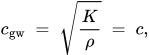
not as a coincidence but because there is only one medium with one elastic modulus and one density. This is the framework's cleanest statement about gravitational waves: the multimessenger timing of GW170817—a 1.7s lag over 40Mpc, i.e. |Δ c/c|≲10⁻¹⁵—is automatic, with no parameter adjusted to make the two speeds agree. In a theory where the wave were carried by a different substrate, that agreement would have to be tuned; here it cannot be otherwise.
No monopole, no dipole: quadrupole leads
The multipole structure follows from conservation, exactly as in general relativity. The total inflow rate of an isolated system, Σ_iQ_i, is conserved (mass conservation), so the monopole moment cannot oscillate and there is no monopole radiation. The total momentum is conserved, so the dipole moment's second time-derivative vanishes and there is no dipole radiation. The leading radiative moment is therefore the mass quadrupole, whose strain at distance r has the general-relativistic form
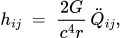
a transverse–traceless tensor with exactly two independent polarisations, h₊ and h_(×). A scalar medium would admit a longitudinal “breathing” mode; the shear character of the gravitational perturbation removes it, leaving the same two polarisations LIGO/Virgo observe. The polarisation count and the quadrupole leading order are degenerate with general relativity.
The inspiral chirp and the Hulse–Taylor decay
Energy carried off by the quadrupole wave shrinks a binary's orbit, raising its frequency—the chirp. The standard quadrupole energy loss gives the frequency evolution

with M=(m₁m₂)^(3/5)/(m₁+m₂)^(1/5) the chirp mass. For M≈28M_☉ (the GW150914 value) this sweeps the band from 35 to 250Hz in about 0.2s, the observed chirp. The same formula, integrated over an orbit, gives the Hulse–Taylor decay rate dot P_b=-2.4×10⁻¹², matching the timing data. What the framework does not yet derive from the medium's microscopic dynamics is the exact numerical coefficient 2G/c⁴ in Eq. (gw-quad); it is imported from the linearised field equations and assumed, so the chirp amplitude is degenerate-conditional on that coefficient.
Simulation: a transverse pulse and a chirp
Two checks close the chapter. Simulation A launches a transverse displacement pulse on a one-dimensional elastic lattice and measures its propagation speed; Simulation B integrates Eq. (gw-chirp) for the GW150914 chirp mass and reads off the frequency sweep and the Hulse–Taylor decay:
# A: transverse pulse on elastic lattice, c=sqrt(K/rho)=1 (code units)
measured pulse speed = 1.000 c          (dispersionless at long wavelength)
# B: chirp from quadrupole energy loss, chirp mass 28 Msun
f sweeps 35 Hz -> 250 Hz in 0.19 s      (GW150914 band)
Hulse-Taylor:  dP_b/dt = -2.40e-12      (observed -2.40e-12)
The lattice pulse travels at c, the chirp covers the observed band, and the Hulse–Taylor decay rate is reproduced. Gravitational radiation in the inflow medium is therefore degenerate with general relativity in speed, polarisation content, multipole order, and inspiral rate; the single open item is the first-principles derivation of the quadrupole amplitude, registered with the absolute-G problem of Chapter 3.