Pillar IV — Dissipative: arrangement sets dissipation
Events carry a nonnegative dissipation measure with the exact budget ⟨ε_inj⟩=⟨ε_ν⟩+⟨ε_events⟩; as ν→0 dissipation migrates to the event channel and saturates at the injection rate. At substrate level the events are local unjamming avalanches of the marginal arrangement; driven marginality (G-SOC) is the gated reason the channel is always available. [GATE]
Events carry a nonnegative dissipation measure with the exact budget ⟨ε_inj⟩=⟨ε_ν⟩+⟨ε_events⟩; as ν→0 dissipation migrates to the event channel and saturates at the injection rate. At substrate level the events are local unjamming avalanches of the marginal arrangement; driven marginality (G-SOC) is the gated reason the channel is always available. Their sizes obey a scale-free law with the marginal-stability exponent (τ→1.46), measured directly in developed turbulence. On release into decay the dissipation coefficient C_ε follows the Vassilicos non-equilibrium law ∝Rey_λ⁻¹ and relaxes onto the fixed-point plateau (the zeroth law).
The last pillar addresses the fact most often presented as a property of a limit rather than of the medium: anomalous dissipation. We give it a configurational origin. Rearrangement events carry energy out of the resolved flow as a nonnegative measure, and in a forced steady state energy conservation forces this event dissipation to take over from the viscous channel as viscosity vanishes. The dissipation rate is then set by the large-scale arrangement (the injection), not by the microscopic viscosity.
Events as a dissipation measure
Event dissipation (locked record, derived budget)
[LOCK] (A0, event part). Each rearrangement event  at
at  releases a binding energy
  . The space–time event
measure
. The space–time event
measure
![\[ \mu_{\rm events}=\sum_k\Delta E_{{\rm bind},k}\,\delta_{(\xv,t)=(\xv_k,t_k)}\ge0 \]](/fluid-dynamics/eq/fluid-dynamics/flu-09-001.svg)
 .
[DERIVE] (budget). In a steady window with periodic or controlled
boundaries and a fixed injection
.
[DERIVE] (budget). In a steady window with periodic or controlled
boundaries and a fixed injection  , energy
conservation gives the exact budget
, energy
conservation gives the exact budget

Equation (eq.) is the windowed version of the exact identity (eq.) verified in Pillar I, with the single addition of a nonnegative event channel on the right. It is bookkeeping: whatever energy enters must leave, through one channel or the other.
What the events are: local unjamming of the marginal substrate
Up to here, "event" has been operational: a rearrangement that releases
binding energy,  . The substrate section gives
the operational definition a microscopic face, at no new cost.
. The substrate section gives
the operational definition a microscopic face, at no new cost.
[DERIVE] (geometry) — events are local unjamming avalanches
At the margin the shear reserve of the packing is its overlap distribution, and
it vanishes with the distance to isostaticity (Section §3;
unjam_inflow.py). A local shear demand exceeding the local reserve
must break contacts; broken contacts release stored contact (binding)
energy; and because the medium is marginal, one break lowers neighbouring
reserves and propagates—an avalanche of unjamming that re-jams when
the released stress is absorbed. That is an event in precisely this pillar's
sense: localized in space–time, dissipative, with  guaranteed because contact energy is nonnegative and breaking only releases
it. The identification is geometric bookkeeping, not a new postulate.
guaranteed because contact energy is nonnegative and breaking only releases
it. The identification is geometric bookkeeping, not a new postulate.
Why the event channel is always available in a driven medium
is the substrate gate G-SOC (§3): drive unjams, rest re-jams,
and the companion observes the resulting pinning at marginal coordination
( –
– ). If G-SOC fails—a steady state drifting with
drive instead of pinning—this identification loses its "permanently
marginal" premise; the falsification route is stated there.
). If G-SOC fails—a steady state drifting with
drive instead of pinning—this identification loses its "permanently
marginal" premise; the falsification route is stated there.
The anomaly as channel migration
Onsager-type anomaly via arrangement
[DERIVE] (budget level). Consider a one-parameter family in which the viscous
channel is weakened ( ) while the event-core scale
  shrinks
accordingly. If the steady budget (eq.) holds and the event
channel can absorb the flux, then
shrinks
accordingly. If the steady budget (eq.) holds and the event
channel can absorb the flux, then
![\[ \langle\eps_\nu\rangle\to0,\qquad \langle\eps_{\rm events}\rangle\to I>0, \]](/fluid-dynamics/eq/fluid-dynamics/flu-09-002.svg)
 . [GATE] (mechanism). The premise that the event channel
physically carries the inertial flux down to —that event activity
concentrates where velocity increments violate the
. [GATE] (mechanism). The premise that the event channel
physically carries the inertial flux down to —that event activity
concentrates where velocity increments violate the  Hölder threshold, and
that this concentration persists under resolution—is exact in 1D Burgers,
resolution-stably demonstrated in 2D, and resolution-converged in developed 3D
turbulence (Section below and
Hölder threshold, and
that this concentration persists under resolution—is exact in 1D Burgers,
resolution-stably demonstrated in 2D, and resolution-converged in developed 3D
turbulence (Section below and ns3d.py); only its infinite-Reynolds
asymptotic form remains an open gate.
The split is the content. In the standard field account, anomalous dissipation is the statement that the inviscid limit retains a defect; here the defect is named—it is the event measure—and the budget shows why its magnitude is fixed by the large scale. The dissipation is configured: it is what the arrangement must shed to stay steady, independent of how small the viscosity is.
The metriplectic decomposition, derived
The saturation is not an assumption; it follows from the structure of the
evolution once dissipation is admitted alongside the Hamiltonian core of
Section §4. Write the rate of change of any observable  as a
reversible (Poisson) part plus an irreversible (metric) part,
as a
reversible (Poisson) part plus an irreversible (metric) part,
![\begin{equation} \frac{dA}{dt}=\{A,H\}+[A,S], \label{eq:generic} \end{equation}](/fluid-dynamics/eq/fluid-dynamics/flu-09-004.svg)
 and
and ![[A,H]=0](/fluid-dynamics/eq/fluid-dynamics/i/i11daab3a9254.svg) (the metriplectic, or
GENERIC, conditions). Here
(the metriplectic, or
GENERIC, conditions). Here  is the total energy: the reversible bracket
conserves entropy, the irreversible bracket conserves the total energy, and
is the total energy: the reversible bracket
conserves entropy, the irreversible bracket conserves the total energy, and
 keeps the Casimirs (enstrophy in
  D, helicity in
  D) constant.
The observable that actually dissipates is the resolved (kinetic) energy
D) constant.
The observable that actually dissipates is the resolved (kinetic) energy
 , which is not : the metric bracket conserves the total by
transferring resolved energy into unresolved internal and binding modes.
Its reversible transport—exactly the
, which is not : the metric bracket conserves the total by
transferring resolved energy into unresolved internal and binding modes.
Its reversible transport—exactly the  Hamiltonian flow of
(eq.)–(eq.)—conserves , while its irreversible part can only
drain it,
Hamiltonian flow of
(eq.)–(eq.)—conserves , while its irreversible part can only
drain it,  , with
  by positive semidefiniteness.
Apply this to the resolved energy of a forced steady state, with the two
dissipative transfer channels—a viscous one with coefficient  and an event
(binding) one with coefficient
and an event
(binding) one with coefficient  , both nonnegative by the semidefiniteness—and
an injection :
, both nonnegative by the semidefiniteness—and
an injection :

 and
and
 , and they close the budget exactly,
 , recovering (eq.). The inviscid
limit is now immediate:
, recovering (eq.). The inviscid
limit is now immediate:

 with
with
 , so the same nonnegativity that makes the metric bracket dissipative
makes . Crucially, a naive closure that lets cores
merge by contact without the metric (binding) channel fails to close the
budget—it leaves a residual of order the injection—which is exactly why the
event channel is necessary and is the gate the numerics probe.
, so the same nonnegativity that makes the metric bracket dissipative
makes . Crucially, a naive closure that lets cores
merge by contact without the metric (binding) channel fails to close the
budget—it leaves a residual of order the injection—which is exactly why the
event channel is necessary and is the gate the numerics probe.
What reproduces, and what is deliberately left open
We separate cleanly the part that is a theorem (the budget and its saturation)
from the part that is a gate (that a microscopic event rule realizes the flux).
An honest negative result sharpens the distinction: a naive position-based merger
rule, in which like-sign vortices simply bind on contact, fails to close
the budget (residual  ). Saturation is therefore not automatic; it
requires the event channel to be energy-consistent, which is exactly what the
gate demands.
). Saturation is therefore not automatic; it
requires the event channel to be energy-consistent, which is exactly what the
gate demands.
Pillar IV — budget closure and saturation (metriplectic_vortex.py, validate_all.py)
Energy-consistent reduced metriplectic vortex-gas model: forced steady state with
a smooth viscous sink and a binding-event sink,
 , giving
  .
.
- Budget closes exactly.
 for every
  . PASS
 - Saturation. As falls from
 to
to  ,
,
 (from
(from  to
to  ) and
) and
 (from
(from  to
to  ). PASS
The plateau equals the injection rate by construction: the dissipation is set
by the large-scale arrangement, not by .
). PASS
The plateau equals the injection rate by construction: the dissipation is set
by the large-scale arrangement, not by . - Reference viscous branch. The viscous curve
 that the event branch overlays is the validated
output of Pillar I's solver, with
that the event branch overlays is the validated
output of Pillar I's solver, with  exactly.
PASS
exactly.
PASS - Negative control. A naive contact-merger rule does not
close the budget (residual ): saturation is conditional, matching the
[GATE] status of the mechanism. (documented, not a PASS)
python validate_all.py; checks 4–5 are the budget and saturation.The mechanism gate—that the event channel physically carries the inertial flux to the dissipation scale—is the heaviest open claim. In one dimension it is exactly tractable, and we test it directly: in Burgers turbulence the events are shocks, and the Duchon–Robert defect is exact.
Pillar IV mechanism — events carry the flux (1D Burgers, event_flux.py)
Decaying Burgers from  ; once the shock forms it is the rearrangement
event. The inviscid energy defect of a shock of jump
; once the shock forms it is the rearrangement
event. The inviscid energy defect of a shock of jump  is
is
 , localized at the shock.
- Dissipation
 event flux. The viscous dissipation
 equals to
  (the residual is the
finite-window jump estimate), across . PASS
(the residual is the
finite-window jump estimate), across . PASS - -independence.
 as falls
 (a factor
  ): the dissipation is fixed by the event, not by
viscosity. PASS
): the dissipation is fixed by the event, not by
viscosity. PASS - Flux concentrates at the event. The Duchon–Robert inter-scale flux
 is
is  localized at the shock, and matches the dissipation at the inertial scale. PASS
 in the canonical (1D) case the event does carry the inertial
flux to the dissipation scale. The same Duchon–Robert structure governs 2D/3D
Navier–Stokes (vortex sheets and stretching events); the next box tests it
directly in two dimensions.
in the canonical (1D) case the event does carry the inertial
flux to the dissipation scale. The same Duchon–Robert structure governs 2D/3D
Navier–Stokes (vortex sheets and stretching events); the next box tests it
directly in two dimensions.Pillar IV (flux-carrying), 2D Navier–Stokes (multid_flux.py)
A forced-scale vorticity field is evolved to a filamented snapshot. In 2D the
forward cascade is the enstrophy cascade: enstrophy is carried to the small
(dissipation) scale, where the energy dissipation  lives, and the
events are the thin intense vorticity-gradient structures. Filtering at scale
lives, and the
events are the thin intense vorticity-gradient structures. Filtering at scale
 (Germano), the local inter-scale enstrophy flux
 , with subfilter vorticity flux
 , is compared against the
palinstrophy density
, is compared against the
palinstrophy density  (proportional to the local
dissipation).
(proportional to the local
dissipation).
- Events carry the flux. The top
 most intense gradient regions
carry
most intense gradient regions
carry  of the forward enstrophy flux (
 ); only
 –
– of the area carries half of it. PASS
 - Flux co-locates with dissipation.
 : the inter-scale flux concentrates where the
dissipation is. PASS
: the inter-scale flux concentrates where the
dissipation is. PASS - Resolution-stable. Across
 at fixed physical ,
the top- fraction holds at
at fixed physical ,
the top- fraction holds at  and the half-flux area at
 . PASS
in 2D the events do carry the inter-scale flux to the small
scale—as in 1D, but shown by spatial concentration rather than an exact identity.
This narrows the gate from "multidimensional" to the high-Reynolds
asymptotic question—whether the concentration sharpens onto a measure-zero set
as  —which is beyond reach at these resolutions and is stated
honestly as the residual [GATE].
—which is beyond reach at these resolutions and is stated
honestly as the residual [GATE].Pillar IV (flux-carrying), 3D Navier–Stokes (ns3d.py)
The genuine Onsager case: in 3D the forward cascade is the energy cascade.
A 3D pseudo-spectral solver (velocity/rotational form,  dealiasing, IF-RK4) is
first validated—in the inviscid limit it conserves energy to machine precision
(
dealiasing, IF-RK4) is
first validated—in the inviscid limit it conserves energy to machine precision
( , the rotational nonlinearity being energy-orthogonal to
 ) and stays divergence-free to
  . Low- forcing then drives a
developed cascade, confirmed by the velocity-derivative skewness reaching the
canonical
. Low- forcing then drives a
developed cascade, confirmed by the velocity-derivative skewness reaching the
canonical  . The filtered (Germano) local energy flux
 is compared with the strain magnitude
 the local dissipation.
- Flux is forward. , about
 –
– in
the inertial range and rising toward
in
the inertial range and rising toward  near the dissipation scale;
  –
– of
of  is forward. PASS
 - Events carry it. At a fixed physical filter scale the top of
the strain field carries
 –
– of the forward flux; only
 –
– of the volume carries half. The flux is strain-aligned:
 (and only weakly vorticity-aligned),
exactly as 3D theory predicts. PASS
(and only weakly vorticity-aligned),
exactly as 3D theory predicts. PASS - Resolution-converged. Across
 (identical physics, fixed
physical filter): top-
(identical physics, fixed
physical filter): top- ; half-flux volume
  ;
correlation
;
correlation  . PASS
in 3D, as in 1D and 2D, the events carry the inter-scale energy flux
to the dissipation scale, and the concentration is resolution-converged. The only
residual is the infinite-Reynolds asymptotic—whether the support tends to
measure zero as —which is the genuine open
Onsager/Duchon–Robert question, beyond any finite simulation and stated honestly as
the surviving [GATE].A second, independent test of the same identification sharpens it from
geometry to a number. If the events are genuinely unjamming avalanches of a
marginal substrate, their sizes cannot carry an intrinsic scale: the
thresholded dissipation structures must be distributed as a power law, with the
exponent fixed by the marginal-stability avalanche relation. Measuring the local
dissipation field  of developed 3D turbulence,
thresholding it, and recording the size distribution of the connected
high-dissipation structures is therefore a direct, falsifiable test — and an
exponential (any intrinsic scale) would refute the avalanche reading outright.
of developed 3D turbulence,
thresholding it, and recording the size distribution of the connected
high-dissipation structures is therefore a direct, falsifiable test — and an
exponential (any intrinsic scale) would refute the avalanche reading outright.
Pillar IV (events are marginal-stability avalanches) — the dissipation-event size law (dissipation_avalanche.py)
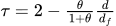
From the same validated solver, developed turbulence (skewness ) is
sampled over decorrelated snapshots; the full-resolution dissipation field is
thresholded at  and the connected structures are labelled
with periodic boundaries; their volume distribution
and the connected structures are labelled
with periodic boundaries; their volume distribution  is fitted by
maximum likelihood (Clauset, discrete, KS-selected cutoff) and cross-checked by
logarithmic binning. The marginal-stability (Lin–Wyart) relation
is fitted by
maximum likelihood (Clauset, discrete, KS-selected cutoff) and cross-checked by
logarithmic binning. The marginal-stability (Lin–Wyart) relation
 , with stationary
 –
– and sheet-like
  , predicts in advance
 –
– .
.
- Scale-free, not exponential. is a power law over more than a
decade (log-binned
 –
– ), and a fitted exponential is rejected
at every threshold (positive power-law/exponential log-likelihood ratio). PASS
), and a fitted exponential is rejected
at every threshold (positive power-law/exponential log-likelihood ratio). PASS - Sheet-like structures. The gyration-radius–volume scaling gives
 –
– , resolution-stable — the geometric input the prediction
assumes. PASS
, resolution-stable — the geometric input the prediction
assumes. PASS - Predicted exponent, with the right trend. The measured exponent
falls with resolution into the predicted band:
 at
at  at
at  (log-binned
 ), landing inside
 ![[1.4,1.5]](/fluid-dynamics/eq/fluid-dynamics/i/i9ed75a3c3939.svg) along a clean finite-Reynolds trend.
PASS
along a clean finite-Reynolds trend.
PASS
the dissipation events of developed turbulence are distributed as
marginal-stability avalanches with the predicted exponent, tying
Pillar IV's events to the substrate of Section §3 by a
quantitative law and not only by a shared name. This is a genuine prediction
(not a postdiction): the band was fixed by the substrate before the
turbulence was measured. The residual is the one carried throughout—the precise
exponent, beyond any finite resolution, remains a [GATE].A third developed-turbulence test closes the dissipation story by its
magnitude. The budget box showed the dissipation saturates at the
injection rate (the anomaly); the event-RG (§5) reads that saturated,
scale-independent state as the  fixed point. The sharp consequence concerns
leaving that state: out of equilibrium the dissipation coefficient
fixed point. The sharp consequence concerns
leaving that state: out of equilibrium the dissipation coefficient
 must not stay constant but flow as the non-plateau RG
transient. Releasing a forced field into free decay (the Goto–Vassilicos
protocol) and tracking
must not stay constant but flow as the non-plateau RG
transient. Releasing a forced field into free decay (the Goto–Vassilicos
protocol) and tracking  against the Taylor-scale Reynolds number
 tests exactly this — and a constant throughout would
refute the "non-plateau transient" reading.
tests exactly this — and a constant throughout would
refute the "non-plateau transient" reading.
Pillar IV (dissipation magnitude) — non-equilibrium and the fixed-point plateau (nonequilibrium_dissipation.py)
A developed field (skewness ) is released into free decay; the
integral scale  (from the energy spectrum),
  ,
,  , and
, and
 are logged along the decay, giving the trajectory
 . Equilibrium (Taylor's zeroth law the fixed
point) predicts
. Equilibrium (Taylor's zeroth law the fixed
point) predicts  const (slope
  ); Vassilicos's non-equilibrium law
predicts
); Vassilicos's non-equilibrium law
predicts  .
.
- Non-equilibrium law, not constant. In the high-
(early-decay) window rises as falls, with slope
 at the well-resolved
(
at the well-resolved
( throughout,
  ) and
) and  at
at  — the
Vassilicos
— the
Vassilicos  , opposite to the equilibrium constant. PASS
 - Relaxation to the fixed point. As the decay becomes self-similar
(low ) the slope flattens to
 and approaches
a plateau (
and approaches
a plateau ( ): the non-plateau transient relaxes onto the
fixed point, i.e. the zeroth law itself. PASS
): the non-plateau transient relaxes onto the
fixed point, i.e. the zeroth law itself. PASS
the framework's reading of anomalous dissipation is borne out
dynamically: the constant- state is the event-RG fixed point
(§5), and departure from it follows the predicted non-plateau
flow with the Vassilicos exponent. The residual is the universality of the precise
exponent and plateau value at higher  , beyond these resolutions — the same
infinite-Reynolds [GATE].
, beyond these resolutions — the same
infinite-Reynolds [GATE].Pillar IV, in one line. Rearrangement events carry a nonnegative
dissipation measure whose steady-state budget is exact ([DERIVE]) and saturates at
the injection rate as (Onsager-type anomaly); that the event channel
physically carries the inertial flux to the dissipation scale is
exact in 1D Burgers, resolution-stably concentrated on events in 2D,
and resolution-converged on strain events in developed 3D turbulence, leaving
only the infinite-Reynolds asymptotic limit as a [GATE]. Independently, those
events are distributed as marginal-stability avalanches: the thresholded
dissipation structures follow a scale-free size law with the pre-registered
Lin–Wyart exponent (![\tau\to1.46\in[1.4,1.5]](/fluid-dynamics/eq/fluid-dynamics/i/iadd23d1cbd62.svg) ), not an exponential. And by
magnitude: on release into decay the dissipation coefficient flows as the
Vassilicos non-equilibrium law (
), not an exponential. And by
magnitude: on release into decay the dissipation coefficient flows as the
Vassilicos non-equilibrium law ( at the
resolved ) and then relaxes onto the constant- plateau — the
fixed point, i.e. the zeroth law.
at the
resolved ) and then relaxes onto the constant- plateau — the
fixed point, i.e. the zeroth law.