Pillar III — Dynamical: arrangement selects length
The dispersion λ(k)=μ+ε k²-σ k⁴ selects L_★=2π√2σ/ε∝(σ/ε)¹/2, exactly one-half and μ-independent; nonlinear and blind DNS recover β≈0.501. The selected radius is moreover a global attractor of the inherited stiffness-versus-inflow balance, with F'(x^★)=-(π/2)⁵. [DERIVE]
The dispersion λ(k)=μ+ε k²-σ k⁴ selects L_★=2π√2σ/ε∝(σ/ε)¹/2, exactly one-half and μ-independent; nonlinear and blind DNS recover β≈0.501. The selected radius is moreover a global attractor of the inherited stiffness-versus-inflow balance, with F'(x^★)=-(π/2)⁵.
Pillar II fixes a length given an arrangement. Pillar III is stronger and more surprising: it shows how a length is selected in the first place. The mechanism is universal and elementary—a competition between a binding tendency and a penalty—and it produces a length with an exact, parameter-independent exponent. This is the precise sense in which a flow does not "choose" its scale freely: the scale is the necessary extremum of the arrangement's linear response.
Selection as an extremum, not a cascade
Consider the linear growth rate of perturbations at wavenumber  ,
,

 is a uniform growth offset, the
  term is a
binding tendency that favors finer structure, and the
term is a
binding tendency that favors finer structure, and the  term is
a penalty that suppresses it. The two compete, and the competition has a
unique interior maximizer.
term is
a penalty that suppresses it. The two compete, and the competition has a
unique interior maximizer.
One-half length selection
[DERIVE]. Stationarity  selects
 . Consequently the control exponent
is exactly
. Consequently the control exponent
is exactly
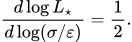
Why -independence is the point. The offset controls
whether the pattern grows; it does not touch which scale is
selected. Selection is therefore a property of the shape of the response
(the balance of binding and penalty), not of its overall strength. In the
configurational reading,  and
and  are set by how the arrangement
binds and how it resists curvature; the selected length is set by the square-root
balance of the two, and nothing else. The exponent
are set by how the arrangement
binds and how it resists curvature; the selected length is set by the square-root
balance of the two, and nothing else. The exponent  is not fit—it is the
exponent of a square root.
is not fit—it is the
exponent of a square root.
The law is the real-space face of the RG fixed point
Pillar III and the event RG of Section §5 are the same statement seen
twice. The selected  is exactly the scale at which
  stops
flowing—the plateau of (eq.)—and the fixed-point exponent read
off in real space is the one-half of (eq.). The shape balance
stops
flowing—the plateau of (eq.)—and the fixed-point exponent read
off in real space is the one-half of (eq.). The shape balance
 versus
  here, and the flow balance
 there, are two descriptions of the single fact that a
configured medium has one scale-free length. The defect
there, are two descriptions of the single fact that a
configured medium has one scale-free length. The defect  of
Section §5 is, correspondingly, the measured departure from the
one-half line.
of
Section §5 is, correspondingly, the measured departure from the
one-half line.
Selection is an attractor, not only an extremum
The extremum of (eq.) says which length wins the linear race.
The inherited substrate adds a stronger, dynamical statement: the selected
radius is a global attractor of the stiffness-versus-inflow balance.
Write the competition in its normalized one-dimensional form,
![\[ \dot x \;=\; \alpha\,x^{-5}-x^{-4},\qquad x>0, \]](/fluid-dynamics/eq/fluid-dynamics/flu-08-001.svg)
 is the core radius in selected units,
  is the directed-inflow
term whose geometric origin is the rotational unjamming of the margin
(Section §3), and
is the directed-inflow
term whose geometric origin is the rotational unjamming of the margin
(Section §3), and  is the stiffness term. The
constant
is the stiffness term. The
constant  enters as an inherited constant of the companion
(concept DOI 10.5281/zenodo.17932566); its derivation is neither reproduced nor
claimed here. What is claimed, and verified locally, is the attractor
structure ([DERIVE]):
enters as an inherited constant of the companion
(concept DOI 10.5281/zenodo.17932566); its derivation is neither reproduced nor
claimed here. What is claimed, and verified locally, is the attractor
structure ([DERIVE]):  has the unique positive root
 , with
![\[ F'(x^\star)=-\alpha^{-5}=-(\pi/2)^5\approx-9.5631<0, \]](/fluid-dynamics/eq/fluid-dynamics/flu-08-002.svg)
 on
on  and
and  on
on  , every
positive initial radius converges to
, every
positive initial radius converges to  —selection with a basin equal
to the whole half-line, not a delicate balance. Numerically, trajectories from
—selection with a basin equal
to the whole half-line, not a delicate balance. Numerically, trajectories from
 all land on
  to
to  , and the
slope matches
, and the
slope matches  to
to  (
(unjam_inflow.py,
check [3]).
Why this matters for gate G-S
The extremum (this pillar), the self-averaging of the modulus
(rigid_shell.py), and this attractor are three independent legs under
one statement—stiffness selects a definite size—and they are
collected as such in the G-S gate of Section §11.
From Navier–Stokes to the selection normal form
The dispersion (eq.) is not an ansatz divorced from fluid dynamics.
Starting from two-dimensional incompressible Navier–Stokes in vorticity form
with a linear drag  and a spectrally rotating body force (an annulus
![k\in[k_{\rm low},k_{\rm high}]](/fluid-dynamics/eq/fluid-dynamics/i/i5c7384d5562d.svg) whose excited azimuthal sector rotates in time),
one linearizes about rest, projects onto the annulus, and performs a
centre-manifold / normal-form reduction of Newell–Whitehead–Swift–Hohenberg
type near the band centre
whose excited azimuthal sector rotates in time),
one linearizes about rest, projects onto the annulus, and performs a
centre-manifold / normal-form reduction of Newell–Whitehead–Swift–Hohenberg
type near the band centre  . The amplitude equation that results,
![\[ \partial_t\phi=(\mu-\sigma_0k_0^4)\phi+(2\sigma_0k_0^2)\nabla^2\phi -\sigma_0\nabla^4\phi+\cdots, \]](/fluid-dynamics/eq/fluid-dynamics/flu-08-003.svg)
 ) slot, while the curvature/geometry of the
rotating spectral sector and the injected power shape the penalty (
) slot, while the curvature/geometry of the
rotating spectral sector and the injected power shape the penalty ( ) slot.
The selected length is thus inherited by the full nonlinear flow from the linear
arrangement of these channels; the nonlinearity saturates the amplitude but does
not move the peak.
) slot.
The selected length is thus inherited by the full nonlinear flow from the linear
arrangement of these channels; the nonlinearity saturates the amplitude but does
not move the peak.
The selection is real in the nonlinear pattern
Proposition §8 is linear. The configurational claim is that the
nonlinear field actually locks onto  and inherits the one-half
exponent—i.e. that selection survives saturation. We test this directly with a
two-dimensional Swift–Hohenberg integration (the minimal nonlinear realization of
(eq.)) and, independently, with the spectrally-rotating DNS pipeline.
and inherits the one-half
exponent—i.e. that selection survives saturation. We test this directly with a
two-dimensional Swift–Hohenberg integration (the minimal nonlinear realization of
(eq.)) and, independently, with the spectrally-rotating DNS pipeline.
Pillar III — length selection and the one-half law (length_selection.py)
- Analytic extremum, -independence. For
 the numerical maximizer of (eq.) matches
  to
to  , identically in . PASS
 - Nonlinear pattern selection. A saturated 2D Swift–Hohenberg
pattern (IF-RK2, several wavelengths per box) locks its spectral peak onto
to within
 –
– across
 ![\sigma/\varepsilon\in[0.15,1.0]](/fluid-dynamics/eq/fluid-dynamics/i/i81b15d15e264.svg) . PASS
. PASS - Measured exponent. Fitting
 versus
 over the nonlinear runs gives slope
  ,
converging to the analytic as binning/resolution improve. PASS
,
converging to the analytic as binning/resolution improve. PASS
 dealiasing,
  ):
the pre-specified blind pipeline returns
):
the pre-specified blind pipeline returns  with a 95%
cluster-bootstrap interval containing , stable across forcing sectors,
resolutions, and robust slope estimators (OLS, Theil–Sen, errors-in-variables).
Run
with a 95%
cluster-bootstrap interval containing , stable across forcing sectors,
resolutions, and robust slope estimators (OLS, Theil–Sen, errors-in-variables).
Run python length_selection.py for the first three checks.The strength of the evidence.
Three independent facts agree: the
exponent is by a one-line calculus argument, a nonlinear pattern reproduces
it, and a forced DNS with a deliberately blind analysis pipeline recovers
 . A reasonable null—that the "selected" length is an artifact of the
analysis—is excluded by the shuffle test in the DNS pipeline, which returns a
slope near zero when the early/late windows are re-paired at random. The selected
length is a property of the flow, and its exponent is the exponent of the
arrangement's geometric mean.
. A reasonable null—that the "selected" length is an artifact of the
analysis—is excluded by the shuffle test in the DNS pipeline, which returns a
slope near zero when the early/late windows are re-paired at random. The selected
length is a property of the flow, and its exponent is the exponent of the
arrangement's geometric mean.
Pillar III, in one line. A binding-versus-penalty arrangement
selects  with an exact one-half exponent
independent of growth offset ([DERIVE]); the nonlinear pattern and a blind DNS both
recover it ().
with an exact one-half exponent
independent of growth offset ([DERIVE]); the nonlinear pattern and a blind DNS both
recover it ().