Two axes of dating accuracy
Every radiometric age splits into two independent axes: internal integrity (the clock) and event attribution (the sample). U–Pb adds a self-check radiocarbon lacks — ²³⁸U→²⁰⁶Pb and ²³⁵U→²⁰⁷Pb must be concordant. Essentially all accuracy risk lies on the attribution axis: an interpretive and geochemical limit, not a precision one.
Any radiometric age splits into two independent axes: internal integrity (the clock) and event attribution (the sample). U–Pb carries a built-in self-check absent in radiocarbon—two clocks, ²³⁸U → ²⁰⁶Pb and ²³⁵U → ²⁰⁷Pb, must agree (concordance). Essentially all accuracy risk lives on the attribution axis, an interpretive and geochemical limit rather than a precision one.
Every radiometric age can be decomposed along two independent axes.
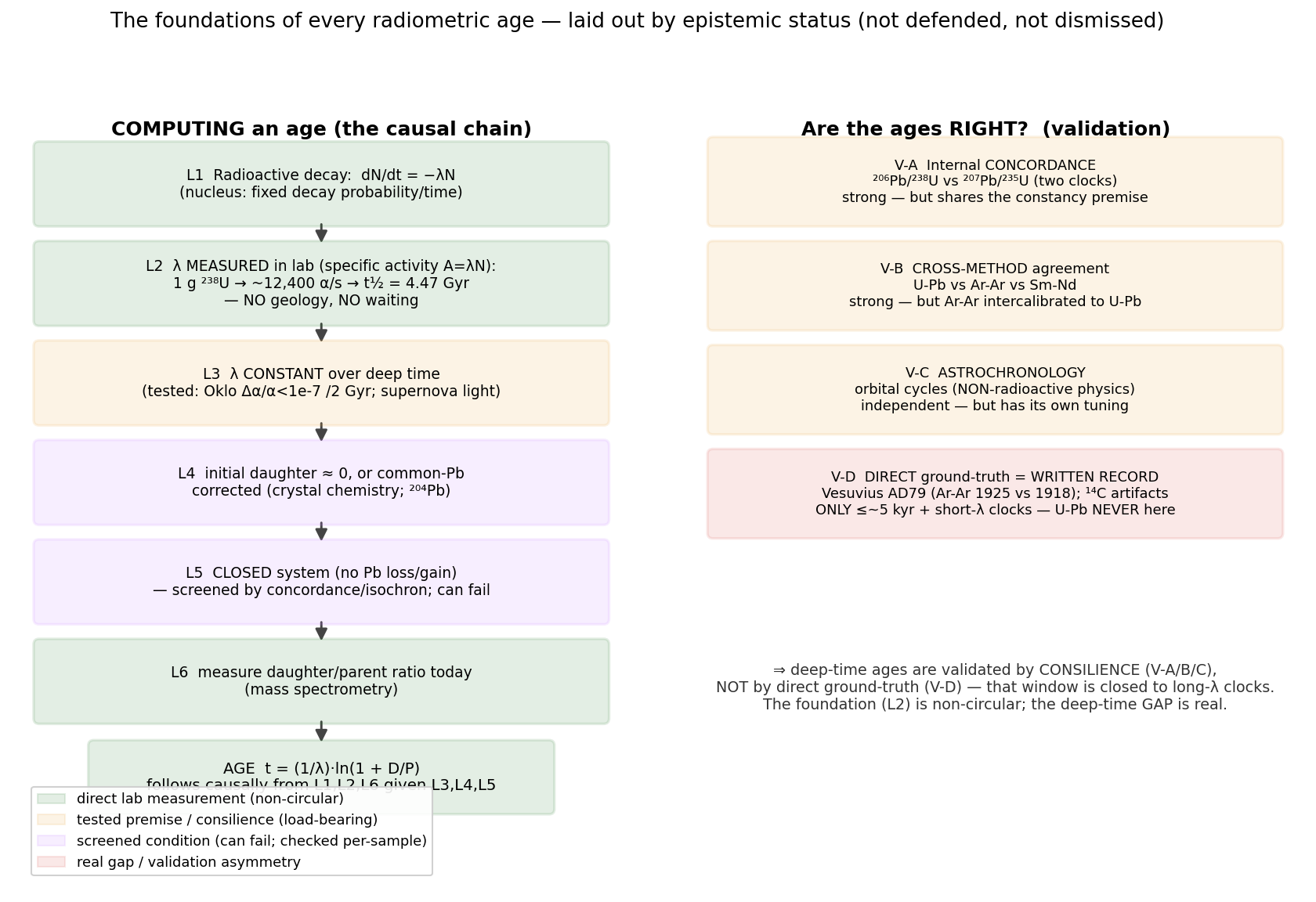
Axis A — internal integrity (the clock). Given a closed system and a known initial state, does the measured parent–daughter ratio yield the right elapsed time? For U–Pb the answer is unusually strong, because two independent clocks (²³⁸U → ²⁰⁶Pb and ²³⁵U → ²⁰⁷Pb) must agree—the concordance constraint, a built-in self-check that radiocarbon lacks. [F]
Axis B — event attribution (the sample). Does the dated material correspond to the event one wishes to date, and has it remained a closed system? This axis carries essentially all of the accuracy risk that this paper is about. It is not a precision limit and not a technology limit; it is an interpretive and geochemical limit.