Spatiotemporal mapping: making the mechanism
Spatiotemporal mapping: making the mechanism testable — So far we only checked plausible orders for rupture speed and time window. However, “time” alone leaves the model weakly falsifiable unless it specifies where rupture starts and how it propagates on the map (LOCK → Derive → Gate).
So far we only checked plausible orders for rupture speed and time window. However, “time” alone leaves the model weakly falsifiable unless it specifies where rupture starts and how it propagates on the map (LOCK → Derive → Gate).
So far we only checked plausible orders for rupture speed and time window. However, “time” alone leaves the model weakly falsifiable unless it specifies where rupture starts and how it propagates on the map. This subsection pre-registers a minimal model that ties rupture to geography.
Candidate nucleation points
This stage does not assert a single nucleation point. Instead it defines a candidate set based on weaknesses such as (i) sutures, (ii) triple junctions/transform faults, and (iii) strong rigidity contrasts, and then uses P5 (opening-onset clustering) data to select among them. Table §12 shows representative seeds; coordinates are initial hypotheses to be updated by data.
Figure.
Candidate nucleation points (initial seeds). Coordinates are updated by data.}
ID Lat Lon Rationale (hypothesized) S1 ~ 0^(°) ~ -15^(°) Near-equatorial Atlantic: dense rigidity contrasts/transforms; a plausible “branching point” for north–south propagation. S2 ~ -55^(°) ~ 0^(°) South Atlantic–Antarctic vicinity: candidate weakness set where ridges/fractures/triple-junction elements coexist. N1 ~ +65^(°) ~ -20^(°) North Atlantic (Iceland region): concentrated heat-flow/structural weakness; candidate northern nucleation.
One-dimensional parameterization: arc-length s and arrival time t(s)
Define an along-rupture coordinate s (with s=0 at nucleation), and allow a location-dependent propagation speed v(s). Then the arrival time is 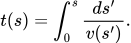
Variable speed model: v(s) from rigidity and damage
Rupture speed need not be uniform; it can depend on rigidity, fracture toughness, and the presence of pre-existing fault zones. We use a minimal parameterization 
Pre-registered test idea. If “opening-onset signals” (stratigraphic transition points, extensional fault assemblages, early oceanic-crust indicators, etc.) are organized by latitude/longitude, one can invert for the best nucleation candidate (S1/S2/N1, etc.) and a piecewise φ(s). If propagation ordering cannot be inferred at all or candidates are indistinguishable, the zipper-propagation element (AR-3) should be downgraded to HOLD.