Asymmetric stabilization: Pacific sloshing
Asymmetric stabilization: Pacific sloshing vs Atlantic filling — This model treats the two oceans’ origins as different: the Pacific behaves as a source-like region whose uplift and subsidence leave a damped, sloshing oscillation, while the Atlantic fills an opening void. The two regimes predict distinct sea-level signatures — overshoot versus sustained rise.
This model treats the origins of the two oceans as different (LOCK → Derive → Gate).
Core idea
This model treats the origins of the two oceans as different:
- Pacific: source-like region — uplift followed by subsidence leaves elastic/viscoelastic oscillation.
- Atlantic: rupture-like region — newly opened volume is filled by water/sediment, leading to monotone stabilization.
Toy model 1: Pacific sloshing (damped oscillation)
Let Pacific-floor displacement be x(t) and sketch a damped harmonic oscillator 
Toy model 2: Atlantic filling (volume charging)
Let the “empty volume” of the Atlantic basin be V(t). A conceptual filling sketch is 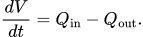
Translation into a test (P3)
P3 must be locked as a test that includes:
- fixed correction version: how GIA/crustal motion/sediment/human-activity corrections were applied,
- fixed feature definitions: e.g., overshoot amplitude A, relaxation half-time t_1/2, monotonicity index,
- stability: leave-one-out checks to ensure the pattern is not dominated by a single site.