Scale checks and Omega-NoGo constraints
Scale checks and Omega-NoGo constraints — This subsection performs first-pass feasibility checks on force/friction/time/impulse scales. If pre-registered Ω-NoGo constraints are violated, the corresponding conclusion is treated as HOLD or STOP. The ratio must be read honestly across scales. The material jamming law is lab-grounded and scale-invariant.
This subsection performs first-pass feasibility checks on force/friction/time/impulse scales. If pre-registered Ω-NoGo constraints are violated, the corresponding conclusion is treated as HOLD or STOP.
This subsection performs first-pass feasibility checks on force/friction/time/impulse scales. If pre-registered Ω-NoGo constraints are violated, the corresponding conclusion is treated as HOLD or STOP.
Tensile failure condition (order)
The failure relation is 
Required inertia scale for a target displacement/time (order)
Use a simple constant-acceleration (from rest) model achieving displacement d in time window T: 

Suction vs friction: the key inequality and ratio Λ
Using the combined resistance shear stress (Eq. §14), 


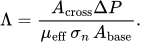
Recommended pre-registered decision rules (examples):
- TEST-L1: under conservative input distributions, if (Λ>1)≥ 0.95, UNLOCK.
- TEST-L2: if (Λ>1)<0.50, STOP.
- TEST-L3: otherwise, HOLD (needs additional data/definitions).
Master-scale accounting: what extrapolates and what is on HOLD
The ratio Λ must be read honestly across scales.
(1) What extrapolates (UNLOCK-eligible). With friction pinned by liquefaction (Section §14), the broad-prior STOP (TEST-L2) is superseded: writing μ_eff=η_flowV/(hσ'), Δ P≤σ', and the slab geometry A_cross/A_base=d/W (detachment depth d, block width W), 
(2) What is on HOLD (the master gamble). Equation §16 is scale-explicit (Λ∝ d²/W): the continental dimensionless geometry d²/W≈ 36 m cannot be reproduced in a normal laboratory sample (matching it at W=1 cm would require a 0.6 m-thick, 1 cm-wide specimen). The system-scale suction runaway therefore does not lab-reproduce, and the continental claim rests on the geometry being correct at scale, not on a clean laboratory-to-Earth dimensionless invariance. We register this explicitly as HOLD (master scale gate), to be narrowed by (i) natural small-basin tests — the same Λ predicts shallower detachments in smaller basins, d_crit∝√(W) (Red Sea ~ 3.3 km, Afar ~ 1.9 km; cf. P7) — or (ii) scale-matched continuum simulations.
Trigger and Ω-NoGo (computed). A shell membrane perturbation σₘ=E Δ R/R reaches tensile-rupture initiation (~ 10 MPa) at Δ R≈ 0.6 km and mobilizes deep σ' (~ 400 MPa) at Δ R≈ 25 km — both inside Ω-NoGo (Δ R<50 km). All six Ω-NoGo limits pass (5/5 active checks; see Section §7). The trigger's origin remains external (assumption-register item), so this establishes only that a sufficient Δ R is within bounds.
Field-test outcome (r17). An attempt to narrow this HOLD against natural analogs (Red Sea, Afar, Baikal, East Africa; P7, Section §18) found that observed detachment/BDT depth is thermally controlled (Spearman(d_obs,coldness)=+1.00) rather than width-controlled (Spearman(d_obs,W)=-0.56), so the √(W) feasibility edge d_crit is not directly observable in rifts. The HOLD therefore stands; the mechanism's cold-thick-lithosphere siting prediction is, however, corroborated.
Timescale/impulse constraint: locking the “instant low-pressure” issue into equations
If suction acts only for a short time τ, impulse (not static force) matters: 

Ω-NoGo (draft): pre-registering “this is too much”
Item Ω-NoGo (draft) Meaning Required Δ R STOP if Δ R ≳ 50 km Model requires excessive uplift to trigger failure Required Δ P STOP if Δ P ≳ 500 MPa Suction requires an implausible pressure difference μ_eff HOLD if μ_eff ≳ 10⁻² Without lubrication, other resistance-reduction is needed Film thickness h STOP if h ≲ 10⁻⁶ m is required Film must be unrealistically thin Time window τ HOLD if only τ ≪ 10³ s is possible Too short to explain large displacement Drainage condition HOLD/FAIL if τ ≳ τ_drain Undrained condition fails; overpressure collapses; squeeze-out risk
Note: the numbers above are drafts. The rigor is not “picking numbers,” but fixing thresholds before analysis and publicly reporting PASS/FAIL.
Pre-registration key map: TeX symbols/tables ↔ config/constraints.yml
This TeX document is the explanatory layer. The authoritative source of PASS/FAIL decisions is config/constraints.yml (and, if P8/P9/P10–P12 are enabled, the corresponding config/p*_prereg.yml files). If TeX and YAML conflict, YAML overrides TeX (reproducibility rule).
TeX item YAML key Unit Decision Hard STOP for Δ R omega_nogo.deltaR_stop_kmkm STOP if exceeded Hard STOP for Δ P omega_nogo.deltaP_stop_MPaMPa STOP if exceeded Minimum requirement for μ_eff omega_nogo.mu_eff_hold_min– HOLD/FAIL if unattainable Hard STOP for film thickness h omega_nogo.h_stop_mm STOP if required below Reference gate for time window τ omega_nogo.tau_hold_ss HOLD if too short Undrained requirement omega_nogo.undrained_requiredbool HOLD/FAIL if τ≥τ_drain Optional P6 propagation fit predictions.P6.*– UNLOCK if thresholds pass Optional P8 magnetic stripes predictions.P8.prereg_filepath fixed in a separate file Optional P9 orogeny predictions.P9.prereg_filepath fixed in a separate file Optional P10 sediment thickness predictions.P10.prereg_filepath fixed in a separate file Optional P11 Mn nodules predictions.P11.prereg_filepath fixed in a separate file Optional P12 volcanism predictions.P12.prereg_filepath fixed in a separate file
Operational rules (enforced).
- If
config/constraints.ymlor anyconfig/p*_prereg.ymlfile changes, issue a new version number. - The automatic gate script (
tests/tests_hardgate.py) reads these keys and logs PASS/FAIL.