Pre-registered predictions P9 to P16
Pre-registered predictions P9 to P16 — This prediction is not a necessary condition for the Atlantic mechanism (C1–C3). Rather, it is a cross-check module to test whether an “event-like (high-rate) deformation” regime is physically plausible at crustal scales, and what independent signatures it would leave (or why it would not) (LOCK → Derive → Gate).
This prediction is not a necessary condition for the Atlantic mechanism (C1–C3). Rather, it is a cross-check module to test whether an “event-like (high-rate) deformation” regime is physically plausible at crustal scales, and what independent signatures it would leave (or why it would not) (LOCK → Derive → Gate).
This prediction is not a necessary condition for the Atlantic mechanism (C1–C3). Rather, it is a cross-check module to test whether an “event-like (high-rate) deformation” regime is physically plausible at crustal scales, and what independent signatures it would leave (or why it would not). (Reference code: TGU-SIM-2025-A.)
Core physics: Deborah number (De). Define 
Important confusion to avoid. The white paper's v_rupture~km/s refers to rupture-propagation speed; it must not be conflated with the plate sliding speed v. P9 checks whether the timescale of “slip/relative displacement” (e.g., orogen/nappes formation) can itself enter a De≫ 1 regime.
Auxiliary order-of-magnitude calculation (energy bound; optional).
Evidence-level caution (no exaggeration). Klippen/nappes, UHP minerals (coesite/diamond), and inverted metamorphism (thermal disequilibrium) can often be explained in multiple standard scenarios. Therefore P9 does not infer speed from mere “existence.” It adjudicates regimes (De≪1 vs De≫1) only via pre-registered quantitative metrics (Δ t, v_exh, t_event/t_diff, etc.).
If one assumes that an orogen's gravitational potential increase PE~ M g (H/2) must be supplied as kinetic energy of collision/impact in a short time (AR-13), then a “required speed” scale can be defined as 
Data (minimum). (1) P–T–t paths of UHP/HP metamorphic belts (peak pressure, peak time, cooling/uplift time), (2) inverted metamorphism / thermal disequilibrium cases, (3) spatial-temporal constraints of “upper sheet” structures such as nappes/klippen.
Test (example).
- TEST-ORO1: estimate average exhumation speed v_exh=Δ z/Δ t from peak depth (pressure-converted) and uplift time Δ t, then classify the regime under De sensitivity (multiple τ_relax assumptions).
- TEST-ORO2: compare thermal diffusion time t_diff~ L²/κ to event time t_event, adjudicating whether thermal disequilibrium is “required” or reproducible in standard thermo-structural models.
FALSIFIER (example).
- If many (pre-registered N) representative UHP/HP cases consistently have Δ t of several Myr and independent thermochronometers/diffusion clocks support it, a “fast pile-up” interpretation is FAIL/HOLD in P9.
- Conversely, if multiple independent clocks consistently force very short Δ t (e.g., ≪ 0.1 Myr) and that short window is simultaneously consistent with structural/thermal signatures, P9 becomes an UNLOCK candidate.
Pre-registration file (recommended; optional). Lock (i) case selection rules, (ii) τ_relax ranges, and (iii) PASS/FAIL thresholds in config/p9_orogeny_prereg.yml.
Recommended DataPack (stub). data/orogeny/uhp_exhumation_cases.csv (Appendix F expansion module).
r17 computed result (honest HOLD). TEST-ORO1: representative UHP terranes exhume from ~100 km over Δ t≈3–20 Myr (Dabie–Sulu subduction ~10–11 Myr, exhumation ~19–20 Myr; WGR >2.5–8.5 km Myr⁻¹), i.e. v_exh~0.5–3 cm yr⁻¹ (fast end ~10 cm yr⁻¹ for coesite preservation; Liou 1994). With τ_M=η/G and crustal η~10²¹–10²⁴ Pa s, the standard exhumation sits at De≪1 (viscous ductile flow). Since these Δ t are of order Myr (≫0.1 Myr), the whitepaper's own falsifier makes a fast-pile-up reading FAIL/HOLD: P9 = HOLD. The orogenic UHP record is consistent with standard slow exhumation and does not independently establish a high-rate regime. By contrast the mechanism's own slip (τ_proc~ s–day) gives De≫1 (brittle), consistent with the WP-T1 stick–slip prediction — but that is a prediction (brittle fault/breccia signatures, distinct from deep ductile exhumation), not independent confirmation. P9 thus remains a cross-check that neither refutes nor confirms the rapid core, and it does not infer speed from the mere existence of UHP/nappe structures (TEST-ORO2: a ~10 km body's thermal diffusion time ~3 Myr is reproducible in standard thermo-structural models).
P10 (optional): Atlantic sediment thickness/budget — is “thin” an age issue?
This prediction forbids impressionistic statements like “sediment is thin/thick” and locks the thickness–age–space relationship as a data test. (Reference code: TGU-SED-2025.)
Key caution. Even under the standard model (H-STD), near-ridge (young crust) sediment thickness being near zero can be expected. Therefore P10's question is not “why is the ridge bare,” but whether the observed thickness field and core chronology are consistent with long-duration accumulation.
Auxiliary order-of-magnitude budget. Let net Atlantic sediment mass flux be F_Atl, mean density ρₛ, and area A_Atl. A simple mean thickness is 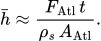
Data (minimum).
- global (or Atlantic) sediment thickness grids (seafloor thickness model) + uncertainty,
- oceanic crust age grids (chronology model) + ridge/transform masks,
- DSDP/ODP/IODP core samples (or public summaries) of sedimentation rate/age (biostrat/magnetostrat).
Test (example).
- TEST-SED1 (thickness–age fit): fit h(d) or h(t_crust) in the Atlantic versus distance d from the ridge or crust age t_crust, and assess whether residuals fall within what the standard model (low sedimentation + redistribution) can explain.
- TEST-SED2 (core cross-validation): check whether grid-based h matches integrated core-based sedimentation rates (or whether there is a systematic mismatch).
FALSIFIER (example).
- Strong falsifier against “young opening”: if cores across the Atlantic systematically span wide ages (tens to hundreds of Myr), and magnetostrat/biostrat are mutually consistent with the thickness field, then a “young Atlantic” is FAIL.
- Warning signal against standard long accumulation: if “old-crust” segments widely approach h→ 0 beyond what standard flux/rate models allow, and core ages are consistently very young, then the weight of the “young accumulation” hypothesis H-SED increases.
Recommended DataPack (stub). data/sediment/atl_sed_thickness_transects.csv, data/sediment/atl_drill_sites.csv (Appendix F expansion module).
P11 (auxiliary; optional): Mn nodules / low-sedimentation indicators — “rapid formation” vs “long exposure”
P11 is an independent proxy module that supports P10. The key is not “nodules exist,” but which timescale nodule growth/age/exposure environments enforce under prereg rules.
Competing interpretations.
- H-STD-type: Mn nodules grow extremely slowly and persist on the surface under low-sedimentation/low-supply environments over long exposure times.
- Event-type: a catastrophic chemical/thermal event caused rapid nodule growth or rapid burial (additional signatures required).
Data/test (example).
- TEST-MN1: connect nodule size/lamination to independent dating (ideally radioisotopic/geochemical clocks) and compute a lower bound on required growth time.
- TEST-MN2: compare with present/past sedimentation rates (core-based) in the same regions to assess whether “burial vs exposure” can persist for long durations.
FALSIFIER (example). If, from nodule size and prereg growth-rate priors (1–10 mm/Myr), the required exposure time forces a Myr-scale lower bound, P11 acts as a boundary condition disfavoring extremely young (kyr–0.01 Myr) burial/rapid deposition variants (V-REC-like), not a direct proof of ARE.
Bundle results (this release). For three QA≥1 representative samples, even under the fastest-growth assumption (10 mm/Myr), the lower bound of required exposure time was computed as =4.0 Myr. This exceeds the prereg threshold (UNLOCK: ≥1.0 Myr), so P11 is locked as PASS (results/p11_nodule_check.json, logs/TEST-P11.log).
Interpretation boundary. The current DataPack is a small sample centered on “typical” values; P11 is used only as an order/boundary gate (long exposure required).
Recommended DataPack (stub). data/sediment/mn_nodule_samples.csv (Appendix F expansion module).
P12 (optional): Volcanic synchronization — “pulse” vs “long dribble”
This module elevates the narrative “big volcanoes are young” into a global data test. (Reference code: TGU-VOLC-2025.)
Key risk (AR-15). Large extant stratovolcanoes often cannot persist for very long due to erosion/collapse/subsidence. Thus simply looking at the ages of volcanoes that still exist can automatically yield a distribution biased young (preservation bias). P12 must test whether narrow-window clustering remains after controlling that bias.
Quantification (example). For each volcano i, define a representative construction time T₈₀(i) (time when 80% of edifice volume was built; the definition is pre-registered), and use the clustering index 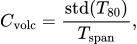
Data (minimum). (1) ages for construction phases of major global volcanoes (radiometric/stratigraphic), (2) if possible, volume/mass weights, (3) topography/erosion/collapse records to model preservation bias (with controls).
Test (example).
- TEST-V1: evaluate clustering of T₈₀ after preservation-bias correction (or like-for-like environment comparison).
- TEST-V2: cross-check whether the same time-window spike persists after region-wise decomposition (Japan/Andes/Cascades/Philippines/hotspots, etc.).
FALSIFIER (example). If, after controlling preservation bias, T₈₀ spreads widely and regional spikes disperse across different times, a “global pulse” is FAIL/HOLD. Conversely, if the same narrow-window cluster repeats across independent regions, it becomes an UNLOCK candidate.
Recommended DataPack (stub). data/volc/volcano_construction_ages.csv (Appendix F expansion module).
P13 (optional): Friction threshold / stick-slip — is “slow drift” possible?
This module directly tests the premise “plates always creep slowly.” The key question is whether observed long-period rates (a few cm/yr) are (1) continuous motion under low friction (weak boundary / high pore pressure), or (2) a remnant of runaway sliding after exceeding a critical stress threshold (P14). (Idea note: docs/user_notes_atlantic_additional_evidence.txt P13.)
Intuition (summary). If friction follows Coulomb law τ=μσ'ₙ and μ is large, the driving shear stress τ_drive (slab pull / ridge push) may not exceed the critical value, making continuous drift difficult. Then either (i) C3-style lubrication/hydraulic jacking must reduce μ_eff, or (ii) a large impulse must push the system over threshold, followed by a kinematic tail.
Minimal model (fixed by preregistration). 
Test (example).
- TEST-FRIC1 (stress ratio): combine literature/model ranges of τ_drive with boundary μₛ,α,P_f ranges and compute the R_τ distribution.
- TEST-FRIC2 (thermal–stress consistency): use observed heat-flow/frictional-heat upper bounds to estimate a feasible upper bound on τ, and eliminate (FAIL) or narrow the assumption combinations in TEST-FRIC1.
FALSIFIER (example). If a weak-boundary (low μ_eff) assumption alone makes R_τ consistently near 1 and no additional impulse is needed, the claim “critical stick-slip is required” is FAIL/HOLD.
Recommended DataPack (stub). data/friction/plate_friction_params.csv. (Pre-registration: config/p13_friction_prereg.yml.)
Bundle results (2025-12-27): PASS. Across six literature-based priors (refs=6), the median of R_τ is 0.221 (IQR≈[0.181,0.257]), meeting the prereg hold threshold (R_τ≤ 0.3) (output: results/p13_friction_gate.json). Interpretation: this is auxiliary evidence that continuous drift may not be mechanically “easy” and that additional conditions (strong lubrication or an impulse) may be required. Note that this is not a direct observation.
P14 (optional): Thermo-kinematic remnant — velocity tail and frictional heat
This module locks, in one place, the two requirements when claiming a “recent high-speed event”: (1) a kinematic decay tail and (2) a frictional-heat budget. (Idea note: docs/user_notes_atlantic_additional_evidence.txt P14.) Caution (AR-18). This module does not “refute” the standard model; it defines the minimum quantitative constraints required when claiming a high-speed event.
Kinematic tail (example parameterization). Let the post-event speed be 
![S = v₀ t₀/1-p[(1+T/t₀)⁽1-p)-1],](/geodynamics/eq/geodynamics/geo-21-007.svg)
Frictional heat (minimum order). If effective shear stress τ acts over area A across distance S, 
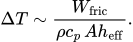
Test (example).
- TEST-TAIL1 (fit tail): compute the (v₀,p,t₀) region that simultaneously matches present speed v(T) and total displacement S.
- TEST-TAIL2 (heat gate): check whether the region allowed by TEST-TAIL1 is compatible with independent observations (heat flow/partial melt/seismic low-velocity zones, etc.).
FALSIFIER (example). If satisfying both v(T) and S forces excessively large v₀, or Δ T forces widespread melting inconsistent with observations (or if required τ is unrealistically large), then FAIL/HOLD.
Recommended DataPack (stub). data/thermal/thermal_budget_params.csv, data/kinematics/plate_velocity_constraints.csv. (Pre-registration: config/p14_thermo_kinematic_prereg.yml.)
P15 (optional): Great Drainage — where did the water go? (basin volume increase vs drainage/sea level/canyons)
This module locks the claim that a “newly opened (or rapidly expanded) basin” acted as a water sink via mass conservation. (Idea note: docs/user_notes_atlantic_additional_evidence.txt P15.) The core is to connect “great drainage / canyon” narratives directly to sea-level (eustatic/relative) records.
Minimum hydrologic budget (model). Let global ocean area be A_ocean and basin volume increase be Δ V(t). A first-order water-conservation approximation gives 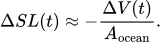
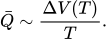
Test (example).
- TEST-WAT1 (sea-level gate): assess whether assumed Δ V(T) and T imply Δ SL compatible with independent sea-level constraints (eustatic/coral/delta).
- TEST-WAT2 (drainage–canyon coevality): assess whether major submarine canyons/large turbidites/shelf incision times cluster in the assumed event window.
- TEST-WAT3 (discharge order): compare Q with known extreme floods (ice-dam outbursts, etc.) to check physical plausibility.
FALSIFIER (example). If Δ V(T) implies Δ SL that repeatedly violates observed sea-level bounds (i.e., required drops/jumps are absent), P15 is FAIL. Or, if canyon/large-deposit timing constraints disperse over ≳Myr independent of the event window, the claim weakens/FAILs.
Simulation stub. code/p15_water_budget_sim.py is a minimal code that takes Δ V,T,A_ocean and outputs Δ SL and Q, including sensitivity (Monte Carlo).
Recommended DataPack (stub). data/hydro/basin_volume_scenarios.csv, data/hydro/submarine_canyon_markers.csv, data/rsl/holocene_sea_level_constraints.csv. (Pre-registration: config/p15_drainage_prereg.yml.)
P16 (optional): North Atlantic freshwater shock — co-inflection of proxies (δ¹⁸O/salinity/AMOC)
This module locks the claim “there was freshwater input (or salinity drop)” by multi-proxy coherence (δ¹⁸O, Mg/Ca, IRD, Pa/Th, speleothems, etc.). (Idea note: docs/user_notes_atlantic_additional_evidence.txt P16.)
Core gate (P16). Within a pre-registered event window, multiple independent North Atlantic records must exhibit simultaneous inflection in the expected direction. The key is not “one proxy moved” but whether freshwater/salinity and circulation response cohere.
Data (this bundle). This release uses four NOAA/WDS paleoclimate series and one PANGAEA series:
- Hudson Strait core HU75-58: δ¹⁸O (planktic foram) (NOAA/WDS)
- core MD99-2251: Pa/Th (AMOC proxy) (NOAA/WDS)
- core MD03-2664: Mg/Ca-SST (NOAA/WDS)
- core GeoB6007-2: alkenone-SST (NOAA/WDS)
- Icelandic shelf JM96-1207: IRD (PANGAEA; used as auxiliary)
The merged input table is data/na_freshwater/p16_na_freshwater_proxy_stack.csv.
Test (P16 inflection coherence).
- For each record, estimate the inflection time tᵢ and uncertainty σᵢ by a prereg method (change-point or segmented regression).
- Compute a coherence score C from the time clustering (e.g., standardized RMSE or a weighted variance).
- UNLOCK if C ≥ C_ and the sign consistency matches prereg expectations.
Bundle result (2025-12-27): PASS. With 5 records, the prereg coherence score is C=0.600 meeting the PASS threshold (C≥ 0.6), and the weighted mean event center is t≈4.35 ka with σ≈0.19 ka (output: results/p16_na_freshwater_coherence.json; log: logs/TEST-P16.log).
FALSIFIER. If records do not show simultaneous inflection or if sign directions contradict expectations, P16 is FAIL/HOLD. If coherence holds only by excluding a specific record post hoc, treat as strong HOLD (near STOP).
Linked AR/H. AR-25, AR-32; competing hypothesis H-FW.