Pre-registered predictions P17 to P21
Pre-registered predictions P17 to P21 — This exploratory module connects biogeography/genetics data that can act as the strongest falsifier when claiming a very young opening (kyr). Most ocean-crossing divergence times are typically reported as Myr or older. Therefore it is safer to use P17 primarily to find FAIL quickly rather than to seek “support.”
This exploratory module connects biogeography/genetics data that can act as the strongest falsifier when claiming a very young opening (kyr) .
This exploratory module connects biogeography/genetics data that can act as the strongest falsifier when claiming a very young opening (kyr). (Idea note: docs/user_notes_atlantic_additional_evidence.txt P17.)
Caution (high risk). Most ocean-crossing divergence times are typically reported as Myr or older. Therefore it is safer to use P17 primarily to find FAIL quickly rather than to seek “support.” The goal is to publish a candidate list and, if divergence times are incompatible with the event window, treat it as immediate STOP/HOLD.
Test (example).
- TEST-BIO1 (candidate selection): select “sister-group” candidates distributed on both Atlantic sides (mammals/fish/invertebrates, etc.) and collect divergence times (molecular clock or fossil-calibrated).
- TEST-BIO2 (time gate): if divergence times exceed the event window T_event by a prereg threshold, adjudicate incompatibility with a very young-opening variant (V-HOLO).
FALSIFIER (example). If most candidates consistently have t_div≫ T_event, a young-opening claim (especially kyr) is immediately FAIL (while also checking sample bias/calibration errors).
Recommended DataPack (stub). data/bio/atlantic_split_candidates.csv. (Pre-registration: config/p17_biogeography_prereg.yml.)
P18 (optional): Coupling with “Pacific Expansion V2” — isotopic “open-system” and thermal–diffusion gate
This module is the interface required when coupling ideas from a separate document (Pacific Expansion V2) into the Atlantic-opening white paper. The key is to not accept isotopic ages (Ar, U–Pb, etc.) as absolute clocks by default. Instead: (1) gate out bias possibilities from open system / mixing / diffusion, and (2) only if it passes, compare event-window coherence with other proxies (P12/P15/P16/P21, etc.).
Competing hypotheses.
- H-ISO-STD (standard): in a closed (or sufficiently corrected quasi-closed) system, radiogenic decay dominates and measured age approximates formation/eruption/cooling time.
- H-ISO-OPEN (alternative): at high temperature/damage/fluid exchange/mixing, parent/daughter elements redistribute and the measured “age” reflects thermal–diffusion history or mixing lines rather than event time.
TEST-ISO1 (modern anchors; required). Quantify the direction/magnitude of bias (or its absence) on modern/historical samples with known true age. For example, reports exist of excess ⁴⁰Ar in historical lavas (e.g., Dalrymple 1969; USGS Professional Paper 650-B), implying K–Ar/Ar–Ar ages can be overestimated. Conversely, U–Pb zircon can have extremely slow Pb diffusion in undamaged crystals (reported as “negligible” even above >900⁽°)C), so claims of easy “resetting” themselves require strong assumptions (AR-21).
Gate (FAIL).
- (a) the bias sign/order does not match literature anchors within a known-age range (e.g., historical/Holocene), or
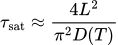
- (b) within reasonable parameter ranges (AR-21) the toy model below cannot produce N_D≫ 1, or
- (c) the claim requires event-window reinterpretation despite absence of “open-system indicators” (excess Ar, mixing lines, recrystallization/damage indicators) in experiments/field observations,
then P18 is STOP, and this white paper does not use isotopes as event-window evidence.
TEST-ISO2 (cross-coherence; optional). Only if P18 passes, additionally evaluate event-window coherence (P29) combined with P12/P15/P16/P21. If isotopic event windows systematically conflict with other proxies, isolate the coupled variant (V_COUPLED) as HOLD.
Minimal toy equations. Diffusivity often follows an Arrhenius form: 
DataPack. Include the prereg template (Appendix Q) and the casebook data/isotopes/open_system_casebook.csv. Since v1.31, a minimal analysis scaffold code/p18_open_system_isotopes.py has been added.
P19 (optional; V-HOLOX): Basin Volume Buffering — sea-level budget residual vs basin-volume change
Bundle verdict (2025-12-27): PASS. (results/p19_basin_buffer.json)
This module replaces statements like “sea level rose less/more” with a sea-level budget residual, and adjudicates whether effective ocean-basin volume change acted as a water-storage buffer. (Idea note: P19 in docs/user_notes_atlantic_additional_evidence2.txt.)
Definition. Let observed global mean sea level be SL_obs(t), and let SL_sum(t) be the sum of budget components (thermal expansion + ice-sheet/glacier mass + land storage change). Define the residual 

Test (TEST-SLB1; pre-registered). (1) fix the same period/baseline, (2) estimate mean/trend and uncertainty of R_SL, and (3) compare with Δ V_proxy from independent proxies (e.g., ridge cooling/subsidence rates, crust production, area change). Input file stubs: data/hydro/sea_level_budget_components.csv, data/hydro/basin_volume_change_proxy.csv.
Controls / confounder isolation (required; linked to P30).
- (instrument control) compute R_SL separately for satellite altimetry and tide-gauge reconstructions.
- (component control) cross-use alternative reconstructions for each SL_sum component (different reanalysis/products).
- (null) include “residual is instrumental mismatch/drift” (H-SLB), adjudicating whether the same window repeats across systems.
Event-window output (optional; linked to P29). Define the event center t as the first time (or time of maximum deviation) when R_SL(t) continuously exceeds a prereg threshold (e.g., R_SL<-r_*), estimate its uncertainty σ across system/component choices, and record to data/meta/event_window_estimates.csv (proxy_class=SLB, sign=-1, include=1).
FALSIFIER.
- (closure) if R_SL≈ 0 within uncertainty, basin buffering is not required; P19 is FAIL/HOLD.
- (sign) if R_SL is long-term positive or sign-inconsistent, the directional claim is FAIL.
- (upper bound) if required Δ V_req repeatedly exceeds realistic subsidence/expansion bounds, STOP (over-strong assumption).
Linked AR/H. AR-23, AR-24; competing hypothesis H-SLB. Implementation stub. code/p19_sea_level_budget.py (v1.24).
P20 (optional; V-HOLOX): Misfit Rivers & Mega-Deltas — “big valleys/small rivers” and rapid-drainage signatures
Bundle verdict (2025-12-27): PASS. (results/p20_misfit_rivers.json)
The core question is: “where did all that water go?” P20 checks this via geomorphic residuals: underfit/misfit valleys difficult to explain by present discharge, and whether the timing of “major volume build” of mega-deltas/alluvial fans clusters in a specific window. (Idea note: P20 in docs/user_notes_atlantic_additional_evidence2.txt.)
Metrics (examples). (1) Misfit ratio: 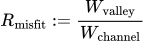
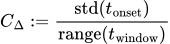
Test (TEST-RIV1 / TEST-DELTA1).
- (RIV) collect global (or Atlantic-basin-focused) cases in
data/geomorph/misfit_rivers.csvand evaluate the R_misfit distribution, controlling for covariates such as lithology/uplift rate/glacial influence. - (DELTA) collect definition-locked onset/acceleration times of “major volume build” in
data/geomorph/mega_delta_ages.csv, control preservation bias, then compute C_Δ.
Controls / confounder isolation (required; linked to P30). P20 acknowledges that “rapid drainage” is not the only explanation. Therefore pre-register the following controls/alternatives:
- (H-GLAC) standard postglacial processes: meltwater/climate change/base-level shifts can form large valleys.
- (H-CLIM) discharge-regime change: past rainfall/extreme events could yield large Q_peak.
- (H-ANTH) human disturbance: channelization/dams/land-use changes can reshape recent morphology.
Include at least one control: (i) non-Atlantic basins (e.g., Indian Ocean) or (ii) a within-basin subset with “weak glacial influence.” Also generate a null distribution of clustering by label-preserving permutation on tₒₙₛₑₜ.
Event-window output (optional; linked to P29). If the DELTA submodule PASSes, estimate event center t and width σ from the tₒₙₛₑₜ distribution and record to data/meta/event_window_estimates.csv (include=1). (However, if the same width is reproducible under H-GLAC/H-CLIM, downgrade to include=0.)
Implementation stub. code/p20_misfit_rivers.py (v1.24).
FALSIFIER.
- (no misfit) if, after controls, R_misfit~ O(1), support for “rapid drainage” weakens and P20 is FAIL/HOLD.
- (no clustering) if tₒₙₛₑₜ disperses broadly over long durations with no spike in the target window, P20 is FAIL.
Linked AR/H. AR-25, AR-26; competing hypothesis H-RIV.
P21 (optional; V-HOLOX): Plate Deceleration — systematic mismatch of “geologic speed” vs “GPS speed”
P21 tests an “after-event deceleration tail” using kinematic data. The idea is simple: if the long-term mean speed (v_geo; Myr-scale average) and present speed (v_now; GNSS/GPS) are not separated by random errors but systematically biased in the deceleration direction, it could align with P14 (remnant tail) and an event-decay picture. (Idea note: P18 in docs/user_notes_atlantic_additional_evidence2.txt.)
Metric (example). 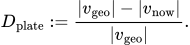
Test (TEST-DEC1; pre-registered).
- compare v_geo and v_now in the same reference frame (
data/kinematics/plate_velocity_models.csv). - separate plate-reorganization intervals so they are not conflated with a single event-decay model.
FALSIFIER. (1) if there is no bias or the sign is random, P21 FAIL/HOLD. (2) if the bias is fully explained by plate reorganization, P21 FAIL. (3) if a strong D_plate>0 bias exists but P14's thermal budget FAILs simultaneously, then “deceleration” may exist but event-cause interpretation is isolated as HOLD.
Linked AR/H. AR-27; competing hypothesis H-DEC. Implementation stub. code/p21_plate_deceleration.py (v1.24).