3-Sector Integerization (120°) and Build Time
3-Sector Integerization (120°) and Build Time: Build time is counting times the tick — any other aggregation needs its own closure. For the left-hand side to be 1, we must have n₁·n₂=-1/2, so the angle between the two axes is 120^∘. Grade [F] forced.
Build time is counting times the tick — any other aggregation needs its own closure. For the left-hand side to be 1, we must have n₁·n₂=-1/2, so the angle between the two axes is 120^∘.
Topological necessity of 3 sectors
To physically enclose a center point (Core) in a 2D cross section, at least three vectors are required (two vectors are linear; four vectors are overcomplete). Therefore, the minimum geometric cost to distinguish states such as charge (±,0) inevitably reduces to a 3-sector structure (120°).
(Proposition) 3 is minimal and 120^∘ is forced
(i) Minimality. With only two vectors one cannot form an enclosure around the center point (except for the degenerate opposite-pair case), and even in the opposite-pair case only a “line” remains, so one cannot generate three sectors (states). Hence the minimal topological cost to enclose the center is 3.(ii) 120^∘ is forced. Let the direction axes be unit vectors n₁,n₂,n₃ and lock the sum-zero closure as

Then n₃=-(n₁+n₂), hence

For the left-hand side to be 1, we must have n₁·n₂=-1/2, so the angle between the two axes is 120^∘. By permutation symmetry all pairs are 120^∘, and thus the 3-sector (120°) structure is not a choice but a geometric consequence of “minimality + sum-zero closure.”
Purpose and outputs of the chapter
This chapter (i) defines the 120° 3-sector coordinate axes, (ii) locks an integerization rule that converts continuous (real-valued) directional/phase contributions into three integer sector counts, and (iii) defines build time by coupling the integerized counts to time ticks. The outputs of this chapter are locked to the following four items.
- Definition of the 3-sector axes n₁,n₂,n₃ (including the 120° conditions).
- Definition of the integerization output (k₁,k₂,k₃)∈Z_(≥ 0)³ and the sum-preservation rule k₁+k₂+k₃=N.
- Definition of the residual (non-cancelled) vector V and its non-degeneracy condition (including the prohibition of collapse to the zero vector).
- Definition of the build time T_build and auxiliary build times (tick-based / event-rate based).
The integerization rule connects directly, in later chapters, to (a) the shell cancellation–survival label (“6 cancel + 1 survive”), (b) the charge-sign label, and (c) the electron (survival) label. Therefore, if the integerization rule is not locked here, the downstream charge/electron labels become undefined.
Definition of the 3-sector (120°) axes
2D sector plane and unit axes
3-sector integerization is performed on a specific plane Π.
The choice of the plane (which 2D subspace of which coordinate system) is locked in analysis_lock.
On the plane Π, define three unit vectors as

120°condition (inner-product convention)
Lock the 3-sector axes to have mutual spacing of 120° by the inner-product convention
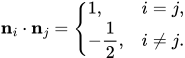
Also lock their sum to be zero (center cancellation):

Equations (S07_120deg_inner)–(S07_n_sum_zero) are the geometric base of 3-sector integerization.
After seeing results, the axes may not be rotated or replaced.
A permutation (reordering) of axes may be allowed, but the permutation rule (e.g., n₁↦ n₂) must be pre-registered in analysis_lock.
Integerization rule: continuous contributions → (k₁,k₂,k₃)
Inputs: direction contribution vector and total count N
The inputs of integerization are a vector u on the plane Π and a total count N:

u represents a “directional contribution” vector derived from event aggregation, shell structure, or core–shell coupling.
The generation procedure of u (which landmarks, which before/after placement, which aggregation window) is locked in analysis_lock.
N is the conserved total integer resource (total sector count) at the given step; its provenance (e.g., total number in a structure, total mass in a given event window) is locked in analysis_lock or canon_lock.
Definition of real-valued sector scores s_i (nonnegativization)
Define projection scores onto the sector axes:

Since p_i can be positive or negative, shift them to nonnegative scores for conversion into integer counts. Define the shift amount as

Therefore

If u is perfectly symmetric with respect to the three axes, then p₁=p₂=p₃ and thus s₁=s₂=s₃=0; in that case normalization is impossible and a separate handling rule is required. Lock the degeneracy indicator

If S=0, classify the input as a “perfectly symmetric input,” and lock the integerization output as
![\begin{equation} (k_1,k_2,k_3)= \begin{cases} \left(\dfrac{N}{3},\dfrac{N}{3},\dfrac{N}{3}\right),& N\equiv 0\ (\mathrm{mod}\ 3),\\[6pt] \left(\left\lfloor\dfrac{N}{3}\right\rfloor,\left\lfloor\dfrac{N}{3}\right\rfloor,\left\lceil\dfrac{N}{3}\right\rceil\right)\ \text{and its permutations},& N\not\equiv 0\ (\mathrm{mod}\ 3), \end{cases} \end{equation}](/physics/eq/physics/phy-07-009.svg)
where the permutation-selection rule must be pre-registered in analysis_lock and cannot be chosen after seeing outcomes.
Definition of normalized fractions f_i
For S>0, define sector fractions by

so that

Integerization (sum-preserving) rule
The goal of integerization is to select an integer triple (k₁,k₂,k₃) that satisfies simultaneously

Define integerization as “the integer allocation closest to the fractions f_i,” and lock the procedure as follows.
(1) Floor allocation

where r_i is the residual (fractional part).
(2) Compute the deficit

By construction, Δ∈0,1,2.
(3) Correct by the largest residuals
Select Δ indices in decreasing order of r_i, and add 1 to k_i for those indices. Formally, define the index set I_Δ⊂1,2,3 by

and define the final integerization output by

where 1_· is the indicator function.
(4) Tie-handling (tie-break)
Because equal residuals can occur in TopK, a tie-break rule must be pre-registered and locked. Only one of the following tie-break modes is allowed (one must be selected and locked).
- TB-LEX: prioritize the index order (1→2→3).
- TB-AXIS: prioritize a pre-registered preferred axis (e.g., n₁ first).
- TB-HASH: hash-based decision computed from an event/structure identifier (same input ⇒ same output).
If the tie-break rule is not locked, the integerization result is non-unique and is judged INCONCLUSIVE.
First-order invariants of the integerization output
The integerization output satisfies the following invariants.
- Sum preservation: k₁+k₂+k₃=N.
- Nonnegativity: k_i≥ 0.
- Fraction approximation: it is constructed so that |k_i/N - f_i| is minimized (ties are resolved only by the pre-registered tie-break rule).
These invariants are used downstream as the integer basis of charge/electron labels. If any invariant is violated, the label becomes undefined.
Residual (non-cancelled) vector and the link to charge/electron labels
Definition of the residual vector V
From the integerization output (k₁,k₂,k₃) define the sector residual (non-cancelled) vector by

By (S07_n_sum_zero), if k₁=k₂=k₃ then V=0. Hence V is locked as an integer-based residual vector that encodes the magnitude and direction of deviation from “perfect cancellation.”
Non-degeneracy condition (label definability condition)
Lock that charge/electron labels are definable only when V is nonzero (non-degenerate). Define the threshold as

where V_(min) is a pre-registered threshold in gate_lock; changing V_(min) is allowed only by a version bump.
If |V|<V_(min), labels are treated as neutral (or undefined), and the handling rule for that case (whether it is CT-LIM or CT-DEF) must be locked by PASS.rules.
Declaration of the link to charge/electron labels
The integerization rule is linked to downstream labels in the following forms.
- Charge-sign label: for a pre-registered charge axis n_Q,

defines the sign label. The choice of n_Q must be locked in
analysis_lockand cannot be chosen after seeing outcomes. - Electron (survival) label: under the shell(7) cancellation–survival convention, the “survival” residual direction is defined from V, and the electron label is assigned according to the existence and signed direction of that survival residual. The details of the survival convention are locked in the discrete-structure chapter; here we only declare that integerization is the integer basis for the label.
Therefore the integerization rule in this chapter is a “super-convention” for charge/electron labels: labels cannot be introduced separately by bypassing the integerization rule.
7.5 Definition of Build Time
7.5.1 Tick-based build time
When the realization time tick Δ t is locked in realization_lock, define the build time corresponding to total count N as

Definition (S07_Tbuild_tick) adopts “1 count per tick.” If a different aggregation convention is required (e.g., multiple counts per tick or sparse counts), it must be defined by a separate closure.
7.5.2 Event-rate-based build time
If a stationary event rate ν is defined (event definition and δ insertion are locked), and the mean time to accumulate N counts in the same regime is used as build time, lock

The use of (S07_Tbuild_rate) is regime-dependent.
If ν is undefined or judged FAIL/INCONCLUSIVE by Gate, then (S07_Tbuild_rate) is forbidden and only (S07_Tbuild_tick) is permitted.
7.5.3 Auxiliary build times via 3-sector decomposition
When the integerization output (k₁,k₂,k₃) is locked, define the sector-wise build times by

so that

T_i is the “accumulated time per sector” and can be used later as a temporal representation of sector asymmetry (e.g., how a sector dominance affects the charge/electron label). In all cases T_i is fixed by (S07_Ti_def) and cannot be redefined after seeing results.
LOCK/Gate connections for this section (none if empty)
- LOCK: Fix the 120° conventions for the 3-sector axes n₁,n₂,n₃ ((S07_120deg_inner), (S07_n_sum_zero)) and lock axis order / permutation / tie-break rules in
analysis_lock. - LOCK: Fix the integerization rule ((S07_shift_si)–(S07_final_ki)) and the sum constraint k₁+k₂+k₃=N in
analysis_lock. - LOCK: Fix the residual vector V ((S07_V_def)) and the charge-axis input n_Q for the label link declaration ((S07_charge_label_decl)) in
analysis_lock. - Gate: Missing locks for sum preservation / nonnegativity / tie-break are
FAILorINCONCLUSIVEunder G-STR/G-LOCK; post hoc selection isFAILunder G-NT. - Gate: The non-degeneracy threshold V_(min) ((S07_Vmin)) and the label-handling rule must be pre-registered in
gate_lockand PASS.rules.
7.1 Minimum-variance integerization (N=3m+r): 89, 82
7.1.1 Definition of the integerization problem
The goal of 3-sector integerization is to distribute a total integer resource N∈Z_(≥ 0) into three nonnegative integer sector counts

so that

while minimizing “bias (asymmetry).”
In this section, define bias by the variance and lock the integerization rule that minimizes this variance as minimum-variance integerization. Let the mean be

and define the (3-sector) variance by
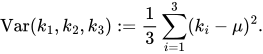
Under the fixed-sum constraint (S07_01_sumN), minimizing (S07_01_variance) is equivalent to minimizing the following second moment.
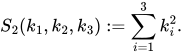
Indeed, using (S07_01_sumN),

Hence, for fixed N, minimizing Var is fully equivalent to minimizing S₂.
7.1.2 Minimum-variance integerization theorem (equalization principle)
7.1.2.1 Equalization lemma
Let an integer triple (k₁,k₂,k₃) satisfy (S07_01_sumN). If some pair (kₐ,k_b) satisfies

then define the following “equalization move”:

The sum is preserved:

Moreover, the second moment strictly decreases:

By assumption (S07_01_gap_ge2), kₐ-k_b≥ 2, hence

so S₂ must decrease. Therefore, if any solution contains a gap of the form (S07_01_gap_ge2), it cannot be a minimum-variance solution.
7.1.2.2 Necessary and sufficient condition for a minimum-variance solution
By the lemma, a solution that minimizes S₂ must have no pairwise gap exceeding 1:

Conversely, any solution satisfying (S07_01_gap_le1) admits no further equalization move (S07_01_balance_move) that decreases S₂. Hence this condition is both necessary and sufficient (on the integer set, a local minimum is a global minimum).
7.1.3 N=3m+r decomposition and the closed form of the minimum-variance solution
7.1.3.1 Definition of quotient and remainder
Define the quotient and remainder of dividing N by 3:

7.1.3.2 Form of the minimum-variance solution (unique up to permutation)
The integer triples that satisfy both (S07_01_gap_le1) and (S07_01_sumN) exist only in the following forms (unique up to permutation).
- r=0:

- r=1:

- r=2:

These three cases fully classify all solutions satisfying (S07_01_gap_le1).
7.1.3.3 Closed form of the minimum second moment
Lock the minimum value of the second moment for the minimum-variance solution as

Indeed, for r=0 one has S₂=3m²; for r=1, S₂=2m²+(m+1)²=3m²+2m+1; for r=2, S₂=m²+2(m+1)²=3m²+4m+2.
7.1.4 Sector priority (tie-break) rule
When r≠ 0, one must choose which sector receives m+1 (i.e., which permutation is adopted). Because this choice cannot be changed after seeing outcomes, pre-register and lock the following “priority permutation.”

Given π_sec, define the minimum-variance integerization output by
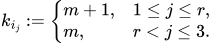
That is, the first r sectors in the priority permutation receive m+1, and the remaining sectors receive m.
If π_sec is not locked, the result is non-unique for r≠ 0, hence INCONCLUSIVE.
7.1.5 Examples: N=89 and N=82
7.1.5.1 N=89

Hence the minimum-variance solution, by (S07_01_case_r2), is

If the priority permutation is locked as π_sec=(1,2,3), then by (S07_01_priority_assign) the output is fixed as

7.1.5.2 N=82

Reading note (numeric collision warning, added v0.2.0). The integer 27 appearing here is the 3-sector mean count (k₁,k₂,k₃)=(27,27,28) from (S07_01_division). It is not a lattice-point count. To prevent an easy misreading, the lattice-point inventory in the relevant cubic shells is tabulated separately:The numerical collision of 27 between the 3-sector mean and the R²≤3 cube count is coincidental; both are correct in their own contexts. (Single source: the geometric necessity of 82=3⁴+1 — the R²≤6 packing 81 plus the single irreducible nozzle residual that does not 3-divide — together with 7=1+6, 89=82+7, and the resulting n-fold event-rate law ν_p,can=3π⁴, is consolidated in §8.0.5.)
Shell Integer-point count Note R²≤2 19 — R²≤3 27 =3×3×3 cube R²≤6 81 coincides with σ=81 R²=7 0 Legendre three-square theorem (empty shell) R²≤9 123 not 126
Hence the minimum-variance solution, by (S07_01_case_r1), is

If the priority permutation is locked as π_sec=(1,2,3), then

7.1.6 Internal justification (minimum-bias principle) and the link to downstream labels
7.1.6.1 Minimum-bias principle (internal rule)
Because the 3-sector structure is locked as a 120° symmetric structure (see the chapter overview and §7.0), the three sectors have equal status. Therefore integerization must satisfy the following internal rules.
- Symmetry preservation: if the input does not distinguish sectors, the output should distinguish sectors as little as possible.
- Bias minimization: minimize sector imbalance (variance or gaps) in the output.
- Allow only unavoidable residuals: leave only the imbalance that is unavoidable due to N(mod3), and forbid any larger imbalance.
A partition satisfying (S07_01_gap_le1) is the unique form that satisfies all three rules simultaneously. In particular, define the maximum gap

then
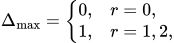
which is minimal. Solutions of the form (S07_01_gap_ge2) have Δ_(max)≥ 2 and violate the internal rule.
7.1.6.2 Minimal residual direction (minimum residual basis for charge/electron labels)
When the 3-sector axes are locked by

and the residual vector is defined by

then for the minimum-variance integerization output,
- For r=0 (perfectly uniform), (k₁,k₂,k₃)=(m,m,m), hence V=m(n₁+n₂+n₃)=0.
- For r=1, the output is of the form (m,m,m+1), hence V points along the axis that receives the “extra 1” (e.g., n_(i₁)).
- For r=2, the output is of the form (m,m+1,m+1), hence V points opposite to the axis that receives “the missing 1” (e.g., -(n_(i₃))).
Thus minimum-variance integerization leaves only the minimum-magnitude residual directionality that is forced by N(mod3). This residual directionality is used downstream as the input for charge sign and electron (survival) labels. Any larger residual (gap ≥ 2) is forbidden as a violation of the internal rule.
7.1.7 Volume (radial) integerization: Rₚ=n_rr_u
This section adds, as an auxiliary closure separate from 3-sector integerization, a “volume (radial) integerization” rule. The purpose is to ensure that the total core count is not merely “an artifact of a sector decomposition,” but is also compatible with an integer-multiple selection of a radial scale.
[D-7.1-7.1] Sub-quantum (SQ) unit radius r_u
In the 82+7 structure, the “unit” (core 82, shell 7) is interpreted not as a single VP but as a higher-level block (Sub-quantum unit, SQ) containing many VPs (object attribution is locked in canon_lock).
Denote the effective radius of this SQ unit by r_u.
[D-7.1-7.2] Integer-multiple radial rule
Declare the following integer-multiple relation between the core radius Rₚ and the SQ unit radius r_u as an integerization rule:

Here n_r is the “radial integerization exponent” and cannot be chosen after seeing outcomes (post hoc choice is FAIL under G-NT).
[D-7.1-7.3] Ideal slot count (volume ratio) n_r³
If (S07_01_radial_integerization) is adopted, then the mathematical maximum number of slots for same-scale spherical units inside the core sphere is given by the volume ratio
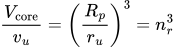
(where V_core∝ Rₚ³ and v_u∝ r_u³). This value is a mathematical upper bound assuming “full filling”; actual placement can be smaller due to rotation, exclusion, and voids.
7.1.8 Packing–rectification coefficient φₚack and the 125→ 82 closed loop
This section records, as an operational coefficient, the fact that the “mathematical slot count” n_r³ is not realized as-is. Define the packing–rectification coefficient φ_pack∈(0,1] by

Here N_core is the core unit count (locked as 82 in this document), and φ_pack is not a post hoc tuning freedom. When N_core and n_r are locked, φ_pack is an automatically derived quantity.
7.1.8.1 Locking n_r=5 and 125→ 82
In the core(82) regime of this document, lock the radial integerization exponent as

This choice cannot be tuned after seeing the outcome (82); changes are allowed only by a version bump. Status note. Since the core count is sourced primarily as 82=3⁴+1 from the 3-division geometry (§8.0.5), this radial route (n_r≡5, n_r³=125, φ_pack=82/125) is non-load-bearing: it is a back-calculated consistency reading of the already-fixed 82, not the derivation of it. The hand-locked n_r=5 therefore no longer gates the main chain; it remains only as the volumetric cross-check below. Substituting (S07_01_nr_lock5) into (S07_01_slot_count), the ideal slot count is

With N_core=82 locked, (S07_01_pack_rect_def) immediately yields
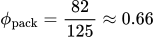
Thus about 34% of the “125 mathematical slots” remain as voids. In the unjamming/influx (Flux) narrative, these voids can be interpreted as channels and elastic margins, but interpretive eligibility must pass a separate Gate (regime/log/reproducibility).
7.1.8.2 Qualification for strong claims (inevitability of 82)
To claim that “82 is inevitable from radial integerization alone,” one must independently measure (or seal by simulation) φ_pack externally and show that n_r³φ_pack converges to the integer 82. Conversely, in the present document where 82 is locked as a structural integer (minimum-variance 3-sector + 82+7 structure), (S07_01_phi_pack_value) should be treated as a back-calculated consistency indicator rather than a prediction.
7.1.8.3 Gate (interpretability decision)
A physical interpretation of φ_pack (e.g., “jamming packing efficiency”) is permitted only when the following conditions are simultaneously satisfied.
- n_r is pre-registered in
analysis_lock/canon_lockand is not changed after seeing outcomes. - The object attribution for N_core (what is counted as 1 unit) and the inclusion/exclusion conventions are locked in
canon_lock. - φ_pack is not absorbed into or redefined as another coefficient (δ,α,φ_jam, etc.).
Symbol overloading is
FAILunder G-SYM.
If any of these conditions is violated, φ_pack may be reported as a number (CT-LIM), but using its interpretation as a basis for a conclusion is forbidden.
LOCK/Gate connections for this section (none if empty)
- LOCK: Fix the minimum-variance objective (variance (S07_01_variance) or equivalently second moment (S07_01_S2)) and the solution forms (S07_01_case_r0)–(S07_01_case_r2) in
analysis_lock. - LOCK: Fix the tie-break priority permutation π_sec and the assignment rule (S07_01_priority_assign) in
analysis_lock. - LOCK: (If the auxiliary closure is used) fix the target objects of the radial integerization rule (S07_01_radial_integerization) (core radius Rₚ, unit radius r_u) and the integer exponent n_r in
canon_lock/analysis_lock. - LOCK: (If the auxiliary closure is used) fix the definition (S07_01_pack_rect_def) of the packing–rectification coefficient and the slot-count formula (S07_01_slot_count) in
analysis_lock. - Gate: Violations of sum preservation (S07_01_sumN), nonnegativity (S07_01_k_domain), or the gap condition (S07_01_gap_le1) are
FAILunder G-STR. - Gate: Missing π_sec lock or permutation mixing is
INCONCLUSIVE/FAILunder G-LOCK. - Gate: Changing sector assignment (permutation) after seeing outcomes is
FAILunder G-NT. - Gate: Post hoc choice of n_r, changing the counting attribution of N_core, or absorbing/redefining φ_pack (symbol overloading) is
FAILunder G-NT/G-LOCK/G-SYM.
7.2 Definition of build times Tₚ, Tₙ
7.2.1 Definition of the canonical event rate νₚ,can (time–count link)
Let the time variable t denote realization time (unit: s).
An event is counted according to the operational definition locked in canon_lock, and event counts are recorded as dimensionless integers.
For a time interval [t₁,t₂), define the raw event set and raw event count by

Define the canonical event rate (canonical turnover rate) ν_p,can by the limit

Definition (S07_02_nu_can_def) is the definition of “events per unit time,” and the unit of ν_p,can is locked as [s⁻¹]. When ν_p,can is treated as a constant within the same regime, it is used so that

Equation (S07_02_N_equals_nuT) is the usage convention of the canonical event rate.
If the regime is not locked or Gate judges INCONCLUSIVE, this usage is forbidden.
7.2.2 Definition of structure counts Nₚ, Nₙ (82+7 and 82)
Build time is defined as “the time required to accumulate a prescribed structure count N.” Lock two structure counts as follows.
- Total count of the p-structure:

- Total count of the n-structure:

Here 82 and 7 are integers provided by the definition of the discrete structure (core 82, shell 7).
Their object attribution and inclusion/exclusion conventions must be locked in canon_lock.
Changing Nₚ,Nₙ after seeing outcomes is forbidden; changes are allowed only by a version bump.
7.2.3 Minimum-variance 3-sector integerization and sector counts (k₁,k₂,k₃)
3-sector integerization decomposes a total count N into three sector integers while minimizing bias (variance). Divide N as

Lock the minimum-variance condition as choosing an integer triple satisfying

The solutions are fully classified up to permutation as

Because the permutation choice (which sector receives m+1) cannot be decided after seeing outcomes, pre-register and lock the sector priority permutation π_sec in analysis_lock.
Using π_sec, assign m+1 to r sectors and m to the remainder.
Sector decomposition of Nₚ=89
From (S07_02_Np_def),

Hence the minimum-variance sector counts are

Sector decomposition of Nₙ=82
From (S07_02_Nn_def),

Hence the minimum-variance sector counts are

7.2.4 Definition of build time (canonical event-rate based)
[D-7.2-1] Build-time function
In a regime where the canonical event rate ν_p,can is locked, define the mean time required to accumulate total count N as the build time:
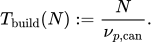
Definition (S07_02_Tbuild_def) is the basic time–count link. It is not an additional assumption; it is equivalent to solving N=ν T for T=N/ν in (S07_02_N_equals_nuT).
p-structure build time Tₚ
From (S07_02_Tbuild_def) and (S07_02_Np_def),

n-structure build time Tₙ
From (S07_02_Tbuild_def) and (S07_02_Nn_def),

7.2.5 Time–structure invariants (conclusions where the canonical event rate cancels)
From (S07_02_Tp_def)–(S07_02_Tn_def), the following invariants follow immediately.
7.2.5.1 Ratio invariant
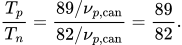
Hence Tₚ/Tₙ is a structural ratio invariant independent of the value of ν_p,can.
7.2.5.2 Difference invariant (time version of the count difference 7)

That is, the build-time difference between the p-structure and the n-structure is fixed as the time version of “additional count 7” under the canonical event rate.
7.2.5.3 Count–time closed loop (dimensionless coupling)

Equation (S07_02_closed_loop) is a dimensionless closed loop in which “canonical rate × build time” returns to the structure count. It is meaningful only under the same locked version.
7.2.6 Sector-wise build-time decomposition (3-sector time–structure link)
For the 3-sector integerization outputs (S07_02_kp), (S07_02_kn), define the sector-wise build times by

By sum preservation (S07_02_minvar),


Hence build time decomposes fully into the time version of 3-sector structure counts.
7.2.7 Regime conditions and failure handling (undefined cases and violations)
For the definitions in this section to have conclusion status, the following conditions must be locked.
- ν_p,can must be treatable as a constant within the same regime, and the event logs required by its definition ((S07_02_nu_can_def)) must be complete.
- The object attribution and inclusion/exclusion conventions for the structure counts Nₚ,Nₙ must be locked.
- In 3-sector integerization, the permutation-selection rule (priority π_sec) must be locked, and the minimum-variance condition (S07_02_minvar) must not be violated.
If these conditions are not satisfied, Tₚ,Tₙ are judged undefined (INCONCLUSIVE) or as regime/structure violations (FAIL), and the outputs do not have conclusion status.
LOCK/Gate connections for this section (none if empty)
- LOCK: Fix the object attribution and inclusion/exclusion conventions for the structure counts Nₚ=89, Nₙ=82 in
canon_lock. - LOCK: Fix the definition of the canonical event rate ν_p,can and the build-time definition T_build(N)=N/ν_p,can in
analysis_lock. - LOCK: Fix the minimum-variance 3-sector integerization (N=3m+r, (S07_02_triplets)) and the priority permutation π_sec in
analysis_lock. - Gate: Violations of the minimum-variance condition |k_i-k_j|≤ 1 or sum preservation k₁+k₂+k₃=N are
FAILunder G-STR. - Gate: Regime mismatch or incomplete logs for ν_p,can are
INCONCLUSIVEunder G-REG or G-REP; post hoc changes areFAILunder G-NT.
7.3 Definitions of Φ and χ (handoff criteria between observation and analysis)
7.3.1 Purpose
This section (i) fixes observable aggregates Φ and χ by internal definitions, (ii) specifies the measurability conditions of Φ and χ (log-based computability), and (iii) defines the Gate that hands Φ and χ off to the analysis part (closure/gate/estimator stack). The Φ and χ in this section are defined from event logs and the 3-sector integerization + rectification conventions only, with no appeal to external texts.
7.3.2 Minimal schema for observation input (event log)
Because Φ and χ are event-aggregation quantities, the event log must include the following fields as mandatory.
Missing fields make the quantities undefined and must be judged immediately as INCONCLUSIVE or FAIL.
- Event set: E.
- Event index: e∈E.
- Event time (tick): n(e)∈Z.
- Tick boundaries for window definition: n₁<n₂.
- Pre/post state identifiers: pre(e), post(e).
- VP subset involved in the event: V(e)⊆V.
- 3-sector integerization input: either total count N(e) or the sector triple (k₁(e),k₂(e),k₃(e)).
- (If rectified survival is used) two phase values: θ(e)∈[0,2π), φ(e)∈[0,2π).
The realization time tick Δ t used in this section must be locked in realization_lock.
Define the window duration by

7.3.3 Definition of Φ (survival-rectification log-odds)
7.3.3.1 Time window and raw event set
Define the raw event set in the tick interval [n₁,n₂) by

Define the raw event count by

If N₀=0, Φ is undefined.
7.3.3.2 Survival weight and rectified event count
Define the half-wave rectifier by
![\begin{equation} [x]_+ := \max(0,x). \end{equation}](/physics/eq/physics/phy-07-083.svg)
Define the survival weight of an event e by
![\begin{equation} w(e) := [\cos\theta(e)]_+\,[\cos\varphi(e)]_+. \end{equation}](/physics/eq/physics/phy-07-084.svg)
Define the rectified event count by
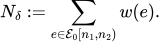
By definition 0≤ N_δ≤ N₀.
7.3.3.3 Survival ratio and stabilization constant ε_Φ
Define the survival ratio by

Because the log-odds diverges at ρ=0 or ρ=1, lock a stabilization constant ε_Φ by

Define the stabilized survival ratio by
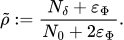
Then 0<ρ<1 holds.
7.3.3.4 Definition of Φ (log-odds)
Define Φ by
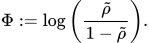
The type of Φ is scalar and its dimension is dimensionless ([1]). Φ is an observable that aggregates “is survival dominant or is cancellation dominant” as a log-odds. It exists only as a quantity computed from event logs under a locked protocol.
7.3.4 Definition of χ (directional coherence χ_dir and internal stability χ_int)
7.3.4.1 3-sector residual vector (integer-based)
Lock one of the following two methods for obtaining 3-sector integerization results on a window [n₁,n₂).
- Event-wise integerization: each event e provides (k₁(e),k₂(e),k₃(e)).
- Window-aggregate integerization: first define the total count N over the window, and then compute (k₁,k₂,k₃) by minimum-variance integerization.
If window-aggregate integerization is used, define the total count by
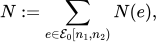
and compute (k₁,k₂,k₃) by the minimum-variance rule in §7.1. The 3-sector axes n₁,n₂,n₃ are locked by the 120° conditions:

Define the window-aggregate residual vector by

If event-wise integerization is used, define the event-wise residual vector by

and perform the following aggregation event-wise.
7.3.4.2 Directional coherence χ_dir
Lock the coherence axis (direction reference) n_χ as

If event-wise aggregation is used, define the effective event set by

Define the unit residual direction by

Define the directional coherence by
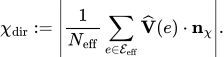
By definition 0≤ χ_dir≤ 1. If N_eff=0, χ_dir is undefined.
If only a single window-aggregate residual vector is used, define it by a single projection:

7.3.4.3 Internal stability χ_int (multi-window consistency)
Define internal stability using the dependence of Φ on window length. Lock a set of multiple window lengths by

For each window length Δ Nₘ, compute Φₘ using the same protocol (same event definition, same survival weights, same ε_Φ):

Define the mean and variance by

Lock an internal-stability scale ε_(χ)>0 by

Define χ_int by
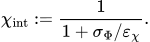
By definition 0<χ_int≤ 1, and if σ_Φ=0 then χ_int=1. If M=0 or any Φₘ is undefined, then χ_int is undefined.
7.3.4.4 Combined coherence χ
Define the combined coherence by the product

Hence 0≤ χ≤ 1. χ is an observable but is also used as the core input that decides whether the quantity can be elevated to an “analysis-eligible” input.
7.3.5 Measurability conditions (preventing undefined cases)
The measurability of Φ and χ holds only when the following conditions are satisfied.
- Log completeness: all fields listed in §7.3.2 exist and each field schema is locked by
protocol_lock. - Sample size: N₀≥ N_(min) and N_eff≥ N_min,eff.
- Rectification definition preserved: the definition (S07_03_w) of w(e) is preserved under the same version.
- Integerization rule preserved: the 3-sector axes (S07_03_sector_axes) and the minimum-variance integerization rule (§7.1) are preserved under the same version.
- Multi-window set fixed: W is locked and each Φₘ is computed under the same convention.
N_(min) and N_min,eff are thresholds pre-registered in gate_lock and cannot be moved after seeing outcomes.
7.3.6 Gate to hand off to the analysis part (definitions, verdicts, and registration convention)
7.3.6.1 Gate classes and standard outputs
The handoff Gate for Φ and χ consists of the following three gates.
Outputs are recorded only as PASS/FAIL/INCONCLUSIVE.
- G-OBS-PHI: judge definability and stability of Φ.
- G-OBS-CHI: judge definability of χ and threshold passage for coherence.
- G-HANDOFF: assuming simultaneous
PASSof G-OBS-PHI and G-OBS-CHI, register quantities as analysis inputs (OBS-REF).
7.3.6.2 Verdict for G-OBS-PHI
Judge G-OBS-PHI=PASS if and only if all of the following conditions hold.
- N₀≥ N_(min).
- Φ is computable by (S07_03_Phi_def) (i.e., ε_Φ is locked and N₀>0).
- The multi-window set W is locked ((S07_03_Wset)) and all Φₘ are definable.
If any required schema item or lock is missing, judge INCONCLUSIVE.
If a definition conflict is detected (e.g., symbol-meaning conflict for Φ, post hoc change of ε_Φ, replacement of w(e)), judge FAIL.
7.3.6.3 Verdict for G-OBS-CHI
Judge G-OBS-CHI=PASS if and only if all of the following conditions hold.
- N_eff≥ N_min,eff.
- χ_dir is definable by (S07_03_chidir_def) or (S07_03_chidir_window) (i.e., n_χ is locked and the |V|>0 condition holds).
- χ_int is definable by (S07_03_chiint_def) (i.e., W and ε_(χ) are locked and Φₘ are definable).
- Threshold passage:

where χ_dir,min,χ_int,min,χ_(min) are thresholds pre-registered in
gate_lock.
If thresholds are not locked, or n_χ is not locked, or integerization rules are mixed, judge INCONCLUSIVE or FAIL.
Moving thresholds after seeing results is a No-Tuning violation and is FAIL.
7.3.6.4 G-HANDOFF (registration of analysis inputs)
Define G-HANDOFF by

If G-HANDOFF=PASS, then Φ, χ_dir, χ_int, χ are registered as analysis inputs (OBS-REF).
Lock the registration record format as follows.
obs_ref_records:
  - quantity_id: Q-PHI-001
    value: (Phi)
    window: [n1,n2)
    lock_refs: {canon_lock_id, realization_lock_id, analysis_lock_id}
    gate_refs: {G-OBS-PHI: PASS, G-OBS-CHI: PASS, G-HANDOFF: PASS}
  - quantity_id: Q-CHI-DIR-001
    value: (chi_dir)
    window: [n1,n2)
    lock_refs: { ... }
    gate_refs: { ... }
  - quantity_id: Q-CHI-INT-001
    value: (chi_int)
    window: [n1,n2)
    lock_refs: { ... }
    gate_refs: { ... }
  - quantity_id: Q-CHI-001
    value: (chi)
    window: [n1,n2)
    lock_refs: { ... }
    gate_refs: { ... }
These records must be sealed by inclusion into analysis_lock or registry_snapshot.
Unsealed values cannot be used as analysis inputs.
7.3.6.5 Allowed scope under FAIL/INCONCLUSIVE
If G-HANDOFF≠PASS, then Φ and χ cannot be used as the basis of a conclusion.
Only the following is permitted.
- Record as a limit conclusion (CT-LIM) together with labels for “undefined/violated conditions.”
- Record the causal labels (missing logs, missing locks, regime violation, threshold failure, No-Tuning violation) in the Gate report.
Sentences that neutralize FAIL/INCONCLUSIVE by interpretation are forbidden.
LOCK/Gate connections for this section (none if empty)
- LOCK: Fix in
analysis_lockthe ε_Φ, survival weights w(e), and window convention required to define Φ ((S07_03_Phi_def)). - LOCK: Fix in
analysis_lockthe n_χ, W, and ε_(χ) required to define χ_dir,χ_int,χ ((S07_03_chidir_def), (S07_03_chiint_def), (S07_03_chi_def)). - Gate: Fix in
gate_lockthe verdict rules for G-OBS-PHI/G-OBS-CHI/G-HANDOFF and the thresholds (N_(min), N_min,eff, χ_dir,min, χ_int,min, χ_(min)). - Gate: Missing schema/locks are
INCONCLUSIVE; definition conflicts/post hoc changes areFAIL(linked to G-SYM/G-LOCK/G-NT). - Gate: Allow OBS-REF registration only when
G-HANDOFF=PASS; unsealed values are forbidden as analysis inputs.
7.4 Sector/sign (±)→ electron/positron labels
7.4.1 Purpose
This section fixes, by definition, an “electron label” and a “positron label” using the 3-sector integerization output and the sign of the residual (non-cancelled) vector. This section does not interpret or justify the meaning of the labels. The outputs of this section are (i) the label definition formulas, (ii) the conditions under which labels are definable, and (iii) the handling rule when labels are undefined.
7.4.2 Inputs (LOCK): 3-sector axes, integerization, residual vector
7.4.2.1 Locking the 3-sector axes
Lock the 3-sector axes n₁,n₂,n₃ by the 120° conventions:

The axis choice and ordering must be locked in analysis_lock and cannot be swapped after seeing outcomes.
7.4.2.2 Sector integerization output
For a total count N, let the sector integerization output be

The generation rule of (k₁,k₂,k₃) (minimum-variance + tie-break) must be locked in analysis_lock.
7.4.2.3 Definition of the residual vector
Define the residual (non-cancelled) vector by

Given the integerization output and the locked axes, V is uniquely determined.
7.4.3 Locking the reference axis for the label (charge axis) n_Q
Define electron/positron labels by judging the sign of V along a single reference axis. Let the reference axis (label axis) be n_Q and lock

Here Π is the sector plane on which the 3-sector axes lie. n_Q cannot be chosen after seeing outcomes; changing n_Q is allowed only by a version bump.
7.4.4 Sign verdict function and label definition
7.4.4.1 Sign verdict function
Define the sign verdict function by

s_Q(V)∈+1,0,-1, where 0 is a reserved value indicating a boundary (neutral) or an undefined verdict.
7.4.4.2 Non-degeneracy (verdict-eligible) threshold
For stability of sign verdicts, lock a non-degeneracy threshold V_(min)>0 by

Define the non-degeneracy condition by

If (S07_04_nondeg) does not hold, the label is classified as undefined (or treated as neutral).
7.4.4.3 Definition of electron/positron labels (definition only)
Define the electron label and positron label by


Also define a combined single label function by

In (S07_04_label_combined), NEUTRAL is a reserved output meaning “label neutral/undefined.”
Whether this output is permissible in conclusion sentences (e.g., only as CT-LIM) must be locked by PASS.rules.
7.4.5 Link between sector asymmetry and sign (definitional link)
When the 3-sector axes are locked by (S07_04_axes), minimum-variance integerization yields a residual direction determined by N(mod3). This section records that fact only as a definitional link.
- If N≡ 0(mod3) and minimum-variance integerization gives (m,m,m), then V=0 and (S07_04_label_combined) yields
NEUTRAL(it fails the non-degeneracy threshold). - If N≡ 1(mod3) and the output is a permutation of (m,m,m+1), then V points along the sector axis that receives “+1.”
- If N≡ 2(mod3) and the output is a permutation of (m,m+1,m+1), then V points opposite to the sector axis that receives m (the “missing 1”).
These items are not an interpretation of labels. They are structural facts following from the definition (S07_04_V) of V and the axis-sum condition (S07_04_axes). The label decision is made only from the sign of V·n_Q.
7.4.6 Label prohibition rules (no interpretation, no redefinition)
Fix the following prohibition rules for the labels defined in this section.
- No interpretation: do not describe the physical meaning of the outputs
ELECTRON/POSITRON/NEUTRALin this section. This section provides definitions only. - No post hoc axis selection: n_Q cannot be chosen after seeing outcomes; axis choice must be pre-registered in
analysis_lock. - No post hoc threshold shift: post hoc movement of V_(min) is forbidden; changes are allowed only by a version bump.
- No bypassing integerization: directly assigning labels while bypassing (k₁,k₂,k₃) or V is forbidden.
- No mixing: mixing results from different lock_id combinations (axes/integerization/thresholds) into a single label conclusion is forbidden.
LOCK/Gate connections for this section (none if empty)
- LOCK: Fix the 3-sector axes (120° conventions) and the integerization rule (minimum-variance + tie-break) in
analysis_lock. - LOCK: Pre-register and fix the label axis n_Q in
analysis_lock. - LOCK: Fix the label definition function L(V) ((S07_04_label_combined)) as a meaning-layer mapping item in
analysis_lock. - Gate: Fix the non-degeneracy threshold V_(min) and the PASS.rules linkage for label verdicts (e.g., how
NEUTRALis handled) ingate_lock. - Gate: Post hoc changes or mixing of axes/threshold/integerization rules are
FAILunder G-NT/G-LOCK; symbol-meaning conflicts areFAILunder G-SYM.