Discrete Proton Structure (82+7)
Discrete Proton Structure (82+7): A continuous circle cannot be 3-divided cleanly — the leftover picks the single nozzle. Exponent = gauge lemma, prefactor = sector count; the +1 in 82 is the nozzle. This section explains why the canonical shell structure has exactly one inlet rather than several. Grade [F] forced.
A continuous circle cannot be 3-divided cleanly — the leftover picks the single nozzle. Exponent = gauge lemma, prefactor = sector count; the +1 in 82 is the nozzle.
8.0 Inflow geometry: single inlet from C₃ symmetry breaking
This section explains why the canonical shell structure has exactly one inlet rather than several. The "7-out-of-8 closed, 1 open" pattern is a derived consequence of C₃ symmetry breaking, not an assertion; the derivation follows.
8.0.1 The continuous-circle vs lattice-3-fold mismatch
Rotational quanta naturally live on the continuous rotation group SO(2) (one full circle). The cubic lattice's discrete rotational symmetry around any body diagonal is only C₃ (3-fold). A continuous group cannot be cleanly 3-divided into a discrete one. The residual orientational mismatch concentrates onto a single distinguished axis: the body diagonal that aligns with the rotational quantum's net orientation. This is the geometric origin of the single inlet.
8.0.2 C₃ decomposition of the 8 body diagonals
The eight body diagonals of the boundary cube R²≤6, that is the points (±1,±1,±1), split under the C₃ rotation cycling x→y→z into two classes:
| Class | Points | Behavior under C₃ |
| Unique-axis pair (2 points) | (1,1,1) and (-1,-1,-1) | Fixed (the axis itself) |
| Cyclic triple (6 points = 3 antipodal pairs) | (1,1,-1), (1,-1,1), (-1,1,1) and their negatives | Permuted cyclically by C₃ |
Thus 8 = 2 + 6: 2 axis-pair points (one body diagonal) plus 6 points forming 3 cyclic antipodal pairs (the 3-sector ring).
8.0.3 The 3-sector vector sum vanishes
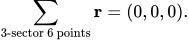
For each of the three cyclic pairs, the two endpoints are antipodal (e.g., (1,1,-1) and (-1,-1,1)), so each pair sums to (0,0,0). Summing all three pairs:
8.0.4 The single nozzle is forced
Because the 3-sector contribution to net inflow is identically zero (§8.0.3), any net direction along which the core exchanges material with its surroundings must lie along the unique fixed axis (§8.0.2). The two endpoints of that axis split into:
- One end: the nozzle (open inlet for inflow).
- The other end: the unpaired closed terminus.
This is exactly the "1 open + 1 closed + 6 paired in a balanced ring" pattern. The 7-shell partition therefore decomposes as 1 + 6 = 7 (nozzle + cyclic ring). This is the same partition used in §8.2.4, under the correspondence: the single surviving index u (the "1" in the 2+4+1 partition of §8.2.4) is the nozzle identified here, and the six cancelling points (the "2+4") are exactly the three antipodal cyclic pairs whose vector sum vanishes (§8.0.3). The Phase-1 erratum (PATCHES.md item #3) corrects the §8.2.4 arithmetic from the inadmissible 2+2+4+1=9 to the geometric 2+4+1=7 consistent with this 1+6 reading.
Status: [F].
The single-inlet structure is a forced geometric consequence of C₃ symmetry breaking; no empirical input enters. It explains, rather than postulates, the "82+7" shell decomposition of Chapter 8.
8.0.5 Nucleon integer–rectification structure (single source of truth) and the n-fold event-rate law
Purpose (SSOT).
This block is the single canonical location for (i) the nucleon integer counts 3,7,82,89, (ii) their geometric necessity, and (iii) the n-fold event-rate law that fixes ν_p,can=3π⁴. Every other section that mentions these integers or ν_p,can references this block and does not re-derive it. The concept net at the end of this block lists all the linked locations.(I) Integer counts forced by the 3-division of the circle.
A continuous rotational quantum lives on SO(2); the cubic lattice admits only the discrete C₃ about a body diagonal (§8.0.1). Because a circle cannot be cleanly 3-divided, the structure is forced into the following integers, all sharing one residual:- 3 sectors — the C₃ ring with Σ_in_i=0 (§7.0, §8.0.3);
- shell 7=1+6 — one nozzle + six balanced-ring points (§8.0.4);
- core 82=3⁴+1 — the 3-division packing 3³· 3=3⁴=81 plus the single irreducible residual that “does not 3-divide” (+1); equivalently the R²≤6 lattice-shell count 81 plus one (§7.1.5);
- build count 89=82+7 — core + shell (§7.1.5, §7.2).
The “+1” in 82=81+1 is the same single-nozzle residual as the “1” in 7=1+6: both are the irreducible remainder of trying to 3-divide a circle. This 82=3⁴+1 reading is adopted as the primary geometric statement of the core count; the back-calculated packing coefficient φ_pack=82/125 (§7.1.8) is retained only as a numerical consistency indicator, not as the source.
(II) The n-fold event-rate law (LOCK-NU-N).
Map each sector to one double rectification of §5.2 (directional phase = inter-sector relative phase; internal phase = sign selection), of survival δ=1/π² (§5.2). For an n-sector object the number of independent inter-sector phase locks is
which is the same linear-algebra count as the Higgs channel reduction 6-1=5 (§13.3.4). Independent locks accumulate by the §5.2 product measure ([A-5.2-U0]), and the single-nozzle canonical rate law ν=sδ (§9.4, §9.2) then gives, with no free coefficient,

(δ fixed in §5.2; exponent n-1 fixed by (S08_nucleon_dim); prefactor n fixed by the sector count). Equivalently, in radius form, rₙ=r₀δ^(n)/n.
Reading the exponent (one subtraction, two descriptions). The “−1” in n−1 is counted once. Seen from the counting side it is the global phase of the ring: n phases, of which a common shift is physically empty, leave n−1 independent locks. Seen from the dynamical side (§8.0.6(B)) it is the same global mode, the one aligned with the axis, which exchanges material through the single nozzle and pays the one survival factor δ in ν = sδ. The two descriptions remove the same mode, so they must not be applied twice (n−2 would give 6π³; applying neither would give 6π⁷). Worked for n = 1, 2, 3 in §MR Step 6.
(III) Electron (n=1) and proton (n=3).

The electron case is a nontrivial check: the law reproduces the independently defined electron clock of §9.3, it is not fitted to it.
(IV) Consequences (graded [F] under LOCK-NU-N).

The factor 2π=α/δ is the derived ratio of the two rectification constants (§13.5.5), not a reporting convention. Under LOCK-NU-N the proton radius rₚ is a derived prediction; the former canonical-input value 0.8412fm is kept only as a cross-check. The “+61 ppm” against the four-digit 0.8412 is mostly rounding of that locked value (≈42 ppm) plus the 6π⁵ residual (18.8 ppm), so it is not an independent test. The physical comparison is with CODATA 2022, r_p = 0.84075(64) fm: +0.8σ. This removes one empirical degree of freedom relative to the length-anchored route of §9.4 (see §1.8).
Provenance ledger for this block.
| Element | Rests on | Status |
| δ=1/π² (per lock) | §5.2 rectification integral | confirmed |
| exponent n-1 | dim(Rⁿ/span1), §13.3.4 | forced |
| prefactor n; count 3 | C₃ 3-division, §7.0/§8.0 | forced |
| 82=3⁴+1, 7=1+6, 89 | 3-division + nozzle residual | forced |
| product accumulation | §5.2 product measure [A-5.2-U0] | locked |
| single-δ rate ν=sδ | §9.2/§9.4 | locked |
| sector ≡ one §5.2 lock | [LOCK-NU-N] (this block; integral made explicit in §8.0.6) | definitional lock |
Concept net (single hub for these objects).
- 3 sectors / C₃ necessity: §7.0, §8.0.1–8.0.4.
- integerization 89,82 (N=3m+r): §7.1, §7.2; radial n_r=5, φ_pack: §7.1.7–7.1.8.
- 7-shell (1+6, Legendre R²=7 empty): §8.0.4, §8.2.
- ν_p,can length cross-check (=tfracD_anch2rₚδ): §9.4.
- electron νₑ=1, rₑ=r₀δ: §9.3.
- δ=1/π²: §5.2; α=2/π: §5.1; Rₚ/L_q=2/π: §6.2.
- mass ratio mₚ/mₑ=6π⁵: §13.5.
- Higgs n-1 analogue (5=6-1): §13.3.
- discrete integer-part cross-read (4(82-9)=292, NON-LOCK): App. F.
8.0.6 The forced 3-sector rectification integral (the forced / definitional boundary of LOCK-NU-N)
Purpose.
This block makes explicit which part of the n-fold law (S08_nfold_law) is a forced integral (no free coefficient) and which part is an irreducible meaning-layer definition. It isolates the latter to two lines that have exactly the status of the definitions of α and δ in §5.(A) The forced integral.
Assign to each of the n sectors one §5.2 rectification event: a directional half-wave phase θ_i and an internal half-wave phase φ_i (i=1,…,n), all full-cycle on [0,2π). By the single-source result of §5.2, the per-sector survival weight averages to![\begin{equation} w_i:=[\cos\theta_i]_+[\cos\varphi_i]_+,\qquad \langle w_i\rangle=\Big(\tfrac{1}{2\pi}\!\int_0^{2\pi}\![\cos\theta_i]_+\,d\theta_i\Big)\Big(\tfrac{1}{2\pi}\!\int_0^{2\pi}\![\cos\varphi_i]_+\,d\varphi_i\Big)=\frac1\pi\cdot\frac1\pi=\delta. \end{equation}](/physics/eq/physics/phy-08-004.svg)
A coherent n-sector event requires simultaneous sector survival; the C₃ ring-closure Σ_in_i=0 (§8.0.3) fixes the global phase as a gauge choice and removes no rectification from the survival integral: all n sectors must still survive, giving δⁿ. The gauge mode is removed one step later, in the rate law of (B), where the nozzle passage pays its single δ; that is the n−1 of §8.0.5(II), not a second subtraction. Under the §5.2 product measure ([A-5.2-U0]) the joint survival is the product
![\begin{equation} \boxed{\;\big\langle W_n\big\rangle=\Big\langle\prod_{i=1}^{n}[\cos\theta_i]_+[\cos\varphi_i]_+\Big\rangle=\prod_{i=1}^{n}\langle w_i\rangle=\delta^{\,n}=\pi^{-2n}\;} \end{equation}](/physics/eq/physics/phy-08-005.svg)
Equation (S08_06_Wn) is forced: every factor is fixed — 1/π per half-wave (the §5.2 integral), two half-waves per sector, n sectors, multiplied under the locked product measure. There is no slot for a free coefficient. Numerically,

(B) Passage to the event rate.
The single-nozzle canonical rate law ν=sδ (§9.2, §9.4), with attempt rate sₙ set by the inverse structural scale and n additive sector activities (§7.1), yields
which reproduces (S08_nfold_law): ν₁=1 (matching the §9.3 electron clock exactly) and ν₃=3π⁴.
(C) The forced / definitional boundary.
Everything numerical above is forced by the §5.2 integral and the C₃ count; no coefficient is free. What an integral cannot in principle produce are two meaning-layer identifications, stated here as the sole definitional content of LOCK-NU-N, with exactly the status of the definitions of α,δ in §5:- [MAP-1] Sector ≡ §5.2 event. Each sector's coherent participation is one §5.2 double rectification (directional θ_i + internal φ_i). This is §5.2's own event definition ([D-5.2-4]) applied per sector; it carries no free coefficient.
- [MAP-2] Survival leftrightarrow scale + additive activity. The joint survival ⟨ Wₙ⟩=δⁿ is identified with the inverse structural scale (resistance = inverse survival, i.e. 1/δ is the mean number of attempts per surviving event, the mean of a geometric distribution, so δ keeps its only role as a survival fraction, §5.4; §9.2; attempt rate = inverse radius, §9.4), and the n sectors contribute additively (prefactor n, §7.1). This is the channel of (S08_06_rate).
A definition is not a theorem; no integral can derive [MAP-1]/[MAP-2], exactly as none derives “α rectifies a directional projection” or “δ is the survival of a two-constraint event.” Hence LOCK-NU-N has the same epistemic status as α and δ: one locatable, non-tunable meaning-layer lock ([MAP-1]+[MAP-2]) plus the forced integral (S08_06_Wn). It is graded [F]{} under that lock, by the same standard that grades α=2/π and δ=1/π² as [F]{}.
(D) Shared lemma: the N-1 gauge-removal count (one forced source, three uses).
The exponent structure here is not specific to nucleons. It is the forced linear-algebra fact
— “N candidate channels, minus one global-reference (gauge) mode” — which recurs as the single source of three otherwise-separate results:
- Nucleon (here): N=n sectors ⇒ n-1 independent inter-sector locks, giving the exponent in νₙ=nπ²⁽ⁿ⁻¹⁾.
- Higgs (§13.3.4, [T-13.3-1]): N=6 cube faces ⇒ 6-1=5 independent channels, giving σ_eff(H)=5π and m_H=U_lat/(5π).
- Fine structure (§14.5.3): N=7 shell signs ⇒ 7-1=6 free signs, i.e. 2⁶ projection microstates in β_disc=210/192=35/32.
Equation (S08_06_gauge_lemma) is a theorem (forced, no free coefficient); the recurrence across three independent constants is a structural signature, not three tunings. The only per-use input is the candidate count N (n sectors, 6 faces, 7 shells), each fixed by the canonical geometry of §7–§8.
Lock record.
[MAP-1] and [MAP-2] are recorded once — here — inanalysis_lock as the meaning-layer content of LOCK-NU-N; (S08_06_Wn) and (S08_06_rate) are then theorems downstream of that lock. Re-stating or re-mapping them elsewhere is FAIL under G-SYM/G-LOCK. This is the lower epistemic bound: below the meaning-layer lock there is nothing further to derive, because definitions are not theorems.
Purpose of the chapter (locking definitions and outputs)
This chapter defines the proton structure as a discrete coordinate set and a contact graph, and locks a verification frame that checks compatibility with the continuum-core results (Chapter 6) and with the rectification/integerization conventions (Chapters 5–7). The outputs of this chapter are locked into the following three bundles.
- Coordinate outputs: the core-82 coordinate set X₈₂, the shell-7 coordinate (or vector) set S₇, the center x_c, and the coordinate-system locks.
- Graph outputs: node sets (82 or 89), edge sets (contact/adjacency), and the definitions of structural indicators such as contact degree/path/backbone.
- Verification outputs: structural invariants, radius/cross-section consistency, the cancellation–survival convention, regime/lock integrity, a reproducibility package, and Gate decision logs.
In this chapter, “82+7” is a definition-locked integer structure; changing these integers after seeing outcomes is forbidden. Any change of the integers is allowed only by a version bump.
Declaration of the coordinate system (locking coordinates/units/reference point)
Coordinate system and units
Discrete coordinates are defined on the 3D Euclidean space R³. The coordinate unit is fixed to an internal length unit, and a dimensionless coordinate system may be used with the normalization length L_q as the reference. The dimensionless coordinate system is defined by the following transformation.
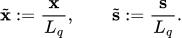
Here L_q is the selection length locked in §6.1, and (S08_x_tilde) is used only in versions where the identification L_q=λ_C is locked.
Locking the center x_c
Lock the center x_c of the core structure as follows.

The center x_c cannot be moved after seeing outcomes. Re-selecting the center is allowed only by a version bump.
Definition of the core-82 coordinate set X₈₂
Define the core 82 as a set of 82 coordinate points (or representative points).

The meaning of each coordinate (what a representative point stands for: VP representative point/contact center/lattice node, etc.) is locked by the object definition in canon_lock.
The coordinate set X₈₂ is stored as a single source of truth (SSOT), and it must not be redefined as a different coordinate set elsewhere in the main text.
Definition of the shell-7 set S₇
Define the shell 7 as a set of 7 coordinates (or vectors).

The meaning of s_k (whether it is a shell coordinate, a shell direction vector, or an event marker point) is locked by the object definition in canon_lock.
The cancellation–survival convention for the shell is locked later as a separate definition; in this overview we include only the requirement that “the shell 7 attaches near the core boundary” in the verification frame (linked to the conditions in §6.4).
Declaration of the graph (contact/adjacency) (locking nodes/edges/weights)
Node sets
The node set used in this chapter is locked to one of the following two options depending on the regime and purpose.

V₈₂ is used for validating the internal core structure, while V₈₉ is used for validating the core–shell coupling and the cancellation–survival convention. Within a single output, the two node sets must not be mixed.
Contact predicate and edge set
Define the contact predicate C(i,j) for nodes i,j as follows.

The contact convention (distance-based/surface-based/persistent-contact-after-relaxation, etc.) is locked in analysis_lock.
Define the edge set as

Therefore the contact graph is defined by

where V is the node set selected in (S08_nodes).
Adjacency matrix and degree
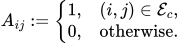
Define the adjacency matrix as
Define the contact degree (degree) of each node as
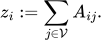
The contact degree is an input for derived indicators such as deficits/throats/paths; if the contact convention is not locked, then A_(ij) and z_i are undefined.
Weights (optional) and weighted graphs
If a weighted graph is used, define a weight function W(i,j)≥ 0 by

The definition of the weight (distance/angle/throat thickness/path resistance, etc.) is locked in analysis_lock.
Conclusions that use weights must not be mixed with conclusions that do not use weights.
Declaration of the verification frame (structural invariants + Gate stack)
Categories of structural invariants
The verification in this chapter targets the following four categories of structural invariants.
- Geometric-consistency invariants: core-radius consistency (R₈₂≡ Rₚ), cross-section invariants (σ₈₂/L_q²≡ 4/π), etc. (linked to the condition list in §6.4).
- Graph invariants: connectivity, bottleneck indicators, min-cut/alternate-path sensitivity, regime consistency of the degree distribution, etc.
- Cancellation–survival invariants: the shell-7 cancellation structure (“6 cancel + 1 survive”) and survival-vector non-degeneracy (|V|≥ V_(min)), etc.
- Integer/sector invariants: sum preservation and minimum-variance conditions of the 3-sector integerization, and the definability conditions of residual-direction labels (linked to Chapter 7).
Standard composition of the Gate stack
Conclusions in this chapter require PASS of the following Gate stack as necessary conditions.
- G-SYM: no conflicts in coordinate/unit/diameter–radius/cell-geometry meanings.
- G-LOCK: coordinate sets/contact conventions/weight definitions/thresholds belong to the same lock_id.
- G-REG: regime coordinate axes (dimension/driving/spanning/bottleneck/initial conditions/observation axes) are consistent.
- G-STR: structural invariants (integers, symmetry, cancellation convention) of core 82 and shell 7 are preserved.
- G-NUM: numerical stability of procedures (contact predicate, projected area, aggregation operations) and repeatability.
- G-REP: re-running with the same package reproduces the same results and the same verdict.
- G-NT: no post hoc changes or selection bias are detected for coordinates/conventions/thresholds/selection rules.
The detailed thresholds and report formats of the Gate stack must be pre-registered in gate_lock and protocol_lock, and must not be modified after seeing outcomes.
Package sealing (coordinates/graph/verdict logs)
The coordinate outputs X₈₂,S₇, the graph output G_c, and verdict logs must be sealed within the same release by being included in manifest and checksums.
Unsealed outputs are not granted conclusion status.
LOCK/Gate connections for this section (none if empty)
- LOCK: Fix X₈₂, S₇, x_c, and the coordinate normalization convention (relative to L_q) in
canon_lock/analysis_lock. - LOCK: Fix the contact predicate C(i,j), the graph G_c, the degree z_i, and (optionally) the weight W(i,j) definitions in
analysis_lock. - Gate: Link structural verification to require
PASSof the G-SYM/G-LOCK/G-REG/G-STR/G-NUM/G-REP/G-NT stack. - Gate: Post hoc changes or selection bias for coordinates/conventions/thresholds trigger immediate
FAILin G-NT. - Gate: Coordinates/graphs/logs without sealing (manifest/checksums/registry_snapshot) are
FAILorINCONCLUSIVEin G-REP.
8.1 Core-82 coordinates / hierarchy (d2) + contact graph
8.1.1 Outputs (coordinate file + hierarchy labels + graph)
The outputs of this section are locked to the following three bundles.
- Coordinate set:

and the center x_c.
- Hierarchy (distance) label:
the shortest-path hierarchy function on the contact graph,

and the d=2 layer set

- Contact graph:

Coordinates, hierarchy, and graph belong to the same analysis_lock version, and different conventions are not mixed within a single output.
8.1.2 Inputs (LOCK): length/radius/procedure parameters
The construction procedure in this section is defined only when the following inputs are locked.
- Core node count:

- Normalization length:

- Core radius:

- Minimum separation length (impenetrability / duplicate prevention):

- Contact-judgement length:

- Candidate-point grid step and boundary:

- Stabilization (relaxation) tolerance and maximum iterations:

- Hierarchy root-set size:

- Tie-break (deterministic rule):
lock a rule
TBthat decides selection order under exact ties (e.g., lexicographic sorting, index-priority, etc.).
If any of the above items are not locked, the outputs of this section are undefined and are judged INCONCLUSIVE.
8.1.3 Generating the candidate set C (fully deterministic procedure)
Candidate points are generated by mapping an integer grid-index set into real space.
8.1.3.1 Integer index set
Define the integer index set as follows.

8.1.3.2 Grid map and candidate points
Define the map as follows.

Define the candidate set C with the following filter.

The point |y|=0 (the center point) is excluded by default in this section.
A version that must include the center is allowed only by the include_center flag in analysis_lock; if the flag is false, the center is always excluded.
8.1.3.3 Candidate sorting (deterministic order)
Fix the deterministic order of candidates by sorting with the following key.

where yₓ,y_y,y_z are the components of y. Sorting is fixed as (1) increasing radius, then (2) lexicographic increasing component order.
8.1.4 Rule for selecting 82 points (deterministic Poisson-gap sampling)
The coordinate set X₈₂ is constructed by selecting 82 points from the candidate set C. The selection rule is fixed to satisfy both the “minimum separation length” and “suppression of maximal variance (uniform distribution).”
8.1.4.1 Minimum-separation condition
The selected points x_i must satisfy

8.1.4.2 Score function (maximize the minimum distance)
Given a partial subset S⊂C, define the score of a candidate point y∈C∖S as

The score is the “minimum distance to the already-selected points,” and a candidate with a larger score is selected in a direction that produces a more uniform distribution.
8.1.4.3 Selection algorithm (fully fixed procedure)
Selection is locked by the following deterministic procedure.
ALG-CORE82-SELECT (inputs: C, d_min, N_core=82, TB)

S := empty set
1) Initial selection:
   - sort C by key(y)
   - add the first element y0 to S (smallest radius; if tie, lexicographic)
2) Iterative selection (|S| < 82):
   - build the candidate set C_ok that does not violate the separation constraint:
       C_ok := { y in C \ S | for all z in S: ||y-z|| >= d_min }
   - if C_ok is empty: FAIL-CORE82-NOTENOUGH
   - for each y in C_ok, compute score(y;S)
   - choose y* with the maximal score
   - if tied, choose one by TB (tie-break)
   - add y* to S
3) Output:
   - index elements of S as {x_i}_{i=1..82} and form X82
This algorithm is deterministic and uses no randomness. If the algorithm cannot fill 82 points, construction fails and does not proceed to downstream steps (hierarchy/graph).
8.1.5 Scale consistency (normalization to the boundary radius Rₚ)
The selected coordinate set X₈₂ is normalized by a single scale factor to ensure radius consistency.
8.1.5.1 Boundary-candidate set and aggregated radius
Define the radius of each point as r_i:=|x_i-x_c|. The center is locked by default as

and any alternative center selection is allowed only by a version bump.
Define the boundary-candidate set as follows, where K_b is a locked integer.

Define the aggregated radius as

where Agg is an aggregation operator locked in analysis_lock (e.g., median, mean).
8.1.5.2 Scale factor and coordinate redefinition
Define the scale factor as

Redefine coordinates as

After rescaling, R₈₂≡ Rₚ holds by definition (definitional consistency). However, this consistency is meaningful only when Agg and B₈₂ are locked.
8.1.6 Stabilization (relaxation): simultaneous satisfaction of minimum separation and boundary constraint
Even after rescaling, to enforce (S08_01_separation) and |x_i|≤ Rₚ, perform the following deterministic relaxation procedure.
8.1.6.1 Defining violation amounts
Define the pairwise violation amount as

Define the boundary violation amount as

Define the overall maximal violation as

8.1.6.2 Deterministic projection–separation relaxation algorithm
ALG-CORE82-RELAX (inputs: X82, d_min, R_p, eps_pos, K_max)

for iter = 1..K_max:
  # (A) pair-separation projection
  for i = 1..82:
    for j = i+1..82:
      d = ||x_i - x_j||
      if d < d_min:
        u = (x_i - x_j) / max(d, tiny)   # tiny>0 is a fixed numerical safeguard constant
        shift = 0.5 * (d_min - d)
        x_i := x_i + shift * u
        x_j := x_j - shift * u

  # (B) radial-boundary projection
  for i = 1..82:
    r = ||x_i||
    if r > R_p:
      x_i := (R_p / r) * x_i

  # (C) stopping rule
  compute D_max
  if D_max <= eps_pos:
    break

if D_max > eps_pos:
  FAIL-CORE82-NOCONVERGE
This algorithm uses a fixed update order (in increasing indices), and tiny is a fixed numerical safeguard constant.
After termination, the following must be guaranteed:

otherwise the verdict is FAIL.
8.1.7 Constructing the contact graph (single distance-based convention)
Fix the contact predicate as a single convention determined from the coordinates.
8.1.7.1 Contact predicate function
Define the contact predicate C(i,j) as

where d_c is the contact-judgement length locked by (S08_01_dc) and must not be adjusted after seeing outcomes.
8.1.7.2 Edge set and adjacency matrix
Define the edge set as

Define the adjacency matrix as

Define the degree as
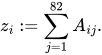
8.1.7.3 Connectivity condition (minimal requirement)
For the graph to function as a single core, it must be connected. Define the connectivity indicator as

If χ_conn=0, the verdict is FAIL-CORE82-DISCONNECTED.
8.1.8 Hierarchy (d2): root set R₀ and BFS distance
Define the hierarchy by the shortest-path distance on the contact graph.
8.1.8.1 Determining the root set R₀
The size N₀ of the root set is locked by (S08_01_N0). Determine the root set by the “smallest radius” criterion.

Ties are resolved by the pre-registered tie-break rule (TB).
8.1.8.2 Hierarchy function d(i)
On the contact graph G_c, define the shortest distance (number of edges) to the root set as

Define the layer sets as

where the “d2” of this section is locked to L₂ ((S08_01_L2)).
8.1.8.3 Hierarchy completeness condition
Every node must be reachable from the root; hence
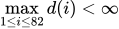
is required.
This is equivalent to connectivity (S08_01_conn), and violation triggers FAIL-CORE82-DISCONNECTED.
8.1.9 Storage format (single source of truth for coordinates/hierarchy/graph)
The outputs of this section are stored in the following files and must be sealed by inclusion in the same release's manifest and checksums.
-
X82.csv: (i,x_i,y_i,z_i,r_i). -
G82.edgelist: edge list (i,j). -
layers82.csv: (i,d(i)) and counts |L_ℓ| by ℓ. -
params82.yaml: Rₚ,L_q,d_(min),γ_c,h_grid,B,ε_pos,K_(max),N₀,K_b,Agg,TB.
Unsealed outputs are not granted conclusion status.
LOCK/Gate connections for this section (none if empty)
- LOCK: Fix N_core=82, Rₚ, L_q, d_(min), γ_c, h_grid, B, ε_pos, K_(max), N₀, K_b, Agg,
TBinanalysis_lock/canon_lock. - Gate: Point-selection failure (
FAIL-CORE82-NOTENOUGH), relaxation failure (FAIL-CORE82-NOCONVERGE), and disconnection (FAIL-CORE82-DISCONNECTED) are immediateFAIL. - Gate: meaning/unit/cell-geometry conflicts are
FAILin G-SYM; lock_id mixing isFAILin G-LOCK. - Gate: if coordinate/graph/hierarchy files are not sealed by
manifest+checksums, then G-REP yieldsFAIL/INCONCLUSIVE. - Gate: post hoc parameter changes or post hoc tie-break selection are
FAILin G-NT.
8.2 Basic 7-shell structure
Geometric minimality of the shell count (7) + residual match
In this section, N_shell=7 is not an arbitrary choice but is fixed as the minimum integer that satisfies simultaneously (i) the 3D cancellation (nulling) convention and (ii) the existence of a single surviving vector (label input). This minimality provides the prior justification for the definitional statement “1 pair + 1 quad + 1 survive” in §8.2.1.
(I) Geometric minimality of cancellation elements
The shell must "cancel as much as possible" (stability) while "not becoming identically zero" (label). In 3D, bias-reducing cancellation naturally comes in two types.
- Pair cancellation (2-element): (s,-s) cancels perfectly in any coordinate system.
- Quad cancellation (4-element): Sum-zero cancellation of three vectors always lies in a plane and thus cannot enforce 3D isotropic cancellation.
In contrast, the four unit vectors in tetrahedral directions q_i_(i=1)⁴ satisfy

and provide a representative (isotropic) cancellation element.
Therefore, to maximize cancellation while including both "one pair" and "one quad", the shell requires at least 2+4=6 vectors.
(II) One surviving vector
To carry the charge/electron label, at least one non-cancelled surviving vector is required (definition in §8.2.1). Hence

(III) Residual match (arithmetic check)
Separately, when the total structural count N_str and the core count N_core are locked independently, the shell count is also forced arithmetically by

In this version, N_str=89 (structure count in §7.2) and N_core=82 (core construction in §8.1) are locked, so the residual is 7. This matches the minimality result (S08_02_shell7_minimal).
8.2.1 Purpose
This section fixes, by definition, the internal structure of the 7-shell as the composite “1 pair + 1 quad + 1 survive” structure (one 2-element cancelling pair + one 4-element cancelling quad + one survivor =7; the same 1+6 partition as §8.0). This section does not interpret; it locks (i) the shell vector (or coordinate) set, (ii) the partitioning rule, (iii) the cancellation predicate, and (iv) the definition of the surviving term. If the definitions of this section are not locked, then the "surviving vector" used as an input in downstream charge/electron labels and in event-rate/mass derivations becomes undefined.
8.2.2 Inputs (LOCK): the shell-7 vector set and coordinate system
Define the shell 7 as the following set.

The meaning of s_k must be locked to one of the following two modes (exclusive lock).
- Point mode (
SHELL-POINT): s_k is a representative shell point (coordinate) relative to the core center x_c. - Vector mode (
SHELL-VEC): s_k is a vector representing a shell direction/contribution.
Regardless of the adopted mode, the coordinate system (reference axes, units, normalization) must be locked in analysis_lock, and cannot be replaced after seeing outcomes.
8.2.3 Standard definition of cancellation judgment (cancellation operators)
"Cancellation" in the shell structure means that the sum of vectors becomes sufficiently small, and cancellation judgment is defined by a threshold.
8.2.3.1 Cancellation threshold
Lock the cancellation threshold s_(min)>0.

8.2.3.2 Pair cancellation judgment
For two distinct indices a≠ b, define the pair-cancellation predicate as

This is an operational definition of cancellation and must not be changed after seeing outcomes.
8.2.3.3 Quad cancellation judgment
For four distinct indices (a,b,c,d), define the quad-cancellation predicate as

Quad cancellation means that the sum of the four terms lies within the cancellation threshold s_(min).
8.2.4 Structural definition of "1 pair + 1 quad + 1 survive" (corrected v0.2.0)
The core of this section is to define a rule that partitions the index set 1,…,7 into the following three parts.

Here

and dot∪ denotes disjoint union (no overlap). P₁ is one cancellation pair, Q is one cancellation quad, and u is the surviving index.
Erratum note (corrected in v0.2.0). Earlier drafts wrote the partition as P₁dot∪ P₂dot∪ Qdot∪u with |P₁|=|P₂|=2, which sums to 2+2+4+1=9≠ 7. This was a typographic error inconsistent with the boxed result N_shell=7 of §8.2(I). The correct partition is the one above (1 pair + 1 quad + 1 survive = 7). The geometric origin of this partition (single nozzle from C₃ symmetry breaking) is derived in the new §8.0.8.2.4.1 Definition of the pair
Define the (single) cancelling pair as the index pair satisfying

That is, the pair must cancel within the threshold s_(min). (The second pair P₂ of earlier drafts is removed: it belonged to the erroneous 2+2+4+1=9 partition corrected in v0.2.0; see the erratum note above.)
8.2.4.2 Definition of the "quad"
Define the quad as the remaining four-index set Q satisfying

That is, the sum of the four terms must cancel within s_(min).
8.2.4.3 Definition of "one survive"
Define the surviving index u as the unique index not included in the pairs and the quad.

Define the surviving vector (or surviving coordinate) as

However, in an operational procedure, pair/quad residuals can be nonzero (within the threshold but not exactly zero). Therefore, extend and lock the standard definition of the surviving vector as

Definition (S08_02_Vsurv_full) is the definition of the "surviving residual including cancellation residuals", and is used later as the input to charge/electron labels. (S08_02_Vsurv_simple) is the special case under ideal perfect cancellation (zero residual).
8.2.5 Partition selection rule (closure to remove non-uniqueness)
The conditions (S08_02_two_pairs) and (S08_02_quad) can admit multiple solutions.
Therefore, the choice of the partition (P₁,Q,u) must be locked as a closure.
This section fixes only the slot of the selection rule and declares that the concrete selection rule is locked as CL-G-SHELL7-PARTITION in analysis_lock.
8.2.5.1 Valid partition set
Define the set of valid partitions by

If P_valid=varnothing, then the structure definition of this section is not applicable, and the shell-7 structure does not hold in the given regime.
8.2.5.2 Selection function (locked as closure)
Define the selection function Select(·) by

Select must be locked in analysis_lock including the following items.
- The optimization objective (choose one: maximize/minimize |V_surv|, minimize total residual, maximize projection to a specified axis, etc.).
- Tie handling (tie-break).
- Failure modes (no valid partition, unresolved multiple solutions, numerical instability, etc.).
- Required Gate stack (G-SYM, G-LOCK, G-REG, G-STR, and if needed G-NUM, G-NT).
8.2.6 Summary of the structural requirements (definitional conclusion)
In this section, the "basic 7-shell structure" is defined by the following single statement.
The shell 7 is partitioned, for the index set 1,…,7, into one cancelling pair P₁, one cancelling quad Q, and one surviving index u (2+4+1=7); the pair and the quad cancel within the cancellation threshold s_(min); and the surviving vector is defined by (S08_02_Vsurv_full).
The above is a definition (not an interpretation), and downstream sections refer to it without restating it.
LOCK/Gate connections for this section (none if empty)
- LOCK: Fix the meaning of the shell set S₇=s_k (point mode / vector mode), the coordinate system, and the unit/normalization conventions in
canon_lock/analysis_lock. - LOCK: Fix the cancellation threshold s_(min) and the cancellation predicates (S08_02_cancel_pair), (S08_02_cancel_quad) in
gate_lock/analysis_lock. - LOCK: Fix the partition structure definition (1 pair + 1 quad + 1 survive) (S08_02_partition)–(S08_02_Vsurv_full) in
analysis_lock. - Gate: Empty valid partition set (P_valid=varnothing) is
FAIL-SHELL7-NOPART; post hoc selection/threshold shift isFAILin G-NT. - Gate: symbol/meaning/unit conflicts are
FAILin G-SYM; lock_id mixing isFAILin G-LOCK.
8.3 Verification frame for “6 cancel + 1 survive”
8.3.1 Definition of the verification target
In this section, “6 cancel + 1 survive” is the verification problem of judging whether the shell-7 partition structure defined in §8.2 holds for actual data (or for the actually produced coordinates/vectors). The verification targets the following three items.
- Existence: under the cancellation threshold s_(min), does a valid partition (P₁,Q,u) exist.
- Consistency: does the selected partition satisfy the cancellation conditions (one pair, one quad).
- Nondegeneracy: does the surviving vector (including cancellation residuals) pass the non-degeneracy threshold so that it can be used as an input for labels/events/downstream derivations.
Verification returns only PASS/FAIL/INCONCLUSIVE; interpretation cannot nullify the verdict.
8.3.2 Inputs (LOCK) and prior definitions
8.3.2.1 Shell vector set
The shell 7 is input as the following set.

The meaning of s_k (point mode / vector mode), the coordinate system, and the normalization conventions must be locked in analysis_lock.
8.3.2.2 Cancellation threshold and non-degeneracy threshold
Input the cancellation threshold s_(min) and the non-degeneracy threshold V_(min) as

where s_(min),V_(min) must be pre-registered in gate_lock and must not be moved after seeing outcomes.
8.3.2.3 Cancellation predicates (refer to the definitions in S8.2)
Pair and quad cancellation are defined by


These predicate definitions are not modified within the same version.
8.3.2.4 Partition-selection closure (locking the selection rule)
Define the valid-partition set and the selection function as


The concrete rule of Select (objective function / tie-break / failure mode / required Gate stack) must be locked in analysis_lock; otherwise the verdict is INCONCLUSIVE.
8.3.2.5 Surviving vector definition (including cancellation residuals)
For the selected partition, define the surviving vector by

Equation (S08_03_Vsurv) is the standard residual definition of “6 cancel residuals + 1 survive,” and is used downstream as an input for charge/electron labels.
8.3.3 Verification items (checklist) definition
The verification items of this section are locked to the following six items. Each item produces a cause label for PASS/FAIL/INCONCLUSIVE.
(V1) Input lock completeness
The following items must all be locked.
- The meaning of S₇ (point/vector mode), coordinate system, and unit/normalization convention.
- Threshold values of s_(min) and V_(min).
- Objective/tie-break/failure mode/required Gate of the Select closure.
If any item is missing, the verdict is INCONCLUSIVE; if post hoc change evidence is detected, it is FAIL.
(V2) Existence of a valid partition
P_valid must be nonempty.

(V3) Cancellation consistency of the selected partition (one pair + one quad)
For the selected result (P₁^*,Q^*,u^*), require

Violation of any condition yields FAIL-SHELL7-CANCEL.
(V4) Quantitative recording of cancellation residuals (consistency indicators)
Define the cancellation residual norms as
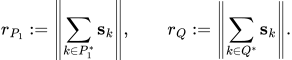
By definition, if (S08_03_cancel_consistency) holds then r_(P₁),r_Q≤ s_(min) must hold.
This item is not an “extra decision” but a mandatory log indicator; missing indicators yield INCONCLUSIVE.
(V5) Surviving non-degeneracy (eligibility as a label/event input)
Define the non-degeneracy condition for the surviving vector by

If (S08_03_surv_nondeg) is violated, the verdict is FAIL-SHELL7-DEGEN.
If this item is FAIL, then this window's shell data cannot be used as an input for downstream charge/electron labels (§7.4) and event-rate/mass derivations (only limitation conclusions are allowed).
(V6) Robustness (consistency under the defined replay stack)
This item requires verdict consistency over a pre-registered “replay set” under the same analysis_lock.
The replay set must be locked as

where each rₘ means (i) a different time window from the same input log, or (ii) a different subsample (by a pre-registered selection rule), or (iii) re-computation of the same data (same code/environment).
If the construction rule of the replay set is not locked, the verdict is INCONCLUSIVE.
Let the surviving vector in each replay be V_surv^((m)) and define the directional-consistency indicator by

Lock the threshold c_(min) in gate_lock (-1≤ c_(min)≤ 1).
Define the robustness rule as
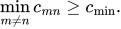
Violation of (S08_03_robust_rule) is treated as FAIL-SHELL7-ROBUST.
This item applies only when the replay set is locked; otherwise robustness verification is not executable (INCONCLUSIVE).
8.3.4 Log specification (mandatory records)
This section grants conclusion status only when the following logs are complete.
The format (JSON/YAML/CSV, etc.) is locked in protocol_lock, but the field meanings are fixed as follows.
8.3.4.1 Input log
-
shell_id: shell data identifier. -
s_k: coordinates/components of s_k for k=1..7. -
mode:SHELL-POINTorSHELL-VEC. -
locks:canon_lock_id,realization_lock_id,analysis_lock_id. -
thresholds: s_(min), V_(min), (optional) c_(min).
8.3.4.2 Partition/cancellation log
-
P1,Q,u: the selected partition (P₁^*,Q^*,u^*). -
residuals: (r_(P₁),r_Q). -
CancelPair(P1),CancelQuad(Q): cancellation predicate values (0/1). -
V_surv: components of V_surv and the norm |V_surv|.
8.3.4.3 Robustness log (if applicable)
-
replay_set: replay set identifier and construction rule. -
V_surv[m]: V_surv^((m)) for each replay m. -
c_min_pair: min_(m≠ n)cₘₙ. -
pass_robust:true/false.
8.3.5 Decision Gate (stack) definition
The Gates in this section are locked to the following stack. Each Gate outputs one of PASS/FAIL/INCONCLUSIVE.
8.3.5.1 G-SHELL7-LOCK (input lock Gate)
-
PASS: all input (LOCK) items in §8.3.2 are locked. -
INCONCLUSIVE: lock missing or schema missing. -
FAIL: post hoc change evidence detected (threshold shift, selection-rule change, lock_id mixing).
8.3.5.2 G-SHELL7-PART (partition existence Gate)
-
PASS: P_valid≠varnothing. -
FAIL:FAIL-SHELL7-NOPART.
8.3.5.3 G-SHELL7-CANCEL (cancellation consistency Gate)
-
PASS: (S08_03_cancel_consistency) holds. -
FAIL:FAIL-SHELL7-CANCEL.
8.3.5.4 G-SHELL7-SURV (surviving non-degeneracy Gate)
-
PASS: (S08_03_surv_nondeg) holds. -
FAIL:FAIL-SHELL7-DEGEN.
8.3.5.5 G-SHELL7-ROBUST (robustness Gate; optional)
-
PASS: replay set is locked and (S08_03_robust_rule) holds. -
INCONCLUSIVE: replay set or c_(min) not locked. -
FAIL:FAIL-SHELL7-ROBUST.
8.3.5.6 Final Gate: G-SHELL7-6C1S
Define the final verdict as

that is, robustness requires PASS when it is locked, but may remain INCONCLUSIVE when it is not locked; in that case, the sentence “robustness verification passed” is forbidden (restricted by PASS.rules).
8.3.6 Allowed conclusion sentences (link to standard templates)
Only when G-SHELL7-6C1S=PASS are conclusion sentences of the following types allowed.
- “This shell data satisfies two-pair + one-quad cancellation and non-degenerate survival under the threshold s_(min).”
- “The surviving vector V_surv is defined and |V_surv|≥ V_(min).”
If the verdict is FAIL or INCONCLUSIVE, only limitation conclusions (CT-LIM) are allowed, and the FAIL label and violated items (V1–V6) must be recorded together.
LOCK/Gate connections for this section (none if empty)
- LOCK: Fix s_(min), V_(min), (optional) the robustness threshold c_(min), and the replay set R_replay in
gate_lock/analysis_lock. - LOCK: Fix the partition-selection closure Select(P_valid) and the surviving-vector definition (S08_03_Vsurv) in
analysis_lock. - Gate: Fix the decision rules for G-SHELL7-LOCK/PART/CANCEL/SURV/ROBUST and the final Gate (S08_03_final_gate) in
gate_lock. - Gate: Post hoc selection (threshold shift, selection-rule swap, lock_id mixing) is judged
FAILunder G-NT/G-LOCK. - Gate: If input/partition/residual/survival logs are not sealed by
manifest+checksums, conclusion status is not granted (linked to G-REP).
8.4 Electron-generation mechanism + charge-label definition
8.4.1 Definitions (surviving vector → emission event → label)
8.4.1.1 Completed core/shell state and completion event
Define the completed state with core 82 and shell 7 coupled as the following object.

where X₈₂ is the core-82 coordinate set, S₇ is the shell-7 vector (or coordinate) set, x_c is the center, and Rₚ is the core radius.
The meaning/unit/coordinate system of each item must be locked in canon_lock/analysis_lock.
Define the completion event as

The occurrence time t_build of the completion event is defined by the build-time convention. In regimes where the canonical event rate ν_p,can is locked,
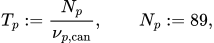
and given a build-start time t₀ we define

If ν_p,can is undefined, then t_build is replaced by a window/tick-based definition; the replacement convention must be locked in analysis_lock.
8.4.1.2 Surviving vector V_surv
Assume the shell-7 partition structure (1 pair + 1 quad + 1 survive) and the cancellation threshold s_(min). Valid-partition selection is locked as closure, and

defines the selected partition. Define the surviving vector (including cancellation residuals) as

Definition (S08_04_Vsurv) is the unique standard survival definition of the “6 cancel + 1 survive” structure; it cannot be replaced by another convention (e.g. assuming perfect cancellation, absolute-sum rules, alternative weighted sums) within the same version.
8.4.1.3 Emission direction (unit direction) and emission point
Define the survival (emission) direction as

If |V_surv|=0, the emission direction is undefined.
Lock the emission length ℓ_emit>0 as

Define the emission point (emission location) as

Definition (S08_04_xemit) is the geometric convention “move outward by ℓ_emit beyond the core boundary (Rₚ)”, and it is not adjusted after seeing outcomes.
8.4.1.4 Charge axis n_Q and charge unit q₀
The charge label is defined by judging the sign of the surviving vector relative to a single reference axis. Lock the charge axis as

Lock the charge unit as
![\begin{equation} q_0:=1, \qquad q_0\ \text{is locked in}\ \texttt{canon\_lock}\ \text{as the base unit of charge dimension }[Q]. \end{equation}](/physics/eq/physics/phy-08-097.svg)
8.4.1.5 Charge-sign function and label functions
Define the charge-sign function as

Define the charge label as

Define the electron/anti-electron label as

Definition (S08_04_e_label) is the formal definition of the label format; it does not include an interpretation of the label meanings.
8.4.2 Rules (emission conditions and label assignment rules)
8.4.2.1 Emission-validity conditions (mandatory Gate premises)
The emission event is defined only when all of the following conditions hold.
(R1) Pass of the “6 cancel + 1 survive” verification
The shell verification Gate must be PASS.

If it is not PASS, emission is not defined and the label cannot be used as an input for conclusions.
(R2) Survival non-degeneracy condition
Lock the non-degeneracy threshold V_(min)>0 as

Define the emission condition as

If (S08_04_emit_condition_V) fails, then widehatn_emit is unstable/undefined and emission is not defined.
(R3) Lock-integrity of axes/thresholds/conventions
The following items must all belong to the same lock_id combination.

If inconsistency or mixing is detected, emission/labels are immediate FAIL.
8.4.2.2 Definition of the emission event (time/location/direction/state)
Define the emission event as

Lock the emission time by

that is, emission is defined as an event recorded at the same time as the core–shell completion event. (To allow a different relative timing between completion and emission requires a separate version bump; it cannot be adjusted within the same version.)
The emission event's location and direction are locked by (S08_04_nemit) and (S08_04_xemit). The event's state labels are locked by (S08_04_Qlabel) and (S08_04_e_label).
8.4.2.3 Label assignment rules (no interpretation; definitional assignment)
When emission is valid, assign labels by the following rules.
- Charge sign: q:=q(V_surv).
- Charge label: Q_label:=q₀ q.
- Electron/anti-electron label: Lₑ:=Lₑ(V_surv).
This label assignment is definitional (not interpretive). Changing the basis (e.g. using a different axis, a different threshold, or a different coupling rule) is forbidden within the same version.
8.4.2.4 Undefinedness handling rules
In the following cases, emission and labels are treated as undefined, and only limitation conclusions (CT-LIM) are allowed.
-
G-SHELL7-6C1S≠PASS. - |V_surv|<V_(min).
- V_surv·n_Q=0 (zero sign).
- Lock_id inconsistency or missing lock registration (thresholds/axis/selection rules not registered).
Patching undefinedness by interpretation, or making it “defined” by post hoc changes of thresholds/axes/conventions, violates No-Tuning and is forbidden.
8.4.3 Output forms (emission record, charge label, electron/anti-electron label)
8.4.3.1 Output form: emission records (must be sealed)
When emission is valid, record and seal an emission record with the following fields.
The record follows the schema in protocol_lock, while the meanings of the fields are fixed as below.
emit_records:
  - emit_id: (unique)
    t_emit: (t_build)
    x_emit: [x, y, z]
    n_emit: [nx, ny, nz]
    V_surv: [Vx, Vy, Vz]
    V_norm: ||V_surv||
    q_sign: -1 | 0 | +1
    Q_label: q0 * q_sign
    e_label: ELECTRON | ANTI_ELECTRON | NEUTRAL
    refs:
      core_state_id: (X82,S7,xc,Rp snapshot id)
      shell_partition: (P1*,P2*,Q*,u*)
    lock_refs:
      canon_lock_id: (...)
      realization_lock_id: (...)
      analysis_lock_id: (...)
    gate_refs:
      G-SHELL7-6C1S: PASS
      (optional) G-REG: PASS
      (optional) G-REP: PASS
The emission record must be sealed by inclusion in manifest and checksums; unsealed records cannot be used as inputs for downstream derivations.
8.4.3.2 Output form: charge label
When emission is valid, the charge label is locked by (S08_04_Qlabel).

If q₀=1 is locked, then Q_label∈-1,0,+1.
8.4.3.3 Output form: electron/anti-electron label
When emission is valid, the electron/anti-electron label is locked by (S08_04_e_label).

Whether the NEUTRAL output is allowed as a conclusion sentence is locked by PASS.rules; this section does not decide allow/forbid (it fixes definitions only).
LOCK/Gate connections for this section (none if empty)
- LOCK: Fix the definition of V_surv ((S08_04_Vsurv)), the emission length ℓ_emit ((S08_04_lemit_lock)), the charge axis n_Q ((S08_04_nQ_lock)), and the charge unit q₀ ((S08_04_q0_lock)).
- Gate: Link shell verification
G-SHELL7-6C1S=PASSand the non-degeneracy condition |V_surv|≥ V_(min) ((S08_04_emit_condition_V)) as necessary conditions for emission. - Gate: Post hoc changes of thresholds (s_(min),V_(min)) and the label axis n_Q, or swapping selection rules, are
FAILunder G-NT. - Gate: symbol/meaning/unit conflicts are
FAILunder G-SYM; lock_id mixing isFAILunder G-LOCK. - Gate: If emission records are not sealed by
manifest+checksums, then G-REP yieldsFAIL/INCONCLUSIVE.
8.5 Dynamical formation cross-check: the steady-state grinder
Concept links: forced radius §11.6.4; canonical rate νₚ=3π⁴ §9.4, §8.0.5; inflow nozzle §8.0.The static account (§6.2, §11.6.4) fixes the proton radius as a forced stiffness/inflow balance. This subsection records an independent dynamical cross-check: a particle simulation of substrate quanta under (i) counter-rotation, (ii) inward contraction, (iii) a hard density-1 (no-interpenetration) constraint, (iv) annihilation of a quantum only when it is compressed below the 2×VP size floor, and (v) immediate external replenishment of each annihilated quantum.
8.5.0 Rotational unjamming: the geometric origin of inflow
The contraction and inflow used above and in §6.2 are not external inputs; they are the rotational-unjamming response of the jamming substrate, with a purely geometric origin. An isostatic packing (z=2d=6) is marginally rigid: it holds exactly the Maxwell-count number of contacts required for rigidity and no surplus, so its reserve against shear is zero. A rotation imposes the velocity field mathbf v=boldsymbolΩ×mathbf r; with two counter-rotating hemispheres the shear rate is maximal across the midplane. Because the isostatic shear reserve is zero, any finite rotational shear exceeds it and breaks contacts: the packing unjams. In the eggshell language of §(VP-N1) this is exactly the demand crossing the yield threshold, Ψ_req>Ψ_yield (unjamming_trigger), taken at the marginal point. Rotation breaks jamming because marginal rigidity has no shear margin to spend — a geometric statement, independent of any material parameter.
The unjammed material can exit only along the one open direction — the single C₃ nozzle of §8.0, the three balanced sectors carrying no net flux (§8.0.3) — so unjamming yields a directed inflow, not diffuse failure. This closes the gap upstream of §6.2: the 1/R⁴ inflow there is the rotational-unjamming current of the isostatic substrate, not a postulate. The simulation makes the dependence explicit — the selected radius scales as x^* 1/Ω: at Ω=0 there is no inflow and no length (x^*→∞), while at the canonical rate (inflow coefficient unity) the stiffness/inflow balance of §11.6.4 returns x^*=α=2/π, i.e. rₚ=(2/π)λ_(C,p). Rotation therefore creates the proton length by unjamming the substrate; that same rotation, sustained, is the grind of §8.5.1–8.5.2. (The rotation/anisotropy extension §17.1 treats the same effect through anisotropic percolation.)
8.5.1 [H] Closure
Assumptions: reduced units c=1, quantum diameter d=1; two counter-rotating hemispheres capped at |v|≤ 0.6c; contraction as a constant inward drift; density-1 enforced by overlap projection; annihilation by size (a quantum cannot enter another, so under load it shrinks, and is removed only at the 2×VP floor); replenishment at the outer edge, one fresh quantum per annihilation. Prediction: a non-collapsing stationary state in which a compact core persists while quanta circulate (inflow → grind → refill). Regime: 3D, driven/dissipative, near density-1; seeds logged.8.5.2 [V] Results
Each finding is reproduced by the v0.3 bundle (02_lattice_percolation_soc/jamming_rotation_verification_v0.3/):
- Balance is necessary. Stiffness alone selects no size; contraction-plus-grind without replenishment runs away to N→ 0; only the balanced, replenished loop is stationary. This is the dynamical counterpart of the forced fixed point of §11.6.4.
- Grind rate = canonical rate. The steady annihilation throughput equals the canonical event rate νₚ=3π⁴≈ 292.23s⁻¹ (§9.4). Dynamically, the proton is a quantum grinder whose rate is the same νₚ that fixes mₚ/mₑ=6π⁵=2πνₚ (§13.5).
- Scope (stated, not hedged). Isotropic contraction of monodisperse quanta yields an amorphous dense packing; the crystalline R²≤ 6 core is selected by the C₃/single-nozzle geometry (§8.0, §8.0.5), not by isotropic compression. The MD therefore confirms the mechanism (balance, rate, no collapse); the 82=81+1 structure is the geometric result of §8, by construction. Verdict:
PASSfor the mechanism.