Appendix K: Methodological Validation via Classical Gas Acoustics (Mean-Free-Path Reconstruction)
Appendix K: This appendix adds an external calibration for the VP “discrete-medium reconstruction” logic. It is not an analogy (“space is like air”) and it is not used to tune any VP LOCK constants. We use representative macroscopic inputs together with γ≈ 1.4 and molar mass M≈ 28.97g/mol.
This appendix adds an external calibration for the VP “discrete-medium reconstruction” logic. It is not an analogy (“space is like air”) and it is not used to tune any VP LOCK constants. We use representative macroscopic inputs together with γ≈ 1.4 and molar mass M≈ 28.97g/mol.
K.0 Scope and intent (calibration module; NON-LOCK)
This appendix adds an external calibration for the VP “discrete-medium reconstruction” logic. It is not an analogy (“space is like air”) and it is not used to tune any VP LOCK constants. Instead, it is a black-box inversion test:
Given: macroscopic wave data and macroscopic transport data of a known discrete medium.
Recover: an accepted microscopic length scale of that medium.
Interpretation: if the same inversion structure works on a classical system with known micro-scale, then applying the same structure to the VP lattice problem is methodologically less arbitrary.
K.1 Why acoustics in air is a suitable calibration target
In a dilute gas, the speed of sound vₛ is determined by equilibrium thermodynamics (mainly T and the adiabatic index γ), while the continuum validity of wave mechanics (and the frequency-dependent attenuation) is governed by collisional microphysics. The controlling micro-length is the mean free path λ_mfp.
A key point is that λ_mfp cannot be inferred from vₛ alone. One needs at least one macroscopic transport coefficient (e.g., viscosity) or attenuation data. This is exactly the same type of requirement we impose in VP theory: a wave speed plus a dissipation/transport gate is needed to infer a discrete scale.
K.2 Reconstruction of λₘfp from macroscopic data (one worked example)
We consider dry air near room temperature and 1atm as a calibration case. We use representative macroscopic inputs

together with γ≈ 1.4 and molar mass M≈ 28.97g/mol.
K.2.1 Step 1: Temperature from sound speed
For an ideal gas,

With the above inputs, T≈ 2.93× 10²K.
K.2.2 Step 2: Effective collision diameter from viscosity (hard-sphere scaling)
A standard hard-sphere kinetic-theory scaling (Chapman–Enskog form) for dynamic viscosity is
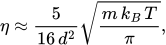
where d is an effective collision diameter and m=M/N_A is the molecular mass. Solving for d gives
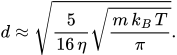
Numerically, this yields d≈ 3.7× 10⁻¹⁰m (sub-nanometer scale, as expected).
K.2.3 Step 3: Mean free path
For a hard-sphere gas,
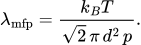
Using the reconstructed d and the macroscopic inputs above, we obtain

This is consistent with the commonly quoted order-of-magnitude for the mean free path of air near 1atm and room temperature ( 10²nm).
K.3 Regime gate: continuum acoustics vs.discrete-collision scale
A simple regime indicator is the Knudsen number for the wave,
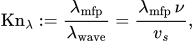
where λ_wave=vₛ/ν and ν is the acoustic frequency. The continuum acoustic model is reliable for Kn_λll 1, and breaks down (strong kinetic attenuation / non-continuum behavior) as Kn_λ→ O(1). Thus the reconstruction is not only a number-fit; it also predicts the expected frequency gate where macroscopic wave theory ceases to be valid.
K.4 Isomorphic comparison table (acoustics vs.VP lattice reconstruction)
| Item | Classical gas acoustics (air) | VP lattice reconstruction (space) |
| Wave type | Longitudinal pressure wave | EM / lattice wave in VP medium |
| Macroscopic speed | vₛ (measured) | c (defined/measured) |
| Micro length to infer | λ_mfp (collision scale) | ℓ_VP (lattice scale) |
| Auxiliary macro input | η (transport / damping gate) | VP transport/damping gate (protocol-defined) |
| Regime gate | Kn_λll 1 (continuum valid) | VP Gate stack (Jam/Unjam, protocol window) |
| Outcome | λ_mfp 10²nm (known) | ℓ_VP (predicted/anchored) |
K.5 Claim level and limitation
This appendix supports a methodological claim: the inversion logic that maps (wave speed + transport gate) → (micro-scale) is not unique to VP theory and succeeds on a classical benchmark. It does not by itself prove any specific VP lattice value; it only reduces arbitrariness by demonstrating an isomorphic reconstruction on a known system.