Appendix H: Theory of Geometric Rigidity (v2.1)
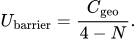
Appendix H: Theory of Geometric Rigidity: Define the geometric gap. With a Boltzmann-type escape probability P_escape ∝ exp(-U_barrier/E_th), define rigidity as inverse failure: Ψ ∝ 1/P_escape. Assume a minimal inverse-gap barrier for rearrangement. This yields an exponential rigidity law, normalized at N=3.
Define the geometric gap. With a Boltzmann-type escape probability P_escape ∝ exp(-U_barrier/E_th), define rigidity as inverse failure: Ψ ∝ 1/P_escape.
This appendix records a compact, self-contained derivation that links an effective coordination number N (jamming state) to a rigidity measure Ψ. It is intended as an extension note: the algebra is locked and reproduced by a script in the DOI bundle, while the physical interpretation can be debated and improved.H.1 Geometric gap and barrier
Define the geometric gap

Assume a minimal inverse-gap barrier for rearrangement:
H.2 Statistical stability and the rigidity form
With a Boltzmann-type escape probability P_escape ∝ exp(-U_barrier/E_th), define rigidity as inverse failure: Ψ ∝ 1/P_escape. This yields an exponential rigidity law, normalized at N=3:
![\begin{equation} \Psi(N) = \Psi_{\mathrm{base}} \exp\Big[k \Big(\frac{1}{4-N} - 1\Big)\Big], \end{equation}](/physics/eq/physics/phy-axh-002.svg)
where k ≡ C_geo/E_th is a dimensionless geometric coupling constant.
H.3 Diagnostic inversion: effective coordination from modulus ratios
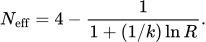
If a material-specific mapping allows Ψ to be compared via a measurable rigidity proxy (e.g., a bulk-modulus ratio R ≈ Kₛ/Kₗ across a transition), then the equation inverts to
H.4 DOI reproducibility artifacts (LOCK)
The following files fully reproduce the numerical table used in this appendix:
- LOCK:
04_vp_whitepaper/LOCK/rigidity_theory_v2_1_lock.json - Data:
04_vp_whitepaper/data/rigidity/rigidity_case_studies_v1.csv - Script:
04_vp_whitepaper/scripts/run_rigidity_theory_v2_1.py
[LOCK] Appendix H table is missing. In the DOI bundle it is regenerated by running 04_vp_whitepaper/scripts/run_rigidity_theory_v2_1.py.