Appendix R. Lattice tension theory: deriving the absolute scale of electromagnetic force
Appendix R. Lattice tension theory: This appendix assumes the following inputs are locked. The goal is to compute (i) the lattice tension F_lat, and (ii) as a product of geometric dilution/coupling/accumulation coefficients, the force at the reference distance rₚ, F_VP(rₚ).
This appendix assumes the following inputs are locked. The goal is to compute (i) the lattice tension F_lat, and (ii) as a product of geometric dilution/coupling/accumulation coefficients, the force at the reference distance rₚ, F_VP(rₚ). Proton radius rₚ and λ_C=(π/2)rₚ.
R.0 Locked inputs and goals
This appendix assumes the following inputs are locked.
- h, c_ref, a, π.
- U_lat:=hc_ref/a.
- Proton radius rₚ and λ_C=(π/2)rₚ.
- Proton resistance integral Sₚ=λ_C/a.
The goal is to compute (i) the lattice tension F_lat, and (ii) as a product of geometric dilution/coupling/accumulation coefficients, the force at the reference distance rₚ, F_VP(rₚ). In the comparison (target-text) section, the standard Coulomb law is used only as a verification metric.
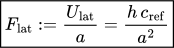
R.1 Definition of the lattice unit tension Fₗat
Define the lattice unit tension as follows.
R.2 Definition of geometric dilution/coupling/accumulation coefficients
Fix the following three coefficients.
(1) Mass dilution factor
Define the first-order dilution into proton structure as
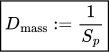
as defined.
(2) Spatial dilution factor (at reference distance rₚ)
Define the scale expansion from lattice length a to core radius rₚ as
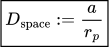
as defined.
(3) Geometric coupling factor (projection×accumulation×spherical correction)
Set the static projection coupling as η_static:=δ², and in the universal regime where δ=1/π²,

Define the dynamic accumulation factor as

as defined, and define the effective coupling as
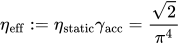
as defined. In addition, combining the spherical geometric correction factor 1/4, fix the final coupling factor as
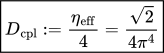
as a locked definition.
R.3 Deriving the absolute force at reference distance rₚ
Combining (AppR_Flat)–(AppR_Dcpl) yields

Define it as above. Expanding,

Here, since Sₚ=λ_C/a, we have 1/Sₚ=a/λ_C, and therefore

Also, substituting λ_C=(π/2)rₚ yields

R.4 Deterministic verification script (geometric derivation + comparison output)
# verify_appendix_R.py
# Purpose:
#  (1) compute F_lat, S_p, F_VP(r_p) using only LOCK values
#  (2) use the standard Coulomb law (target text) only in the comparison section to print numerical comparisons

import json
from math import pi, sqrt

def read_json(path: str) -> dict:
    with open(path, "r", encoding="utf-8") as f:
        return json.load(f)

def main():
    canon = read_json("registry/canon_lock.json")
    realz = read_json("registry/realization_lock.json")

    # [LOCK] constants
    h_Js = canon["constants"].get("h_Js", 6.62607015e-34)
    c_ref = realz["inputs"]["c_ref_m_s"]
    a_m   = realz["inputs"]["a_m"]
    r_p   = canon["inputs"]["r_p_m"]
    assert abs(r_p/8.412e-16 - 1) < 5e-4, "canon r_p not reconciled to v0.4.1 (0.8412 fm)"

    # [DERIVED] lattice tension
    F_lat = (h_Js * c_ref) / (a_m**2)

    # [DERIVED] lambda_C, S_p
    lambda_C = (pi/2.0) * r_p
    S_p = lambda_C / a_m

    # [DERIVED] coupling
    eta_static = 1.0 / (pi**4)      # delta^2 with delta=1/pi^2
    gamma_acc = sqrt(2.0)           # accumulation
    eta_eff = eta_static * gamma_acc
    Dcpl = eta_eff / 4.0            # spherical correction

    # [DERIVED] absolute force at r_p
    F_vp = F_lat * (1.0/S_p) * (a_m/r_p) * Dcpl

    out = {
        "status": "SUPERSEDED (record only; see S14.2 / S14.5; ratio_FVP_over_Fstd ~ 1.99)",
        "derived": {
            "F_lat_N": F_lat,
            "lambda_C_m": lambda_C,
            "S_p_dimless": S_p,
            "eta_static": eta_static,
            "gamma_acc": gamma_acc,
            "eta_eff": eta_eff,
            "D_cpl": Dcpl,
            "F_VP_rp_N": F_vp
        }
    }

    # [COMPARE] target-text computation (verification only)
    # Standard Coulomb force between +/-e at separation r_p:
    # F = (1/(4*pi*epsilon0)) * e^2 / r_p^2
    e_C = 1.602176634e-19
    eps0 = 8.8541878128e-12
    F_std = (1.0/(4.0*pi*eps0)) * (e_C*e_C) / (r_p*r_p)

    out["compare_target_text"] = {
        "F_std_Coulomb_N": F_std,
        "ratio_FVP_over_Fstd": (F_vp / F_std),
        "abs_rel_diff": abs(1.0 - (F_vp / F_std))
    }

    print(json.dumps(out, indent=2, ensure_ascii=False))

if __name__ == "__main__":
    main()