Geometric Rectification Constants (Single Source of Truth)
Geometric Rectification Constants: Every π is an averaged rotation and every 2 has a name — the constants are sentences, not knobs. α and δ may be cited everywhere and re-derived nowhere. Every observable in this framework that involves a directional rotation undergoes a phase-averaging (rectification) integral. The average is taken over the rotation phase about a fixed axis (the nozzle diagonal of §8.0.4), so the averaging space is the phase circle S¹, not the sphere of axis directions; a sphere average (⟨|cosθ|⟩=1/2) would answer the different question of a randomly oriented axis. Grade [F] forced.
Every π is an averaged rotation and every 2 has a name — the constants are sentences, not knobs. α and δ may be cited everywhere and re-derived nowhere.
5.0 Reading convention: the π and 2 decoder
Concept links: the rectification constant δ=1/π² is derived in §5.2.Core sentence.
Every observable in this framework that involves a directional rotation undergoes a phase-averaging (rectification) integral. The average is taken over the rotation phase about a fixed axis (the nozzle diagonal of §8.0.4), so the averaging space is the phase circle S¹, not the sphere of axis directions; a sphere average (⟨|cosθ|⟩=1/2) would answer the different question of a randomly oriented axis. Powers of π and factors of 2 appearing in the closed forms therefore have a fixed reading:
- π^k: k rotations averaged.
- 2: the two ends of an oriented axis.
A reader who suspects numerology should ask, at each π, "what is rotating?" and, at each 2, "what axis has two ends here?" The answers are below.
Decoder table.
| Quantity | Closed form | Reading |
| Single rectification | α = 2/π | two axis-ends / one rotation averaged |
| Double rectification | δ = 1/π² | two rotations averaged, both ends summed |
| Generalised n-rectification | νₙ = nπ²⁽ⁿ⁻¹⁾ | n orientations, n-1 rotation-pairs averaged |
| Core radius ratio | Rₚ/L_q = 2/π | two boundary ends / one rotation averaged |
| Higgs channel | m_H = U_lat/(5π) | 5 channels (cell-face count minus global-reference) / one rotation averaged |
| Mass ratio | mₚ/mₑ = 6π⁵ | 6 paired contributions, 5 nested rotations |
| Electron rest mass | mₑ c² = 2hc/D | two endpoints / one Compton length |
Why this cannot be tuning.
Every entry in the table reduces to "how many oriented axes" times "how many rotations averaged." Both are integers fixed by the canonical-cell geometry. There is no place to insert a free coefficient: π does not adjust, 2 does not adjust, the integer counts are fixed by the lattice. The closed forms therefore have the same epistemic status as the formulas 1/2π∫₀^(2π)sinθdθ=0 and ⟨cosθ⟩=2/π from the half-cycle of a sine: these are not numerology, they are integrals.
Purpose and scope
This chapter defines the geometric rectification constants α and δ as the document-wide single source of truth and freezes their usage rules. Here, “single source of truth” means that (i) the defining equations of α and δ, (ii) the derivations that produce α and δ under a fixed rectification convention, and (iii) the registry lock locations of α and δ exist in exactly one place in the entire document. Outside this chapter, it is forbidden to re-derive α or δ, to reuse the same symbols with other meanings, or to redefine them under a different convention.
Definition of rectification constants (reserved symbols)
The rectification constants are fixed as the following two items.
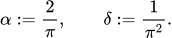
Here, π is locked as a dimensionless constant, and α and δ are locked as dimensionless constants. In addition, α and δ are reserved symbols for rectification constants and cannot be reused with other meanings. In particular, freeze the following rules as global rules.
- δ is reserved as the rectification constant. Any other delta meaning (gap/throat/thickness/defect, etc.) must be separated by subscripts or by a different symbol (e.g., δ_gap,δ_throat, etc.).
- α is reserved as the rectification constant. Any other alpha meaning must be separated by subscripts or by a different symbol (e.g., α_aniso, etc.).
- Violating a reserved symbol (overloading one symbol with multiple meanings) is immediately invalid at the stage prior to meaning-layer mapping; it cannot be patched by interpretation.
Single-source-of-truth (SSOT) rules
Freeze the SSOT rules for α and δ as follows.
- Single location for the definition: Equation (rect_alpha_delta_def) appears exactly once in the entire document as the definition of α and δ. Later sections must not rewrite the same equation; they only reference it.
- Single location for the derivation: The derivations that α and δ are produced by a particular rectification convention (angle average / projection / squaring convention, etc.) are performed exactly once inside this chapter (the following subsections). Outside this chapter, reproducing the derivation is forbidden.
- Single source in the registry: α and δ are locked under
rectification_constantsincanon_lock. The same entry must not be duplicated in any other registry or elsewhere in the main text. - Version binding: The definition/derivation/convention of α and δ is bound to
canon_lock_id. Even if one uses the same symbols with the same numerical values, it is forbidden to mix differentcanon_lock_ids in a single conclusion sentence.
5.4 Reuse rules (reference style and conclusion-sentence form)
When using α and δ outside this chapter, follow the reuse rules below.
- Reference-first: Every derivation/table/figure/log that contains α or δ must include a reference to which
lock_idincanon_locklocks that item. - No substitution-as-derivation: It is forbidden to substitute α by 2/π or δ by 1/π² inside an equation to make the presentation look like a “derivation.” If substitution is needed, mark the step explicitly as a simple substitution and do not mix it with a rectification derivation.
- Separation of rectification conventions: If an equation involving α or δ contains operations such as averaging / projection / squaring, the convention of those operations (what is averaged, the window, the normalization) must be locked as a separate closure. Using α,δ without locking the convention makes the definition ill-posed.
- Role restriction: α and δ are used only as rectification constants. Reinterpreting them as a new meaning (e.g., a different coefficient or a different correction term) is forbidden.
5.5 Violation types and immediate invalidation rules
Violations of SSOT or reuse rules for α and δ cannot be patched by interpretation. If any of the following violations occurs, the corresponding output is immediately invalid.
- Within the same document version, presenting the definition of α or δ again in a different form (re-definition), or deriving it again under a different convention (re-derivation).
- Using δ with meanings such as gap/throat/thickness, or abbreviating another delta (e.g., δ_gap) as the rectification constant δ (symbol overloading).
- Omitting the required
canon_lock_idreference for α or δ, or mixing values from differentcanon_lock_ids (lock mixing). - Generating a conclusion that contains α or δ while the averaging/projection/squaring convention is not locked (procedure not locked).
If a violation occurs, the output loses conclusion status, and this loss propagates to derived outputs along the dependency graph.
5.1 Derivation of α=2/π
Concept links: this rectification α=2/π sets the proton size ratio §6.2. Distinct from the fine-structure constant αₑₘ≈1/137 (§14.5); same letter, different quantity.5.1.1 Definition of the rectification problem (directional component → scalar effective quantity)
In this section, α is defined as the constant “that rectifies a directional (or phase) component into a scalar effective quantity.” Deriving α requires the following minimal ingredients.
[D-5.1-1] Phase variable
Define the phase variable θ as a variable on the following set.

θ is the minimal angular variable that represents the directionality of an internal state, and the meaning of θ (angle with respect to which axis) is locked by the coordinate-system definition in analysis_lock.
The derivation in this section uses only the fact that θ is a full-cycle angular variable on (alpha_phase_domain).
[D-5.1-2] Directional component (projection) and sign emergence
Define the “directional component” (before converting to a scalar effective quantity) in the following form.

where X₀≥ 0 is a magnitude scale (non-signed scale), and cosθ is the minimal projection function that produces ± signs through the phase θ. Definition (alpha_projection) is not used to claim that “any physical quantity must follow cosine projection.” In this document, cosθ is a definitional choice as the minimal sign-changing projection function over a full cycle. If one adopts a different projection function, then one must define a different rectification constant under a new symbol and lock it as a separate registry item.
[D-5.1-3] Rectification operator
Rectification is defined as the operation that “reduces a sign-canceling directional component to an effective quantity in the magnitude view.” To do so, define the rectification operator including an absolute value as
 := |X_{\parallel}(\theta)|. \end{equation}](/physics/eq/physics/phy-05-003.svg)
Define the rectified scalar effective quantity X_rect by a full-cycle average (the averaging convention is locked below).
![\begin{equation} X_{\mathrm{rect}} := \left\langle \mathrm{Rect}[X_{\parallel}] \right\rangle = \left\langle |X_{0}\cos\theta| \right\rangle. \end{equation}](/physics/eq/physics/phy-05-004.svg)
Here ⟨·⟩ is the full-cycle averaging operator on (alpha_phase_domain).
5.1.2 Definition of the full-cycle averaging operator (canonical measure)
The average over θ is defined by a canonical measure on the full cycle.
[D-5.1-4] Canonical measure
Define the canonical measure dμ(θ) as

Definition (alpha_uniform_measure) is a definition (convention) that fixes how averaging is performed over the full cycle.
Introducing a different weight (a non-uniform measure) after seeing results is forbidden.
If a non-uniform measure is needed, it must be defined as a separate closure; that closure must be locked in analysis_lock together with its failure modes and Gate stack.
[D-5.1-5] Full-cycle averaging operator
Define the full-cycle averaging operator induced by the canonical measure as

This definition is fixed only in this chapter (the SSOT for rectification constants); later sections only reference it.
5.1.3 Full calculation of ⟨ |cosθ| ⟩
Combining definitions (alpha_rect_average_def) and (alpha_average_operator) gives

Thus the key is to compute the integral
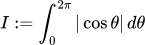
by decomposing the domain into sign intervals of |cosθ|.
(1) Sign-interval decomposition
The sign of cosθ is determined on the following intervals.
![\begin{equation} \cos\theta \ge 0 \ \text{for}\ \theta\in\left[0,\frac{\pi}{2}\right]\cup\left[\frac{3\pi}{2},2\pi\right], \qquad \cos\theta \le 0 \ \text{for}\ \theta\in\left[\frac{\pi}{2},\frac{3\pi}{2}\right]. \end{equation}](/physics/eq/physics/phy-05-009.svg)
Therefore
![\begin{equation} |\cos\theta|= \begin{cases} \cos\theta, & \theta\in\left[0,\frac{\pi}{2}\right]\cup\left[\frac{3\pi}{2},2\pi\right],\\ -\cos\theta, & \theta\in\left[\frac{\pi}{2},\frac{3\pi}{2}\right]. \end{cases} \end{equation}](/physics/eq/physics/phy-05-010.svg)
(2) Sum over intervals
From (alpha_I_def) and (alpha_abs_cos_piecewise),

Compute each integral in order.
(3) First-interval integral
![\begin{equation} \int_{0}^{\pi/2} \cos\theta\, d\theta = \left[\sin\theta\right]_{0}^{\pi/2} = \sin\left(\frac{\pi}{2}\right)-\sin(0) = 1-0 = 1. \end{equation}](/physics/eq/physics/phy-05-012.svg)
(4) Second-interval integral
Because the sign is flipped in the second interval,
![\begin{align} \int_{\pi/2}^{3\pi/2} (-\cos\theta)\, d\theta &= -\left[\sin\theta\right]_{\pi/2}^{3\pi/2} = -\left(\sin\left(\frac{3\pi}{2}\right)-\sin\left(\frac{\pi}{2}\right)\right) \notag\\ &= -\left((-1)-1\right) = -(-2) = 2. \end{align}](/physics/eq/physics/phy-05-013.svg)
(5) Third-interval integral
![\begin{equation} \int_{3\pi/2}^{2\pi} \cos\theta\, d\theta = \left[\sin\theta\right]_{3\pi/2}^{2\pi} = \sin(2\pi)-\sin\left(\frac{3\pi}{2}\right) = 0-(-1) = 1. \end{equation}](/physics/eq/physics/phy-05-014.svg)
(6) Summation
Substituting (alpha_I1), (alpha_I2), (alpha_I3) into (alpha_I_split) yields

Hence the full-cycle average is

5.1.4 Fixing the rectification constant α and conversion formulas
From (alpha_rect_reduce) and (alpha_abs_cos_average),

Therefore, the scalar effective quantity obtained by full-cycle rectification of the directional component X_(∥)(θ)=X₀cosθ is

In (alpha_definition_from_rect), α is a constant derived from the rectification convention (canonical measure + absolute value + full-cycle averaging). This derivation is performed only in this chapter (SSOT for rectification constants). Later sections only reference α as the result of (alpha_definition_from_rect).
5.1.5 Usage links (a common coefficient for all transforms requiring rectification)
In this document, α is used as a common coefficient that converts a “sign-bearing directional component” into a “sign-free effective scalar.” Freeze the usage in the following standard form.
[D-5.1-6] Standard usage form
When a directional component is defined as

then the rectified scalar is defined by

where X₀ is a magnitude scale and must not be confused with the sign-including full-cycle average of X_(∥). In particular,

so the sign-including average cancels to zero, while the rectified average yields the effective quantity. This distinction is reused repeatedly in all later “cancellation → survival” derivations.
[D-5.1-7] Representative usage links (by section numbers)
Representative usage sites for α are linked below by section number (all are used only by referencing the single rectification convention (alpha_average_operator)–(alpha_definition_from_rect)).
- Core length-selection ratio: In Chapter 6 (continuum core model), when recording the ratio between the core radius and the reference length as a rectification coefficient, α is used as the length-selection ratio coefficient.
- Event-rate rectification: In Chapter 9 (event definition and canonical event rate), when defining a rectified event rate (scalar frequency) from a directional event rate (sign-bearing or phase-bearing), α is used as the rectification coefficient.
- Scalarization of the cancellation–survival convention: In Chapter 8 (discrete shell structure) and Chapter 4 (meaning-layer mapping), when defining the effective scalar quantity that remains after cancellation, α is used as the rectification coefficient of sign components.
These usage sites use α only as a “rectification coefficient” and never re-derive α or replace it by a different averaging convention. If a different averaging convention is required, define a separate rectification coefficient under a new symbol, which requires a separate registry entry and Gate.
5.2 Derivation of δ=1/π² + universality axiom
Concept links: the reading convention (π/2 decoder) is §5.0.5.2.1 Role of the rectification coefficient δ (survival coefficient for sign-constrained events)
δ is fixed as the coefficient that, when a sign-bearing directional component is aggregated as an event, rectifies the portion cancelled by the sign constraint into the “mean surviving fraction.”
δ is a dimensionless constant. Its value is derived in this section and then locked in canon_lock.
Outside this section, re-derivation / re-definition / substitution-mixed-with-derivation of δ is forbidden.
5.2.2 Required definitions (rectification operator, measure, and the two constrained phases of an event)
The derivation in this section requires the following definitions.
[D-5.2-1] Full-cycle phases
The phase variables used in event aggregation are defined as full-cycle angle variables.

θ and φ are used as phases representing two different “constraints.” The types of constraints are fixed below in [D-5.2-4].
[D-5.2-2] Canonical measure (uniform measure)
Full-cycle averages are defined by the canonical measure.

Definition (delta_uniform_measure) is locked as the canonical convention for rectification constants; inserting a weighted measure (non-uniform distribution) after seeing the result is forbidden.
[D-5.2-3] Half-wave rectification operator
In sign-constrained events, “survival” is defined as being counted only when the directional component satisfies a particular sign. To implement this, define the half-wave rectification operator by
![\begin{equation} [x]_{+}:=\max(0,x). \end{equation}](/physics/eq/physics/phy-05-024.svg)
Half-wave rectification differs from absolute-value rectification (|x|). While |x| removes the sign, [x]_+ includes an explicit sign selection (only one half-cycle survives).
[D-5.2-4] Two-constraint event (AND coupling of two phases)
Event survival is defined as the simultaneous satisfaction of two independent constraints. The constraints are represented by the following two phases.
- Directional-constraint phase θ: a constraint that an event survives only when it has a “forward” component along a fixed direction (e.g., a chosen axis or a chosen boundary normal).
- Internal-constraint phase φ: a constraint that an event survives only when it has a “forward” component under an internal structural rule (e.g., a cancellation–survival sign-selection rule for local updates).
The combination of the two constraints is defined as an AND coupling (a product). That is, define the survival weight of an event e by
![\begin{equation} w(e) := \bigl[\cos\theta(e)\bigr]_{+}\,\bigl[\cos\varphi(e)\bigr]_{+}. \end{equation}](/physics/eq/physics/phy-05-025.svg)
In (delta_weight_def), w(e)∈[0,1], and when w(e)=0 the event contributes nothing to the survival aggregate.
Definition (delta_weight_def) is an operational definition of survival and must be locked under the meaning-layer mapping in analysis_lock; changing it after seeing results (e.g., replacing with |·|, adding powers, inserting thresholds, clipping, etc.) is forbidden.
5.2.3 First rectification average: ⟨ [cosθ]₊⟩ = 1/π
From (delta_uniform_measure) and (delta_pospart_def), compute
![\begin{equation} \left\langle [\cos\theta]_{+}\right\rangle := \frac{1}{2\pi}\int_{0}^{2\pi} [\cos\theta]_{+}\, d\theta \end{equation}](/physics/eq/physics/phy-05-026.svg)
The function [cosθ]₊ equals cosθ only on the positive region of cosθ, and is zero on the negative region.
(1) Decomposition of the positive region
The region where cosθ>0 is
![\begin{equation} \theta\in\left[0,\frac{\pi}{2}\right)\ \cup\ \left(\frac{3\pi}{2},2\pi\right]. \end{equation}](/physics/eq/physics/phy-05-027.svg)
Therefore,
![\begin{equation} [\cos\theta]_{+} = \begin{cases} \cos\theta, & \theta\in\left[0,\frac{\pi}{2}\right]\cup\left[\frac{3\pi}{2},2\pi\right],\\[4pt] 0, & \theta\in\left[\frac{\pi}{2},\frac{3\pi}{2}\right]. \end{cases} \end{equation}](/physics/eq/physics/phy-05-028.svg)
(2) Integral evaluation
From (delta_beta_def) and (delta_pospart_piecewise),
![\begin{align} \int_{0}^{2\pi} [\cos\theta]_{+}\, d\theta &= \int_{0}^{\pi/2}\cos\theta\, d\theta + \int_{\pi/2}^{3\pi/2}0\, d\theta + \int_{3\pi/2}^{2\pi}\cos\theta\, d\theta \notag\\ &= \left[\sin\theta\right]_{0}^{\pi/2} + 0 + \left[\sin\theta\right]_{3\pi/2}^{2\pi} \notag\\ &= \Bigl(\sin(\pi/2)-\sin(0)\Bigr)+\Bigl(\sin(2\pi)-\sin(3\pi/2)\Bigr) \notag\\ &= (1-0)+(0-(-1)) = 2. \end{align}](/physics/eq/physics/phy-05-029.svg)
Hence
![\begin{equation} \left\langle [\cos\theta]_{+}\right\rangle = \frac{1}{2\pi}\cdot 2 = \frac{1}{\pi}. \end{equation}](/physics/eq/physics/phy-05-030.svg)
For convenience, define
![\begin{equation} \beta := \left\langle [\cos\theta]_{+}\right\rangle \end{equation}](/physics/eq/physics/phy-05-031.svg)
Then by (delta_beta_value),

Here β is not reserved as a rectification constant; it is only an intermediate quantity within this section. The final rectification constant is fixed as δ below.
5.2.4 Second rectification average: δ=⟨ [cosθ]₊[cosφ]₊⟩ = 1/π²
When the survival weight of an event e is defined by (delta_weight_def), define the mean survival coefficient δ in a regime as
![\begin{equation} \delta := \left\langle [\cos\theta]_{+}[\cos\varphi]_{+}\right\rangle. \end{equation}](/physics/eq/physics/phy-05-033.svg)
The average is taken over the full-cycle canonical measure on (θ,φ).
[A-5.2-U0] (intermediate assumption) product measure of the two phases
The derivation in this section uses the assumption that the canonical measure on (θ,φ) factorizes as a product measure.

This assumption is locked only under the “absence of bias sources (default state)” conditions in 5.2.5. If the assumption fails, the universal value of δ is not claimed; the case is handled as a falsification trigger (5.2.6).
(1) Separation of the double integral
From (delta_def_double) and (delta_product_measure),
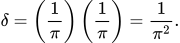
![\begin{align} \delta &= \int_{0}^{2\pi}\int_{0}^{2\pi} [\cos\theta]_{+}[\cos\varphi]_{+}\, \frac{d\theta}{2\pi}\frac{d\varphi}{2\pi} \notag\\ &= \left(\frac{1}{2\pi}\int_{0}^{2\pi}[\cos\theta]_{+}\, d\theta\right) \left(\frac{1}{2\pi}\int_{0}^{2\pi}[\cos\varphi]_{+}\, d\varphi\right). \end{align}](/physics/eq/physics/phy-05-035.svg)
Each parenthesis is the same integral as (delta_beta_def), and by (delta_beta_value) each equals 1/π. Therefore,
5.2.5 [D] Rectification constant as a maximum-entropy distribution
This section does not introduce δ=1/π² as an axiom. If the initial condition and the driving protocol do not contain any physical information (forces, constraints, boundary conditions) that would prefer a particular phase θ₀ or φ₀ as a pre-registered input, then by an information-theoretic principle the phase distribution P(θ) must take the form that maximizes the entropy
![\begin{equation} H[P] = -\int_{0}^{2\pi} P(\theta)\,\ln P(\theta)\,d\theta \end{equation}](/physics/eq/physics/phy-05-037.svg)
Hence (under normalization ∫ P=1),
![\begin{equation} \text{maximize }H[P]\ \Longrightarrow\ P(\theta)=\frac{1}{2\pi}\quad(\text{Uniform}) \end{equation}](/physics/eq/physics/phy-05-038.svg)
which determines the default state. The same logic applies to φ.
Condition (Gate): “absence of a bias mechanism”
The uniform-distribution conclusion is qualified as a universal constant only when the condition “there is no mechanism that induces bias” is PASS.
This document turns it into a Gate via the conditions below (and the falsification triggers in 5.2.6).
- [A-5.2-U1] full-cycle uniformity (Null): the distributions of θ,φ take the uniform distribution of (delta_uniform_measure) as the default state.
- [A-5.2-U2] dual constraints: the survival weight is defined by the half-wave-rectified product in (delta_weight_def).
- [A-5.2-U3] product measure (uncorrelated): when no bias/constraint information exists, the joint measure is treated as the product measure (delta_product_measure).
- [A-5.2-U4] regime fixed: if a bias mechanism (external field, boundary condition, constraint) exists, it must be pre-registered; in that case, the universal use of δ is automatically suspended and the trigger checks in 5.2.6 are forced.
Therefore δ=1/π² is not “let us believe it,” but a default state implied by the absence of bias sources. When bias is detected (5.2.6), universal use is immediately forbidden.
5.2.6 Falsification triggers (broken conditions) and handling rules
The universality axiom set [A-5.2-U] is judged to be broken if any of the following triggers occurs.
Each trigger must be pre-registered in gate_lock together with its threshold; post-hoc changes are forbidden.
5.2.6.1 Trigger T1: collapse of uniformity (biased phase)
From an event sample, define the following quantities and judge that uniformity is broken if they violate the threshold.

With the threshold ε_bias locked in gate_lock,

If this judgment occurs, record that [A-5.2-U1] is broken, and forbid the universal use of δ in that regime.
5.2.6.2 Trigger T2: collapse of product measure (correlated phases)
From an event sample, define the following correlation metric.
![\begin{equation} u(e):=[\cos\theta(e)]_{+}, \qquad v(e):=[\cos\varphi(e)]_{+}, \qquad C_{uv}:=\left|\frac{1}{N}\sum_{e=1}^{N}u(e)v(e)-\left(\frac{1}{N}\sum_{e=1}^{N}u(e)\right)\left(\frac{1}{N}\sum_{e=1}^{N}v(e)\right)\right|. \end{equation}](/physics/eq/physics/phy-05-041.svg)
With the threshold ε_corr locked in gate_lock,

If this judgment occurs, record that [A-5.2-U3] is broken, and forbid the universal use of δ in that regime.
5.2.6.3 Trigger T3: collapse of numerical universality (mismatch of δ)
From an event sample, define the empirical estimator of δ by
![\begin{equation} \hat{\delta} := \frac{1}{N}\sum_{e=1}^{N} w(e) = \frac{1}{N}\sum_{e=1}^{N} [\cos\theta(e)]_{+}[\cos\varphi(e)]_{+}. \end{equation}](/physics/eq/physics/phy-05-043.svg)
With the threshold ε_(δ) locked in gate_lock,

If this judgment occurs, record that at least one of [A-5.2-U1]~[A-5.2-U3] fails, or that the survival definition (delta_weight_def) is not maintained in the regime.
5.2.6.4 Trigger T4: collapse of the survival definition (procedure change or mixing)
Judge that the survival definition (delta_weight_def) is broken if any of the following occurs.
- Mixing the use of |x| or other nonlinear functions (powers, threshold functions, clipping, etc.) instead of [x]₊.
- Changing the definitions of θ,φ (coordinate system, representative axis, pre/post event reference) without a lock_id.
- Mixing meaning-layer mappings/closures from different
analysis_lock_ids within the same output.
In this case, judge immediately as

and the output and its derived outputs lose conclusion status.
5.2.6.5 Trigger T5: out-of-regime extrapolation (scope violation)
If one uses δ as a universal constant as-is in a regime where a drive axis or anisotropy axis such as DRV-ROT is turned on in the regime coordinates, or in a regime where spanning collapses such as R_span=SPAN-0, then judge it as out-of-regime extrapolation.
In this case, handle as

and allow only limit-type conclusions (CT-LIM).
5.2.7 Usage links (canonical event rate and survival–cancellation family)
δ is used as a “survival coefficient” in the following families of derivations.
- Canonical event rate: when event aggregation requires two constraints simultaneously, define the rectified event rate by multiplying the raw event count (count before constraints) by δ. The use of δ is restricted to regimes where [A-5.2-U] holds.
- Cancellation–survival family: in discrete shell structures where “cancellation” includes sign selection, the mean surviving contribution is rectified via half-wave averages; when two constraints are simultaneously required, δ appears.
- Cross-consistency (RCROSS) and Gate: δ is not used to justify numerical agreement, but only as a rectification coefficient that is locked inside the regime, serving as an input to cross-consistency and reproduction Gates.
5.3 Where δ enters
5.3.1 Definition of δ and prerequisites for use (a complete definition, not a summary)
δ is defined as the rectification coefficient that represents the mean surviving fraction in “two-constraint events.” In this section, δ is used only on top of the following definitions and prerequisites.
[D-5.3-1] Two phase variables and the canonical measure
Define the two phase variables as follows.

Lock the canonical measure as the uniform full-cycle measure.

The uniform measure is part of the rectification convention and is not modified by inserting weights after seeing the result.
[D-5.3-2] Half-wave rectification operator and survival weight
Define the half-wave rectification operator as
![\begin{equation} [x]_{+}:=\max(0,x). \end{equation}](/physics/eq/physics/phy-05-049.svg)
Define the survival weight of an event e as
![\begin{equation} w(e):=[\cos\theta(e)]_{+}\,[\cos\varphi(e)]_{+}. \end{equation}](/physics/eq/physics/phy-05-050.svg)
Definition (S05_weight) is the operational definition of “survival” and cannot be replaced by |·| or other nonlinear functions within the same version.
[D-5.3-3] Definition of δ
Define δ as the mean of the survival weight.
![\begin{equation} \delta := \left\langle w \right\rangle = \int_{0}^{2\pi}\!\!\int_{0}^{2\pi} [\cos\theta]_{+}[\cos\varphi]_{+}\, d\mu(\theta)\,d\mu(\varphi). \end{equation}](/physics/eq/physics/phy-05-051.svg)
Moreover, in a regime where the following universality prerequisite (product measure) holds and is locked,

it is fixed as

Using (S05_delta_value) is forbidden in regimes where the universality prerequisite does not hold; in that case, treat δ only as a regime-dependent estimator (and lock the estimator and thresholds via closures and Gate).
5.3.2 δ in event rates (definition–insertion–result form)
5.3.2.1 Definition: raw event count and raw event rate
Choose a tick window [n₁,n₂) and define the realized time length of the window as

Here, Δ t is the realized time tick locked in realization_lock.
Define “raw events” in the tick window as

Define the raw event count and the raw event rate as

ν₀ is the event rate before applying the constraints.
5.3.2.2 Insertion: aggregating the two-constraint survival weight
For the raw event set E₀[n₁,n₂), define the “rectified event count” by applying the survival weight (S05_weight):
![\begin{equation} N_{\delta} := \sum_{e\in\mathcal{E}_{0}[n_1,n_2)} w(e) = \sum_{e\in\mathcal{E}_{0}[n_1,n_2)} [\cos\theta(e)]_{+}[\cos\varphi(e)]_{+}. \end{equation}](/physics/eq/physics/phy-05-057.svg)
Definition (S05_Ndelta) is the minimal aggregation that records “event survival” numerically; the definitions of θ(e) and φ(e) (coordinate system/axis/representation convention) must be locked in analysis_lock.
In regimes where the universality prerequisites (uniform measure and product measure) are locked, fix the following equivalence as part of the rectification convention:

Here, δ may be locked to (S05_delta_value); when locked, δ is referenced not as “a number inserted ad hoc,” but as a registry entry of the rectification convention.
5.3.2.3 Result form: rectified event rate
Define the rectified event rate as

In regimes where the universality prerequisites hold so that (S05_Ndelta_equiv) is allowed,
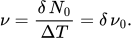
Therefore, the role of δ in event rates is the “survival rectification” of the raw event rate ν₀, and the insertion point is locked either as (S05_Ndelta_equiv) or as the result equation (S05_rect_rate_result).
5.3.3 δ in effective velocity (definition–insertion–result form)
5.3.3.1 Definition: direction-constrained displacement and raw forward speed
Lock the propagation (or transport) direction as a unit vector n_v:

When an event e occurs in the tick window [n₁,n₂), define the “forward displacement” (from pre/post configurations) as

where tildex_tag is the representative coordinate locked for the event (e.g., a core marker, a shell-survival marker, or a cell marker). The convention of choosing the representative coordinate must be locked in analysis_lock.
Δ x_(∥)(e) is the forward displacement in internal units (dimensionless or internal-length units); the realized length is mapped via a in (S05_dx_real).
Define the sum of raw forward displacements as
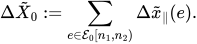
Define the raw internal forward speed as

v₀ is the raw definition in which every event is credited equally for forward transport; two-constraint survival has not yet been applied.
5.3.3.2 Insertion: rectifying forward displacement by survival weights
Define the rectified displacement by inserting the survival weights into the forward displacement sum:

Define the corresponding rectified internal forward speed as

If the universality prerequisite holds and, moreover, the forward displacement Δ x_(∥)(e) is separable (on average) from the survival phases within the regime (this independence must be locked as a regime condition in analysis_lock), then the following rectification closure is allowed:

This equivalence does not hold “always”; it is a closure that holds only when the regime condition is locked. Using it out of regime is forbidden.
5.3.3.3 Result form: realized effective velocity
Use the realization map between realized length x and internal length x as

Realized time is t:=Δ tt, and in the tick window Δ T=Δ NΔ t by definition (S05_time_window).
Define the realized effective velocity as

If the universality and independence conditions hold so that (S05_dx_rect_equiv) is allowed,

Therefore, the role of δ in effective velocity is “survival rectification of forward contribution,” and the insertion point is locked either at the displacement sum (S05_sum_dx_rect) or at the result equation (S05_veff_result).
5.3.4 δ in mass derivation (definition–insertion–result form)
5.3.4.1 Definition: operational definition of a mass scale (event–geometry coupling)
In this document, “mass” is not introduced as a justification from external doctrine. It is introduced only through the operational definition below.
Let the realized unit energy U_lat be the scale locked in realization_lock. The numerical recipe for generating U_lat is outside the scope of this section; here we use only the fact that U_lat is a locked unit with “energy dimension.”
For an object O, define the “mass scale” m(O) as

where Λ(O) is a dimensionless “geometry–event coupling coefficient.” Freeze the standard form as the following product:

- Γ(O) is the geometric coefficient. It is derived from object definitions (core/shell/cell, etc.) and length ratios; its definitions and derivation conventions are locked in
canon_lock. - Ξ(O) is the event coefficient. It is derived from event aggregation (tick window, event definition, survival convention); its definitions and aggregation conventions are locked in
analysis_lock.
Freeze the insertion point of δ in mass derivation to be inside Ξ(O).
5.3.4.2 Insertion: inserting δ into the event coefficient Ξ(O)
For an object O, define the raw event coefficient as
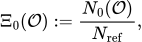
where N₀(O) is the “raw event count attributed to object O” defined analogously to (S05_event_set_raw), and N_ref is the locked reference count in the same time window. The choice of the reference count must be pre-registered; post-hoc changes are forbidden.
Define the rectified event coefficient as

In regimes where the universality prerequisite holds so that N_(δ)(O)≡ δ N₀(O) is allowed,

This is locked as the insertion point of δ in mass derivations.
5.3.4.3 Result form: mass scale with δ included
From (S05_mass_def)–(S05_lambda_factor) and (S05_Xi_delta_insert), in regimes where the universality prerequisite holds,

Therefore, in mass derivations δ enters only as “survival rectification of the event coefficient” and cannot be used as a term that adjusts the geometric coefficient Γ(O). Absorbing δ into the geometric coefficient, or changing the definition of Γ(O) to eliminate δ, is forbidden.
5.3.5 δ in force derivation (definition–insertion–result form)
5.3.5.1 Definition: unit force and directional event flux
Fix the unit force F_lat by the following derived definition.

Here, U_lat and a are realized scales locked in realization_lock. Definition (S05_Flat) is an internal definition of “unit energy / unit length” and is not grounded on external doctrine.
Define the directional event flux as follows. Lock the direction as a unit vector n_F.

For each event e, define the “directional contribution sign” s_F(e)∈-1,0,+1 by

where the choice convention of tildex_tag must be locked. Define the raw directional aggregate as
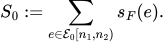
S₀ is the net sign sum of directional events and is dimensionless.
5.3.5.2 Insertion: inserting survival weights into the force-direction aggregate
Define the rectified aggregate by inserting the survival weight into the directional aggregation:
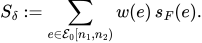
If the universality prerequisite holds and, moreover, the sign s_F(e) is separable (on average) from the survival phases within the regime (this independence must be locked as a regime condition), then the following rectification closure is allowed:

This equivalence does not hold automatically out of regime; using it out of regime is forbidden as extrapolation.
5.3.5.3 Result form: force scale with δ included
Define the force scale as
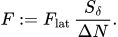
Here, Δ N is the tick length (definition (S05_time_window)), and S_(δ)/Δ N is the “directional survival aggregate per tick.” If the universality and independence conditions hold so that (S05_Sdelta_equiv) is allowed,

Therefore, the role of δ in force derivations is “survival rectification of the directional-event aggregate,” and the insertion point is locked either at (S05_Sdelta) or at the result equation (S05_force_result).
5.3.6 Common prohibitions for δ insertion (no reverse insertion / absorption / redefinition)
The δ insertion fixed in this section comes with the following prohibitions.
- No reverse insertion: it is forbidden to redefine raw quantities (N₀,ν₀,v₀,Ξ₀,S₀, etc.) in order to remove δ from a result equation.
- No absorption: it is forbidden to absorb δ into the definition of a geometric coefficient Γ(O) or into the definition of unit scales (a,Δ t,U_lat) to make δ disappear superficially.
- No redefinition: it is forbidden to redefine δ by swapping event definitions, averaging conventions, or threshold conventions. Redefinition exists only as a version update, and a version update requires a full re-derivation / full re-judgment.
- No out-of-regime extrapolation: it is forbidden to use (S05_delta_value) in a regime where the universality prerequisite does not hold, or to automatically apply (S05_Ndelta_equiv), (S05_dx_rect_equiv), (S05_Sdelta_equiv).