The Single Input: The Inflow Rate
The whole volume rests on one body-specific quantity: the inflow rate Q, the rate at which matter annihilates vacuum quanta and the surrounding medium flows in to replace them. This chapter fixes Q precisely, shows that it is proportional to mass, and tabulates it for the Solar System. The per-nucleon rate is geometric, imported from the physics volume.
The whole of this volume rests on one body-specific quantity: the rate at which a piece of matter annihilates vacuum quanta, equivalently the rate at which the surrounding medium must flow into it. We call this the inflow rate Q, established in the physics volume. The inflow rate is fixed per nucleon by ν_H=3π⁴+1.
The whole of this volume rests on one body-specific quantity: the rate at which a piece of matter annihilates vacuum quanta, equivalently the rate at which the surrounding medium must flow into it. We call this the inflow rate Q. This chapter fixes Q precisely, derives it for ordinary matter, tabulates it for the bodies of the Solar System, and states its epistemic status. No gravitational or cosmological content is used yet; those begin in Chapter 3 and take Q as their only material input.
Premises imported from the physics volume
We import four results from the physics volume and use nothing else foundational.
- (P1) Medium. The vacuum is a space-filling, fully packed (“no-void”) arrangement of
identical rigid quanta; its small disturbances propagate as an elastic wave with
c²=K/ρ (stiffness over density). Established in the physics volume, DOI
10.5281/zenodo.17932566. - (P2) Nucleon rate. Each nucleon annihilates vacuum quanta at the canonical rate

fixed geometrically by the n-fold rectification law (physics volume, §8.0.5). This annihilation is identified there as the root cause of gravity.
- (P3) Electron rate. The same n-fold law, νₙ=nπ²⁽ⁿ⁻¹⁾, gives the
electron (its n=1 member) the rate

matching the electron clock of the physics volume (§9.3). Note that νₑ is fixed by the n-fold law, not by scaling the nucleon rate down by the mass ratio.
- (P4) Processing-rate clock. A clock's rate is the local medium signal speed √(K/ρ_eff), so the refractive index n=c_ref/c_med and the clock rate are the same medium quantity; the local kinematic and gravitational time dilations follow, with the exact Lorentz factor's value forced (finite-c closure + isotropy) and the gravitational dilation equal to √(1−2GM/rc²) by the river identity (physics volume §18.2–§18.6, v0.10.0). Used in Chapter 7 (Step 4) to ground the (1+z) light-curve stretch rather than posit it. Established in the physics volume §18.
For internal consistency we record that the same law ties the masses through mₚ/mₑ=2πνₚ=6π⁵≈1836.118 (physics volume §13.5); we will not need this ratio until later chapters, but it shows that νₚ and νₑ are members of one structure rather than independent inputs.
The inflow rate of a hydrogen atom
A neutral hydrogen atom is one proton plus one electron. Because the annihilation events of its constituents are independent contributions to the same depletion of the medium, the rate at which a hydrogen atom annihilates quanta is the sum

This is the single most important number of the chapter. We emphasise two features that are easy to get wrong.
First, the electron contributes a whole unit, 1s⁻¹, not a mass-weighted fraction of the proton's rate. A naive expectation—“inflow is proportional to mass, so the electron should contribute νₚ(mₑ/mₚ)≈0.159s⁻¹”—is incorrect at the level of an individual particle, because the rates are set by the n-fold law (P2, P3), not by mass. The proportionality to mass emerges only for bulk matter, for the reason given in §(bulk). (This point corrects a tempting shortcut; in the spirit of Chapter 0 we state it rather than pass over it.)
Second, the value (nuH) is fixed by π and the integers 3 and 1; it is not a free parameter that can drift as the theory is refined. This is precisely what makes it usable as an anchor (§(status)).
Bulk matter: why the inflow rate is proportional to mass
Consider a macroscopic body containing N_(nuc) nucleons and Nₑ electrons. Summing the independent contributions (nup)–(nue),

Two facts make the first term dominant. The per-particle rates satisfy νₚ≈292≫νₑ=1, and ordinary matter has Nₑ≤ N_(nuc) (one electron per nucleon for hydrogen, about one per two nucleons for heavier elements). Hence the electron term is at most N_(nuc)/N_(nuc)·(1/292)≈0.3% of the nucleon term, and

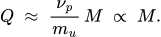
Since a body's mass is carried almost entirely by its nucleons, N_(nuc)=M/m_u with m_u=1.66054×10⁻²⁷kg the atomic mass unit, we obtain the central proportionality
Anchoring convention.
It is convenient to anchor the mass-specific rate to hydrogen, the one composition for which the count is exact (Nₑ=N_(nuc)). Using the hydrogen-atom mass m_H=1.6735×10⁻²⁷kg and the atomic rate (nuH),

For matter heavier than hydrogen (about half an electron per nucleon) the true Q/M is lower than (QperM) by the 0.2% noted above; we adopt the hydrogen anchor throughout and treat this composition spread as a known, sub-percent uncertainty rather than absorbing it into a tuned parameter.
Inflow rates of Solar-System bodies
Equation (QperM) fixes the inflow rate of any body from its mass alone. Table (Qbody) lists Q=M·(ν_H/m_( H)) and the nucleon count N_(nuc)=M/m_u for the Sun, the eight planets, and the Moon, together with the ratio Q/Q_(⊕) (which, because Q∝ M, equals M/M_(⊕)). These numbers are large but carry no hidden assumption: they are the mass divided by a nucleon mass and multiplied by a fixed per-nucleon rate. They are tabulated here once so that later chapters can refer to a single, unambiguous source and avoid confusion over per-body values.
| Body | Mass M [kg] | Nucleons N_(nuc) | Inflow rate Q [s⁻¹] (Q/Q_(⊕)) |
| Sun | 1.9889×10³⁰ | 1.198×10⁵⁷ | 3.485×10⁵⁹ (3.330×10⁵) |
| Mercury | 3.3011×10²³ | 1.988×10⁵⁰ | 5.784×10⁵² (5.53×10⁻²) |
| Venus | 4.8675×10²⁴ | 2.931×10⁵¹ | 8.529×10⁵³ (0.815) |
| Earth | 5.9724×10²⁴ | 3.597×10⁵¹ | 1.046×10⁵⁴ (1.000) |
| Mars | 6.4171×10²³ | 3.864×10⁵⁰ | 1.124×10⁵³ (0.1074) |
| Jupiter | 1.8982×10²⁷ | 1.143×10⁵⁴ | 3.326×10⁵⁶ (317.8) |
| Saturn | 5.6834×10²⁶ | 3.423×10⁵³ | 9.958×10⁵⁵ (95.16) |
| Uranus | 8.6810×10²⁵ | 5.228×10⁵² | 1.521×10⁵⁵ (14.54) |
| Neptune | 1.0241×10²⁶ | 6.167×10⁵² | 1.794×10⁵⁵ (17.15) |
| Moon | 7.3420×10²² | 4.421×10⁴⁹ | 1.286×10⁵² (1.229×10⁻²) |
What is fixed and what is conventional.
The ratios in Table (Qbody) are fixed once and for all by the masses. The absolute values depend on the hydrogen anchor (QperM). As we will see in Chapter 3, gravity depends only on the product of Q with a single universal medium constant κ, in the combination κQ (which plays the role of GM); fixing κ once, by matching GM_☉=κQ_☉ for the Sun, then determines the gravitational effect of every other body through its tabulated Q. No further body-specific input is ever required.
What this one number controls
It is worth stating in advance what is and is not loaded onto Q, so that the reader can judge each later chapter against this promise. From Q together with universal medium constants, the following chapters derive, with no additional body-specific parameter: the gravitational field and the equivalence principle (Chapter 3); planetary orbits and Kepler's laws (Chapter 4); axial spin and tidal locking (Chapter 5); galactic rotation curves and the acceleration scale a₀ (Chapter 6); the cosmological redshift–distance relation (Chapter 7); and “dark matter” as a deficit of the same medium (Chapter 8). The cosmic microwave background and the meaning of temperature follow in Chapter 9. In short, one body-specific number—an annihilation rate fixed by π—is asked to carry the whole of gravitation and a large part of cosmology. Whether it succeeds is the subject of the rest of the volume, judged chapter by chapter against the raw measurements and against the attached simulations.
Status of this chapter
The inflow rate is internally coherent but externally unverified. Its internal logic is fixed: the per-particle rates (nup)–(nue) are forced by the n-fold law of the physics volume, and the bulk law (Qprop)–(QperM) follows from them by counting. But there is at present no independent measurement of a vacuum-annihilation rate against which (nuH) could be checked directly; its empirical support is indirect, through the gravitational and cosmological consequences developed in the chapters that follow. We therefore treat ν_H=3π⁴+1 as a fixed anchor: a value held constant because it is determined by the framework's geometry, not because it has been measured. Per-body inflow rates may be refined later for composition (the sub-percent electron/nucleon effect of §(bulk)), but the anchor itself does not drift, because π does not drift. This is the precise sense in which the foundation of this volume is secure internally while remaining open to external test.