Light as the Lattice Elastic Wave (and its Sharpest Tension)

This chapter does two opposite things plainly. It establishes the foundation the volume rests on—light is an elastic wave of the vacuum lattice, its speed emerging from the medium's stiffness and density—and it confronts the framework's sharpest tension: a lattice should disperse light, yet none is observed. The conflict is reframed, not resolved.

Three facts about light constrain any medium theory: its speed in vacuum is a universal constant, the same for all observers; it is a transverse wave with two polarizations; and its vacuum speed is independent of energy to extraordinary precision.

This chapter does two opposite things, and it is important that it does both plainly. On one hand it establishes the foundation the whole volume rests on: light is an elastic wave of the vacuum lattice, and its speed emerges as c²=K/ρ. On the other hand it confronts the framework's single sharpest external tension, the one place where a naive reading is in clear conflict with experiment: a lattice carries waves that disperse, yet light shows no vacuum dispersion to a precision 8 to 15 orders of magnitude beyond what a transverse-mode reading would predict. We lead with that tension rather than burying it—and then turn to the framework's own angle account, which classifies gamma as a quasi-longitudinal mode (not the transverse branch the estimate assumes) and so reframes the conflict from decisive into an open dynamical item. We claim neither that the tension is hidden nor that it is resolved.

The raw facts to be explained

Three facts about light constrain any medium theory. (i) Its speed in vacuum is a universal constant, the same for all observers. (ii) It is a transverse wave (two polarizations). (iii) Its vacuum speed is independent of energy to extraordinary precision: high-energy photons from distant gamma-ray bursts arrive with the same speed as low-energy ones, bounding any energy-dependent dispersion far below the scale of any plausible microscopic lattice. Fact (i) is the foundation this framework wants; fact (iii) is the one that threatens it.

The logical chain (no step omitted)

  1. Light is the lattice elastic wave. A disturbance of the packed vacuum quanta propagates as an elastic wave; its long-wavelength speed is set by the medium's stiffness K and density ρ,
    \begin{equation} c^{2}=K/\rho . \end{equation}

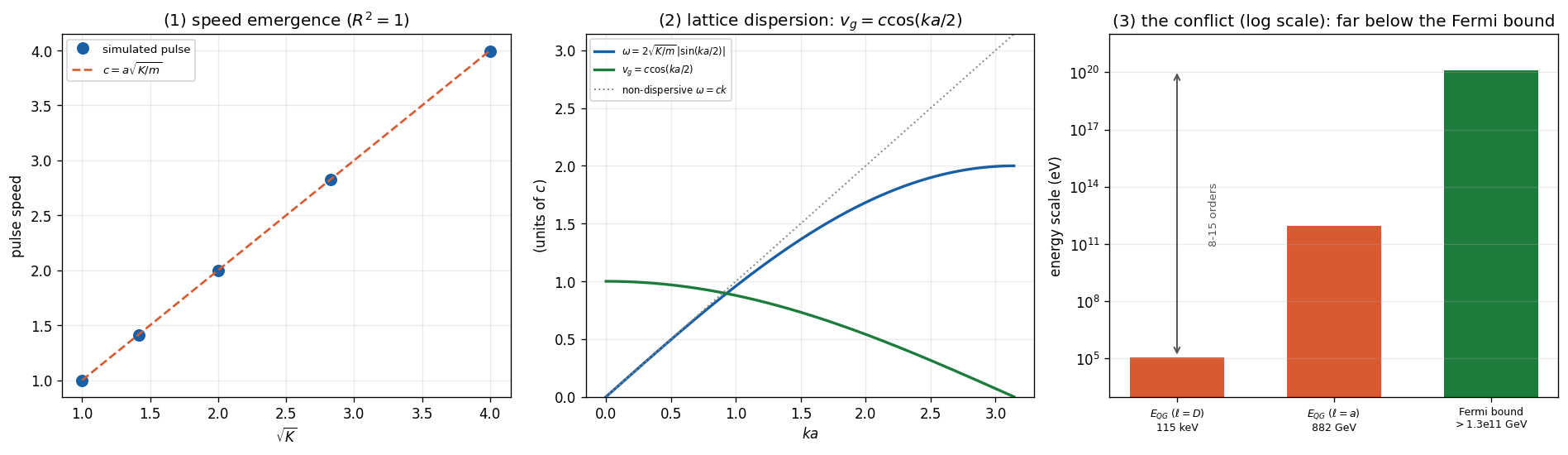
    The speed is therefore not a postulate but an emergent property of the medium, the same for all observers comoving with it (simulation: a pulse on a mass–spring lattice moves at c=a√(K/m), exactly ∝√(K) and independent of amplitude).

  2. Transverse waves are light. The shear (transverse) mode of the lattice carries the two polarizations of light; the longitudinal mode is a separate degree of freedom (the angle account, §4). This identifies light with the transverse elastic wave.
  3. But a lattice disperses — the tension. A discrete lattice does not carry waves at a single speed. Its exact dispersion is

    \begin{equation} \omega(k)=2\sqrt{K/m}\,\Big|\sin\frac{ka}{2}\Big|, \qquad v_{g}=\frac{d\omega}{dk}=c\,\cos\frac{ka}{2}, \end{equation}

    so the group velocity falls as the wavelength shortens: high-energy light should travel slower than low-energy light. This is unavoidable for a literal lattice wave, and it is the source of the conflict.

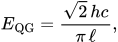
  4. The predicted dispersion scale. Expanding Eq. (disp) for long wavelength, v_g/c≃1-tfrac12(ka/2)², a quadratic energy dependence v_g/c=1-(E/E_(QG))² with
    \begin{equation} E_{\mathrm{QG}}=\frac{\sqrt{2}\,hc}{\pi\,\ell}, \end{equation}

    where ℓ is the effective lattice spacing. For the two candidate spacings of this framework, E_(QG)=115keV (for ℓ=D=4.8526pm, the angle scale) or E_(QG)=882GeV (for ℓ=a=6.33×10⁻¹⁹m, the cell).

  5. The conflict with observation. The Fermi observation of GRB 090510 bounds the quadratic dispersion scale at E_(QG,2)>1.3×10¹¹GeV=1.3×10²⁰eV. The framework's prediction is therefore too strong—light disperses far too much—by 15 orders of magnitude (if ℓ=D) or 8 orders (if ℓ=a). This is a decisive conflict on its face—though “on its face” is load-bearing: the estimate treats gamma as a transverse high-k mode, whereas the framework's own angle account (§(angle-disp)) classifies it as quasi-longitudinal, which reopens the question.
  6. The only escape, and a natural success. The framework can survive this only if light is, in effect, dispersionless: some property of the medium must make the low-energy modes Lorentz-invariant to far higher precision than a generic lattice, so that E_(QG) is effectively pushed above the Fermi bound. Whether such an emergent dispersionless regime exists is not derived here and is the volume's most important open problem. By contrast, gravitational waves—long-wavelength disturbances of the same medium—are predicted to travel at c with no comparable dispersion in the band probed, in agreement with GW170817 (|Δ v|/c<10⁻¹⁵).
Simulation and verification

The reproducibility script (ch2_light.py) confirms each piece. Speed emergence: a pulse on a one-dimensional mass–spring lattice propagates at c=a√(K/m), exactly linear in √(K) (R²=1) and independent of amplitude—Eq. (cKrho). Isotropy (3D fcc): on the three-dimensional face-centred-cubic lattice (coordination number 12) the long-wavelength speed is the same along [100], [110] and [111] to one part in 10⁸, and over 2000 random directions has fractional spread 4×10⁻⁹, so c is a genuine scalar (analytically c=2√(K/m), from the isotropic neighbour sum Σ_jd_(jα)d_(jβ)=8δ_(αβ)) rather than a direction-dependent artifact. Dispersion: the exact lattice relation (disp) gives v_g=ccos(ka/2), and Eq. (EQG) yields E_(QG)=1.15×10⁵eV (ℓ=D) and 8.82×10¹¹eV (ℓ=a). Conflict: against the Fermi bound 1.3×10²⁰eV these are 15 and 8 orders too small, respectively (Fig. (light), right). The numbers are not in our favour, and the figure shows it directly.

A gamma-ray burst as a collective disturbance

The estimate above models a burst as a stream of independent high-k photon modes, each carrying the lattice dispersion v_g=ccos(ka/2). There is a first reason to doubt that picture, prior to any question about the mode of an individual photon: in the medium, a burst can instead be a collective disturbance. When two large quantum inflows—compact objects acting as inflow sinks—collide and their inflow lines break, they launch a single macroscopic disturbance of the lattice, the same class of event that radiates a gravitational wave. This is not idle: the short burst Fermi used to set the bound, GRB 090510, is itself a compact-merger burst, and GW170817 showed a gravitational wave and a short GRB arriving within 1.7s after 130 Mly—the coincidence a collective-disturbance origin predicts.

The script ch2_grb.py makes the mechanism concrete on the very lattice that carries light. It contrasts two ways energy can travel: (A) a single weak high-k wave packet—the “independent high-energy photon,” linear regime—and (B) the strong disturbance launched when two inward inflows collide (nonlinear FPU-β regime). The contrast is sharp. The independent high-k packet disperses: with v_g=cos(k₀/2)≈0.73cno measurable spreading (width factor 1.0), like a gravitational wave—the nonlinearity supplied by the violent collision balancing the dispersion, the standard soliton mechanism. So if Fermi's bursts are collective disturbances rather than streams of independent photons, they are expected to arrive dispersionless, independently of the per-photon mode question taken up next.

Honest scope.

This is a mechanism, not a derivation. ch2_grb.py uses toy, normalised units; it establishes that the colliding-inflow picture is self-consistent and yields a dispersionless burst (degenerate, on the observed coincidence, with the standard compact-merger account), which is what GW170817 and Fermi together require. It does not derive the detected keV–GeV gamma-ray spectrum from the disturbance—the energyleftrightarrowwavelength reinterpretation that would do so is not established—and so it does not close the dispersion problem. Whether real GRB emission sits in this coherent regime is open. Its standing is thus a toy mechanism: it removes the “independent high-k photons” assumption on which the conflict rests, but the spectrum derivation belongs to the same open dynamical work as the quasi-longitudinal dispersion (§(angle-disp)).

The burst as a stiff-medium event (exploratory)

The collective-disturbance picture of §(collective) leaves two things underived: the burst's energy budget, and its spectrum. A sharper reading of the same mechanism supplies both and ties the burst to a quantity the framework otherwise only postulates. The reading is this: a gamma-ray burst is not light that crosses the cosmos and disperses—it is a violent, volumetric event in a very stiff medium, and the gamma rays are radiation we sample from it. The same merging inflows that launch the event launch the gravitational wave; in the framework a gravitational wave is a wave of the lattice, so the burst and the wave are one disturbance read in two ways.

Energetics: many quanta, not a large quantum.

Light, in the framework, is a single quantum of the lattice's transverse mode, E=ħω (§(goldstone)). A burst is the whole shaken volume; the ratio of energies is therefore, to order of magnitude, the number of grains set in motion,
\begin{equation} \frac{E_{\mathrm{burst}}}{E_{\mathrm{photon}}}\;\sim\;\frac{V}{a^{3}}, \end{equation}

which for a bright burst (E_(burst) 10⁵³erg) and a 31GeV gamma quantum is 2×10⁵⁴. Equivalently, a region of only 1m³, fully excited at the gamma scale, already carries an entire burst's energy—a vivid measure of how stiff and dense the medium is. The enormous energy of a burst is thus many quanta over a three-dimensional volume, not a large per-quantum energy; the gamma quantum itself (31GeV, ka≈0.1, ≈63 lattice spacings) is an ordinary, well-supported ripple of the lattice. Put as a force rather than an energy, the burst is the sum of the lattice forces over the churning volume: each cell excited at the gamma scale carries a force E_(γ)/a≈8×10⁹N (itself a measure of the stiffness), and summing 2×10⁵⁴ such cells over the volume is the blast—the same bookkeeping as totalling the energy of every parcel of water in an underwater explosion. The arithmetic is in ch2_gammacontent.py.

The gravitational-wave link, and a handle on the stiffness postulate.

Reading the burst and the gravitational wave as one disturbance reframes an apparent paradox: why is the gravitational wave so small (strain h 10⁻²¹) while the gamma is so large? Because the medium is extraordinarily stiff—a colossal energy produces only a whisper of strain, exactly as a very stiff spring stores great energy in a tiny displacement. Quantitatively the elastic scale a gravitational wave reveals is c⁴/G≈ 1.2×10⁴⁴N; in the framework's terms this is a measurement of the bulk modulus K in c²=K/ρ. That matters beyond the burst: the physics volume (DOI \href{https://doi.org/10.5281/zenodo.17932566}{10.5281/zenodo.17932566}) flags the unbounded local stiffness of the lattice as a postulate it cannot measure internally. The gravitational-wave strain–energy relation is precisely such a measurement, supplied from outside. The two channels also differ only in how we sample them—the gravitational wave as a strain at one detector, the gamma as photons emerging from a three-dimensional volume; same physics, different measurement dimension. The event GW170817—a gravitational wave and a short gamma-ray burst arriving within 1.7s over 130Mly, bounding the wave speed to c within 10⁻¹⁵—both supplies this anchor and shows directly that the collective (continuum) mode is non-dispersive at low wavenumber.

Spectrum: churning is broadband.

§(collective) did not derive the keV–GeV spectrum from the disturbance. Its volumetric, turbulent (“churning”) character supplies a candidate. A multi-scale disturbance carries broadband spectral content: ch2_gammacontent.py shows that a churning front carries power continuously from low wavenumber up into the gamma band and on to the lattice zone-boundary ( 620GeV at this calibration), whereas a smooth disturbance does not reach the gamma band at all (Fig. (gammacontent)). The spectral shape—hence the gamma fraction—is independent of amplitude: a tiny churning wave has the same gamma fraction as a violent one. “Gamma is present” is fixed by the disturbance's structure; “the energy is enormous” is fixed by its amplitude.

What it does not resolve, and why (a decisive test).

This reading answers the energy and (candidate) spectrum questions and anchors the stiffness empirically—but it does not close the dispersion problem, and a direct test shows exactly why. ch2_burstprop.py launches a churning broadband disturbance and, as it propagates, splits it into its low-wavenumber part (the long-wavelength envelope, what a detector registers as a gravitational wave) and its high-wavenumber part (the gamma content). The low-k envelope travels as a coherent front at ≈ c; the high-k content travels at v_g=ccos(ka/2)separates, lagging the front by ≈[1-cos(ka/2)]×distance (Fig. (burstprop)). This separation occurs at the same rate whether the disturbance is weak or strong: the nonlinearity that keeps the envelope coherent does not bind the gamma content to it. The coherence reported in §(collective) is thus the low-k envelope; the gamma rides off it. Over a cosmological baseline the lag is the original conflict, unchanged—at ka≈0.1 and D 9Gly it exceeds the Fermi bound by 15 orders. A jammed, incompressible (density=1) vacuum does not rescue it either (ch2_jammed2d.py): incompressibility freezes the longitudinal channel but leaves the transverse (light) dispersion cos(ka/2) unchanged—jamming rescales c, not the normalised dispersion.

The other escape, and why it also fails.

One might instead deny that any gamma propagates: let the cosmos-crossing object be only the collective wave (the non-dispersive low-k mode, the gravitational wave), and let the gamma be produced locally when that arriving wave shakes our lattice. The energy is available—a wave far too gentle to register as a gravitational wave (h 10⁻²²) already carries a whole burst's energy flux, because the medium is so stiff. But the wave cannot make the gamma. Generating gamma-scale (high-k) shaking from a long-wavelength (low-k) disturbance is an up-conversion, and up-conversion requires the per-bond strain to approach unity, since the nonlinear term competes with the linear one only when β(strain)² 1. ch2_upconvert.py confirms this in both one and three dimensions: the high-k fraction stays at the per-cent level or below until the strain is of order one, and the threshold is the same in 1D and 3D because it is per-bond—dimension-independent. A non-dispersively propagated wave is, however, necessarily smooth, hence low-strain (strain h 10⁻²²): some twenty orders below threshold. Three dimensions do change two things—the cascade to small scales is richer once nonlinear, and converging geometry (focusing) raises the strain—but focusing acts at the converging source (the merger), not in the diverging wave that reaches us. So 3D helps make gamma at the source, where it then faces propagation; it does not let a gentle arriving wave make gamma in flight.

Standing.

The burst-as-stiff-medium-event reading is a genuine enrichment of §(collective): it gives the energy budget (volumetric, E_(burst)/Eₚₕₒₜₒₙ V/a³, the sum of lattice forces over the churning volume), a candidate spectrum (churning is broadband), and—through the gravitational-wave link—an external, empirical handle on the stiffness the framework otherwise only postulates. These are solid. It does not close the dispersion tension, and the two conceivable escapes fail for clean, opposite reasons: gamma emitted at the source disperses off the propagating front (ch2_burstprop.py), while a gentle arriving wave is some twenty orders too weak to generate gamma locally (ch2_upconvert.py)—and neither gap is closed by going to three dimensions. Both therefore point to the same single requirement examined in §(goldstone)–§(stiffness): that gamma propagate as the exact continuum (Box_c) mode, not seeing the lattice spacing. The gravitational-wave link does not remove that requirement—it sharpens it, by establishing that the collective mode is observed non-dispersive at low wavenumber and isolating the gamma-band coherence over cosmological distance as the one genuinely open item. That item is also a live question in fundamental physics: whether the discreteness of spacetime leaves any imprint on the propagation of light.

The angle account of polarization (exploratory)

The framework offers a geometric account of why light is transverse: a wave of wavelength λ propagates through the lattice at an angle χ to a lattice axis with

\begin{equation} \sin\chi=\frac{\lambda}{mD},\qquad m=\lceil\lambda/D\rceil, \end{equation}

so that the physical mode sits closest to transverse. Evaluating this: a 1pm gamma ray gives χ≈11.9^(∘) (strongly longitudinal), green (532nm) χ≈89.80^(∘), red (633nm) χ≈89.93^(∘), and a 1m radio wave χ≈90.0^(∘): optical and radio light is essentially transverse, as observed, while very hard radiation acquires a longitudinal character. A D-independent test follows: compared at a common diffraction order, sinχ∝λ, so the angle-sines of two lines scale as their wavelength ratio, e.g. 633/532=1.190, regardless of the unknown spacing D. We present this as an exploratory account; its detailed justification belongs to the physics volume, DOI \href{https://doi.org/10.5281/zenodo.17932566}{10.5281/zenodo.17932566}, where the relation is constructed from a single right triangle (the m-quantum chain mD as hypotenuse, the transverse swing λ as opposite side) and is registered as a falsifiable prediction.

What the angle account implies for the dispersion tension

The dispersion estimate stated at the front of this chapter and the angle account just given describe the same gamma radiation, but they model its passage through the lattice in mutually incompatible ways—and the incompatibility is the point. The estimate treats a gamma ray as a high-k instance of the ordinary transverse elastic wave: it assigns a propagation wavevector k=2π/λ and reads the group velocity from v_g=ccos(ka/2), identically to optical light but at short wavelength. The angle account assigns the same radiation a different geometric mode: for λalong the lattice axis (quasi-longitudinal), whereas optical light (m enormous, χ→90^(∘)) is the transverse branch. On the framework's own optics, gamma and visible light are not one mode sampled at two wavelengths; they are two modes.

Consequence for the “decisive” reading.

The 8–15-order figure was obtained by applying the transverse-branch dispersion to gamma. If the angle account is taken at face value that is the wrong branch: the estimate carries a relation derived for the transverse mode over to radiation the same framework labels quasi-longitudinal. The decisive conflict is therefore not unconditional—it is contingent on the identification “gamma disperses exactly as short-wavelength transverse light,” which §10.9.1 of the physics volume does not adopt. A falsification that depends on a mode assignment the theory disowns is not decisive.

What this does and does not settle.

We are deliberately exact about the residue.

Taken with the collective-disturbance mechanism above, the net effect is to move the vacuum-dispersion item from “decisive conflict” to an apparent conflict resting on two assumptions the framework disputes—that a burst is a stream of independent photons (the collective-disturbance section) and that those photons are the transverse branch (this section). Neither replacement is a derivation: the collective burst's spectrum and the quasi-longitudinal branch's dispersion are both uncomputed, so the residue is an open dynamical problem, not a resolved one. The script ch2_lightangle.py makes the geometric half concrete—it reproduces the §10.9.1 band table from sinχ=λ/(mD) and confirms that Fermi-band energies (MeV–GeV) sit at χ≈0.01^(∘)–15^(∘), i.e.\ quasi-longitudinal. The dynamical half—ω(k) for that branch versus the Fermi bound—is the open item recorded in Chapter 16.

The reality-mapping note: the mass-free visible-band closure (imported, v2)

The angle account above is pinned to reality through exactly one ratio. The physics volume's quantum-base verification (its §10.9.1) shows that the sole mapping input is λ/D: on a medium specified only as ρ=1, perfect elasticity, B=c², no friction, voids forbidden — with no mass value entering the dynamics — the committed pair

\chi(632.99\,\mathrm{nm})=89.9378^{\circ},\qquad \chi(532.0\,\mathrm{nm})=89.8248^{\circ}

follows from sinχ=λ/(mD) at the canonical D, and the ratio (λ/D)₆₃₃/(λ/D)₅₃₂=633/532=1.18983 cancels D and any mass scale outright (the D-independent line that ch2_light.py prints). These are the physics volume's pre-registered B1 numbers; the deterministic, seed-free verification module is shipped with this volume's reproducibility package as phys_import_06_light_mapping_massfree/ (gate G-LIGHT-MAP-Q: PASS; output sha256-gated), so the closure can be re-run here without the physics volume in hand. Two disciplines carry over with it. First, observation claims about χ are gated: the physics volume's open observation gate G-ISO (§10.9.2) requires the axis-fixing and coherence scale, the averaging-away protocols, the observable window, and consistency with precision propagation data before any experimental χ claim — the direct test quoted in §(angle-disp) runs through that gate, and this volume's gamma-dispersion question registers against its item (iv). Second, what the closure does and does not buy here: it fixes the optical-band mapping scale to D with zero fit freedom (the datum quoted in the two-length appendix and in Chapter 16), and it buys nothing for the gamma branch, whose dynamics remain the volume's first open problem.

The deeper account: light as the Goldstone mode of the synchronized lattice

Both reframings above sit inside a deeper account the physics volume already gives (§14.0, DOI \href{https://doi.org/10.5281/zenodo.17932566}{10.5281/zenodo.17932566}), which also says most directly why light need not carry the generic lattice dispersion at all. Its premise is that each quantum's only degree of freedom is rotation, and that in the jammed plenum the coupled rotators phase-lock—a Kuramoto-type synchronization—onto a common axis, so that all quanta share one rotation phase. Synchronization spontaneously breaks the global U(1) of that common phase, and the massless Goldstone mode of the broken symmetry is identified with light: the electric field is the displacement (polar), the magnetic field the rotational twist (axial), and source-free Maxwell is exactly the curl square-root of the wave operator Box_c. A field governed by Box_c has ω=ck exactly—linear, dispersionless—rather than the discrete-lattice ω=2(c/a)sin(ka/2) of a generic phonon. On this account the Ch. 2 conflict's error is upstream of the mode question: it treats light as a generic lattice phonon, whereas the framework treats it as the Box_c/Maxwell Goldstone mode, which does not disperse.

The script ch2_goldstone.py tests the mechanism on a synchronized-rotor lattice, with two findings. First, the rotors do lock: a Kuramoto ensemble with a spread of natural frequencies, above a coupling threshold, drives the order parameter r=|⟨ e^(iθ)⟩| to ≈0.96—a common axis forms, as the premise requires. Second, the Goldstone mode of the synchronized medium has the spin-wave dispersion ω(k)=2√(J/I)|sin(k/2)|, reproduced by the simulation to under a percent. This is the honest punchline: at long wavelength the mode is linear, ω≈ c_(eff)k with v_g→ c_(eff)—dispersionless, exactly the band (radio, visible) where light is observed dispersionless. At short wavelength the bare Goldstone mode curves (v_g=c_(eff)cos(k/2) falls), so synchronization alone does not make gamma dispersionless.

Honest scope.

This locates the open problem precisely. The synchronized-rotor picture earns the dispersionlessness of low-energy light for free—a real success of the medium account. Reaching exact Box_c (Maxwell) behaviour up to gamma—rather than the bare spin-wave that curves—rests on the curl-factorization being physically forced at all k: light must be the continuum Maxwell mode, protected from lattice discreteness, not a discrete cell-to-cell relay. The §10.9.1 angle construction does not by itself supply this. It is a geometric map (a length in, an angle out), and with the integer count m=⌈λ/D⌉ the angle χ(λ) is a sawtooth, not a smooth dispersion; read instead as dynamics, a discrete chain of m cells of size D carrying the transverse swing has group velocity ccos(π/m), which at gamma (m=1,2) is pathological—zero or backward—and would reinstate the conflict. The dispersionlessness therefore depends essentially on the continuum-Box_c identification, whose physical forcing the physics volume grades a hypothesis (\textsf{Hm}). So the deepest account turns the dispersion item from an unexplained conflict into a specific, located open question: is the electromagnetic Goldstone mode protected to be exactly Box_c up to gamma, or does it inherit lattice discreteness there? That is the dynamical question Chapter 16 records as open.

Why dispersionless: the collective-stiffness ceiling

The Goldstone account can be made sharper still, in a way that cleanly separates what is forced from what is hypothesised—because the dispersionless behaviour rests on firmer ground than the curl coupling that carries it. In the physics volume the vacuum's characteristic relation is not an assumption but a theorem: the symmetry axioms force a normal form whose dispersion is ω²=(K/ρ)k², i.e. ω=ck exactly linear, with no lattice or medium model invoked (§0.5, theorem N3, grade \textsf{Fm}). Here c=√(K/ρ) is the collective stiffness-over-density speed of the lattice itself—which exists independently of the quanta riding on it—and the positive-energy axiom (N4) makes it a causal ceiling: nothing propagates faster than c. A dispersionless light speed is thus the symmetry-forced law, not a hypothesis; a fixed-lattice simulation confirms c∝√(K), amplitude-independent and isotropic (§10.0). A direct collision test (ch2_collision.py) makes the axis explicit: head-on packets pass through one another unchanged, and the speed is identical for a gentle and a violent (large-amplitude) shaking of the same wavelength—so the stiffness fixes the speed regardless of how destructive the disturbance is. What stays wavelength-dependent is the discreteness, not the stiffness: at fixed K the speed still falls as ccos(ka/2) for short waves. The open item therefore lives on the wavelength axis alone, not the amplitude axis.

What disperses is only the realization. A discrete lattice carries ω=2(c/a)sin(ka/2), which converges to ω=ck as k→0 (§10.0), so the question for gamma is quantitative: is it long-wavelength relative to the lattice scale? The relevant scale is the fundamental VP spacing a≈6.3×10⁻¹⁹m—not the quantum diameter D—and gamma is deep in the long-wavelength regime there (ka 10⁻³). The script ch2_stiffness.py quantifies the residual (Fig. (stiffness)): at scale a the discrete dispersion corresponds to a quadratic quantum-gravity scale E_(QG,2)=√2hc/(π a)≈882GeV, which improves on the naive D-scale estimate (115keV) by seven orders but still sits about eight orders below the Fermi GRB 090510 bound (E_(QG,2)>1.3×10¹¹GeV). Only the exact continuum law (E_(QG,2)→∞) clears Fermi.

Two things qualify this figure, both pointing the same way. It is the single-mode estimate—it treats the gamma as one independent Fourier mode at k=2π/λ. But a burst is not one oscillation, and a collective disturbance need not disperse at all (§(collective): the soliton stays coherent, ×1.0, where an independent high-k packet spreads, ×11), so its components arrive together regardless of energy—which is what the Fermi comparison actually tests. The 882GeV residual is therefore the worst case (independent high-k propagation), and both the collective-soliton route (§(collective)) and the exact-Box_c route remove it; what neither yet supplies is the quantitative coherence, or protection, scale that would push the effective E_(QG) above the Fermi bound.

So the open item is now sharp and well-posed: the dispersionless law and the ceiling are both forced; what remains is whether light is protected to realize the continuum Box_c exactly—rather than inheriting the lattice's O((ka)²) correction—up to gamma. This is the same protection the curl-factorization needs (§(goldstone)), now stated as one quantitative question.

The relativistic energy–velocity relation: why high energy is safe

One more observation reframes that residual, and it follows directly from the ceiling. A causal ceiling—nothing faster than c, forced by the positive-energy axiom (N4, §0.5)—is a relativistic structure, and a relativistic excitation of rest energy E₀ and total energy E obeys E²=(pc)²+E₀², so its signal velocity is v/c=pc/E=√1-(E₀/E)² and

\begin{equation} \frac{\Delta v}{c}=1-\frac{v}{c}\approx\frac12\Big(\frac{E_{0}}{E}\Big)^{2}\qquad(E\gg E_{0}). \end{equation}

This shrinks with energy—the opposite of the lattice-phonon law Δ v/c=+(E/E_(QG))² that produced the 882GeV residual. The two laws have opposite slopes (Fig. (relativistic)a): under the relativistic relation, high-energy gamma is the safest case, not the most dangerous. And light is the massless Goldstone mode (E₀=0; the U(1) breaking of §(goldstone) gives a massless Goldstone), for which Δ v/c=0 exactly—a massless relativistic mode travels at c for every energy, dispersionless. The simulation ch2_relativistic.py confirms both behaviours on one Klein–Gordon lattice: v_g≤ c throughout (the ceiling), the massive mode's v_g rising toward c with energy (anti-dispersion), and the massless continuum mode at c (Fig. (relativistic)b). On this reading the “conflict” is the artifact of applying the non-relativistic phonon law to light.

What this does and does not settle.

It is genuinely favourable: it removes the intuition that the tension worsens at high energy—under the relativistic relation it improves. But it does not, by itself, close the gap. On the lattice, even a massless mode carries the phonon v_g=ccos(ka/2) (Fig. (relativistic)b, falling curve); the exact-c result is a continuum statement. So the one open item is unchanged—whether light realizes the continuum Box_c exactly, rather than the lattice phonon, at gamma k (§(goldstone), §(stiffness); grade \textsf{Hm})—now seen through a relativistic lens that makes the resolution natural and high energy benign. We also note the limit of the collective picture: a linear collective coherence does not change the central, carrier-governed velocity, so the coherence-length question reduces to this same protection question rather than substituting for it. A direct 2D simulation bears this out: a launched gamma wave packet (ch2_gammashot.py) travels at v_g=ccos(ka/2)—it disperses—and, far from fanning out at 90^(∘), stays more collimated than a visible packet (a shorter wavelength diffracts less). The dispersion is thus a property of any lattice wave packet; only light's being the continuum mode removes it.

Status of this chapter

Anticipated objections

“If light is a lattice wave it must disperse like phonons — so the theory is wrong.”

On the face of it, yes: this is the central tension, and we have put it at the front of the chapter rather than at the end. A literal discrete lattice predicts a quadratic dispersion that GRB timing excludes by 8–15 orders of magnitude. The framework can be right about light only if the relevant modes are Lorentz-invariant to far higher precision than a generic lattice—i.e.\ if light is effectively dispersionless. Emergent dispersionless regimes are known to occur in some condensed-matter and analogue-gravity systems, but we do not derive one here. There is, however, a sharper point: the 8–15-order estimate treats gamma as a transverse high-k mode, whereas the framework's own angle account (§(angle-disp)) places gamma in the quasi-longitudinal branch—a different mode, whose dispersion is not the transverse v_g=ccos(ka/2) and is not yet derived. So the honest status is two-layered: as a transverse high-k mode this is the clearest potential falsification; read through the framework's own optics it is an open dynamical question, not a settled conflict. We neither hide the tension nor overstate its resolution.

“Then why claim light is a lattice wave at all?”

Because the speed emergence c²=K/ρ and the transverse character are genuine successes, and because gravitational waves at c follow naturally. The medium picture earns those; it owes, in return, an account of why light does not disperse. We state the debt plainly rather than hide it.

“Is the dispersion scale not just the Planck scale, which is allowed?”

No. The candidate scales here (115keV or 882GeV) are far below the Planck energy (1.2×10¹⁹GeV) and below the Fermi bound; that is precisely the problem. A Planck-scale dispersion would be allowed; a keV-to-GeV-scale dispersion is not.

Reproducibility

ch2_light.py (reproducibility package) (1) propagates a pulse on a mass–spring lattice and confirms c=a√(K/m)∝√(K) (R²=1), amplitude-independent; (2) evaluates the lattice dispersion v_g=ccos(ka/2) and the scale E_(QG)=√2hc/(πℓ), returning 1.15×10⁵eV (ℓ=D) and 8.82×10¹¹eV (ℓ=a), and compares them to the Fermi bound 1.3×10²⁰eV (8–15 orders of conflict); (3) tabulates the angle account sinχ=λ/(mD) and the D-independent ratio sinχ₆₃₃/sinχ₅₃₂ =633/532=1.190 at a common order. Expected output is exactly these numbers, including the conflict—the script is intended to make the tension reproducible, not to hide it.

A companion script ch2_lightangle.py reproduces the physics-volume §10.9.1 band table from sinχ=λ/(mD) (m=⌈λ/D⌉, D=4.8526 pm canonical), and the pre-registered 632.99/532 nm pair, confirming that radio/visible light is near-transverse (χ→90^(∘)) while Fermi-band gamma (MeV–GeV) is quasi-longitudinal (χ≈0.01^(∘)–15^(∘)). It is the geometric basis for the reclassification in §(angle-disp); its expected output is exactly the §10.9.1 angle table (1pm→11.9^(∘), 1fm→0.012^(∘), visible→89.85^(∘)).

A third script ch2_grb.py demonstrates the collective-disturbance mechanism on the same lattice: an independent high-k photon packet spreads by ×11 (v_g=cos(k₀/2)≈ 0.73c), while the disturbance launched by two colliding inflows (nonlinear FPU-β) stays coherent (×1.0, dispersionless like a gravitational wave). Expected output is the width-factor contrast ≈11; the script states in its own output that it is a toy mechanism that does not derive the gamma-ray spectrum or close the dispersion problem.

Quantifying the collective-mode reconciliation (v2). ch2_gamma_collective.py sharpens ch2_grb.py into a quantitative statement. A localized shake of the lattice is inevitably broadband (by Fourier, a spatially narrow pulse carries a wide band of wavenumbers), so “gamma of many wavelengths” is a consequence, not an assumption. The correct diagnostic for dispersionlessness is the leading-front peak and width—a Gaussian breaks into a soliton train, so the total envelope width is misleading: a linear independent-mode packet disperses (peak ×0.45, leading width ×1.25), while the collective FPU-β disturbance forms a sharp coherent front (peak ×2.84, leading width ×0.50), the bands staying locked. Physically, independent 10MeV and 10keV modes over L=130Mly would arrive Δ t≈3×10¹⁹s apart—the Fermi tension restated (E_(QG)(D)≈ 115keV against the bound >1.3×10²⁰eV, 15 orders)—yet GW170817 bounds gamma and gravitational waves to within 1.7s over that distance (effective E_(QG)>10¹⁰eV). The collective mode supplies exactly that coherence: the broadband packet rides the continuum (Box_c) mode and arrives together. This still does not derive ω(k) of the quasi-longitudinal branch microscopically (that remains open), but it exhibits the mechanism that reconciles the Fermi bound with GW170817, leaving an observational residual—whether real GRB gamma is always in this collective regime. What actually arrives (v2). ch2_gw_gamma_3d.py and ch2_gw_gamma_arriving.py remove a unit confusion that would make such bursts sound catastrophic. The often-quoted “ 10⁵³erg” is a source energy, back-calculated by integrating the inferred isotropic luminosity over 4π and the emitting volume; it is not what reaches a detector. The arriving fluence is F=E_(iso)/(4π d²)—for GRB 170817A, F≈2.6×10⁻⁷erg cm⁻², the energy of 10⁻¹³s of sunlight on the same area, harmless. Only a Galactic-scale ( kpc) burst delivers a dangerous fluence. What reaches us is a broadband keV–GeV spectrum at modest fluence, exactly as the lattice-shake picture predicts—not a single planet-burning blast.

A fourth script ch2_goldstone.py tests the deeper Goldstone account (§(goldstone); physics volume §14.0): a Kuramoto rotor ensemble synchronizes onto a common axis (order parameter r→0.96 for strong coupling), and the Goldstone mode of the synchronized medium has the spin-wave dispersion ω=2√(J/I)|sin(k/2)| (matched to <1%)—linear and dispersionless (v_g→ c_(eff)) at long wavelength, curving at high k. Expected output is the order-parameter lock and the dispersion table; the script states that synchronization alone gives dispersionless light only at long wavelength, with the gamma regime open.

A fifth script ch2_stiffness.py makes the substrate-level point quantitative (§(stiffness); physics volume §0.5, §10.0): on an elastic lattice it confirms the collective-stiffness speed c=√(K) with v_g=ccos(ka/2)≤ c for all k (the causal ceiling) and amplitude-independence, then computes the gamma dispersion residual at the fundamental VP spacing a. Expected output is E_(QG,2)=√2hc/(π a)≈882GeV at scale a (versus 115keV at D), about eight orders below the Fermi bound; the script states that only the exact-continuum limit clears Fermi, so the dispersionless law is forced while its high-k realization for light is open.

A sixth script ch2_relativistic.py contrasts the two energy–velocity laws (§(relativistic)) on one Klein–Gordon lattice: v_g≤ c throughout (the ceiling), a massive mode's v_g rising toward c with energy (relativistic anti-dispersion, Δ v/c=tfrac12(E₀/E)²), versus the massless lattice phonon v_g=ccos(ka/2). Expected output is the two opposite-slope laws and the Fermi comparison: the relativistic law meets the bound for rest energy E₀lesssim10eV and exactly (Δ v/c=0) for massless light, while the phonon law gives the 882GeV residual; the script states that the lattice-vs-continuum exactness remains the one open item.

A seventh script ch2_gammashot.py launches a gamma versus a visible wave packet on a 2D lattice and watches them move: the gamma packet propagates at v_g=ccos(ka/2) (it disperses, peak speed ≈0.43c here) while the visible packet stays at ≈ c, and the gamma beam spreads less transversely, not more. Expected output is the two peak speeds and the transverse-spread ratio; the script states that a lattice wave packet genuinely disperses, so only light being the continuum mode removes it.)

Final stage: Chapter 16, the honest ledger of the whole volume (degenerate / distinguishing / conflicting, gathered in one place) and the falsifiable predictions, including the vacuum dispersion of this chapter as a live test. Foundations are imported from the physics volume, DOI \href{https://doi.org/10.5281/zenodo.17932566}{10.5281/zenodo.17932566}.