The Angle Account: Gamma as a Quasi-Longitudinal Mode
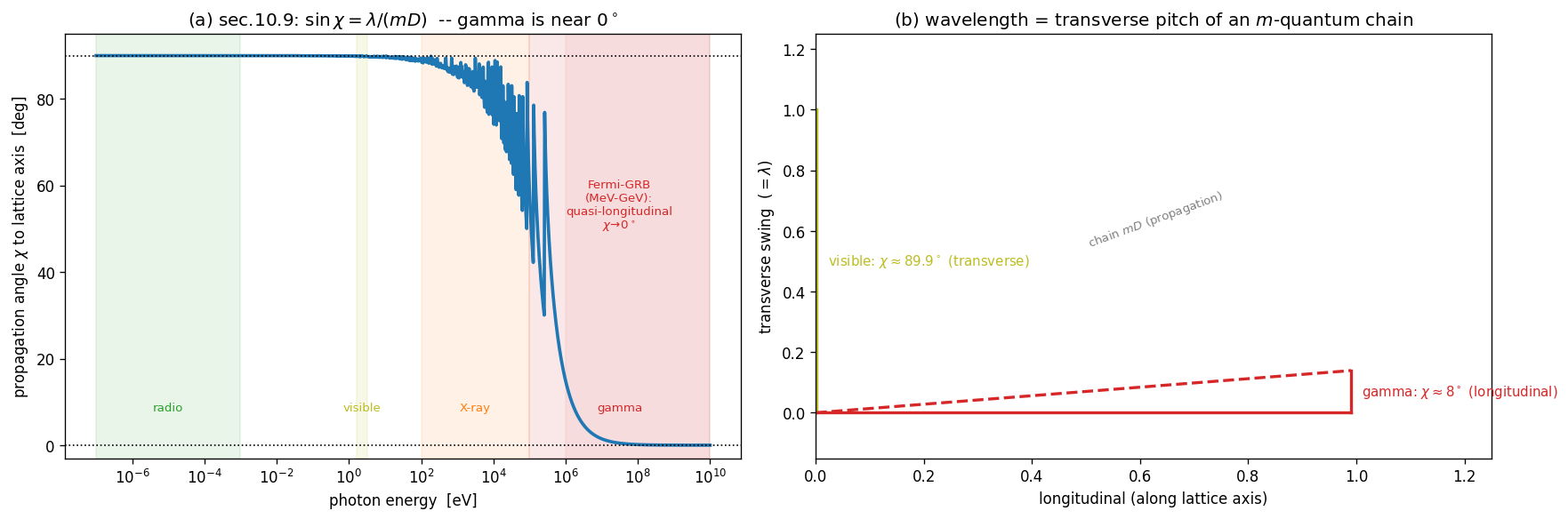
On the framework's angle account a wave of wavelength λ runs through the lattice at angle sinχ=λ/(mD): optical light is near-transverse (χ→90°) while Fermi-band gamma is quasi-longitudinal (χ→0°). Gamma and visible light are two modes, not one mode at two wavelengths, so the transverse-branch dispersion behind the 8–15-order Fermi conflict is applied to the wrong mode.
The angle account gives a geometric reason light is transverse: sinχ=λ/(mD) with m=⌈λ/D⌉. Optical light sits near χ→90° (transverse, as observed) while Fermi-band gamma sits at χ≈0.01°–15° (quasi-longitudinal), so the 8–15-order dispersion conflict applies the transverse law to a mode the framework labels longitudinal. A D-independent test follows: angle-sines scale as wavelength, 633/532=1.190, independent of the unknown spacing D.
The angle account of polarization (exploratory)
The framework offers a geometric account of why light is transverse: a wave of wavelength λ propagates through the lattice at an angle χ to a lattice axis with

so that the physical mode sits closest to transverse. Evaluating this: a 1pm gamma ray gives
χ≈11.9^(∘) (strongly longitudinal), green (532nm) χ≈89.80^(∘),
red (633nm) χ≈89.93^(∘), and a 1m radio wave χ≈90.0^(∘):
optical and radio light is essentially transverse, as observed, while very hard radiation acquires
a longitudinal character. A D-independent test follows: compared at a common diffraction
order, sinχ∝λ, so the angle-sines of two lines scale as their wavelength ratio,
e.g. 633/532=1.190, regardless of the unknown spacing D. We present this as an exploratory
account; its detailed justification belongs to the physics volume, DOI 10.5281/zenodo.17932566, where the
relation is constructed from a single right triangle (the m-quantum chain mD as hypotenuse,
the transverse swing λ as opposite side) and is registered as a falsifiable prediction.
What the angle account implies for the dispersion tension
The dispersion estimate stated at the front of this chapter and the angle account just given describe the same gamma radiation, but they model its passage through the lattice in mutually incompatible ways—and the incompatibility is the point. The estimate treats a gamma ray as a high-k instance of the ordinary transverse elastic wave: it assigns a propagation wavevector k=2π/λ and reads the group velocity from v_g=ccos(ka/2), identically to optical light but at short wavelength. The angle account assigns the same radiation a different geometric mode: for λ<D one has m=⌈λ/D⌉=1, sinχ=λ/D, and χ→0^(∘), so the disturbance runs nearly along the lattice axis (quasi-longitudinal), whereas optical light (m enormous, χ→90^(∘)) is the transverse branch. On the framework's own optics, gamma and visible light are not one mode sampled at two wavelengths; they are two modes.
Consequence for the “decisive” reading.
The 8–15-order figure was obtained by applying the transverse-branch dispersion to gamma. If the angle account is taken at face value that is the wrong branch: the estimate carries a relation derived for the transverse mode over to radiation the same framework labels quasi-longitudinal. The decisive conflict is therefore not unconditional—it is contingent on the identification “gamma disperses exactly as short-wavelength transverse light,” which §10.9.1 of the physics volume does not adopt. A falsification that depends on a mode assignment the theory disowns is not decisive.What this does and does not settle.
We are deliberately exact about the residue.- It downgrades the conflict. The “clearest falsification” reading assumed the transverse branch; the framework's own geometry says gamma is the other branch, so the unconditional conflict becomes conditional.
- It does not resolve the question. The angle account fixes the propagation angle, not the propagation dynamics: sinχ=λ/(mD) is geometry, while the dispersion relation ω(k) of the quasi-longitudinal branch is derived in neither volume and cannot be read off the triangle (naive attempts to do so are not self-consistent, which is itself why a dynamical treatment is required). The framework's gamma-dispersion prediction is, at present, undetermined: one branch (transverse) conflicts, the other (quasi-longitudinal) is uncomputed.
- The escape is therefore not guaranteed. If the quasi-longitudinal dynamics, once derived, again yields a keV–GeV dispersion, the conflict returns; if it yields effective dispersionlessness, the conflict dissolves. The reframing shows the matter is open, not won.
- The existing datum is consistent with the reframing. Fermi sees no energy-dependent arrival across the GRB band; a gamma branch whose propagation is not the transverse v_g=ccos(ka/2) is compatible with that null at the mechanism level—a consistency argument, not a derived prediction.
- The geometry is independently falsifiable. §10.9.1 registers a direct test: near
χ 90^(∘), cosχ is tiny, so measuring the transverse angle of visible light
against a lattice/anisotropy axis would pin D to 0.001% and decide among candidate
spacings—exposing the angle relation to experiment independently of the dispersion question. That
test is gated: it runs through the physics volume's open observation gate
G-ISO(§10.9.2), and no experimental χ claim is made before that gate passes (see §(realmap)).
Taken with the collective-disturbance mechanism above, the net effect is to move the
vacuum-dispersion item from “decisive conflict” to an apparent conflict resting on two
assumptions the framework disputes—that a burst is a stream of independent photons (the
collective-disturbance section) and that those photons are the transverse branch (this
section). Neither replacement is a derivation: the collective burst's spectrum and the
quasi-longitudinal branch's dispersion are both uncomputed, so the residue is an open
dynamical problem, not a resolved one. The script ch2_lightangle.py makes the
geometric half concrete—it reproduces the §10.9.1 band table from sinχ=λ/(mD) and
confirms that Fermi-band energies (MeV–GeV) sit at χ≈0.01^(∘)–15^(∘), i.e.\
quasi-longitudinal. The dynamical half—ω(k) for that branch versus the Fermi bound—is the
open item recorded in Chapter 16.
The reality-mapping note: the mass-free visible-band closure (imported, v2)
The angle account above is pinned to reality through exactly one ratio. The physics volume's quantum-base verification (its §10.9.1) shows that the sole mapping input is λ/D: on a medium specified only as ρ=1, perfect elasticity, B=c², no friction, voids forbidden — with no mass value entering the dynamics — the committed pair

follows from sinχ=λ/(mD) at the canonical D, and the ratio
(λ/D)₆₃₃/(λ/D)₅₃₂=633/532=1.18983 cancels D and any mass scale outright
(the D-independent line that ch2_light.py prints). These are the physics volume's
pre-registered B1 numbers; the deterministic, seed-free verification module is shipped with this
volume's reproducibility package as phys_import_06_light_mapping_massfree/ (gate
G-LIGHT-MAP-Q: PASS; output sha256-gated), so the closure can be re-run here without
the physics volume in hand. Two disciplines carry over with it. First, observation claims about
χ are gated: the physics volume's open observation gate G-ISO (§10.9.2) requires the
axis-fixing and coherence scale, the averaging-away protocols, the observable window, and consistency
with precision propagation data before any experimental χ claim — the direct test quoted
in §(angle-disp) runs through that gate, and this volume's gamma-dispersion question registers
against its item (iv). Second, what the closure does and does not buy here: it fixes the
optical-band mapping scale to D with zero fit freedom (the datum quoted in the two-length
appendix and in Chapter 16), and it buys nothing for the gamma branch, whose dynamics remain the
volume's first open problem.