Back-Calculation: A Broadband Gamma Spectrum
A gamma-ray burst is one broadband shake of the vacuum lattice, not a stream of independent photons. By Fourier's theorem the shake is broadband, so its short-wavelength tail reaches the gamma band; the 31 GeV photon (ka ≈ 0.1) is that high-wavenumber tail, read out as energy by E = ħck. Emission is established; cosmological-distance coherence stays open [O].
A localized shake of the vacuum lattice is broadband by construction, carrying power from radio up into the gamma band; what a calorimeter reports as a 31 GeV photon is the ka ≈ 0.1 component of one disturbance — a ≈63-cell wavelength — via E = ħck = 311.7 GeV × ka. The gamma reach is fixed by the shake's sharpness, not its amplitude. This establishes broadband emission; whether the gamma-band content stays coherent with the low-energy content over a cosmological baseline is the open dispersion item.
One shake of the lattice is broadband
A localized disturbance of the vacuum lattice carries a wide band of wavenumbers, not a single one. This is Fourier's theorem: the narrower the disturbance in space, the broader its spectrum in wavenumber. So a violent, structurally sharp "churning" shake necessarily contains high-wavenumber content, while a smooth disturbance does not.
"Gamma of many wavelengths" is therefore a consequence of the shake, not an added assumption. The burst is one collective disturbance of the medium that radiates a gravitational wave; the gamma rays are radiation we sample from the same event. The script ch2_backcalc_spectrum.py makes this concrete on the same lattice that carries light.
The 31 GeV photon is the high-wavenumber tail
A calorimeter does not measure a wavelength — it measures the energy deposited by the e⁺e⁻ shower and back-calculates a photon energy. In the framework's optics that back-calculation is one map: E = ħω = ħck for the continuum (Maxwell/Goldstone) mode. The detector thus reports the high-wavenumber content of one disturbance as a spread of photon energies.
In lattice units the map is E = (ħc/a)·ka = 311.7 GeV × ka. The famous 31 GeV photon of GRB 090510 then sits at ka ≈ 0.1 — a ≈63-cell wavelength, deep in the long-wavelength regime where ω ≈ ck holds. It is the high-energy tail of one broadband shake, not an isolated ultra-energetic quantum that must propagate as a discrete-lattice phonon.
Gamma reach is set by sharpness, not amplitude
Whether the spectrum reaches the gamma band is fixed by the disturbance's structure, not its energy. Two equal-energy shakes — one sharp (≈2 cells), one smooth (≈5000 cells) — give opposite spectra: the sharp shake carries 99.3% of its power above 1 GeV, the smooth one effectively none. A tiny sharp shake has the same gamma fraction as a violent one; "gamma is present" is fixed by structure, "the energy is enormous" by amplitude.
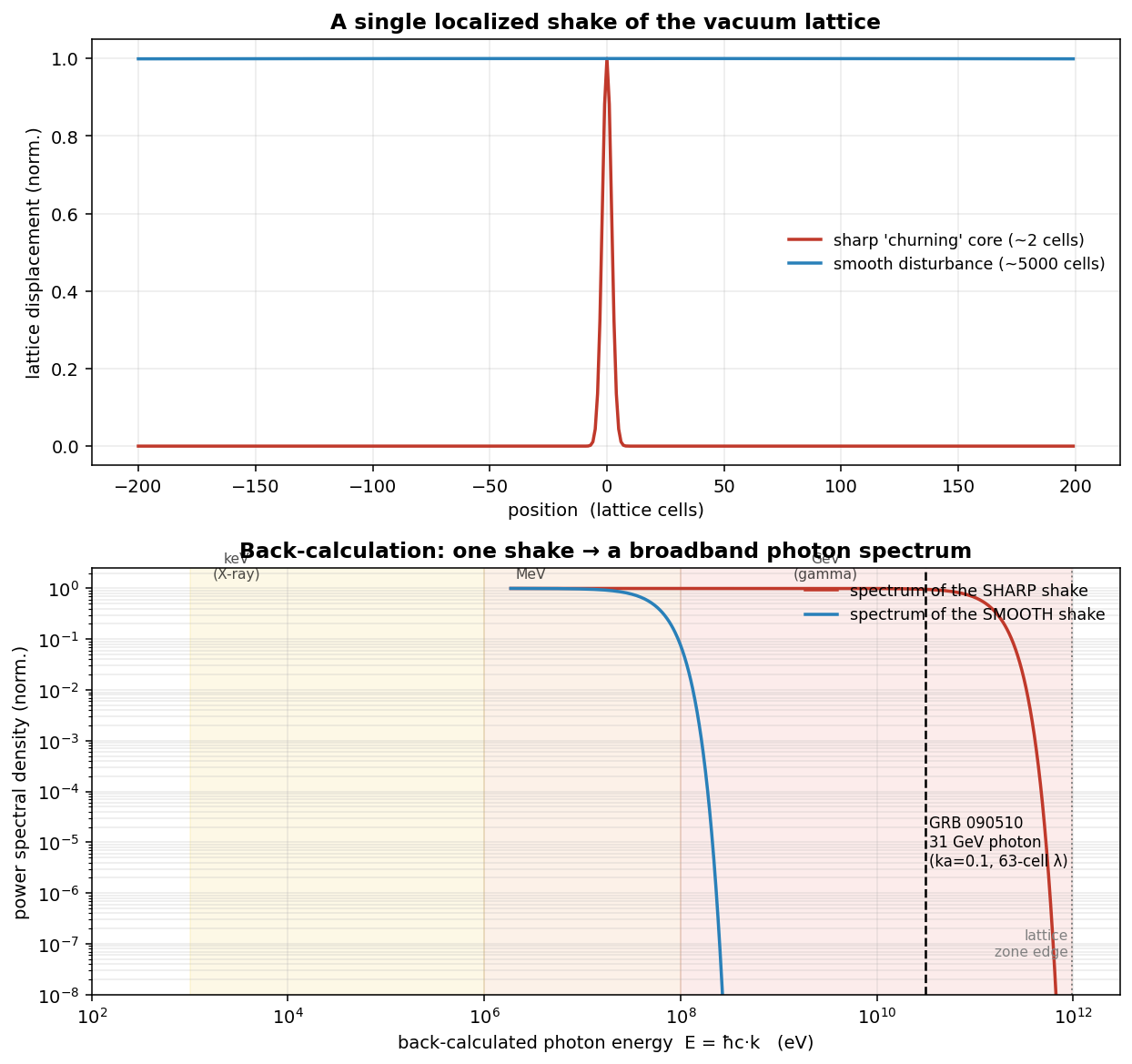
| disturbance (equal energy) | power > 1 MeV | > 100 MeV | > 1 GeV (gamma) | reaches gamma? |
|---|---|---|---|---|
| sharp churning core (≈2 cells) | 1.000 | 0.999 | 0.993 | yes |
| smooth disturbance (≈5000 cells) | 0.967 | 0.023 | 8×10⁻³² | no |
What this establishes, and what stays open
This establishes the emission side: one localized lattice shake is broadband and its high-wavenumber tail reaches the gamma band. It dissolves the puzzle of an isolated ultra-energetic quantum — the 31 GeV photon is one shake's tail, read out as energy. Exhibiting this broadband-emission mechanism is a real reframing, not a hand-waving escape.
It does not establish the propagation side. Whether the gamma-band content arrives coherent with the low-energy content over a cosmological baseline is a separate question — the open dispersion item, graded [O] "relaxed, not fully closed." A broadband-emission mechanism is not a derivation of dispersionless transport, and this page does not claim one.
The reframing does, however, move the propagation question to firmer ground. Treating a burst as one collective disturbance rather than independent photons replaces "do independent 31 GeV and 10 keV photons disperse?" with "does one coherent front stay coherent?" — the regime where the collective-soliton result of §2.2 applies. The rigorous coherence over cosmological distance remains the single open dynamical item recorded in §16.
Reproducibility
The script ch2_backcalc_spectrum.py builds a localized lattice shake, FFTs it, and maps wavenumber to photon energy by E = ħc·k. It confirms the calibration ħc/a = 311.7 GeV at ka = 1, so the 31 GeV photon sits at ka ≈ 0.1 (a 63-cell wavelength), and reports the sharp-versus-smooth gamma fractions above. A width sweep shows the conclusion is width-independent — every sharp shake reaches the gamma band, no smooth one does — so it rests on no tuned constant.
The run is deterministic: only ħ, c (CODATA) and the locked cell a enter the physics, SEED = 19, and a 2×SHA-256 over 6-significant-figure results gives a fixed digest. The script prints its own scope, separating the established emission result from the open propagation item, so the reframing cannot be misread as closure. The collective-coherence companion is ch2_gamma_collective.py (§2.2).