Why Light Need Not Disperse: the Goldstone/Continuum Mode
Light is the massless Goldstone mode of the synchronized rotation-phase — source-free Maxwell governed by □c, with ω=ck exactly, not a generic phonon. The symmetry axioms force ω=ck (theorem N3); only the discrete realization disperses, and at the cell scale a gamma sits at ka≲10⁻³. Whether light realizes the exact continuum mode up to gamma is the one open item.
The deepest account makes ω=ck a theorem, not a model: the symmetry axioms force the normal form ω=ck exactly (theorem N3, grade Fm), and the positive-energy axiom makes c a causal ceiling. Light is the massless Goldstone/□c mode, for which Δv/c=0 at every energy; only the discrete realization adds the O((ka)²) lattice correction, giving E_QG,2≈882 GeV at the cell a. The single open item is whether the electromagnetic Goldstone mode is protected to exact □c up to gamma, or inherits that correction there.
The deeper account: light as the Goldstone mode of the synchronized lattice
Both reframings above sit inside a deeper account the physics volume already gives (§14.0, DOI
10.5281/zenodo.17932566), which also says most directly why light need not carry the generic lattice dispersion at
all. Its premise is that each quantum's only degree of freedom is rotation, and that in the jammed
plenum the coupled rotators phase-lock—a Kuramoto-type synchronization—onto a common
axis, so that all quanta share one rotation phase. Synchronization spontaneously breaks the global
U(1) of that common phase, and the massless Goldstone mode of the broken symmetry is
identified with light: the electric field is the displacement (polar), the magnetic field the
rotational twist (axial), and source-free Maxwell is exactly the curl square-root of the wave
operator Box_c. A field governed by Box_c has ω=ck exactly—linear,
dispersionless—rather than the discrete-lattice ω=2(c/a)sin(ka/2) of a generic phonon. On
this account the Ch. 2 conflict's error is upstream of the mode question: it treats light as a
generic lattice phonon, whereas the framework treats it as the Box_c/Maxwell Goldstone mode,
which does not disperse.
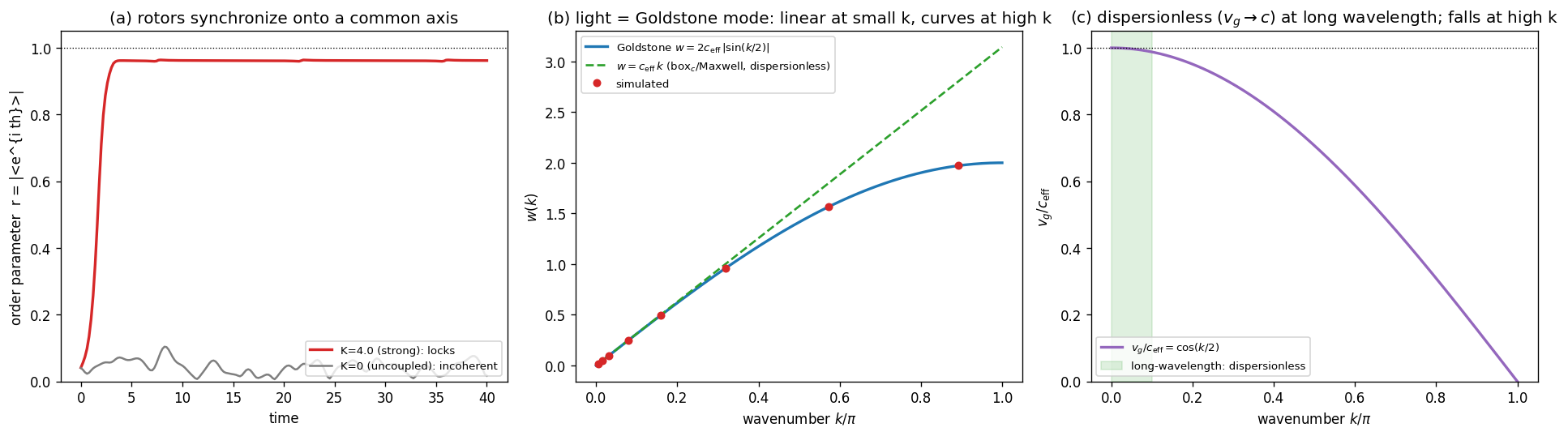
The script ch2_goldstone.py tests the mechanism on a synchronized-rotor lattice, with two
findings. First, the rotors do lock: a Kuramoto ensemble with a spread of natural frequencies,
above a coupling threshold, drives the order parameter r=|⟨ e^(iθ)⟩| to
≈0.96—a common axis forms, as the premise requires. Second, the Goldstone mode of the
synchronized medium has the spin-wave dispersion ω(k)=2√(J/I)|sin(k/2)|, reproduced by
the simulation to under a percent. This is the honest punchline: at long wavelength the mode
is linear, ω≈ c_(eff)k with v_g→ c_(eff)—dispersionless,
exactly the band (radio, visible) where light is observed dispersionless. At short wavelength
the bare Goldstone mode curves (v_g=c_(eff)cos(k/2) falls), so synchronization
alone does not make gamma dispersionless.
Honest scope.
This locates the open problem precisely. The synchronized-rotor picture earns the dispersionlessness of low-energy light for free—a real success of the medium account. Reaching exact Box_c (Maxwell) behaviour up to gamma—rather than the bare spin-wave that curves—rests on the curl-factorization being physically forced at all k: light must be the continuum Maxwell mode, protected from lattice discreteness, not a discrete cell-to-cell relay. The §10.9.1 angle construction does not by itself supply this. It is a geometric map (a length in, an angle out), and with the integer count m=⌈λ/D⌉ the angle χ(λ) is a sawtooth, not a smooth dispersion; read instead as dynamics, a discrete chain of m cells of size D carrying the transverse swing has group velocity ccos(π/m), which at gamma (m=1,2) is pathological—zero or backward—and would reinstate the conflict. The dispersionlessness therefore depends essentially on the continuum-Box_c identification, whose physical forcing the physics volume grades a hypothesis ([Hm]). So the deepest account turns the dispersion item from an unexplained conflict into a specific, located open question: is the electromagnetic Goldstone mode protected to be exactly Box_c up to gamma, or does it inherit lattice discreteness there? That is the dynamical question Chapter 16 records as open.Why dispersionless: the collective-stiffness ceiling
The Goldstone account can be made sharper still, in a way that cleanly separates what is forced from
what is hypothesised—because the dispersionless behaviour rests on firmer ground than the curl
coupling that carries it. In the physics volume the vacuum's characteristic relation is not an
assumption but a theorem: the symmetry axioms force a normal form whose dispersion is
ω²=(K/ρ)k², i.e. ω=ck exactly linear, with no lattice or medium model
invoked (§0.5, theorem N3, grade [Fm]). Here c=√(K/ρ) is the collective
stiffness-over-density speed of the lattice itself—which exists independently of the quanta riding
on it—and the positive-energy axiom (N4) makes it a causal ceiling: nothing propagates faster than
c. A dispersionless light speed is thus the symmetry-forced law, not a hypothesis; a fixed-lattice
simulation confirms c∝√(K), amplitude-independent and isotropic (§10.0).
A direct collision test (ch2_collision.py) makes the axis explicit: head-on packets
pass through one another unchanged, and the speed is identical for a gentle and a violent
(large-amplitude) shaking of the same wavelength—so the stiffness fixes the speed
regardless of how destructive the disturbance is. What stays wavelength-dependent is the
discreteness, not the stiffness: at fixed K the speed still falls as ccos(ka/2) for
short waves. The open item therefore lives on the wavelength axis alone, not the amplitude axis.
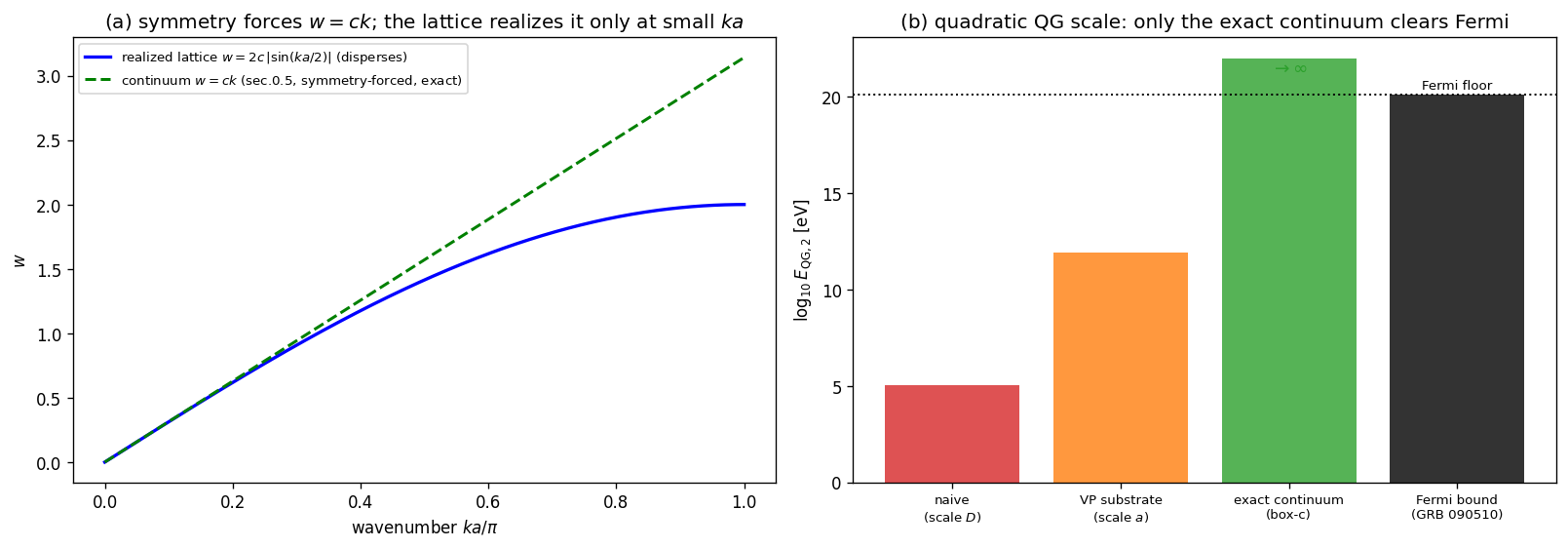
What disperses is only the realization. A discrete lattice carries
ω=2(c/a)sin(ka/2), which converges to ω=ck as k→0 (§10.0), so the question for
gamma is quantitative: is it long-wavelength relative to the lattice scale? The relevant
scale is the fundamental VP spacing a≈6.3×10⁻¹⁹m—not the quantum diameter
D—and gamma is deep in the long-wavelength regime there (ka 10⁻³). The script
ch2_stiffness.py quantifies the residual (Fig. (stiffness)): at scale a the
discrete dispersion corresponds to a quadratic quantum-gravity scale
E_(QG,2)=√2hc/(π a)≈882GeV, which improves on the naive D-scale estimate
(115keV) by seven orders but still sits about eight orders below the Fermi GRB 090510
bound (E_(QG,2)>1.3×10¹¹GeV). Only the exact continuum law
(E_(QG,2)→∞) clears Fermi.
Two things qualify this figure, both pointing the same way. It is the single-mode estimate—it treats the gamma as one independent Fourier mode at k=2π/λ. But a burst is not one oscillation, and a collective disturbance need not disperse at all (§(collective): the soliton stays coherent, ×1.0, where an independent high-k packet spreads, ×11), so its components arrive together regardless of energy—which is what the Fermi comparison actually tests. The 882GeV residual is therefore the worst case (independent high-k propagation), and both the collective-soliton route (§(collective)) and the exact-Box_c route remove it; what neither yet supplies is the quantitative coherence, or protection, scale that would push the effective E_(QG) above the Fermi bound.
So the open item is now sharp and well-posed: the dispersionless law and the ceiling are both forced; what remains is whether light is protected to realize the continuum Box_c exactly—rather than inheriting the lattice's O((ka)²) correction—up to gamma. This is the same protection the curl-factorization needs (§(goldstone)), now stated as one quantitative question.
The relativistic energy–velocity relation: why high energy is safe
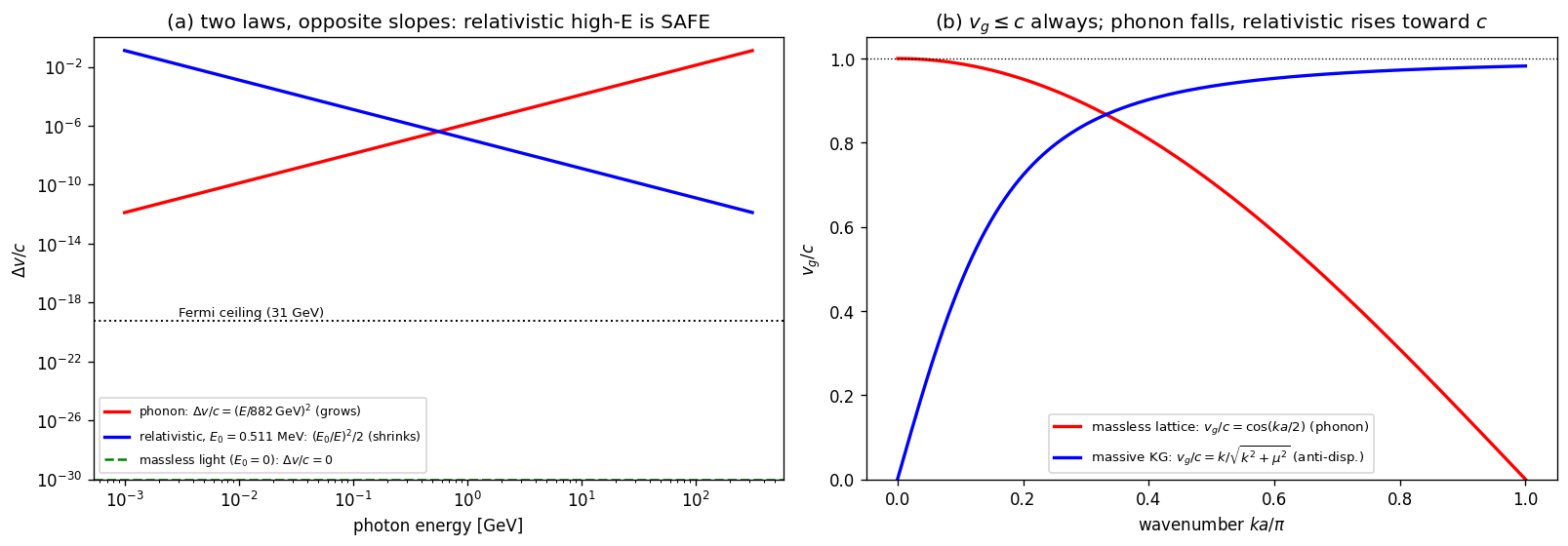
One more observation reframes that residual, and it follows directly from the ceiling. A causal ceiling—nothing faster than c, forced by the positive-energy axiom (N4, §0.5)—is a relativistic structure, and a relativistic excitation of rest energy E₀ and total energy E obeys E²=(pc)²+E₀², so its signal velocity is v/c=pc/E=√1-(E₀/E)² and

This shrinks with energy—the opposite of the lattice-phonon law Δ
v/c=+(E/E_(QG))² that produced the 882GeV residual. The two laws have opposite
slopes (Fig. (relativistic)a): under the relativistic relation, high-energy gamma is
the safest case, not the most dangerous. And light is the massless Goldstone mode
(E₀=0; the U(1) breaking of §(goldstone) gives a massless Goldstone), for which
Δ v/c=0 exactly—a massless relativistic mode travels at c for every energy,
dispersionless. The simulation ch2_relativistic.py confirms both behaviours on one
Klein–Gordon lattice: v_g≤ c throughout (the ceiling), the massive mode's v_g
rising toward c with energy (anti-dispersion), and the massless continuum mode at c
(Fig. (relativistic)b). On this reading the “conflict” is the artifact of applying the
non-relativistic phonon law to light.
What this does and does not settle.
It is genuinely favourable: it removes the intuition that the tension worsens at high energy—under the relativistic relation it improves. But it does not, by itself, close the gap. On the lattice, even a massless mode carries the phonon v_g=ccos(ka/2) (Fig. (relativistic)b, falling curve); the exact-c result is a continuum statement. So the one open item is unchanged—whether light realizes the continuum Box_c exactly, rather than the lattice phonon, at gamma k (§(goldstone), §(stiffness); grade [Hm])—now seen through a relativistic lens that makes the resolution natural and high energy benign. We also note the limit of the collective picture: a linear collective coherence does not change the central, carrier-governed velocity, so the coherence-length question reduces to this same protection question rather than substituting for it. A direct 2D simulation bears this out: a launched gamma wave packet (ch2_gammashot.py)
travels at v_g=ccos(ka/2)—it disperses—and, far from fanning out at 90^(∘), stays
more collimated than a visible packet (a shorter wavelength diffracts less). The dispersion
is thus a property of any lattice wave packet; only light's being the continuum mode removes it.