Gamma-Ray Bursts as Collective Lattice Disturbances
A gamma-ray burst can be one collective disturbance of the vacuum lattice, not a stream of independent photons. A collision-driven soliton front stays coherent and travels at c, dispersionless, removing the independent-high-k-photon assumption behind the Fermi tension. Its energy is many quanta over a volume, not a large per-quantum energy.
Modeled as one collective lattice disturbance — the same event that radiates a gravitational wave — a gamma-ray burst forms a coherent soliton front that travels at c with no spreading, like GW170817's wave arriving with its short GRB within 1.7 s over 130 Mly. The burst's energy is E_burst/E_photon ~ V/a³ quanta over a volume, a measure of the medium's stiffness, not a large per-quantum energy.
A gamma-ray burst as a collective disturbance
The estimate above models a burst as a stream of independent high-k photon modes, each carrying the lattice dispersion v_g=ccos(ka/2). There is a first reason to doubt that picture, prior to any question about the mode of an individual photon: in the medium, a burst can instead be a collective disturbance. When two large quantum inflows—compact objects acting as inflow sinks—collide and their inflow lines break, they launch a single macroscopic disturbance of the lattice, the same class of event that radiates a gravitational wave. This is not idle: the short burst Fermi used to set the bound, GRB 090510, is itself a compact-merger burst, and GW170817 showed a gravitational wave and a short GRB arriving within 1.7s after 130 Mly—the coincidence a collective-disturbance origin predicts.
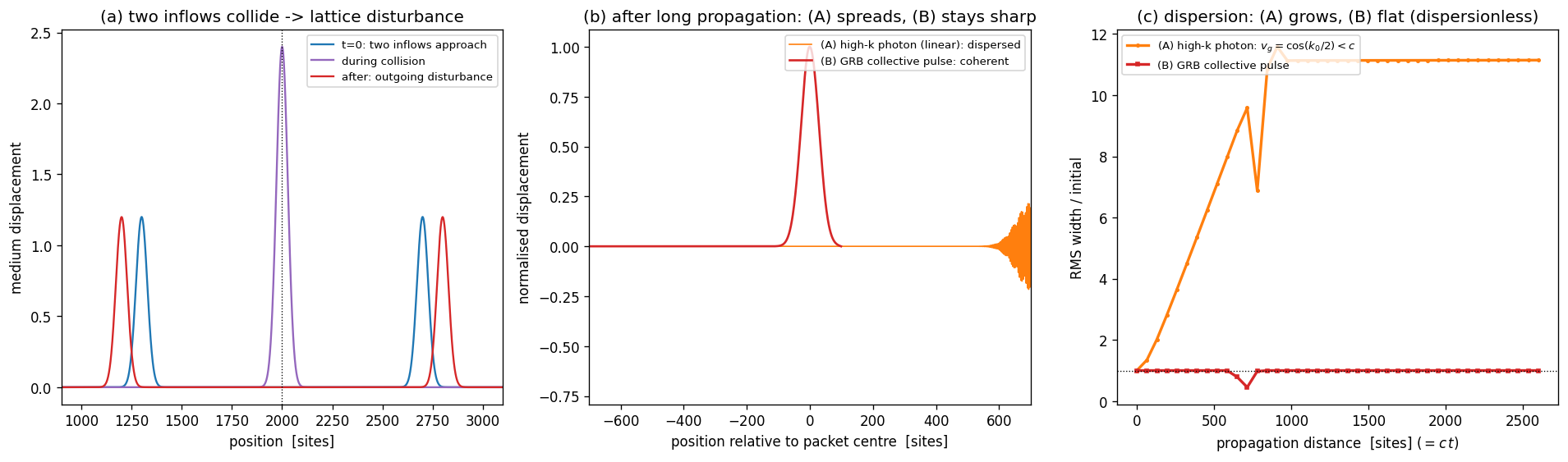
The script ch2_grb.py makes the mechanism concrete on the very lattice that carries light.
It contrasts two ways energy can travel: (A) a single weak high-k wave packet—the “independent
high-energy photon,” linear regime—and (B) the strong disturbance launched when two inward
inflows collide (nonlinear FPU-β regime). The contrast is sharp. The independent high-k
packet disperses: with v_g=cos(k₀/2)≈0.73c<c its components separate and its
RMS width grows by a factor of 11 over the run. The collision-driven disturbance instead
organises into a coherent compression front and propagates at ≈ c with no measurable
spreading (width factor 1.0), like a gravitational wave—the nonlinearity supplied by the violent
collision balancing the dispersion, the standard soliton mechanism. So if Fermi's bursts are
collective disturbances rather than streams of independent photons, they are expected to arrive
dispersionless, independently of the per-photon mode question taken up next.
Honest scope.
This is a mechanism, not a derivation.ch2_grb.py uses toy,
normalised units; it establishes that the colliding-inflow picture is self-consistent and
yields a dispersionless burst (degenerate, on the observed coincidence, with the standard
compact-merger account), which is what GW170817 and Fermi together require. It does not
derive the detected keV–GeV gamma-ray spectrum from the disturbance—the
energy↔wavelength reinterpretation that would do so is not established—and so it
does not close the dispersion problem. Whether real GRB emission sits in this coherent regime is
open. Its standing is thus a toy mechanism: it removes the “independent high-k photons”
assumption on which the conflict rests, but the spectrum derivation belongs to the same open
dynamical work as the quasi-longitudinal dispersion (§(angle-disp)).
The burst as a stiff-medium event (exploratory)
The collective-disturbance picture of §(collective) leaves two things underived: the burst's energy budget, and its spectrum. A sharper reading of the same mechanism supplies both and ties the burst to a quantity the framework otherwise only postulates. The reading is this: a gamma-ray burst is not light that crosses the cosmos and disperses—it is a violent, volumetric event in a very stiff medium, and the gamma rays are radiation we sample from it. The same merging inflows that launch the event launch the gravitational wave; in the framework a gravitational wave is a wave of the lattice, so the burst and the wave are one disturbance read in two ways.
Energetics: many quanta, not a large quantum.
Light, in the framework, is a single quantum of the lattice's transverse mode, E=ħω (§(goldstone)). A burst is the whole shaken volume; the ratio of energies is therefore, to order of magnitude, the number of grains set in motion,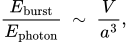
which for a bright burst (E_(burst) 10⁵³erg) and a 31GeV gamma quantum is
2×10⁵⁴. Equivalently, a region of only 1m³, fully excited at the gamma scale,
already carries an entire burst's energy—a vivid measure of how stiff and dense the medium is. The enormous
energy of a burst is thus many quanta over a three-dimensional volume, not a large per-quantum energy;
the gamma quantum itself (31GeV, ka≈0.1, ≈63 lattice spacings) is an ordinary,
well-supported ripple of the lattice. Put as a force rather than an energy, the burst is the sum of the
lattice forces over the churning volume: each cell excited at the gamma scale carries a force
E_(γ)/a≈8×10⁹N (itself a measure of the stiffness), and summing 2×10⁵⁴
such cells over the volume is the blast—the same bookkeeping as totalling the energy of every parcel of water
in an underwater explosion. The arithmetic is in ch2_gammacontent.py.
The gravitational-wave link, and a handle on the stiffness postulate.
Reading the burst and the gravitational wave as one disturbance reframes an apparent paradox: why is the gravitational wave so small (strain h 10⁻²¹) while the gamma is so large? Because the medium is extraordinarily stiff—a colossal energy produces only a whisper of strain, exactly as a very stiff spring stores great energy in a tiny displacement. Quantitatively the elastic scale a gravitational wave reveals is c⁴/G≈ 1.2×10⁴⁴N; in the framework's terms this is a measurement of the bulk modulus K in c²=K/ρ. That matters beyond the burst: the physics volume (DOI10.5281/zenodo.17932566) flags the unbounded local
stiffness of the lattice as a postulate it cannot measure internally. The gravitational-wave
strain–energy relation is precisely such a measurement, supplied from outside. The two channels also differ
only in how we sample them—the gravitational wave as a strain at one detector, the gamma as photons
emerging from a three-dimensional volume; same physics, different measurement dimension. The event GW170817—a
gravitational wave and a short gamma-ray burst arriving within 1.7s over 130Mly, bounding the
wave speed to c within 10⁻¹⁵—both supplies this anchor and shows directly that the collective
(continuum) mode is non-dispersive at low wavenumber.
Spectrum: churning is broadband.
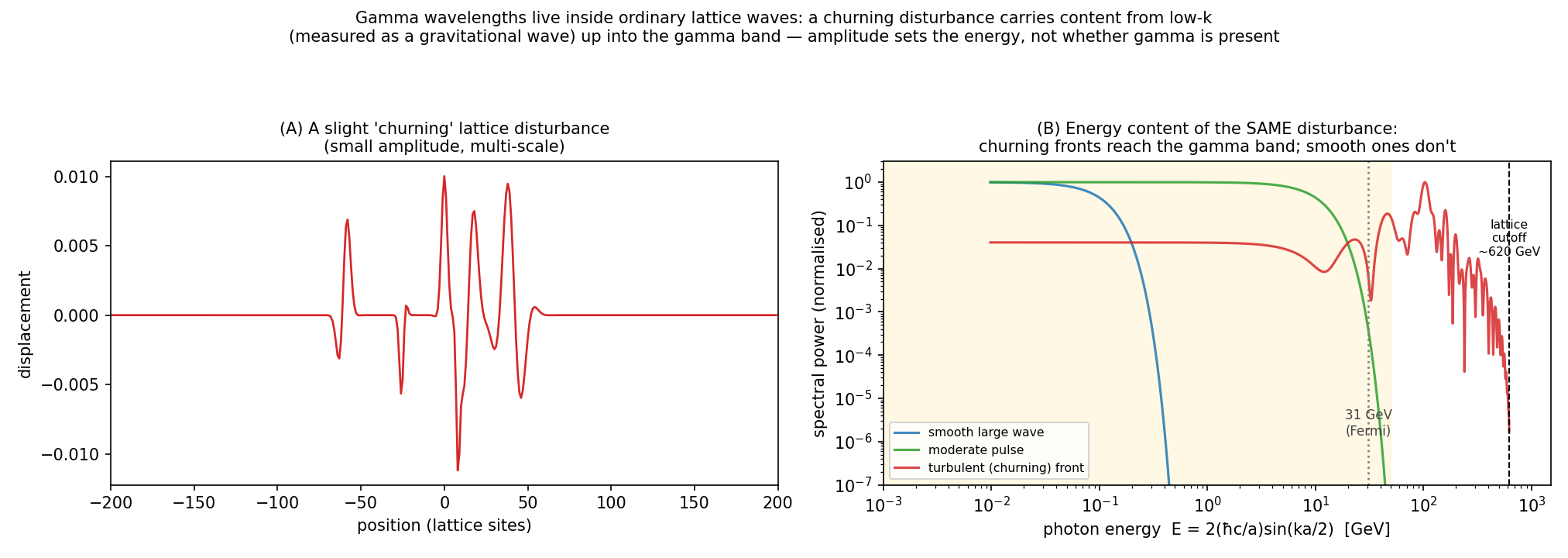
§(collective) did not derive the keV–GeV spectrum from the disturbance. Its volumetric, turbulent (“churning”) character supplies a candidate. A multi-scale disturbance carries broadband spectral content:ch2_gammacontent.py shows that a churning front
carries power continuously from low wavenumber up into the gamma band and on to the lattice zone-boundary
( 620GeV at this calibration), whereas a smooth disturbance does not reach the gamma band at all
(Fig. (gammacontent)). The spectral shape—hence the gamma fraction—is independent of
amplitude: a tiny churning wave has the same gamma fraction as a violent one. “Gamma is present” is fixed by
the disturbance's structure; “the energy is enormous” is fixed by its amplitude.
What it does not resolve, and why (a decisive test).
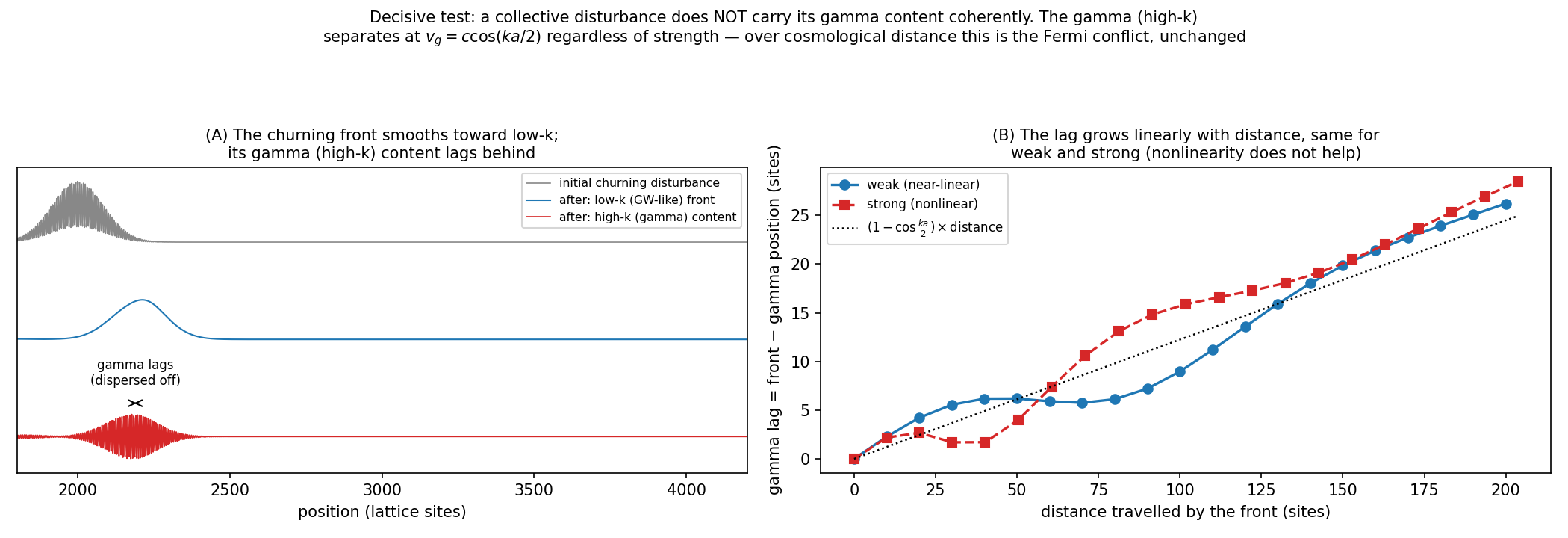
This reading answers the energy and (candidate) spectrum questions and anchors the stiffness empirically—but it does not close the dispersion problem, and a direct test shows exactly why.ch2_burstprop.py launches a churning broadband disturbance and,
as it propagates, splits it into its low-wavenumber part (the long-wavelength envelope, what a detector
registers as a gravitational wave) and its high-wavenumber part (the gamma content). The low-k envelope
travels as a coherent front at ≈ c; the high-k content travels at v_g=ccos(ka/2)<c and
separates, lagging the front by ≈[1-cos(ka/2)]×distance (Fig. (burstprop)).
This separation occurs at the same rate whether the disturbance is weak or strong: the nonlinearity that
keeps the envelope coherent does not bind the gamma content to it. The coherence reported in
§(collective) is thus the low-k envelope; the gamma rides off it. Over a cosmological baseline the
lag is the original conflict, unchanged—at ka≈0.1 and D 9Gly it exceeds the Fermi bound by
15 orders. A jammed, incompressible (density=1) vacuum does not rescue it either
(ch2_jammed2d.py): incompressibility freezes the longitudinal channel but leaves the transverse
(light) dispersion cos(ka/2) unchanged—jamming rescales c, not the normalised dispersion.
The other escape, and why it also fails.
One might instead deny that any gamma propagates: let the cosmos-crossing object be only the collective wave (the non-dispersive low-k mode, the gravitational wave), and let the gamma be produced locally when that arriving wave shakes our lattice. The energy is available—a wave far too gentle to register as a gravitational wave (h 10⁻²²) already carries a whole burst's energy flux, because the medium is so stiff. But the wave cannot make the gamma. Generating gamma-scale (high-k) shaking from a long-wavelength (low-k) disturbance is an up-conversion, and up-conversion requires the per-bond strain to approach unity, since the nonlinear term competes with the linear one only when β(strain)² 1.ch2_upconvert.py confirms this in both one and three dimensions: the
high-k fraction stays at the per-cent level or below until the strain is of order one, and the threshold is
the same in 1D and 3D because it is per-bond—dimension-independent. A non-dispersively propagated wave
is, however, necessarily smooth, hence low-strain (strain h 10⁻²²): some twenty orders below
threshold. Three dimensions do change two things—the cascade to small scales is richer once nonlinear, and
converging geometry (focusing) raises the strain—but focusing acts at the converging source (the
merger), not in the diverging wave that reaches us. So 3D helps make gamma at the source, where it then
faces propagation; it does not let a gentle arriving wave make gamma in flight.
Standing.
The burst-as-stiff-medium-event reading is a genuine enrichment of §(collective): it gives the energy budget (volumetric, E_(burst)/Eₚₕₒₜₒₙ V/a³, the sum of lattice forces over the churning volume), a candidate spectrum (churning is broadband), and—through the gravitational-wave link—an external, empirical handle on the stiffness the framework otherwise only postulates. These are solid. It does not close the dispersion tension, and the two conceivable escapes fail for clean, opposite reasons: gamma emitted at the source disperses off the propagating front (ch2_burstprop.py), while a gentle arriving wave is some twenty orders too weak to generate gamma
locally (ch2_upconvert.py)—and neither gap is closed by going to three dimensions. Both therefore
point to the same single requirement examined in §(goldstone)–§(stiffness): that gamma
propagate as the exact continuum (Box_c) mode, not seeing the lattice spacing. The gravitational-wave link
does not remove that requirement—it sharpens it, by establishing that the collective mode is observed
non-dispersive at low wavenumber and isolating the gamma-band coherence over cosmological distance as the one
genuinely open item. That item is also a live question in fundamental physics: whether the discreteness of
spacetime leaves any imprint on the propagation of light.