Gate Physics: Saturation and a Critical Radius
Beyond the gravity derivation, the framework's inflow saturates: there is a maximum inflow the medium can sustain, giving a critical radius where the field gates. This page shows the gate physics — saturation and the critical radius — that can be demonstrated here, with the remainder deferred to the physics volume. Objections and the chapter's status are gathered here.
The inflow that produces gravity cannot grow without bound: the medium saturates at a maximum sustainable rate, which defines a critical radius where the 1/r² gravitational field gates. This page presents the gate physics demonstrable in this volume — saturation and the critical radius — alongside anticipated objections and the chapter's status, with deeper structure deferred to the physics volume.
What can be shown here: gate physics (saturation and a critical radius)
Two of those imported results—that the restoring channel saturates at g_(*), and
that the inflow reaching the wave speed defines a critical radius—need not be taken purely on
loan. Their mechanism follows from one minimal ingredient, a finite microscopic transport
speed, and can be shown directly (Fig. (gate)); only the absolute value of
the cap remains a physics-volume matter (DOI 10.5281/zenodo.17932566). (This is the volume's stance throughout: we do not prove
the foundations, we show their consequences.)
The flux bound.
If the active phase cannot move faster than c (|v|≤ c), then the energy flux is bounded by the active energy density it carries:

The mean transport velocity therefore has a ceiling. (The same bound caps the second moment, trT≤ c²eₐ, which limits any isotropic closure to κ_T≤ c²/3.)
Saturation.
The active→stored conversion rate is a maximum rate times a dimensionless, bounded gain,
![\begin{equation} \Gamma=\Gamma_{\max}\,g(e_{\mathrm{a}}), \qquad g:[0,1]\to[0,1],\quad g(0)=0, \end{equation}](/cosmology/eq/cosmology/cos-03-009.svg)
for example the Hill form g(eₐ)=eₐⁿ/(K_(Γ)ⁿ+eₐⁿ). Since g≤1, the rate cannot exceed Γ_(max): the restoring channel saturates. This is the microphysical shape of the cap g_(*)—why a contact restoring force levels off rather than growing without bound.
An emergent critical radius.
Under an inverse-square drive |F_r|=K_F/r², the demanded transport velocity grows inward as u_(dem)=K_F/(B r²) and meets the ceiling c at
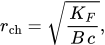
inside which the flow is choked: the transport velocity is pinned at c and the choking ratio χ_S=u_(dem)/c≥1. A horizon-like critical radius—a surface where the inflow reaches the wave speed—thus emerges solely from a flux-capacity bound, with no extra postulate. (Its coefficient is drive-dependent; the strong-field black-hole horizon Rₛ=2GM/c² is the geometric-channel instance, Chapter 9.)
What the simulation shows.
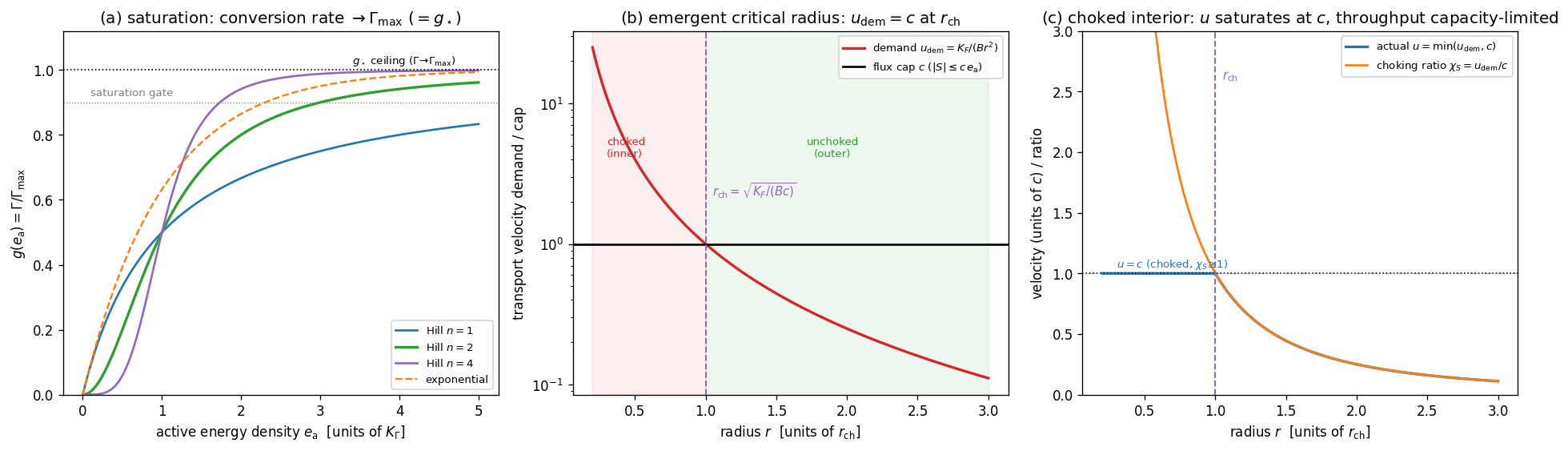
ch3_gate.py evaluates the three relations (Fig. (gate)): the gain
g(eₐ) climbing from 0 to its ceiling 1 (the conversion rate saturating at
Γ_(max)); the inward demand u_(dem)∝1/r² crossing the cap c at the
analytic r_(ch)=√K_F/(Bc) (measured 1.001 in units where r_(ch)=1);
and the resulting choked interior in which u=min(u_(dem),c) saturates at c.
Status of the gate claim.
- Evidence (Gate 1): mechanism, not measurement. A finite transport speed does produce both a saturating restoring rate and a horizon-like critical radius. The units are toy and c,K_F,B,K_(Γ),n are inputs; the simulation does not derive the absolute value of G/g_(*) (the “four-wall” question stays open), nor the Schwarzschild coefficient Rₛ=2GM/c² (whose linear-in-M scaling comes from the uncapped geometric channel, not the inverse-square choke radius, which scales as √K_F).
- Label (Gate 2): degenerate in outcome. The existence of a saturating cap and of a surface where the inflow reaches c is degenerate with a capped restoring force and the standard horizon; the distinguishing content is the mechanism—a throughput choke with a finite, non-singular interior (Chapter 9).
- Scope (Gate 3): present-day. These are statements about how gravity saturates and how a horizon forms now; no origin or cosmic-history claim.
Anticipated objections
“This is Le Sage gravity, which is known to fail.”
Classical Le Sage models post a flux of particles streaming through space and founder on the drag and heating such particles would produce. The present mechanism differs in kind. (i) The leading-order law is exactly Newton's 1/r² (Eq. (Fnewton)), with no leading drag term, because the force is the momentum of the absorbed medium, not of a transverse particle flux. (ii) Aberration of the inflow produces only a v/c-order secular effect, i.e.\ an extraordinarily slow orbital decay, not a first-order drag. (iii) The energy carried in by absorption is not a fatal heating paradox but is reinterpreted as the power source of central engines (active galactic nuclei and their jets), a point developed in Chapters 6 and 8. The medium here is the vacuum itself, and the relevant transport is its inflow momentum.
“This is just Newton relabelled.”
At Solar-System scale, this is correct, and we say so without hedging: the predictions are identical to Newton's, so this chapter and the next are degenerate with standard gravity and constitute a consistency check, not evidence of superiority. The framework's distinct, non-degenerate content appears where the same inflow law, combined with the cosmic background inflow, departs from Newton—galactic rotation and the derived acceleration scale a₀=cH₀/2π (Chapter 6). The value of the re-description is twofold: economy (a single quantity, the inflow rate Q, replaces the separate notions of gravitational charge, inertial mass, and the equivalence principle, which are here one thing and one theorem); and extensibility to regimes where it ceases to be degenerate.
Status of this chapter
- Derived (internal success). The inverse-square force, the identification of mass with the inflow rate, the identification of G with a medium constant, and the equivalence principle. The two non-trivial selections—1/r² over 1/r⁵ by stability, and the exact cancellation of the test body's Q—are confirmed by Simulations A and B.
- Degenerate. All weak-field/orbital predictions coincide with Newtonian gravity (quantified body-by-body in Chapter 4). This is consistency and economy, not a discriminating result.
- Open / partly shown. The mechanism of the saturation and of the critical radius is now shown by simulation (§(gate), gate physics): a single finite transport speed yields both the cap g_(*) and a choke radius r_(ch). What remains open is the absolute value of G/g_(*) (the “four-wall” question), still fixed empirically through κ; aberration-induced secular decay and the absorbed-energy/central-engine link remain qualitative.
With the inverse-square law, the meaning of mass and G, and the equivalence principle in hand—all from the single inflow rate of Chapter 1—we turn in Chapter 4 to the quantitative consistency test: reproducing the measured orbital speeds and periods of the Solar System to sub-percent accuracy.
Reproducibility
All three simulations are pure-Python (NumPy), use a symplectic kick–drift–kick integrator, and report the numbers quoted above. Units are normalised (r₀=1, circular speed =1 for Sim A; GM=4π², i.e. years/AU, for Sims B and C).
- Sim A — stability (1/r² vs 1/r⁵). Integrate a 1%-perturbed circular orbit under a=-kr⁻ⁿ r, k=1. Output: n=2 keeps r∈[1.00,1.04] (bounded); n=5 grows r:1→41 and rising (runaway). Generates Fig. (stab).
- Sim B — equivalence principle. Field a=κQₛ/r² with κQₛ=4π²; integrate two bodies with Q differing by 10⁴ (force proptoQ, inertia proptoQ, ratio independent of Q). Output: max trajectory difference 1.9×10⁻¹⁴.
- Sim C — mass/G degeneracy. Integrate under (κ,Qₛ) and (κ/10⁶,10⁶Qₛ) (same product κQₛ=GM). Output: max trajectory difference 2.7×10⁻¹³.
10.5281/zenodo.17932566.