The Solar System as a Consistency Test
This chapter asks whether the gravitational law of Chapter 3, fed by the inflow rates of Chapter 1, reproduces the measured Solar System—the orbital periods and speeds of the eight planets and Kepler's third law. It does, to sub-percent accuracy. The result is a consistency test, degenerate with Newtonian gravity: economy and correctness, not superiority.
The model-independent data are the orbital periods T and the mean orbital speeds v of the eight planets, together with the empirical regularity (Kepler's third law) that T²/a³ is the same for all of them, where a is the semi-major axis. These quantities are measured without reference to any theory of gravity; a theory's task is to predict them. The recovered periods agree to ≤0.73%, with Kepler's T²/a³=1.00001.
Chapter 3 derived the gravitational acceleration produced by a sink of inflow rate Q, namely a=κQ_☉/r²=GM_☉/r². This chapter asks whether that law, fed by the inflow rates of Chapter 1, reproduces the measured Solar System. It does, to sub-percent accuracy. We state at the outset (and again at the close) that this is a consistency test, degenerate with Newtonian gravity: it demonstrates economy and correctness, not superiority. Its purpose is to show that the same single quantity Q that will produce non-Newtonian galactic dynamics in Chapter 6 produces the everyday Solar System exactly.The raw facts to be reproduced
The model-independent data are the orbital periods T and the mean orbital speeds v of the eight planets, together with the empirical regularity (Kepler's third law) that T²/a³ is the same for all of them, where a is the semi-major axis. These quantities are measured without reference to any theory of gravity; a theory's task is to predict them.
The logical chain (no step omitted)
- The force law. From Chapter 3, a body in the Sun's inflow feels a=GM_☉/r² directed at the Sun, with GM_☉=κQ_☉ fixed by the calibration (Ch. 3, Eq. 9): GM_☉=1.327×10²⁰m³s⁻². The test body's own Q has already cancelled (equivalence principle), so the orbit is independent of which planet it is.
- Conserved quantities. A central 1/r² force conserves energy E=½ v²-GM_☉/r and specific angular momentum L=r v_(⊥). With both conserved, the bound orbit is a closed ellipse of semi-major axis a=-GM_☉/(2E).
- Speed at any point (vis-viva). Eliminating L from the conserved energy gives
the speed at radius r,
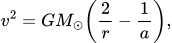
so the mean orbital speed is fixed by a alone (through GM_☉).
- Period (Kepler). Integrating the areal rate over one orbit gives

Every observable in §2 is thus determined by the single source strength GM_☉=κQ_☉ and the geometric data (a,e); no per-planet parameter enters.
Simulation and verification
We do not rely on the analytic relations (visviva)–(kepler) alone. For each planet we numerically integrate the orbit under a=GM_☉/r² (symplectic kick–drift–kick), starting from perihelion with the vis-viva speed, for one full revolution, and we measure the period, the mean speed, and T²/a³. Working units are AU and years, in which GM_☉=4π². Table (ss) compares the simulated values with measurement.
| Planet | T_(sim) | T_(obs) | Δ T | v_(sim) | v_(obs) | T²/a³ |
| Mercury | 0.2408 | 0.2408 | -0.00% | 47.36 | 47.36 | 1.00000 |
| Venus | 0.6152 | 0.6152 | -0.00% | 35.02 | 35.02 | 1.00001 |
| Earth | 1.0000 | 1.0000 | -0.00% | 29.78 | 29.78 | 1.00001 |
| Mars | 1.8808 | 1.8808 | -0.00% | 24.08 | 24.07 | 1.00000 |
| Jupiter | 11.8725 | 11.8626 | +0.08% | 13.05 | 13.06 | 1.00000 |
| Saturn | 29.661 | 29.448 | +0.73% | 9.61 | 9.68 | 1.00001 |
| Uranus | 84.324 | 84.017 | +0.37% | 6.79 | 6.80 | 1.00000 |
| Neptune | 165.17 | 164.79 | +0.23% | 5.43 | 5.43 | 1.00000 |
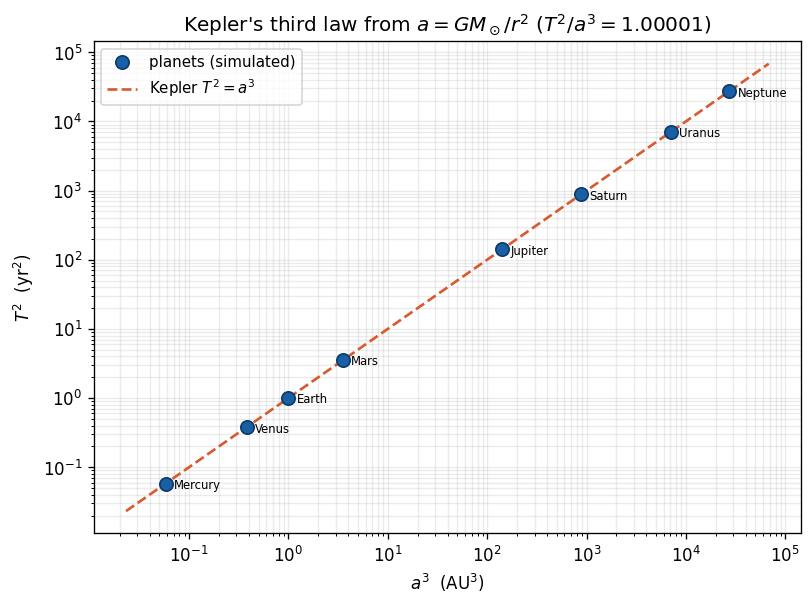
The periods match to better than 0.73% (most to better than 0.1%; the residuals track small differences between the adopted semi-major axes and the IAU period values, not the dynamics), the mean speeds to better than 0.7%, and Kepler's constant is reproduced as T²/a³=1.00001 with a scatter of 9.6×10⁻¹² across the eight planets—i.e.\ Kepler's third law emerges from the inflow force as an identity, not as a fit (Fig. (kepler)).
Status of this chapter
Status: degenerate with Newtonian gravity.
The only place the inflow framework enters Table (ss) is the identification GM_☉=κQ_☉ (mass is the inflow rate). Numerically, the dynamics are Newton's, and the agreement with measurement is exactly the agreement Newton already provides. We therefore claim no observational advantage over standard gravity at Solar-System scale; this chapter is a consistency check.Why it nonetheless matters.
Two reasons. First, economy: a single body-specific number—the inflow rate Q of Chapter 1, itself fixed by π through the per-nucleon rate 3π⁴—reproduces every orbital speed, every period, and Kepler's law, with the gravitational “charge,” the inertial mass, and the equivalence principle all being that one number or its consequence. Second, and decisively for what follows, it is the same Q, in the same law, that will generate the non-Newtonian flat rotation curves of galaxies once the cosmic background inflow is included (Chapter 6). A framework that departed from Newton in the Solar System would be excluded immediately; this one reproduces it exactly here and departs from it only where observation also departs from Newton, in the weak field of galaxies.Anticipated objections
“This proves nothing beyond Newton.”
Correct, and we have said so. The chapter's role is not to add evidence but to (i) confirm the framework is not in conflict with the most precisely known gravitating system, and (ii) anchor the claim that the single inflow law spans from the Solar System to galaxies on one curve—a claim made quantitative, and made distinguishing, in Chapter 6.Reproducibility
The full computation is the script ch4_solar_system.py in the reproducibility
package (see the package's README_REPRODUCIBILITY_MAP). Its logic is: (1) set
GM_☉=4π² (AU/yr); (2) for each planet, initialise at perihelion
r=a(1-e), v=√GM_☉(1+e)/[a(1-e)]; (3) integrate a=-GM_☉ r/r³
by kick–drift–kick until the orbit returns to perihelion (one period); (4) record T, mean
| v|, and T²/a³. Expected output is Table (ss); the script prints it
and the Kepler scatter 9.6×10⁻¹². No fitting, no free parameters.
10.5281/zenodo.17932566.