Gravity as Absorbed-Inflow Momentum
The central chapter takes the inflow rate Q from Chapter 1 as its only input and derives gravity. The inflow velocity field gives the force as absorbed momentum, fixing the 1/r² law; mass is the inflow rate, G a property of the medium, and the equivalence principle is referred to physics (cap level only). Gate physics is treated in the following page.
From the single input of Chapter 1 — the inflow rate Q — this chapter derives gravity. The inflow velocity field yields the gravitational force as absorbed momentum, fixing the inverse-square 1/r² law; mass is identified with the inflow rate and G with a property of the medium, and the equivalence principle is referred to physics (cap level only). It is the load-bearing derivation the rest of the volume rests on.
This is Chapter 3, the central chapter of the volume. It takes as its only body-specific input the inflow rate Q defined and tabulated in Chapter 1 (Q∝ M, with Q/M=1.7522×10²⁹quantas⁻¹kg⁻¹), and from it derives the gravitational field, the meaning of mass and of the gravitational constant, and the equivalence principle. Following the rules of Chapter 0, the argument is given as a numbered chain with no step left implicit, every non-trivial step is checked by an attached, reproducible simulation, and the strong-field results that belong to the physics volume are imported by citation rather than re-derived.The raw facts to be explained
The model-independent facts of gravitation are few and familiar: unsupported bodies near the Earth accelerate downward at g≃9.81ms⁻² regardless of their composition; the planets trace closed, stable orbits about the Sun characterised by the heliocentric strength GM_☉=1.327×10²⁰m³s⁻²; and the orbital data obey an inverse-square force law. We will show that all three—the inverse-square law, the composition independence, and the identification of the source strength with GM—follow from a body being a sink of the vacuum medium, draining it at the rate Q of Chapter 1.
The inflow velocity field (steps 1–3)
We first establish the velocity field that a single sink sets up in the surrounding medium.
- Depletion. A body of inflow rate Q₁ annihilates Q₁ vacuum quanta per second (Chapter 1). This continuously removes quanta from the region it occupies.
- Refilling (no-void). By premise (P1) of Chapter 1 the medium is fully packed and admits no voids; the surrounding quanta therefore move inward to replace those annihilated. After transients this settles to a steady, spherically symmetric, radially inward flow.
- Conservation fixes the profile. In steady state every quantum that is annihilated
must first cross every sphere surrounding the body, so the inward flux through a sphere of
radius r equals the annihilation rate:
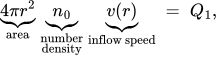
with n₀ the undisturbed number density of the medium (a universal constant). Solving,
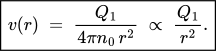
The inflow speed falls as 1/r². This is the single field quantity from which the force will be built; note that nothing here yet refers to a second body.
The gravitational force as absorbed momentum (steps 4–6)
- A second sink in the flow. Place a second body, of inflow rate Q₂, at distance r from the first. About itself the second body draws an isotropic inflow, which by symmetry exerts no net force on it. The only asymmetry it experiences is the inflow (vfield) set up by the first body, which at the second body's location carries the medium past it with velocity v(r) directed toward body 1.
- Momentum delivered by absorption. The second body is a sink: it annihilates
quanta at rate Q₂. Each quantum (mass m_q) that it absorbs from its surroundings is,
on average, drifting toward body 1 with the local velocity v(r), hence carrying momentum
m_qv(r) toward body 1. By momentum conservation the absorbing body acquires this
momentum. The momentum delivered per unit time—i.e. the force—is therefore

directed toward body 1 (attractive).
- The inverse-square law. Equation (force) is an attractive force
proportional to the product of the two inflow rates and falling as 1/r². Writing
κ' ≡ m_q/(4π n₀), a universal constant of the medium,
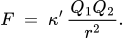
This has exactly Newton's form, with the role of “gravitational charge” played by the inflow rate Q.
Why 1/r² and not 1/r⁵ (step 7)
This step is the one most easily skipped and therefore, by the rule of Chapter 0, the one we make most explicit. A natural-seeming alternative would treat the gravitating body not as a sink that absorbs momentum, but as a parcel carried along by the inflow, feeling the flow's own (convective) acceleration. For the steady radial field (vfield) that acceleration is

The two candidate laws differ sharply: absorption of momentum gives 1/r² (Eq. (force)), whereas convective carry-along gives 1/r⁵ (Eq. (rfive)). Which is physically correct is decided by what the body actually is. A gravitating body annihilates the medium; it is a sink, not a passive tracer. A sink does not move with the local flow—it removes the flow—so the force it feels is the momentum it absorbs, Eq. (force), the 1/r² law. The convective expression (rfive) would apply to a neutrally buoyant tracer that neither emits nor absorbs the medium, which a massive body is not.
Stability confirms the selection.
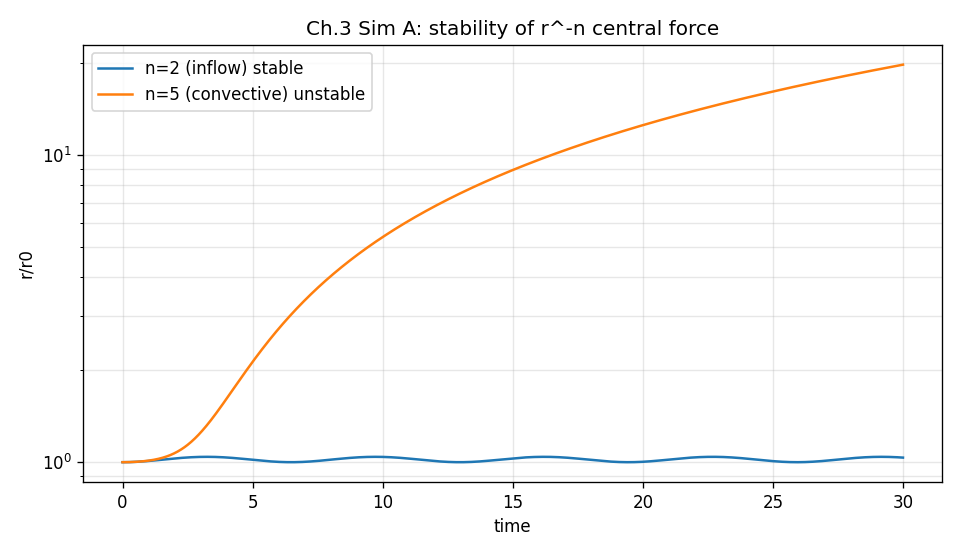
The two laws are also distinguished observationally, because orbits under a central force F∝ r⁻ⁿ are stable only for n<3 (a circular orbit's small radial perturbations oscillate for n<3 and grow without bound for n≥3). Thus n=2 (absorption) permits the stable, long-lived planetary orbits we observe, while n=5 (carry-along) does not. Simulation A integrates a circular orbit given a 1% tangential-speed perturbation under each law:
def leapfrog(n_exp, perturb=0.01, T=60, N=600000, k=1.0):
    x=[1.,0.]; v=[0.,1.+perturb]; dt=T/N
    acc=lambda x:-k*hypot(x)**(-n_exp)*(x/hypot(x))
    # ... kick-drift-kick; record r(t) ...
n=2 : r stays in [1.00, 1.04]              -> BOUNDED (libration ~4%)
n=5 : r grows 1 -> 41 and keeps climbing   -> RUNAWAY (escape)
The result (Fig. (stab)) is unambiguous: under the n=2 absorption law the perturbed orbit librates within a few percent of its radius, exactly as the planets do; under the n=5 carry-along law the same orbit runs away by more than a factor of forty and continues to grow. Since planetary orbits are observed to be stable over billions of years, the gravitational mechanism must be momentum absorption (1/r²), not convective carry-along (1/r⁵). This is the “why this and not that” that an inverse-square claim requires.
Mass is the inflow rate; G is a property of the medium (step 8)
- Identifying GM. Comparing the force (Fnewton) with Newton's
F=GM₁M₂/r² shows that the gravitational mass of a body is proportional to its inflow
rate, MproptoQ. Equivalently, the source strength is

where β is the constant relating inertia to inflow rate (next section) and κ is a universal medium constant. We fix κ once, by matching the Sun:

Every other body's source strength then follows from its tabulated Q (Chapter 1, Table 1) with no further input. As a consistency check, κQ_(⊕) =3.81×10⁻⁴⁰×1.046×10⁵⁴=3.98×10¹⁴m³s⁻² =GM_(⊕), recovering the measured terrestrial value.
The mass/G split is conventional.
Only the product κQ(=GM) enters any orbit (Eq. (GMkappa) feeds the acceleration a=κQ₁/r² of the next section). Rescaling Q→ cQ and κ→κ/c leaves κQ unchanged and the orbit identical. Simulation C verifies this to machine precision:(kappa, Q) vs (kappa/1e6, Q*1e6) [same product kappa*Q = GM] max |trajectory difference| over an orbit = 2.7e-13 -> identical
Hence the framework fixes the product; how one chooses to call part of it “G” and part of it “mass” is a matter of units. Adopting the measured G recovers the conventional mass scale, and the inflow rate Q is then simply the mass expressed in annihilation-rate units.
The equivalence principle, as a theorem (step 9)
- Inertia is also the inflow rate. The same sink property that makes Q the
gravitational charge also makes it the inertia: resisting acceleration means rearranging the
quanta one is absorbing, so a body's inertial mass is m=βQ with the same
universal β for all matter. The acceleration of body 2 in body 1's field is then

The test body's own rate Q₂ appears in the force (proptoQ₂) and in its inertia (proptoQ₂) and therefore cancels. The acceleration depends only on the source, not on the composition or amount of the falling body.
This is the (weak) equivalence principle—universality of free fall—obtained here as a theorem rather than assumed as a postulate, because gravitational coupling and inertia are literally the same physical quantity, the inflow rate. Simulation B drops two test bodies whose inflow rates differ by a factor 10⁴ in the same source field:
Q_a   vs   Q_b = 1e4 * Q_a   in the same field  a = kappa*Q_source / r^2
   max |trajectory_a - trajectory_b| over an orbit = 1.9e-14  ->  identical
The trajectories coincide to machine precision, as the cancellation (EP) requires.
What is deferred to the physics volume
The derivation above is the leading-order, weak- and far-field result, and it is exactly Newtonian gravity. The strong-field completion is established in the physics volume and is not re-derived here; we record its results in one paragraph and import them by citation. There the field is two-channel: a geometric channel g_(geom)=GM/R² that is not capped, plus a contact (restoring) channel g_(restore)=min(gₚₒₜ,g_(*)) that saturates at a yield value g_(*)=c²Ψ_(yield) — these, with the four-wall status below, are the genuine physics-volume imports. The strong-field consequences, by contrast, are owned by this volume (ownership corrected in v2; the physics volume does not carry them): the inflow reaching the wave speed at Rₛ=2GM/c² gives the river/Painlev\'e picture of black holes developed in Chapter 9, and the resulting effective optical index n=1+Rₛ/r reproduces light bending δ=1.752” (the Eddington value; derived in Chapter 9 from the same inflow). The physics volume (v0.6.0) has additionally opened a recovery program R1–R4 for the historical full-physics magnitude claim (its §17.4.4). One honest consequence of that structure must be flagged here: because the restoring channel saturates, the absolute value of G (equivalently, of g=9.81ms⁻²) is tied to a yield cap, and a first-principles micro-derivation of that absolute value is not yet complete—the “four-wall” no-go discussed in the physics volume. In the present volume G therefore enters only through the empirically fixed product κ of Eq. (kappaval); we never claim to derive its absolute value here, and we mark this as open in the ledger (Chapter 16).