Axial Spin and Tidal Locking from Inflow
Spin is a first-class phenomenon a theory of gravity must produce. This chapter derives axial spin in two parts: an intrinsic spin from a swirling, one-sided inflow, and a tidal evolution driven by the inflow gradient that locks or unlocks rotation. The locking dichotomy is derived, not assumed; Mercury's 3:2 resonance is treated separately.
Axial spin is derived from vacuum inflow in two parts. Part A sets an intrinsic spin when a body accretes a swirling, one-sided inflow; Part B evolves the spin under the inflow gradient, which either locks rotation to the orbit or leaves it free. The locking-versus-free dichotomy is derived from the gradient, not assumed, and is tested against the planets. The tidal torque driving this evolution scales as 1/r³.
Spin is not a detail to be waved through. The rotation of a body, and the fact that the Moon keeps one face to the Earth, are phenomena that a theory of gravity must produce, and to a reader nothing about them is “obvious.” This chapter therefore derives axial spin as a first-class phenomenon, in two parts and with no step omitted: an intrinsic spin set when a body accretes a one-sided (swirling) inflow, and a subsequent tidal evolution driven by the gradient of the primary's inflow. The decisive, clean result is the tidal lock: a fast initial spin is driven to synchronous rotation, reproducing the Moon. We also reproduce Mercury's 3:2 from the eccentric spin–orbit dynamics, while being explicit that the capture probability—not the existence or stability of the lock—is what depends on the tidal-response model.The raw facts to be explained
The measured spin states are diverse: the terrestrial planets and gas giants rotate with periods from 10h (Jupiter) to 243days (Venus, and retrograde); the Moon's rotation period equals its orbital period (synchronous, “tidally locked”), as do most large moons; and Mercury rotates exactly three times for every two orbits (a 3:2 spin–orbit resonance). A theory must account both for the existence of spin and for this diversity.
Part A — Intrinsic spin from a one-sided inflow (steps 1–3)
- The inflow carries angular momentum. The inflow of Chapter 3 was treated as spherically symmetric, which is exact only for an isolated body fed isotropically. A body that forms by accreting from a preferred direction or from a feeding disk draws an inflow that is one-sided: it has a net swirl (vorticity) about a common axis, hence a nonzero angular momentum flux, not merely a radial mass flux.
- Accretion transfers that angular momentum. As the body absorbs this swirling
inflow it must, by conservation of angular momentum, take up the inflow's angular momentum and
spin up. With mass-accretion rate dot M, surface radius a, swirl speed v_(sw),
and instantaneous spin ω, the torque is the rate of angular-momentum delivery,
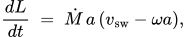
the lever arm a times the rate dot M times the relative tangential speed of the inflow with respect to the co-moving surface.
- Saturation at surface co-rotation. The torque (spinup) vanishes when
the surface co-rotates with the swirl, ω a = v_(sw), i.e.

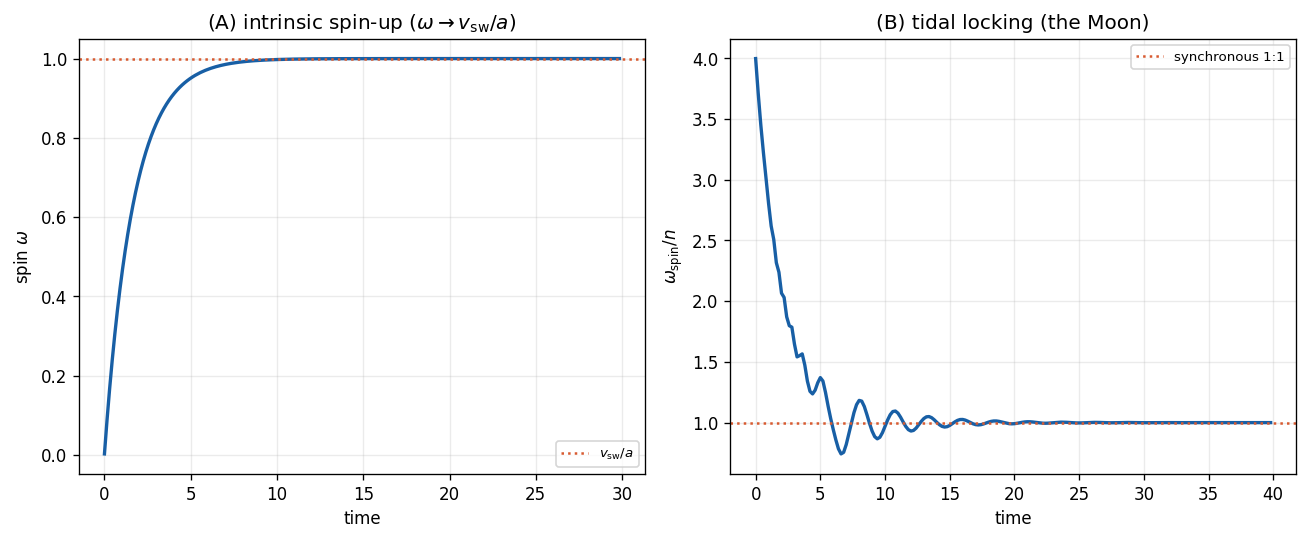
Integrating (spinup) (Simulation A) shows ω climbing monotonically to this equilibrium and stopping there. The body acquires a spin whose axis and magnitude are set by the accretion geometry—the direction and swirl of the inflow it formed from.
Two consequences follow immediately and matter for the diversity in §1: (i) the intrinsic spin direction is whatever the accretion swirl was, so it can be retrograde (a body fed with opposite swirl spins backward—relevant to Venus); and (ii) the intrinsic rate depends on the accretion history, so it is not a universal number. Intrinsic spin is therefore an outcome of how a body formed, derived here from the same inflow that produces gravity, not an independent postulate.
Part B — Tidal evolution from the inflow gradient (steps 4–8)
A body in orbit does not keep its intrinsic spin unchanged; the primary's inflow reshapes it.
- The primary's inflow has a gradient. From v_(inflow)∝1/r²
(Chapter 3, Eq. 2), the near side of an orbiting body of size L at distance R sits in a
stronger inflow than its far side. The differential acceleration across the body is the tidal
field,

For the Moon in the Earth's inflow this evaluates to Δ g=4.88×10⁻⁵ms⁻², matching the tidal approximation 2GML/R³=4.875×10⁻⁵ms⁻² (Simulation B). The tidal field is nothing other than the gradient of the inflow that already produces gravity—no separate tidal postulate is introduced.
- The gradient raises a bulge. The differential pull (tidegrad) stretches the body along the line to the primary, raising a bulge whose long axis points (in equilibrium) at the primary.
- Dissipation makes the bulge lag, producing a torque. If the body's spin is not
already synchronous, the bulge is continually re-raised as the body rotates; with internal
dissipation it cannot respond instantaneously and so lags the instantaneous line to the
primary. The primary's pull on this lagging, misaligned bulge exerts a torque on the spin. The
rotational equation of motion is, with θ the body's orientation and φ the orbital
angle,

where A∝ GM(B-A_(I))/R³ sets the tidal-torque strength and γ the dissipation.
- Synchronous locking; “in a plane.” For a circular orbit (ω_(orb)=n constant), Eq. (tidalode) drives the spin to ω_(spin)=ω_(orb): the body ends rotating once per orbit, keeping one face to the primary. Simulation B integrates this from a fast initial spin and finds ω_(spin)/n:4→1.000 (Fig. (spin), right). The reason the problem is clean is geometric: the bulge, the primary, and the spin axis (perpendicular to the orbital plane) all lie in one configuration, so the rotation is a single degree of freedom θ—this is the “because it is in a plane” that makes the lock sharp. (A tilted spin axis would add precession and obliquity dynamics, treated elsewhere.)
- Eccentric orbits give resonances. If the orbit is eccentric, the orbital angular velocity varies over the orbit, and the spin can be captured into a spin–orbit resonance—rotating p times per 2 orbits for half-integer p—rather than into the 1:1 lock. Which resonance is selected depends on the eccentricity and on the tidal response. Mercury (e=0.206) sits in the 3:2 resonance.
The locking dichotomy is derived, not assumed
Part B fixes the mechanism; it also fixes which bodies the mechanism captures. The despinning time implied by the inflow-gradient torque,

is dominated by the a⁶/Mₚ² scaling: close to a massive primary the lock is fast, far
from a light one it never completes. Comparing τ_(lock) to the age of the Solar
System (4.5Gyr) with a single fiducial (α,Q,k₂,ω_i)—no per-body
tuning—sorts all twelve test bodies correctly: every observed locked or despun body (the Moon;
Io, Europa, Ganymede; Titan; Charon; Phobos; and Mercury, solar-despun into the 3:2 of the next
section) has τ_(lock)<4.5Gyr, while every free rotator (Earth, Mars, and the giant
planets) has τ_(lock)>4.5Gyr. The script ch_spin_locking.py tabulates the
twelve and plots them against the age line. What remains genuinely contingent is not the
locking outcome but the intrinsic spin—its initial rate and, in anomalous cases such as
Venus's slow retrograde rotation, even its sign—which formation sets and which this chapter does
not claim to derive. The dichotomy locked-vs-free is forced; the residual spin history is honestly
left open.
Status of this chapter
Shown.
The existence of spin (Part A: accretion of a swirling inflow drives a body to a definite, surface-co-rotating spin) and the 1:1 tidal lock (Part B: the inflow gradient drives a fast spin to synchronous rotation). Both are reproduced by Simulations A and B; the tidal field is quantitatively the inflow gradient (Eq. (tidegrad), matched to the Earth–Moon value).Degenerate.
The tidal torque (tidalode) is standard tidal physics; the content of this chapter is that this torque is the gradient of the gravitational inflow, so spin evolution follows from the single inflow principle with no extra postulate. At the level of predictions it is degenerate with conventional tidal theory.Mercury's 3:2 (shown, with a probabilistic caveat).
The eccentric spin–orbit pendulum of Eq. (spinorbit) reproduces Mercury's 3:2: at e=0.206 the 3:2 is the dominant non-synchronous resonance and a stable lock, and a spin drifting down from above is captured into it, whereas a circular orbit gives 1:1 (Fig. (mercury)). What is not forced is the capture probability—it depends on the initial phase, the tidal-response model (constant-Q vs. constant-lag), and the triaxiality. The framework admits and favours the observed 3:2 at Mercury's eccentricity (a consistency result), not a unique deterministic outcome.The diversity of spins.
Observed spin states are the combined outcome of intrinsic spin (Part A, set by accretion history and possibly retrograde, as for Venus) and tidal evolution (Part B, locking or resonating depending on eccentricity and dissipation). There is no single closed-form spin rate, and we do not pretend otherwise; what the framework supplies is the two mechanisms, each derived from the inflow, whose combination yields the observed variety.Anticipated objections
“If spin `comes out,' why is Venus retrograde and Mercury 3:2?”
Because spin is not a single deterministic formula but the sum of an accretion-set intrinsic spin and a tidal evolution. A body fed with opposite swirl acquires a retrograde intrinsic spin (Venus); a body on an eccentric orbit can lock into a resonance rather than 1:1, and for Mercury's e=0.206 that resonance is the 3:2, which we reproduce (Fig. (mercury)). We exhibit the mechanisms cleanly; the specific end states depend on each body's history, and the probability of capture into the 3:2 (not its existence or stability) depends on the tidal-response model.
“This is just standard tidal theory.”
At the level of the torque, yes, and we say so (degenerate). The non-trivial claim is upstream: the tidal field is not an independent ingredient but the gradient of the same inflow that produces gravity (Eq. (tidegrad)). Spin and tides thus require no postulate beyond the single inflow rate of Chapter 1; this is the economy the volume is built on, now extended to rotation.
Reproducibility
The computation is ch5_spin_tidal.py in the reproducibility package. Its logic:
(A) integrate dω/dt=(dot M a/I)(v_(sw)-ω a) and confirm
ω→ v_(sw)/a; (B) integrate the tidal rotation
Eq. (tidalode) for a circular orbit from ω_(spin)/n=4 and confirm it
locks to 1.000; and evaluate the Earth–Moon inflow gradient
Eq. (tidegrad), confirming Δ g=4.88×10⁻⁵ms⁻²=2GML/R³.
ch5_mercury_capture.py
closes the quantitative gap left above. The capture probability is a standard spin-orbit-resonance
result and is not framework-specific (the tidal dynamics are identical): for the
constant-Q model Goldreich & Peale (1966) give P_(cap)≈0.07, while
core–mantle friction and a chaotically higher past eccentricity raise it to ≈0.55–0.73
(Correia & Laskar 2004). A vectorised ensemble integration of the resonant pendulum
ddotγ=-½ω₀²sin2γ-drift-friction(dotγ)
(libration period 15.7yr, matching the observed 12–15yr) reproduces the mechanism:
capture is probabilistic, falling as the tidal sweep speeds up (1.00→0.06) and rising with
friction. The open item is thus quantified, not removed—the 3:2 is favoured with a
definite, model-dependent probability ( 7–73%), which is precisely the volume's
“favours but does not force.”
(D) integrate the eccentric spin–orbit pendulum Eq. (spinorbit): report the
resonance strengths H(p,e) (3:2 dominant non-synchronous at e=0.206), the bounded libration of
the 3:2 resonant angle (1.5 turns/orbit), and the capture—ω_(spin)/n→1.5 for
e=0.206 versus →1.0 for a circular orbit.
Expected output: ω_(eq)=v_(sw)/a reached; ω_(spin)/n→1.000;
Δ g=4.88×10⁻⁵; 3:2 capture at Mercury's e. No fitting; the only inputs are the
orbital geometry and the dissipation strength (whose value sets the locking timescale, not
the locked state).
Next stage: Chapter 6 (galactic rotation and the derivation
a₀=cH₀/2π)—the first chapter whose result is distinguishing rather than
degenerate. Foundations continue to be imported from the physics volume, DOI 10.5281/zenodo.17932566.