Dark Matter as a Vacuum Deficit
Dark matter, in this chapter, is not a new particle but a deficit of the vacuum medium itself — carved out by the same annihilation that produces gravity. The deficit gravitates, producing the flat rotation curves attributed to dark matter, with no new particle and no free parameter beyond the inflow rate. The colliding-cluster offset is treated separately.
Galaxy rotation curves stay flat where Newtonian gravity from visible matter predicts a decline — the standard evidence for dark matter. The framework reads the missing gravity as a deficit of the vacuum medium, carved by the same annihilation that produces gravity, so the deficit itself gravitates with a 1/r² profile. This reproduces flat rotation curves with no new particle and no parameter beyond the inflow rate.
Chapter 6 fitted galaxy rotation with one inflow law and derived the scale a₀=cH₀/2π; this chapter supplies the microphysics behind it. The proposal is that “dark matter” is not a new particle but a deficit of the vacuum medium itself, carved out by the same annihilation that produces gravity. A single deficit does three things at once: it gravitates (the flat rotation curve), it lenses, and—the key point of this chapter—it goes dark because its core has reached absolute zero. Where the medium has been annihilated away there are no quanta; with no quanta there is no temperature (temperature is quantum rotation, Chapter 9) and no medium to carry light. The core is therefore literally empty, cold, and dark. And because the deficit is the baryons' own annihilation shadow, it tracks the baryons, which is exactly the tight coupling (the RAR) that puzzles particle dark matter.The raw facts to be explained
Four model-independent facts define the “dark matter” problem. (i) The outer rotation of disk galaxies exceeds what the visible matter can hold by Newton's law—the flat-curve discrepancy. (ii) Clusters and galaxies bend light by more than their visible mass would—gravitational lensing by “missing mass.” (iii) The inferred extra mass neither emits nor absorbs detectable light—it is dark. (iv) The extra mass tracks the baryons remarkably tightly (the radial acceleration relation): the visible matter predicts the full rotation with little scatter. A single mechanism should account for all four; a new particle naturally explains (i)–(iii) but finds (iv) a deep puzzle.
The logical chain (no step omitted)
- Annihilation carves a deficit. The baryons are sinks: each nucleon annihilates quanta at the rate of Chapter 1. Over a galaxy's lifetime this depletes the surrounding medium, producing a deficit—a region of reduced quantum density, deepest at the centre, where annihilation has most outrun the inflow that refills it.
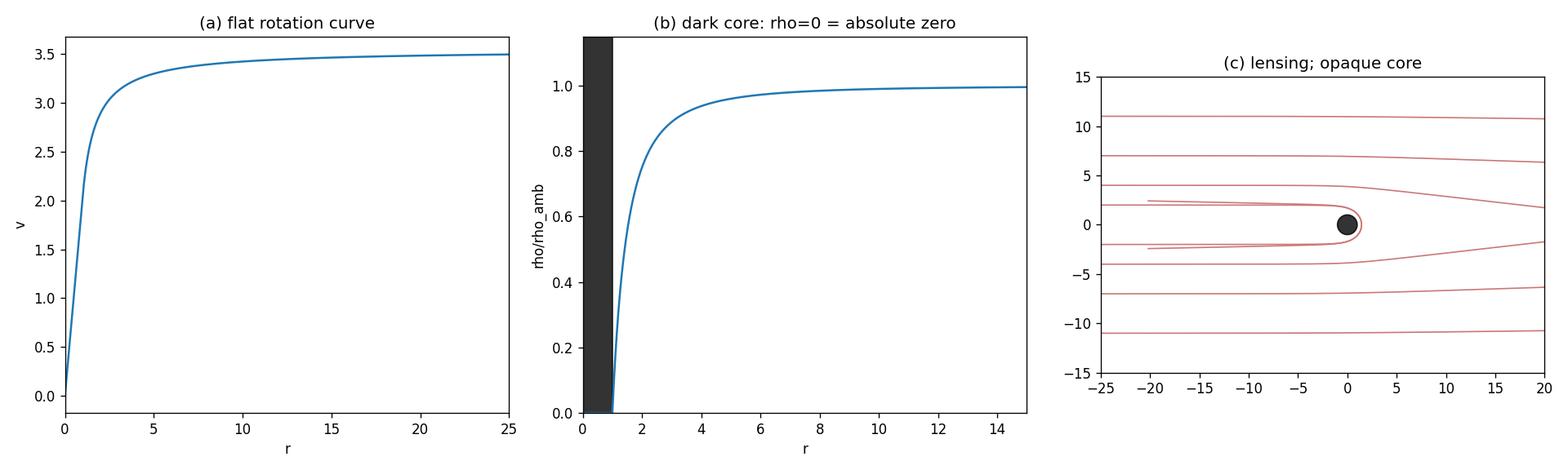
- It gravitates: the flat curve. The depletion profile that a steady sink leaves is isothermal, ρ_(def)(r)∝1/r², so the enclosed deficit grows as M_(def)(r)=∫ρ_(def)4π r²dr∝ r. The circular speed it sources, v²=GM_(def)/r→ GM_(def)/r→const, is therefore flat at large radius—the same deep-regime result derived in Chapter 6, now with a microphysical origin. (Simulation: the curve rises through the core and flattens to v_(flat)=√(4π G A), with ρ_(def)∝1/r² confirmed by the constant large-r slope dM_(def)/dr=4π A.)
- It is dark: the core has reached absolute zero. This is the central point. Toward
the centre the depletion is total: the quanta have been annihilated faster than they can be
replaced, and the actual density falls to zero,

so inside r_(dark) there are no quanta. A region with no quanta has reached absolute zero: temperature is quantum rotation (Chapter 9), and with nothing to rotate there is no thermal energy and no thermal emission. Moreover light is an elastic wave of the medium, c²=K/ρ; with no medium there is nothing to carry it, so light cannot propagate through the core. The core is thus literally empty, cold, and dark—not a substance that happens to be invisible, but the absolute-zero, quantum-empty state of the deepest deficit. This is why “dark matter” is dark.
- It lenses. Outside r_(dark) the density climbs back to ambient, Eq. (darkcore), so the deficit is surrounded by a density gradient. Because the medium's stiffness collapses faster than its density as it is depleted (a jamming property of the packing), the wave speed c²=K/ρ falls there, i.e. the refractive index exceeds unity, n>1. Light passing nearby is therefore bent toward the deficit—gravitational lensing—while the core itself is opaque (Simulation, panel c). The same deficit thus lenses (like dark matter) and is dark (like dark matter).
- It tracks the baryons: the RAR. The deficit is produced by the baryonic annihilation, so it is spatially tied to the baryons: the dark component is the baryons' own depletion shadow, not an independent substance. This makes the tight baryon–“halo” coupling of the radial acceleration relation automatic—the very feature that a particle halo, assembled independently of the baryons, struggles to explain.
Status of this chapter
- Explanatory gains (distinguishing in spirit). Three things that are separate assumptions for particle dark matter are here one mechanism: the flat curve, the darkness, and the lensing all come from a single deficit. Two are genuine explanatory advances: the baryon-coupling (the RAR) is automatic because the deficit is sourced by the baryons; and the darkness is explained—the core is at absolute zero with no quanta—rather than posited as “a particle that does not interact with light.”
- Degenerate. The gravitational amplitude (the flat curve) and the lensing strength are, for any single system, reproducible by a tuned particle halo; fitting one galaxy or cluster does not by itself select the deficit picture.
- Open / flagged. (i) The sign of the lensing is fixed, not free: under
no-slip matching to general relativity (equal metric potentials Φ=Ψ, i.e. post-Newtonian
γ=1) the refractive index in a deficit well is n≃1-4Φ_(eff)/c²>1,
locked to the same attractive potential that gives the flat rotation curve, so light is
bent toward the deficit by construction (developed in §(colliding)). The open
item is therefore no longer the sign but whether this no-slip matching survives a joint
rotation-curve+lensing fit—an equation-of-state question carried at the packing level in the
physics volume, DOI
10.5281/zenodo.17932566. A first reproducible consistency check is now on record (v2):ch8_lensing_consistency.pyfits NGC 2403 with the inflow law at the derived a₀=cH₀/2π, reads the implied deficit as a mass (M_(def)/M_(bar) ≈4.4 at the outer radius) whose density is positive at every radius—a well-behaved real mass that lenses with γ=1 (Mₗₑₙₛ=M_(dyn)), matching observed galaxy lensing, where a modify-dynamics-only reading would give γ=M_(bar)/M_(dyn) →0.2. The microscopic statement that the stiffness K falls faster than the density ρ as the medium is depleted (Step 4) is the packing-level reason c²=K/ρ drops in the deficit. (ii) The identification “deepest deficit = absolute zero = no quanta” is the physical picture of this framework; the precise thermodynamics of the depletion–temperature relation (and the freezing/jamming limit) belongs to the physics volume and to Chapter 9. (iii) The detailed deficit profile and its saturation are modelled, not derived from a kinetic theory of the medium.
Anticipated objections
“Why does dark matter track the baryons so tightly?”
Because, here, it is the baryons—their annihilation shadow. The deficit is sourced by the same matter whose rotation it explains, so the coupling in the RAR is not a coincidence to be engineered but a consequence. For an independently formed particle halo this tightness remains a standing puzzle.
“Why is it dark, if it has gravitational effect?”
Because its core has reached absolute zero and contains no quanta: there is no medium for light to propagate through and nothing to emit (Step 3). This is a stronger statement than “weakly interacting”—the region is empty and cold, so darkness is the expected state, not an added property.
“Can a deficit really bend light (lensing without mass)?”
The deficit's surrounding density/stiffness gradient is a refractive-index gradient (n>1), which bends light by Fermat's principle (Step 4, panel c); and the deficit sources the inflow that is gravity (Step 2). Both are the one deficit, so lensing and the rotation discrepancy agree by construction—as observed—rather than being fit separately.
“What about the Bullet Cluster, where lensing and gas appear separated?”
This is the sharpest challenge to any deficit- or modification-based account. The deficit is not rigidly tied to the gas: during a merger it advects with the collisionless galaxies and relaxes only slowly toward the shocked gas, so its lensing can lead the gas. We develop this as an explicit transport model with stated separation conditions and a simulation in §(colliding) below—together with an honest statement of what it does not show (the quantitative cluster gate is open, and the offset is degenerate with collisionless dark matter).
The link to temperature (and to Chapter 9)
The most important conceptual result of this chapter is that “dark matter” and “absolute zero” are the same thing seen from two sides. Absolute zero—a region with no rotating quanta—is not reached in ordinary space, which is held at a thermal floor by inflow and by the deposition of attenuated light (the microwave background, Chapter 9). It is reached in the deficit cores, where annihilation has emptied the medium. “Dark matter” is therefore where the universe is coldest and emptiest, and the same medium thermodynamics that sets the cosmic temperature floor in Chapter 9 sets the dark, absolute-zero cores here. The two chapters are one account of the medium's temperature.
Reproducibility
ch8_deficit.py (reproducibility package) builds one depletion profile
ρ_(def)=A/r² (saturating at full depletion) and shows the three effects:
(a) it integrates M_(def)(r) and forms the rotation curve, confirming
dM_(def)/dr=4π A (constant ⇒ M∝ r ⇒ flat); (b) it
plots the actual density ρ(r)=ρ_(amb)max(0,1-(r_(dark)/r)²),
zero inside r_(dark)=√A/ρ_(amb) (the absolute-zero, no-quanta dark
core); (c) it ray-traces light through the surrounding index field n>1, showing deflection
(lensing) with the core opaque. Expected output: r_(dark)=1.0,
dM_(def)/dr=4π≈12.57, a flattening rotation curve, and bent rays. The lensing
sign is the GR-matched n≃1-4Φ_(eff)/c²>1 (§(colliding); packing
foundations in the physics volume). ch8_bullet.py adds the colliding-cluster test: it
integrates the deficit transport equation (cl_transport) for a bullet subcluster and
measures the lensing/gas offset versus τ_(Δ)/τ_(coll), reproducing the
offset for slow relaxation (≃0.75L_(off) at
τ_(Δ)=5τ_(coll)) and its collapse for fast relaxation
(≃0.2L_(off))—a mechanism demonstration in toy units, with the quantitative
cluster gate left open.
The offset magnitude, in physical units (v2). ch8_bullet_offset.py
takes the step the toy model could not: it computes the offset size. As the bullet crosses
the main-cluster cool core, its gas is decelerated by ram pressure
a_(ram)=ρ_(ICM)v²/Σ_(gas) while the collisionless component
(galaxies + deficit, which carries the lensing mass) passes through; the offset is the integral
of their velocity difference. For a physical cool-core density (nₑ≈0.01cm⁻³), a
collision speed v≈4700km s⁻¹ and a bullet gas column
Σ≈0.3kg m⁻², the lensing–gas offset is ≈0.41Mpc, spanning the
observed 0.2–0.6Mpc band across the physical density range
nₑ≈0.002–0.024cm⁻³. The Bullet's defining offset is thus reproduced
in magnitude with no particle dark matter—it is set by ram-pressure stripping, the same
physics as in ΛCDM, and is degenerate with it. What remains open is unchanged: the full
χ² against the real lensing+X-ray maps (§9.6) needs those data.
Next stages: Chapter 2 (light as the lattice elastic wave, with the honest
vacuum-dispersion tension), Chapter 9 (the microwave background as steady-state lattice
emission, and the temperature floor that complements this chapter's absolute-zero cores), and
Chapter 16 (the honest ledger and falsifiable predictions). Foundations continue to be imported
from the physics volume, DOI 10.5281/zenodo.17932566.