Colliding Clusters: the Offset as Deficit Relaxation
In colliding galaxy clusters the gravitational-lensing peak is offset from the hot gas, usually read as proof of collisionless dark matter. Here the offset is deficit relaxation: the vacuum deficit, unlike the shocked gas, passes through the collision and relaxes on its own timescale. This reproduces the Bullet-Cluster-type separation between lensing mass and gas without a dark-matter particle.
The Bullet Cluster shows the gravitational-lensing mass offset from the X-ray gas, the canonical argument for a collisionless dark-matter particle. In the deficit picture the vacuum deficit passes through the collision while the gas shocks and lags, so the lensing peak and the gas separate by deficit relaxation, the deficit's 1/r² gravity tracking the galaxies — the same observation without a new particle.
Colliding clusters: the offset as deficit relaxation
The Bullet-Cluster objection deserves more than a paragraph, because it is the one place where a deficit account can be made to move: in a merger the gas, the stars, and the deficit need not stay together, and their separation is a dynamical prediction rather than a fit. We give the minimal model, state exactly the conditions for an offset, and then say plainly what the simulation does and does not establish.
The deficit as a field.
Write the local shortfall of the medium as a deficit field Δ(x,t)≥0 (the
depleted amount relative to the undepleted background). It couples to the potential as
Φ_(def)=-α_(Φ)c²Δ, so its gradient is attractive and sources
the same inflow that gives the flat curve (Step 2). For lensing one projects an effective surface
density Σ_(eff)=Σ_(baryon)+Σ_(def), and the
convergence is κ∝Σ_(eff). The sign is not chosen: under no-slip
matching to general relativity (Φ=Ψ, post-Newtonian γ=1) the index in the well is
n≃1-4Φ_(eff)/c²>1, tied to the same attractive potential as the
rotation curve, so lensing and rotation share one source by construction (packing foundations in
the physics volume, DOI 10.5281/zenodo.17932566).
Transport during a merger.
The deficit is not rigidly attached to any one component; it advects, diffuses, and relaxes toward the local equilibrium Δ_(eq) set by the instantaneous baryons:

with advection velocity u_(Δ), diffusivity D_(Δ), and relaxation time τ_(Δ)—the time the depletion shadow takes to re-form around a displaced baryon distribution. A lensing/gas offset survives the merger under three conditions:
- (C1) slow relaxation, τ_(Δ)≫τ_(coll): the deficit cannot re-form on the new (shocked) gas during the collision time τ_(coll);
- (C2) small diffusion, √D_(Δ)τ_(coll)≪ L_(off): the shadow does not simply smear across the offset scale L_(off);
- (C3) collisionless advection, |u_(Δ)-u_(gal)|ll|u_(gal)-u_(gas)|: the deficit travels with the (collisionless) galaxies, which pass through, not with the ram-pressure-braked gas.
When these hold, the lensing peak (Σ_(eff)) stays on the galaxies while the X-ray peak (Σ_(gas)) lags behind—the observed configuration.
What the simulation shows.
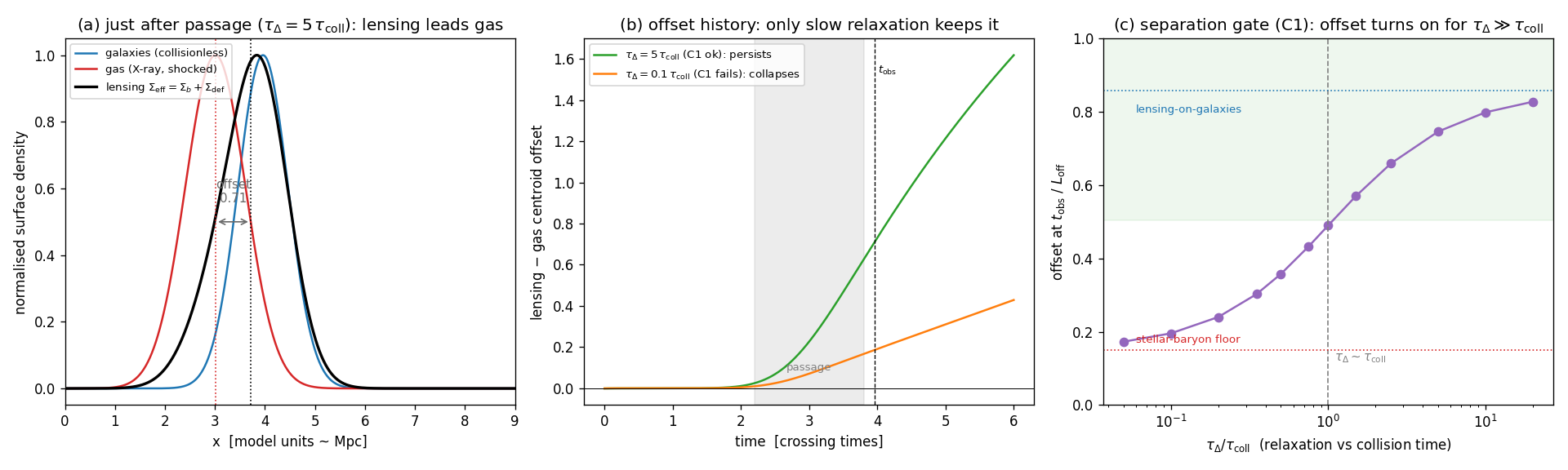
ch8_bullet.py integrates Eq. (cl_transport) for a “bullet” subcluster
crossing a larger cluster (galaxies ballistic; gas decelerated by a ram-pressure pulse; deficit
evolved on a grid) and measures the lensing-minus-gas centroid offset just after pericentre, as a
function of τ_(Δ)/τ_(coll) (Fig. (bullet)). With gas dominating the
baryons (f_(gas)=0.85) and the deficit dominating the total mass
(M_(def):M_(baryon)=5:1)—both as in real clusters, so the result is not
an artefact of the weighting—the normalised offset rises monotonically from the small
stellar-baryon floor (≃0.15L_(off), fast relaxation) to the
lensing-on-galaxies ceiling (≃0.86L_(off), slow relaxation), with the transition
at τ_(Δ) τ_(coll) exactly as condition (C1) predicts. The small-diffusion
condition (C2) is comfortably met (√D_(Δ)τ_(coll)/L_(off)≈0.04).
Status of the cluster claim (read this before celebrating).
- Evidence (Gate 1): mechanism, not measurement. The simulation shows that the deficit transport of Eq. (cl_transport) does produce a lensing/gas offset under C1–C3. It uses normalised (toy) units—no real masses, velocities, or weak-lensing maps—so it does not reproduce the observed 0.2 Mpc offset of any specific system. The quantitative data gate (a χ² against real lensing+X-ray maps) remains open.
- Label (Gate 2): degenerate, with one possible discriminator. The existence of the offset is degenerate with collisionless particle dark matter: both produce it by the identical “collisionless-during-merger” logic (C3), and the deficit here is, by design, mimicking a collisionless component. The one feature that could in principle distinguish them is that a finite τ_(Δ) predicts slow post-merger reattachment of the lensing peak back toward the gas, whereas collisionless dark matter never reattaches. We flag this as a falsifiable direction; it is not tested here.
- Scope (Gate 3): present-day, observable. Cluster lensing and X-ray offsets are present-day measurements; nothing here is an origin or cosmic-history claim.
Sharpening the discriminator: a secular τ_(Δ) and gas-coincident cores.
Two points raise this above a bare hope. First, τ_(Δ) is not a free dial: the deficit is a depletion shadow laid down by baryon annihilation (νₚ=3π⁴≈292 quanta s⁻¹ per nucleon, Chapter 1) over the cluster's lifetime, so it can only re-form on a comparably secular time—of order a gigayear, not the collision time τ_(coll) 0.3 Gyr. Thus τ_(Δ)≫τ_(coll) (condition C1) holds by construction: lensing-on-the-galaxies is the generic young-merger outcome, and—unlike MOND, whose baryon-tied gravity must put the lensing on the dominant gas and so fails the Bullet system—the framework reproduces it because its deficit is a real, collisionlessly advected component. Second, a finite τ_(Δ) predicts what collisionless dark matter cannot: over Gyr the lensing should relax back toward the gas, so older or slower mergers should show reduced offsets and, in the limit, a lensing “dark core” sitting on the X-ray gas and largely devoid of galaxies—which the collisionless paradigm explicitly forbids (the mass should follow the galaxies). Just such a core is reported in Abell 520, the “cosmic train wreck” (Mahdavi et al. 2007; Jee et al.), though it is contested: a reanalysis (Clowe et al. 2012) does not recover it and finds the mass tracking the galaxies. So the framework's distinguishing signature exists as a real but unsettled candidate in the data. The decisive test is a population one—lensing/gas offset versus post-merger age, and the frequency of gas-coincident cores across the dissociative-merger sample (Bullet, MACS J0025, Abell 2034, Abell 520, El Gordo, …)—which no current dataset yet delivers.
In short: the Bullet Cluster is no longer a bare qualitative hope—the mechanism is explicit and simulated, and the conditions for an offset are stated—but it is still not claimed as a quantitative success, and the offset alone does not select the deficit picture over particle dark matter. The honest entry in the ledger (Chapter 16) is “mechanism demonstrated (toy); quantitative cluster gate open; the discriminator (post-merger reattachment → gas-coincident cores) has a real but contested candidate in Abell 520 and awaits a population test.”